Who’s Monitoring the Monitors?
A favorite movie of mine is Enemy of the State starring Will Smith and Gene Hackman. The plot line (I will call Will Smith’s character Will Smith, ditto for Gene Hackman) summary is Will Smith is a lawyer representing a client in a labor relations case involving an organized crime boss. While shopping for lingerie for his wife, Will Smith encounters an old school friend who is fleeing from NSA agents. The friend drops a video into Will’s shopping bag. The friend then hops on a bike and is killed by a truck. The NSA agents, unable to find the video on the dead friend’s person, use surveillance equipment to see the video being dropped into Will Smith’s bag. They go to his house to try to get the video, but Will Smith refuses to let them in. A rogue NSA leader, who killed a US Senator and was filmed in the act, then uses his authority to set up a training exercise to retrieve the video. On the way, Will’s life and marriage are nearly destroyed. Gene Hackman, an ex-agent with super technology skills reluctantly comes to his rescue. At the end of the movie, Will Smith’s wife asks “who is monitoring the monitors?”


From Technology Review, a publication of MIT:
Surveillance Video Becomes a Tool for Studying Customer Behavior
Software mines security footage to help business owners see what people do once they’re inside the store.
- TUESDAY, JANUARY 31, 2012
- BY TOM SIMONITE
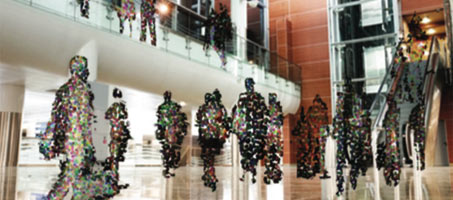
Who’s there: Prism Skylabs’ software processes surveillance footage to show how busy a place is without compromising customers’ privacy.
Prism Skylabs
Prism Skylabs
The huge success of online shopping and advertising—led by giants like Amazon and Google—is in no small part thanks to software that logs when you visit Web pages and what you click on. Startup Prism Skylabs offers brick-and-mortar businesses the equivalent—counting, logging, and tracking people in a store, coffee shop, or gym with software that works with video from security cameras.
“There’s a lot of wonderful information locked up in video, and 40 million security cameras in the U.S. collecting it, but it’s data that’s not been available,” says Steve Russell, cofounder and CEO of Prism, based in San Francisco. “We want to free up that information.”
Prism’s software can count people that come into a business, measure the length of the line at checkout, and produce static or animated visualizations showing how people moved around a store. It is designed so that it cannot identify or track individuals. One national wireless carrier is already using Prism’s technology to generate heat maps of where visitors go in their showrooms, to compare the level of interest in different devices—valuable data to them and to the device makers.
Prism’s software can also be used to turn security footage into a live version of Google’s Street View, says Ron Palmeri, Prism’s president and other cofounder. “We give the ability to go beyond the facades of businesses and show you the inside and even how busy it is, using very effectively privacy-protected imagery.”
Prism’s software can blur people into anonymous ghosts, show them in what Russell calls “predator vision” (a pixelated image), or remove them altogether and replace them with a “heat map,” on which colors signal the density of people. One gym in San Francisco trialing the technology plans to use it to show customers a live view of how busy it is.
Although security cameras are typically low quality, Prism uses computational photography techniques to combine multiple frames to produce images with higher quality and resolution than the original video. “We can remove the ugly, grainy quality of surveillance footage,” says Russell.
Prism’s software is designed to be used with existing security cameras. Software installed on a computer linked to the cameras digests the raw video into a compressed form that is sent to cloud servers, where Prism’s software does the hard work. It sends back the visualizations, statistics, and other data it extracts to a PC, smart phone, or tablet.
Since surveillance cameras are static, Prism’s software can work out which parts of a scene are fixed in place, such as walls, flooring, and furniture. Anything that moves against that background is clipped out and subjected to further processing. Russell hints that he hopes to eventually offer more sophisticated analysis by taking advantage of emerging computational photography techniques—for example, Lytro’s light field cameras, which produce images that can be refocused after they have been taken.
(End of article excerpt.)
The problem with a lot of scientists is that they get so caught up in the joy of their new toy that they do not think through what it will be used for. Surveillance cameras in stores will be used by law enforcement to conduct spying on US citizens, all in the name of keeping us safe from International Terrorists. But what happens when a rogue operator needs to cover his tracks or wants to use the video footage to commit crimes himself? Who is monitoring the monitors?
- 1
- 2

 Passing Through . . . .
Hi, I also like that film “Enemy of The State”. And I have a posting about it here http://priajelita.wordpress.com/2012/02/17/telephone-mama/ Please check it if you have time. Thank you.