Developments is Fusion Technology

Plasma physics: The fusion upstarts

Fuelled by venture capital and a lot of hope, alternative fusion technologies are heating up.

M. Mitchell Waldrop

Hubert Kang Photography
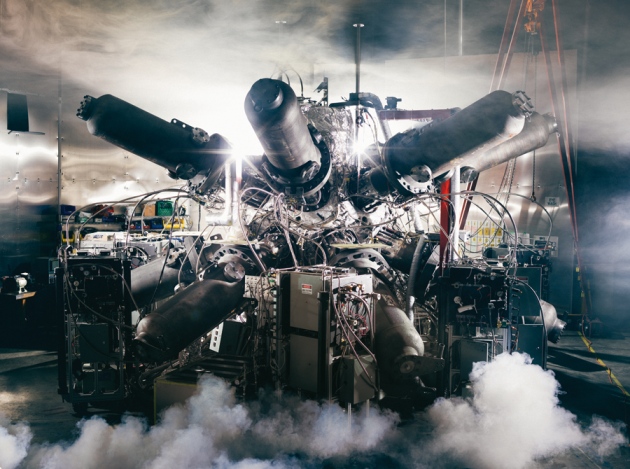
General Fusion’s reactor would use massive pistons to crush fuel in a spinning vortex of liquid lead.
To reach one of the world’s most secretive nuclear-fusion companies, visitors must wind their way through a suburban office park at the foot of the Santa Ana Mountains, just east of Irvine, California, until they pull up outside the large but unmarked headquarters of Tri Alpha Energy.
Fusion1

This is as close as any outsider can get without signing a non-disclosure agreement; Tri Alpha protects its trade secrets so tightly that it does not even have a website. But the fragments of information that have filtered out make it clear that the building houses one of the largest fusion experiments now operating in the United States. It is also one of the most unconventional. Instead of using the doughnut-shaped ‘tokamak’ reactor that has dominated fusion-energy research for more than 40 years, Tri Alpha is testing a linear reactor that it claims will be smaller, simpler and cheaper — and will lead to commercial fusion power in little more than a decade, far ahead of the 30 to 50 years often quoted for tokamaks.

That sounds particularly appealing at a time when the world’s leading fusion project, a giant tokamak named ITER, is mired in delays and cost overruns. The facility, being built in Cadarache, France, is expected to be the first fusion reactor capable of generating an excess of energy from a sustained burn of its plasma fuel. But it looks set to cost as much as US$50 billion — about 10 times the original estimate — and will not begin its first fuelled experiments before 2027, 11 years behind schedule.

With ITER consuming the lion’s share of the US fusion-energy budget, fans of alternative approaches have scant government support. But growing impatience with the tokamak technology has spurred the Tri Alpha team and many other physicists in the United States and Canada to pursue different options. Over the past decade and a half, these mavericks have launched at least half a dozen companies to pursue alternative designs for fusion reactors. Some are reporting encouraging results, not to mention attracting sizeable investments. Tri Alpha itself has raised $150 million from the likes of Microsoft co-founder Paul Allen and the Russian government’s venture-capital firm, Rusnano.

But that success is bringing increased scrutiny of their bold promises. Tri Alpha “has got very tough problems to overcome as it starts scaling up to reactor size”, says Jeffrey Freidberg, a nuclear physicist at the Massachusetts Institute of Technology (MIT) in Cambridge. For example, the company must prove that it can achieve the billion-kelvin temperatures needed to burn the exotic fuel it wants to use, and must demonstrate a practical way to convert the energy output into electricity. Similar questions could be raised about any of the other upstarts, says Stephen Dean, who heads Fusion Power Associates, an advocacy group in Gaithersburg, Maryland. “I don’t think you can honestly say that any of these things are at the stage where fusion can be demonstrated quickly,” he says.

Will alternative fusion companies be able to sustain their momentum and justify their founders’ optimism? Or will they fizzle like so many fusion dreams before them?

Follow the Sun
In principle, building a fusion reactor is just a matter of imitating the Sun. Take the appropriate isotopes of hydrogen or other light elements, add heat to strip the electrons from the nuclei and form an ionized plasma, then compress that plasma and hold it together for a while, allowing the nuclei to fuse and convert a portion of their mass into energy. But in practice, trying to mimic a star leads to horrendous engineering problems: for example, hot plasma trapped in a magnetic field tends to twist and turn like an enraged snake struggling to escape.

Fusion researchers have long favoured tokamaks as the best way to contain this plasma beast. Developed by Soviet physicists in the 1950s and announced to the West a decade later, the reactors achieved plasma densities, temperatures and confinement times much higher than any machine before them. And as physicists refined the design, they improved the way that tokamaks controlled high-energy plasma.

Illustration: Jasiek Krzysztofiak/Nature
Expand
But from the beginning, many physicists have wondered whether tokamaks could ever be scaled up to achieve commercial power output. They are dauntingly complex, for starters. The toroidal chamber has to be wound with multiple sets of electromagnetic coils to shape the magnetic field that confines the plasma. And more coils run through the doughnut hole to drive a powerful electric current through the plasma (see ‘Trapping fusion fire’).

Fusion2

Then there is the fuel, a mixture of the hydrogen isotopes deuterium (D) and tritium (T). D–T is widely regarded as the only sane choice for a power reactor because it ignites at a lower temperature than any other combination — only about 100 million kelvin — and releases much more energy. But 80% of that energy emerges from the reaction in the form of speeding neutrons, which would wreak havoc on the walls of a power reactor, leaving them highly radioactive. To generate electricity, the neutrons’ energy would have to be used to heat water in a conventional steam turbine — a process that is only 30–40% efficient.

Cost, complexity and slow progress have also dogged inertial-confinement fusion, the most prominent alternative to the tokamaks’ magnetic confinement. This approach, in which frozen fuel pellets are imploded by high-powered laser beams, has also received a lot of government funding. But despite decades of effort on inertial confinement, initiatives such as the National Ignition Facility at Lawrence Livermore National Laboratory in Livermore, California, are still struggling to deliver on their fusion-power promises (see Nature 491, 159; 2012).

Radical departure
Such concerns have sparked some enthusiasm for the stellarator: a toroidal device that simplifies certain aspects of the tokamak but requires even more complex magnets. But most mainstream plasma physicists have simply left the practical engineering issues for later, assuming that fixes will emerge after the plasma physics has been worked out. The fusion mavericks are among the minority who argue that a more radical solution is needed: first get the engineering right, by designing a simple, cheap reactor that power companies might actually want to buy, and then try to make the plasmas behave.

One of those upstarts is Norman Rostoker, a physicist at the University of California, Irvine, who co-founded Tri Alpha in 1998 at the age of 72. He and his colleagues proposed ditching D–T fuel in favour of fusing protons with boron-11, a stable isotope that comprises about 80% of natural boron. Igniting this p–11B fuel would require temperatures of about a billion kelvin, almost 100 times as hot as the core of the Sun. And the energy created in each fusion event would be only about half that released by D–T. But the reaction products would be practically free of troublesome neutrons: the fusion would generate just three energetic helium nuclei, also known as α-particles. These are charged, so they could be guided by magnetic fields into an ‘inverse cyclotron’ device that would convert their energy into an ordinary electric current with around 90% efficiency.

Burning a billion-kelvin p–11B plasma in a tokamak was out of the question, not least because unfeasibly large magnetic fields would be needed to confine it. So Rostoker and his colleagues designed a linear reactor that looks like two cannons pointed barrel to barrel. Each cannon would fire rings of plasma called plasmoids that are known to be remarkably stable: the flow of ions in the plasma would generate a magnetic field, which in turn would keep the plasma confined. “It’s the most ideal configuration you could imagine,” says Alan Hoffman, a plasma physicist at the University of Washington in Seattle.

To start the reactor, each cannon would fire a plasmoid into a central chamber, where the two would merge into a larger, free-floating plasmoid that would survive for as long as it could be fed with additional fuel. The α-particles emerging from the reaction would be guided back through the cannons by another magnetic field, and captured in the energy converter.

“Will fusion companies be able to sustain their momentum — or will they fizzle?”
By the time the team published this concept1 in 1997, it was becoming clear that the US energy department was not going to fund development of the machine, preferring instead to focus on tokamaks, which seemed to be a safer bet. “The big experiments have been funded for decades, so there’s little chance they won’t meet their milestones,” says John Slough, a plasma physicist at the University of Washington. “If they start funding these alternatives, all the uncertainties come back.”

So Rostoker and his colleagues decided to take advantage of the United States’ robust culture of high-tech startups and venture-capital funding. They formed a company, naming it Tri Alpha after the output of the p–11B reaction, and went on to raise enough investment to employ more than 100 people.

Dean suspects that the start-up mindset may explain why Tri Alpha is so secretive. “It’s part of the mystique of being a venture-capital-funded company: develop your ideas before anyone else can see them,” he says. But over the past five years or so, the company has started to let its employees publish results and present at conferences. With its current test machine, a 10-metre device called the C-2, Tri Alpha has shown that the colliding plasmoids merge as expected2, and that the fireball can sustain itself for up to 4 milliseconds — impressively long by plasma-physics standards — as long as fuel beams are being injected3. Last year, Tri Alpha researcher Houyang Guo announced at a plasma conference in Fort Worth, Texas, that the burn duration had increased to 5 milliseconds. The company is now looking for cash to build a larger machine.

“As a science programme, it’s been highly successful,” says Hoffman, who reviewed the work for Allen when the billionaire was deciding whether to invest. “But it’s not p–11B.” So far, he says, Tri Alpha has run its C-2 only with deuterium, and it is a long way from achieving the extreme plasma conditions needed to burn its ultimate fuel.

Nor has Tri Alpha demonstrated direct conversion of α-particles to electricity. “I haven’t seen any schemes that would actually work in practice,” says Martin Greenwald, an MIT physicist and former chair of the energy department’s fusion-energy advisory committee. Indeed, Tri Alpha is planning that its first-generation power reactor would use a more conventional steam-turbine system. Other fusion entrepreneurs will have to tackle similar challenges, but that has not deterred them. Slough is chief scientific officer at Helion Energy in Redmond, Washington, which is developing a linear colliding-beam reactor that would be small enough to be carried on the back of a large truck. The Helion reactor will fire a steady stream of plasmoids from each side into a chamber, where the fuel is crushed by magnetic fields until fusion begins. Within one second, the fusion products are channelled away just as the next pair of plasmoids hurtles in. “The analogy we like to make is to a diesel engine,” says the company’s chief executive, David Kirtley. “On each stroke you inject the fuel, compress it with the piston it until it ignites without needing a spark, and the explosion pushes back on the piston.”

Related stories
Fusion furore
Laser fusion experiment extracts net energy from fuel
Triple-threat method sparks hope for fusion
More related stories
Helion has demonstrated the concept4 in a D–D reactor with plasmoids that fire once every three minutes, and it is now seeking $15 million in private financing over the next five years to develop a full-scale machine that could use D–T fuel to reach the break-even point, when it generates as much energy as it takes to run. The company hopes that its reactor could eventually reach the hotter conditions needed to fuse deuterium with helium-3, another combination that produces only α-particles and protons, with no neutron by-products.

Kirtley is optimistic about the money. “There is a giant market need for low-cost, safe, clean power,” he says. “So we’re seeing a big push in the private investment community to fund alternative ways to generate it.” And if the fund-raising is successful, says Kirtley, “our plan is to have our pilot power plant come online in six years.”

In a spin
Other alternative concepts stick with D–T fuel, but confine it in different ways. In Burnaby, Canada, researchers at General Fusion have designed a reactor in which a plasmoid of D–T will be injected into a spinning vortex of liquid lead, which will then be crushed inwards by a forest of pistons. If this compression happens within a few microseconds, the plasma will implode to create fusion conditions5. One advantage of this design is that the liquid lead does not degrade when it gets blasted by neutrons, says Michel Laberge, who founded General Fusion in 2002.

General Fusion has demonstrated the idea with a small-scale device, using pistons driven by explosives, and has raised about $50 million from venture capitalists and the Canadian government. If the company can win another $25 million or so, Laberge says, it will build a beefier implosion system that can compress the plasma to the levels needed for fusion — perhaps within the next two years.

Despite such optimism, Dean estimates that it will be at least a decade, maybe a lot longer, before any alternative fusion company produces a working power plant. There is simply too much new technology to be demonstrated, he says. “I think these things are well motivated, and should be supported — but I don’t think we’re on the verge of a breakthrough.”

It is not clear how much of that support will come from the US energy department in the foreseeable future. The department’s fusion-energy programme has provided a modicum of cash for Helion, as well as for some small-scale academic work on alternative reactors. And its long-shot funding agency, the Advanced Research Projects Agency—Energy, has expressed interest in some of the alterative concepts, to the extent of holding a workshop on them last year. The fusion-energy advisory committee is preparing a ten-year research plan, due by the start of next year, that could conceivably lead to more backing for the upstarts. But funds are tight, and ITER continues to be a huge financial drain.

For now, the big money will probably have to come from the private sector. And despite the many technical hurdles, investors seem willing to take a chance.

“People are starting to think, ‘Hey, maybe there are other ways of doing this!’” says Slough. “Maybe it’s worth a few million to find out.”

Nature 511, 398–400 (24 July 2014) doi:10.1038/511398a

Paintings of Penzance

THE PAINTINGS OF PENZANCE

Authors on Museums: small and intimate, Penlee House is a gallery in tune with its Cornish setting—and the weather. For Jim Crace, it has even become central to his marriage

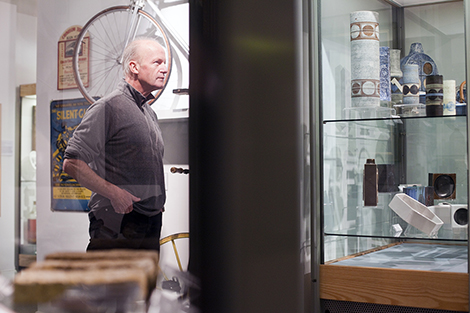
UK - Cornwall - Author Jim Crace in the room dedicated to paintings by the Newlyn School at the Penlee House Gallery

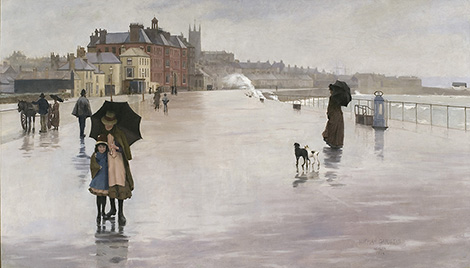
We cannot help but be concerned for the woman in the long grey dress and her reluctant dogs. The tide is high; there is a beating wind and sheets of rain—and she has promenaded far too close to the railings shielding Penzance against Mount’s Bay. If she does not turn about or, at least, move to the left into the lee of the buildings, before she reaches Battery Rocks and the quay below St Mary’s Church, there’s a chance the sea will sweep her off her feet. That black umbrella she’s holding over her hat and shoulders will hardly save her from the heavy, white loops of water, ten feet high, which, egged on by a lively Cornish gale, have struck and cleared the defensive walls above the shore.

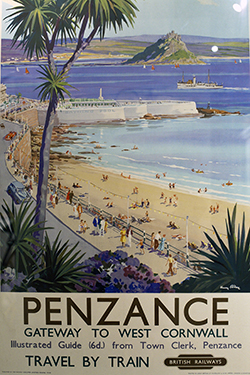
This is “The Rain it Raineth Every Day” (below), Norman Garstin’s best-known oil painting and one of the most satisfying assets of Penlee House, the modest, richly parochial gallery and museum in the middle of Penzance which my wife, Pam Turton, and I have visited, on and off, in and out of season, and usually taking refuge from the weather, for 40 years. Our fondness for the place is as old and as cherished as our first holiday near the town in 1974. The setting is a pretty one: semi-tropical gardens with a fine 11th-century granite cross and an historic cider mill, marking the entrance to a plain Victorian merchant’s house with just six smallish exhibition rooms and an orangery (now serving as a café) to house the collection.Inside, Penlee House is without pretension. It is a space that knows its limitations and its strengths—and makes the most of them. The three ground-floor rooms ring the changes as much as they can with quarterly exhibitions, but they are invariably curated to a local theme in keeping with the gallery’s mission to be at “the artistic heart of West Cornwall’s history”. Nothing east of the Tamar seems to count in here. Devon could be Mars. Even the recent Graham Sutherland show, “From Darkness into Light”, was limited to his work as an official war artist at the Geevor tin mine, a few miles to the north-west. Other recent shows—Edward Bouverie Hoyton’s Cornish etchings, for example, and “In Memoriam”, a display from the stacks of the best gallery bequests—are not exactly narrow in scope but they are determinedly regional. There are two further rooms upstairs with cabinets of Cornish curiosities, assembled with no greater an organising principle than that they are from the neighbourhood. There are cases of Stone Age flint implements (axe-blades, chisels, scrapers, arrowheads), many found alongside burial urns nearby. Even the Bronze Age gold collar or lunula on loan from the British Museum in London has a local provenance; it was found in 1783—under some manure, it is said—in Gwithian, overlooking St Ives Bay. With the pleasing randomness of a bric-à-brac shop, the collar shares its space with railway posters—one promoting “THE CORNISH RIVIERA, land of legend and romance”, 
another “PENZANCE: GATEWAY TO WEST CORNWALL”; a display of locally made Troika pottery, the designs inspired by Paul Klee; and the loggerhead turtle washed up on Sennen beach in 1982. A couple of paces away, visitors can take equivocal pleasure in the battered fin of a 500kg German bomb which, in October 1940, blew off the foot of the bed in which three generations of the Richards family, plus two evacuee children, were sleeping in nearby Lannoweth Road. (Everyone survived.) Yes, to be devoted as I am to 
these rooms, which guilelessly and evenhandedly 
exhibit both the ephemeral and the momentous, you have to be prepared for lucky-dip.

AoM Crace 3

Up to this point, casual holiday-makers might wonder if they need to be Cornish by birth or at least long-term incomers to truly appreciate the doggedly indigenous displays of Penlee House. “Scraping the barrel” is a phrase that might come to mind. But what a barrel! For the very best is yet to come. The third and final room on the upper floor is the jewel in Penlee’s coronet. This is where the Newlyn School of artists, including Walter Langley, Stanhope Forbes, Frank Bramley and Fred Hall, has its dedicated home. It is a small but stunning collection, packed with feeling, colour and brightness, despite the room’s disorienting lack of natural light. Usually there are as few as 15 paintings on display and two hard cherrywood benches from which to view them. These works by a handful of painters, mostly settlers, record the beauty, sorrow and hard labour of local life from the late 19th to the early 20th century. They might be thought a little sentimental on first encounter, possibly because the landscapes and the seascapes that frame them cannot possess the grim brutality of the industrial north or Midlands. There is no furnace smoke, there are no 
abject slums in these fishing ports; for the most part, the people portrayed look clean and tanned and reasonably fed. But it is hard to view the work of Langley, the Birmingham-born “Pioneer of the Newlyn Art Colony” (the title is engraved on his tombstone in Penzance), without acknowledging the moral seriousness with which the best of these artists 
approached their work. His masterful and seemingly buoyant watercolour of 1886, “Departure of the Fleet for the North”, is narratively incomplete until it is compared with its companion piece, the crushingly austere “Among the Missing”, with its weeping mothers and widows; the fishing life was—and is—perilous and punishing for these Cornishmen, no matter how picturesque the sea might be for visitors.

UK - Cornwall - Detail of an early railway painting at the Penlee House Gallery

It pays, too, to look closely at the paint itself, especially the oils. Many of the Newlyn colony had travelled on the continent and would have rubbed shoulders with colleagues from the older Barbizon group near Paris; others would certainly have encountered the work of Jules Bastien-Lepage, the French master of naturalism. So it is no surprise that new techniques were imported into Britain partly via Newlyn and Penzance, including the en plein air conventions of the French school which had the artists standing on location, sharing a plane with their subjects, rather than sitting in their studios, and the expressive flat-brush techniques which add an impressionistic feathering to works of otherwise watchful realism.

There is a further reason why this small room is pleasing, and why for me it provides a pleasure that is both intense and personal. Of all the many paintings I have encountered in all the galleries that an amateur’s lifelong interest in art has led me to, there is not one I know better than “School is Out” by the Canadian Elizabeth Armstrong. Nor is there one more central to our marriage. Visiting it and seeing it, time after time, with increasing frequency, and in each other’s company, has been a bonding experience; galleries are kind to those who want to fall and stay in love.

Top Old familiar faces: Jim Crace studies “School is Out” by Elizabeth Stanhope Forbes. The descendants of some of the children still live in West Cornwall

Middle Life imitates art: Norman Garstin’s “The Rain it Raineth Every Day”, described at the start of this piece and re-enacted at the endPAINTINGS OF PENZANCE

This is the painting (detail, right) that my wife studied for the degree dissertation she presented to the Barber Institute in Birmingham (another favourite gallery). I ought to call Armstrong by the name Elizabeth Stanhope Forbes because that is the attribution given to the painting by the gallery. But it was painted just before she married Stanhope in 1889 and when she was still an independent woman, full of the promise and achievement that being married and female in prim Victorian Cornwall would rob in later years. Before Newlyn and Stanhope, Armstrong had been a spirited pupil and colleague of Whistler and Sickert in London and she had worked among the pre-Newlyn schools in Munich, Brittany and Holland. Indeed, her 1884 portrait of a Zandvoort fisher-girl, the smallest and most tender painting in the room, is a work of outstanding beauty and the piece that is most often chosen by the staff and docents at Penlee as the one they’d choose to put in their handbags if they thought they’d get away with it. “School is Out” provides exactly what the title promises, a picture of 14 pupils and two junior-school teachers packing up after a somewhat tearful day of study, but it has the added, weighty charm of portraying, almost brushstroke by brushstroke, the artist’s own love of children. It brought us down to Penzance and Newlyn many times as we tried to identify the building shown in the painting (it was, my wife established, an artist’s free amalgam of a couple of schools in Paul) and to put a name to the predominantly red-haired children in the picture, before finding those several surviving relatives still living in this far-flung toe-end of the country.

UK - Cornwall - Details of the painting School is Out by Elizabeth Adele Forbes at the Penlee House Gallery, Penzance

It’s possible to miss Norman Garstin’s “The Rain it Raineth Every Day”, often hung behind the door as you walk in. It takes its title from Feste’s song in “Twelfth Night” and records a day familiar to anyone who’s ever holidayed in Penzance, a day of unforgiving showers. It’s hard to imagine how this outspoken, one-eyed Irishman could have completed en plein air his preparatory sketches of this rain-soaked woman in the late 1880s, and then captured her in such vivid detail in oil when the weather was so evidently fierce.It’s hard to imagine, too, how my wife and I can have been so reckless, during last year’s Christmas storms, as to step outside Penlee House into the very weather we’d come indoors to escape. It is only a few hundred yards down a road lined with palm trees—its front gardens planted with species too tender, one suspects, to survive a winter anywhere an inch farther north—to Garstin’s promenade. His painting had prepared us for the dangers but, just like that woman in the soaked grey dress, we were blind and deaf to them, despite seeing that all the access roads had been coned off to drivers and pedestrians. The front was almost as deserted as it was in the painting. We were the only fools to have parked our car next to the sea wall. We leant into the wind, scarcely able to hold our footing, and pressed our foreheads against the storm. But we were also promenading far too close to the defensive walls. A great white heavy loop of water cleared the parapets above the shore. It did not quite knock us off our feet but it shook and drenched us. We had come through what Garstin’s woman has yet to arrive at, a beating from the sea. It was as if we’d stumbled out of two dimensions into three.

UK - Cornwall - Author Jim Crace at the Penlee House Gallery

That soaking on the promenade stands for much of what I value most about Penlee. This unassuming refuge from the wind and rain offers more than art, antiquities and archaeology; it encourages a familiarity with the county within its walls and the county beyond them. As we have grown conversant with its hinterland, we have also come to see how almost everything on display suggests a walk or outing somewhere close—when and if the sun comes out, that is. The quays and slipways of the Newlyn paintings are an easy stroll away and almost unchanged; and higher in the lanes of the town the net lofts where the paintings were completed and the slightly grander houses where the artists lived can be hunted, as can their tombstones in the village graveyards.

And then, inspired by the many Neolithic artefacts on display in the curiosity cabinets of Penlee, you can easily go in fruitful search of Stone Age flints yourself, as I have done. Or, seeing the shot and stuffed bittern from the 1840s or the startled-looking chough and vagrant hoopoe in their glass cases, set off in pursuit of the living birds—because the elusive bittern has recently been a winter visitor to the brackish marshes of Marazion, a single lost hoopoe fell exhausted in Church Cove on the Lizard last spring, and choughs are once again inhabiting the Pendeen cliffs. Penlee reaches far beyond its doors.

For all the splendours of the world’s greatest galleries, visitors are likely to be kept at arm’s length, spectators of a world that can seem too rarefied to let them in. There is no reason why the Louvre should be your favourite gallery just because it has the grandest collections in France, any more than Kew should necessarily be a favourite garden because it has the largest assemblage of plants, or Tesco your chosen shop because it has the widest variety of canned beans. Some place small and intimate, like Penlee House, where the associations are personal, private even, is bound to earn a deeper, fonder loyalty.

Next New Thing from Microsoft?

Microsoft’s Cortana Learns Some Home-Automation Tricks

Cortana, Microsoft’s virtual assistant for smartphones, will soon be able to control some home-automation gadgets.

By Rachel Metz on July 16, 2014

WHY IT MATTERS

As smart home devices become more common, we’ll need simple ways to control them.

Cortana, Microsoft’s vocal virtual assistant, is gaining the ability to control smart-home products like lights and thermostats.

Home-automation company Insteon, based in Irvine, California, is working on a Windows Phone 8.1 app slated for release later this year that aims to make it easier to do things such as turn on the lights or boost the temperature by issuing commands via Cortana like, “Insteon, turn off all the lights” or “Insteon, adjust living room thermostat temperature down.”

Cortana, which was announced in April and is built into Microsoft’s Windows Phone 8.1 (which began rolling out to Windows Phone 8 users on Tuesday), can answer spoken queries like “What’s the traffic like on my way to work?” and respond to commands like “Change my 10 a.m. meeting to 11” or “Remind me to feed the cat when I get home” (see “Say Hello to Microsoft’s Answer to Siri”).

In many respects, it’s very similar to Google Now and Apple’s Siri, but unlike these competitors, Microsoft is allowing third-party developers to create apps that can be controlled using Cortana—a move that could inspire app developers to dream up new uses for the voice interface.

In addition to its iOS and Android apps, Insteon already offers conventional apps that allow users to control the company’s Internet-connected lightbulbs, wall switches, thermostats, and outlets on Windows phones and tablets.

The addition of Cortana voice controls is still in the early stages. During a demonstration at a Microsoft Store in San Francisco on Tuesday with a Windows smartphone and array of Insteon gadgets, it could do only a few simple things like turn an Insteon lightbulb on and off or, in response to the spoken command, “Insteon, it’s hot in here.” The smartphone responded “Nobody likes being hot, want to adjust your thermostat?” while pulling up thermostat information.

Insteon cofounder and CEO Joe Dada said in an interview Tuesday that he has long been interested in bringing voice control to his company’s automation products. Yet while Insteon has tried voice-recognition technologies in the past, it found consumers weren’t interested enough and the technologies didn’t work well enough. “It was just too early,” he said.

Dada says he’s currently using Cortana at home to turn various things on and off.

Despite efforts to improve understanding of voices and language and filtering of background noise, though, usage of voice-recognition technology is still not all that common. Consumers expect voice-recognition software to work nearly all the time, and often get frustrated when it fails—which is still a common problem no matter which company is behind it.

More NSA Stupidity

Germany tells top U.S. spy official to leave the country

By Ben Brumfield, CNN
updated 6:03 PM EDT, Fri July 11, 2014

(CNN) — Germany’s government has asked America’s top spy chief stationed in the country to leave.
It’s a punitive gesture usually reserved for adversarial nations in times of crisis and only very rarely for an ally, particularly a very close one.
But allegations of American spying have seriously injured German trust, Chancellor Angela Merkel has said. And it’s time for a reset.
Germany let loose the diplomatic slap, reminiscent of a Cold War rebuke, after news of two new possible U.S. espionage cases broke back to back in a week’s time.
Two Germans — one working at a German intelligence agency, the other in the Ministry of Defense — are suspected of spying for the United States.
Will spying now ruin US-German relations? New U.S. spying allegations anger Germany
Local media report that both cases involve stolen official German documents.
The U.S. official shown the door is based in Berlin at the U.S. Embassy, which followed up on Friday’s announcement with a note to journalists:
“The U.S. Embassy has seen the reports that Germany has asked the U.S. Mission Germany’s intelligence chief to leave the country. As a standard practice, we will not comment on intelligence matters.”
A German official confirmed that person was the CIA’s station chief and that the agency’s director, John Brennan, has talked multiple times with his German counterpart.
‘So much stupidity’
Top German government officials have candidly spoken about the decision to expel the U.S. official as they poured their disappointment over alleged U.S. spying into microphones and cameras for days.
Most pointedly, Finance Minister Wolfgang Schaeuble casually described the alleged U.S. actions as “daft” before a television talk show audience. “One can only cry over so much stupidity,” he said.
He based his remarks on the essential value of Germany’s cooperation with U.S. intelligence agencies to fight international terrorism and complained that spying spoils the relationship.
Legal action
The latest allegations weigh densely on ties already burdened since Edward Snowden leaked indications that the National Security Agency tapped into Merkel’s own cell phone.
They have seemingly undone any of Washington’s diplomatic smoothing over previously alleged NSA intrusions.
One of the new cases has landed on top of an existing investigation on federal prosecutors’ desks into the possible spying on Merkel.
The NSA scandal has also prompted prosecutors to set up a new special committee to investigate and criminally prosecute cyberspying by foreign intelligence.
Merkel deferred to the pending results of those investigations, but it didn’t stop her from expressing on Thursday the disappointment she feels over the suspected acts.
“From a common sense standpoint, in my opinion, spying on allies is, in the end, a waste of energy. We have so many problems, and we should, I find, concentrate on the essentials.”
ISIS, Syria, terrorism — all take priority over spying on each other, she said. And trust between allies is vital.
Privacy is sacred
To understand Germany’s particular hurt over spying allegations, one need only to look at the country’s history in the 20th century, when oppressive fascist and communist regimes spied on citizens in order to persecute them.
During the Cold War, high-level spy scandals stoked division between then divided democratic West Germany and communist East Germany.
The scandals triggered government shakedowns and deep public outrage in the West.
As a result of the Nazi past, democratic, postwar Germany has instituted very strict privacy laws that prohibit government agencies, companies and private individuals from gathering or passing even simple information about citizens without their express consent. Or in criminal cases, without probable cause.
Data protection is so sacred in Germany that advertisers there are prevented from profiling prospective consumers.
Top U.S., German diplomats to meet
Amid the new allegations, the top U.S. and German diplomats are expected to meet in Vienna, Austria, this weekend during multination negotiations about the future of Iran’s nuclear program, a senior U.S. State Department official said.
While the official said U.S. Secretary of State John Kerry and German Foreign Minister Frank Walter Steinmeier will touch on topics such as the Middle East and Ukraine, it’d be hard to imagine the two ignoring the spy issue.
Across the Atlantic in Washington, the new allegations have also raised the eyebrows of some elected officials.
“I am concerned that we are sending the wrong message to a key ally,” said Democratic Sen. Mark Udall of Colorado.
Otherwise, administration officials have countered their German counterparts’ candor with lips as sealed as those at the U.S. Embassy in Berlin.
White House spokesman Josh Earnest declined to comment on the reported intelligence activity as a matter of policy, to protect American national security and “intelligence assets.”
“I’m not going to have anything more to add on that front,” State Department spokeswoman Jen Psaki told a journalist who asked if reports of Germany booting the U.S. intelligence official were true.
German journalists who contacted Washington officials for comment on the cases, when news of them first broke, reported receiving e-mail replies containing only two words, which they included in their articles in the original English: NO Comment

A Really Big Bird!

A newly declared species may be the largest flying bird to ever live

bird11404743290
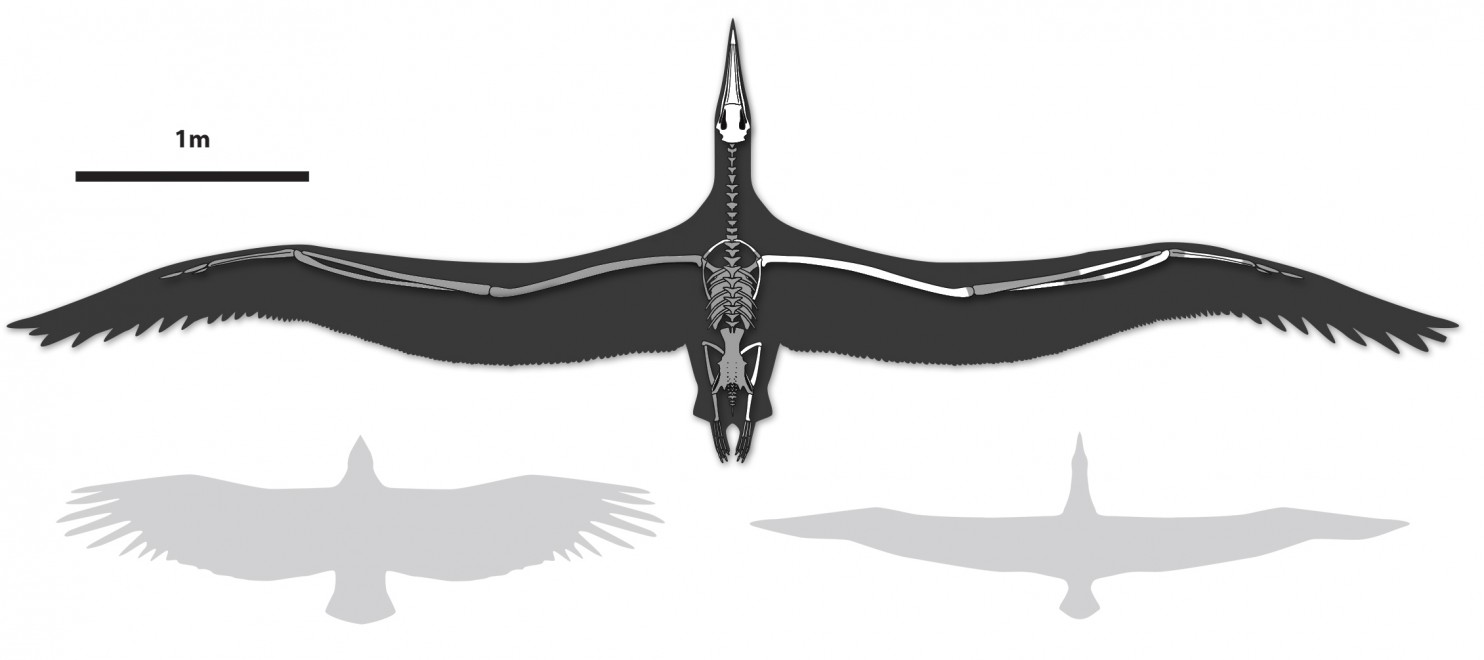
An artist’s drawing of the newly named species Pelagornis sandersi shows the discovered bone fragments in white. The strikingly well-preserved specimen consisted of multiple wing and leg bones and a complete skull. (Liz Bradford)
By Rachel Feltman July 7 at 6:58 PM
When South Carolina construction workers came across the giant, winged fossil at the Charleston airport in 1983, they had to use a backhoe to pull the bird, which lived about 25 million years ago, up from the earth.

But if the bird was actually a brand-new species, researchers faced a big question: Could such a large bird, with a wingspan of 20 to 24 feet, actually get off the ground? After all, the larger the bird, the less likely its wings are able to lift it unaided.

The answer came from Dan Ksepka, paleontologist and science curator at the Bruce Museum in Greenwich, Conn.

He modeled a probable method of flight for the long-extinct bird, named as a new species this week in the Proceedings of the National Academy of Sciences. If Ksepka’s simulations are correct, Pelagornis sandersi would be the largest airborne bird ever discovered.

Pelagornis sandersi relied on the ocean to keep it aloft. Similar in many ways to a modern-day albatross — although with at least twice the wingspan and very different in appearance, Ksepka said — the bird probably needed a lot of help to fly. It had to run downhill into a head wind, catching the air like a hang glider. Once airborne, it relied on air currents rising from the ocean to keep it gliding.

Paleontologist Dan Ksepka examines the fossilized skull of what may be the biggest flying bird ever found. Its telltale beak allowed Ksepka to identify the find as a previously unknown species of pelagornithid, an extinct group of giant seabirds known for bony, toothlike spikes that lined their upper and lower jaws. (Courtesy of Dan Ksepka)
Like the albatross, Pelagornis sandersi spent much of its time over water.

“It was a bit warmer 25 million years ago,” Ksepka said, “and the sea level was higher. So even though the Charleston airport, where the fossil was found, is on dry land today, it used to be an ocean.”

A Rare Chance to Elect a Rational Governor of Texas

Stand With Wendy Davis

StandWithWendy

One year ago, Wendy Davis launched a 13-hour filibuster to stop Austin insiders from closing women’s health clinics across the state that provided crucial care to tens of thousands of Texas women.

But that filibuster was about so much more to the women and men from across the state who came together on June 25, 2013.

It was an act of courage and strength to fight back against political insiders abusing their power. The Austin insiders did everything they could to shut Wendy up, to shut the filibuster down and to silence the voices of Texans across the state.

But we would not be silenced.

Wendy’s filibuster has inspired millions of people across our state to join the fight for Texas. We’ve seen her strength and courage spread, reflected and amplified everywhere.

And on this one-year anniversary that courage is greater than ever before and the fight has only just begun.

We’ll keep speaking up. We’ll keep fighting back.

Say you’ll join u

Problems with Pronouns

BIG QUESTIONS LEAD TO SMALLER ONES

~ Posted by Rosie Blau, June 23rd 2014

Sometimes being an editor involves coming up with grand thoughts and wild ideas. Much of the time, though, we are thinking about commas, headlines and other matters that, if we get them right, the reader barely notices. Often it’s the smallest of these that provoke the greatest debate in the office.

It was a pronoun that whipped up a storm as the July/August issue of Intelligent Life went to press. In every edition we run a feature called “The Big Question”, in which we put a poser to six writers. This time the question was about how many children to have. But when it came to putting that question on the page, we had a hard time agreeing precisely how to phrase it: “How many children should you have?”, or “How many children should we have?”

Some of us preferred “you”, because it was simple, direct and reflected the personal nature of the question, but others thought it was too bossy—not the first time I have been so accused. They thought “we” was more inclusive and was a better way to introduce a feature whose answers ranged from the highly personal to the planet-saving universal.

A particular concern from the “we” camp was that the question might be offensive—to anyone who didn’t have children or couldn’t have children, for example. I countered that “we” assumed that children had two parents. However you ask it, I suspect the question will raise some hackles. This feature is designed to evoke strong feelings and strong views. Asking about children is an intensely personal issue, perhaps the most intimate question we have asked.

In the end we came up with a slightly untidy compromise: “we” on the cover, “you” inside. That probably means we succeeded in offending absolutely everyone. Sorry.

Public Domain

Public domain

The adventure of the copyrighted detective
Jun 19th 2014, 22:28 by G.F. | SEATTLE

THE curious case of one Mr Sherlock Holmes has completed its journey through the American courts. Who, if anyone, owns the rights to this precise ratiocinator? An appeals court said on June 16th that in the United States the answer is no one. Mr Holmes as a character, plus the majority of his characteristics and those of his chums, are decidedly in the public domain.

Arthur Conan Doyle’s detective first appeared in a story in 1887. The Conan Doyle Estate, an organisation that looks after the interests of Conan Doyle’s heirs, has said that because ten stories were printed in America for the first time between 1923 and 1927—and so remain under copyright there—all of Mr Holmes’s and Dr John Watson’s salient characteristics are therefore protected. (In Britain and many other countries, all of Conan Doyle’s works entered the public domain in 1980, 50 years after his death. In America the copyright regime has changed for works published in 1978 or later, but most works published between 1923 and 1977 remain in copyright for 95 years.)

Prospero wrote in February 2013 about a lawsuit filed by Leslie Klinger, a lawyer and Holmes expert, who wished to publish a second collection of Holmes-inspired work, edited with Laurie King, an author of detective fiction. For the first collection, he acceded to the wishes of his publisher, which paid the estate a fee. For the second, he refused. He freely acknowledges the in-copyright status of the ten last works, but says he has scrubbed his book of any fact or traits that appear exclusively in those stories. The estate threatened to sue and to warn book distributors against stocking the title.

Mr Klinger’s lawsuit travelled quickly through the courts, and the estate failed to appear during hearings last year. In December 2013 a judge issued a summary judgment in favour of Mr Klinger’s position that any story elements involving Conan Doyle’s detectives that appeared before 1923 were in the public domain. The estate appealed, but a three-judge panel backed the judge when it returned its decision on June 16th.

The estate has relied throughout on an interpretation of copyright law that experts consulted by Prospero and jurists have rejected: that is, that the sum of a character is formed across the entirety of the works in which he or she appears, and is thus protected if any work remains under copyright. The appeals court reaffirmed established law and practice that only sufficiently original elements that appear in individually published works receive such protection.

Richard Posner, one of the three judges at the appeals court and an elegant writer of decisions, noted that the question is “whether copyright protection of a fictional character can be extended beyond the expiration of the copyright on it because the author altered the character in a subsequent work.” Mr Posner writes that it is definitely not the case. Were it to be so, authors would have a direct incentive to continue writing stories with old characters to keep copyright protection in effect for longer periods of time. (The entire decision is worth a read; it’s quite amusing.)

The estate has not let previous setbacks stop it from claiming rights that it asserts it possesses. Mr Klinger may proceed with his publication, but in the tetchy world of publishers, television studios and film studios, in which expensive operations can be halted through a whisper of ownership worries, Conan Doyle’s heirs may continue to collect royalties. And the Supreme Court may be called upon once again to investigate, prognosticate and make logical deductions. Unlike those solved by the great detective, this case is not closed.

Strange Physics of Water at Super-Low Temperatures

Liquid Water in an Icy No Man’s Land

Scientists probe the strange physics of water at super-low temperatures
Jun 20, 2014 |By Ben Fogelson
supercooled water droplets

By zapping tiny water droplets with x-ray laser pulses, scientists have gotten their first glimpse into the behavior of supercooled water in a hard-to-reach “no man’s land” of temperatures below –41 degrees C. Understanding water below its normal freezing point of 0 degrees C has been a challenge because it must be handled with extreme care to keep it in liquid form. The resulting insights may help settle a debate among physicists over water’s fundamental properties, including whether it can take on a fourth state beyond the standard three of solid, liquid and gas.

Water has strange properties unlike those of almost any other liquid, such as expanding rather than contracting upon freezing, and it gets more bizarre as it gets colder. In fact, water’s oddities start at the warmer temperatures suitable for most of life on Earth, says Stanford University photon scientist Anders Nilsson, senior author of a new paper describing the weird water. “We wanted to go into the supercooling,” he says, “because that’s where everything is amplified in this very strange behavior, and we need to understand where this strange behavior comes from.”

Physicists have created supercooled water before, but never this cold and never for long enough to study it closely. To make that leap, Nilsson’s team had to move very fast. Using Stanford’s SLAC National Accelerator Laboratory, they fired tiny water droplets, each the width of a human hair, into a vacuum chamber where they started to evaporate and cool off at a rate of about 100,000 degrees C per second. The team then blasted these supercooled droplets in midair with bursts from an x-ray laser. As the x-rays passed through the water, they scattered, painting a detailed picture of the water’s molecular structure. The whole process took only a few milliseconds per drop, but that was long enough for Nilsson’s team to observe them before they’d hardened into ice. The experiment is detailed in the June 19 issue of Nature (Scientific American is part of Nature Publishing Group).

This ultrafast x-ray technique represents a breakthrough. “I thought it was wonderful,” says Pablo G. Debenedetti, a professor at Princeton University who studies supercooled water and is not affiliated with the project. “They were able to extend the range of temperatures over which you can study liquid water.” Previous experiments had been able to study liquid water down to –41 degrees C, but the new study pushed that limit down to –46. The hope is that extending this limit will help resolve a debate about how water behaves when it gets so cold.

The debate is over the existence of a “critical point”: a specific temperature below which water would have an additional phase of matter beyond the usual three (solid, liquid and gas). Below the critical temperature, so the theory goes, water would have two distinct liquid states of matter, each with different physical properties such as density and compressibility. Depending on the ambient pressure, supercooled water could be in either one of these states.

Up to now, sophisticated computer models offered the only way to study water below –41 degrees C, but they were not accurate enough to predict exactly how real water behaves. Some of the models predict the existence of a critical point whereas others do not. The new technique has yet to settle the debate, but it should give researchers the experimental firepower they need to prove once and for all whether the critical point exists.

The answer will not just teach us about supercooled water. If the critical point does exist, it will explain a lot about how water behaves under more ordinary conditions. Although water at room temperature and pressure exists as a single liquid state, little clusters of molecules could coalesce into temporary structures that act like the two supercooled liquid states. “The water doesn’t really know what it wants to be. It’s sort of dancing around locally in small regions of either of these two,” Nilsson says, “and that is why water behaves so weirdly, according to the theory.”

How to Enjoy Soccer

JUNE 19, 2014
HOW TO ENJOY SOCCER
diffee-world-cup-580

I was five years old when I first heard the word “soccer.” My best friend and I were changing into our fresh-out-of-the-box uniforms in his Mom’s station wagon, and I figured that the name of this sport we were about to try must have something to do with the long purple socks that we were trying to pull on over what we’d just learned were called shin guards.

A year later, once I’d learned to spell, I was baffled to see that the name of my favorite sport wasn’t “socker.” And so, the first soccer game I ever saw was the first game I played in. I probably scored a goal, too. I usually did. Not to brag, but as a five-year-old kid on the sun-scorched fields of North Texas, wearing a perforated purple jersey that hung down to my knees, I was an absolute menace in front of goal. This was in the mid-seventies, in the middle of the big U.S. soccer boom. The original North American Soccer League had just formed. I was a Dallas Tornado fan. I saw them play the New York Cosmos with Pelé and Beckenbauer in the squad. I had a poster of Kyle Rote, Jr., on my wall. It seemed like every kid in America was playing soccer, even the girls. And the best of those little girls, who grew up playing right alongside the boys, went on to form the incredibly dominant first generation of the U.S. women’s national soccer team. I enjoy thinking that I had something to do with that.

That’s how it started for me, and I haven’t stopped playing, watching, and loving soccer since. But that’s just me—oh, and about a gazillion other people around the world, and even one or two hundred in the United States. That’s a joke. Despite the running gag that “Amuricans hate soccer,” there are plenty of soccer fans in America, and most of us don’t care whether you want to join us or not. Just don’t tell us that soccer is boring because, believe it or not, that’s not a very interesting thing to say. For the rest of you, the interested and interesting folks out there who might not know much about the game but want to enjoy it a little more during this World Cup, here are a few tips.

Pick a team.

Life’s more fun when you have a dog in the race, so make a bracket. Place a friendly bet. Pick a team to go all the way, or just choose your side match to match. I like rooting for the underdog. Don’t know who the underdog is? America from here on out is an underdog.

Do the minimal research.

You are just five minutes on the Internet away from understanding the offside rule and how it affects the game. That’s the only tricky one. Another five minutes and you’ll know the next matchups, which teams are favorites, who has injuries, and even what their girlfriends look like if that’s your bag.

Don’t be a ball watcher.

If two players are a leg’s length from the ball, there are twenty others playing the game elsewhere on the field, and everything they do affects everything else. Soccer is a complex, ever-flowing chess game with running. Get into it. See how the movements of a player’s teammates give him passing opportunities or open up new space for him to dribble. What choices does he make? On defense, notice how the positioning of a single player a couple yards in any direction changes the team’s defensive “shape” and either closes down space or opens it up.

Enjoy the sociocultural anthropology of it all.

Pay attention to the rising and falling of individual and team confidence, the turning of momentum, the clashing of wills. Consider the delicate balance of a team’s commitment to offense or defense in terms of risk versus reward. Notice how countries and even continents play the game differently—I find that part endlessly fascinating.

Finally, and most important…

Appreciate what’s happening.

Don’t let the wide camera angles lull you into missing the physicality of it. It’s easy to start thinking that it’s perfectly reasonable for a kicked ball to go exactly where the player intended, or that a ball flying fifty yards through the air should by all logic settle down nice and easy on the toe of a person’s foot, but remember that a soccer ball is an inanimate object. Almost everything you’re seeing these players do with it has taken hours and hours, even years, to perfect. It’s like watching a constant stream of magic tricks. Enjoy that. Clap right there on the couch if you want to. That’s what I do.

Now, as many have said, it’s hard to truly appreciate this stuff if you’ve never played before, but if you haven’t, try this. Imagine you’re running as fast as you can. I mean a full-on panting sprint. Now imagine doing something else with your feet at the same time. Seriously, imagine it. It’s hard to wrap your head around the idea, isn’t it? Now imagine there’s another human trying his best to stop you. Imagine that other human is a brawny Brazilian nicknamed Hulk. When you start to see it that way, you realize that soccer isn’t all about the goals. It’s about all the amazing little things that happen along the way. That’s why Pelé called it the beautiful game. And because he called it that, I got picked on a lot as a kid.

The cartoonist Matt Diffee is sending us World Cup dispatches. Follow him at @matthewdiffee