The End of a Musical Era

(CNN) — Maria von Trapp, the last of the singing children immortalized in the movie musical “The Sound of Music,” died at her Vermont home of natural causes, her half-brother told CNN on Saturday.

The native of Austria was 99 and lived in Stowe. She died Tuesday.
Maria von Trapp was the third-oldest child of Agathe Whitehead and Capt. Georg von Trapp. The couple had seven children: Rupert, Agathe, Maria, Werner, Hedwig, Johanna and Martina.
Georg von Trapp’s second wife, Maria Kutschera von Trapp, wrote a book titled “The Story of the Trapp Family Singers,” which sparked two German-made movies and “The Sound of Music.”

In 1959, the play “The Sound of Music” opened on Broadway. Julie Andrews, in arguably her most famous role, played the part of Georg’s wife, Maria, in the 1965 film. Christopher Plummer played Baron von Trapp. The movie won five Academy Awards, including best picture.

Johannes, the youngest son of Maria and Georg von Trapp, issued a statement following his sister’s passing: “Thank you for your thoughts. Maria had a wonderful life and while we will miss her, the memories of her will live on,” Johannes wrote.

Maria von Trapp later in life served as a lay missionary in Papua, New Guinea. She never married.
Photos: People we lost in 2014 Photos: People we lost in 2014

Both of Maria’s parents were talented musicians. Agathe played the violin and the piano while her father played the violin, accordion and mandolin.
“Sometimes our house must have sounded like a musical conservatory. You could hear us practice piano, violin, guitar, cello, clarinet, accordion, and later, recorders. We would gather in the evenings to play Viennese folksongs on our instruments with Father leading on the violin,” Maria wrote in her autobiography found on the Trapp Family Lodge’s website.
Agathe von Trapp died of scarlet fever in 1922. Maria also suffered from the disease and needed to be tutored at home as a result. That teacher, Maria, would eventually marry Georg in 1927.

The couple would go on to have three more children: Rosemarie, Eleonore and Johannes. The Trapps fled Nazi-occupied Austria in 1938 and moved to the United States.
The Trapp family, after traveling the world, purchased a 27-room family home in Stowe in 1950.
Thirty years later, the building was destroyed in a fire, then rebuilt into the Trapp Family Lodge. The property is still owned and operated by remaining members of the Trapp family, according to the lodge’s website.

The elder Maria von Trapp died in 1987.

What’s next after WhatsApp: a guide to the future of messaging apps

Facebook’s $19bn deal points to the internet’s future, but from Viber’s domination to upstart Kik, WhatsApp is hardly unique

theguardian.com, Friday 21 February 2014 15.22 EST

Here’s the first thing about all of this you should know: while US companies obviously have significant purchasing power, American startups are in some ways behind the global curve; much of the innovation is happening thousands of miles away from Menlo Park. And here’s the second thing: WhatsApp’s competitors make its current revenue model look really, really sluggish.

Messaging is enticing for a few reasons. For one, it’s a medium used by people all over the world. For another, it’s quieter; messages deliver a stream of photos, video or simple text direct from loved ones, without the added noise of everyone else on the internet. Messages provide for the fastest way for people to connect or find each other in a crowd. And messages allow people to buy stuff – lots and lots of stuff – in an almost criminally seamless manner.

Consider the following a 101 guide to some of the messaging apps you may not have heard about, including a brief refresher on WhatsApp. These apps provide services that WhatsApp/Facebook may hope to emulate in the race to make money and literally monopolize the world’s attention. (And if that sounds creepy, that’s because it sort of is. The Guardian’s Dan Gilmor takes a look at a world where Zuckerberg, not phone service providers, dominate communication.)
Short attention span version: Born and bred in Silicon Valley by two ex-Yahoo employees, this app registers one million new users per day, and 450m users per month use the service to send text, photo and video. And now it’s worth a lot of money.

Where it’s popular: Europe – up to 80% market penetration in countries including Brazil, Germany, Portugal and Spain – and Latin America, India

Numbers: $19bm is the only number anyone’s paying attention to at the moment

Why it’s worth watching: See above. Also, WhatsApp’s revenue strategy ($1 after a year of free use) looks especially sluggish compared to other apps offering similar services.

More reading: Dominic Rushe’s breaking story on the acquisition also has great background on founders’ visions for the tool – and more numbers, if you need them.

Short attention span version: Line was developed in Japan after phone communication failed due to the 2011 tsunami. Users can use text, photo, video and sticker emoticons to chat. Users can also buy things, and brands can buy stickers that users can send to each other for free.

Where it’s popular: Japan, Thailand, Spain

Numbers: Approximately 300m users, only 50m of them in Japan

Why it’s worth watching: Line has made money selling sticker emoticons and games – not far from the types of diversions you’d find on Facebook. This month, experiments with “flash sales” in Thailand resulted in 5.5m out of the country’s 22m total Line users signing up to buy discounted food and cosmetics.

These were technically ads, but clearly not invasive enough that make people bristle. This could be a hugely instructive move for WhatsApp. And, oh yeah, Line is said to be considering an overseas IPO this year, which analysts say could put the value of the company around $10bn.

More reading: Ben Thompson has an excellent deep dive into Line’s flash sales and stickers strategy at Stratechery.

App: WeChat

Short attention span version: Developed in China (the world’s largest telecommunications market), WeChat is owned by Tencent, an internet service provider that has monopolized the market and set sights on the west.

Where it’s popular: South-east Asia, South Africa, Russia, India

Numbers: Approximately 300m users; expected to earn $1.1bn next year

Why it’s worth watching: Much like Line, WeChat has already figured out how to entice users into linking the service to their bank accounts for purchases, which include buying new smartphones, through special promotions. It’ll also be interesting to see if WeChat can crack western markets by, in the words of the Economist, persuading “consumers living in free societies to use a social network actively monitored by an authoritarian regime”.

More reading: Quartz has a nice explainer on WeChat’s ability to retain users and keep them within the app.

App: Viber

Short attention span version: Operating out of Cyprus, this one’s pretty much like the others, but with more of an emphasis on the kind of messaging you do with your actual voice. In the olden days we used to call this “phone calls” or “Skyping”. Viber was purchased for relative peanuts ($900m) last week by Japanese comms giant Rakuten.

Where it’s popular: It’s used in 193 countries – everywhere?

Numbers: Reportedly losing money to the tune of $29.5m last year, but has approximately 300m users.

Why it’s worth watching: Much like Facebook, Rakuten is seeking to expand its empire by broadening its profile of services. But Rakuten an online retail company (think Amazon status), so it’ll be interesting to see what it does with Viber’s wide user reach and a sticker-based communication model similar to Line’s

More reading: Variety has drawn some nice comparisons to the WhatsApp deal here

App: Kik messenger

Short attention span version: Created at the University of Waterloo, this messenger just launched an in-app web browser. And teens love the tool, one of several signals that the next generation will be more into direct messaging than millennials. It has yielded many a “parents beware” blog post.

Kiki Messenger
Kik Messenger. Photograph: /Kik Messenger
Where it’s popular: The US and Canada

Numbers: Approximately 100m users; raised $19.5m worth of funding in 2013

Why it’s worth watching: Kik is making a big push to retain users inside the app for much of their web browsing and social sharing experience.

More reading: Props to TechCrunch for asking Kik CEO Ted Livingston if Facebook’s WhatsApp acquisition had resulted in any similar offers for Kik – reporter Darrell Etherington got a non-response.

Suffice it to say, the race to conquer messaging is on, in every time zone, all over the world. Adjust your thinking accordingly – the Snapchat/Instagram/Twitter DM shuffle of last year was relatively quiet compared to this. If you’re still searching for apps, Samuel Gibbs has a good rundown of everything that’s left, including Snapchat and Facebook’s actual messenger app. (It’s called Messenger.)

Wearable Technology Update

Wearable Computing February 21, 2014, 10:51 am
Start-Up Disguises Wearable Tech as Jewelry

By NICK WINGFIELD
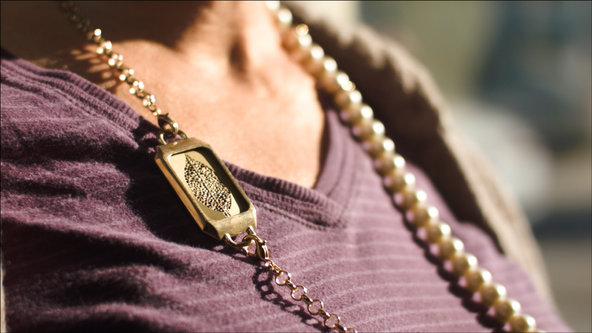
Cuff, the maker of fashionable wearable devices, is emphasizing personal security as one of their main uses. Cuff, the maker of fashionable wearable devices, is emphasizing personal security as one of their main uses.

21bits-cuff1-tmagArticle
There are two broad strains of wearable technology emerging: the doo-dads that proclaim their techiness from the wrists, faces and other body parts that they are fastened to, and those that try to conceal that quality.

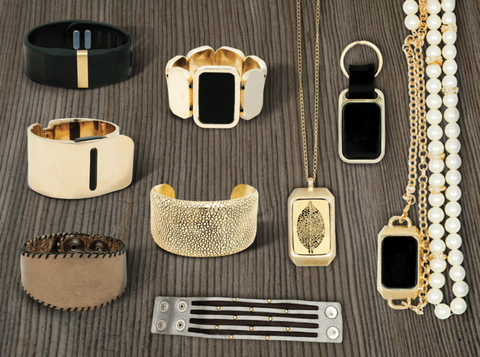
Cuff, a new wearable start-up in the San Francisco Bay Area, is making products firmly in the latter category. Earlier this week, the company unveiled a line of accessories that look more like the jewelry featured in an issue of Vogue, than hardware from the pages of Wired. There are bracelets made of leather and metal with names like The Lena, The Carin and The Mia, necklaces (The Lisa, The Soleil) and keychains (The J and The G).

These are not, in short, Google Glass or Samsung’s Galaxy Gear, the high-tech eyewear and smart wristwatch that telegraph their nerd cachet as if they were screaming it through a megaphone.

Cuff’s line of accessories, which range from $50 to $150, don’t try to do as much, technology wise, as those other wearables do. They act a bit like remote controls for the smartphones that they connect wirelessly to and on which they depend for access to the Internet. Initially the company is emphasizing personal security as one of the main uses of the devices, Cuff’s founder, Deepa Sood, said in an interview.
The technology inside Cuff’s line of accessories includes a battery that lasts a year so people don’t have to recharge them constantly. The technology inside Cuff’s line of accessories includes a battery that lasts a year so people don’t have to recharge them constantly.

21bits-cuff2-blog480

A woman who encounters a threatening situation on the street or elsewhere can press her finger to a Cuff bracelet on her wrist, which will then send an electronic distress signal to one or more people she has authorized through the Cuff app to receive those messages. The signal will reveal her physical location.

A senior citizen can do the same if they’ve fallen and can’t get up. A wearer of a Cuff accessory can program any number of other actions to occur on their smartphones — for instance, a tap of the wrist can send an automated message alerting family that the wearer is driving home. A text message or email from a spouse or parent can vibrate the accessory.

The technology inside the accessories includes a battery that lasts a year so people don’t have to recharge them constantly. There’s an accelerometer chip inside them which will allow Cuff to later turn on walking- and sleep-monitoring functions like those in the Jawbone Up, a bracelet that people use to keep track of their daily activity levels.

Underlying all of the Cuff accessories is a belief that there needs to be a higher fashion quotient to wearable technology if people, especially women, are to wear them, said Ms. Sood, who was previously the vice president of product development at Restoration Hardware, the furniture retailer.

“There’s this aesthetic vision that technology doesn’t have to scream technology,” said Ms. Sood, who has long made jewelry on her own. “That was super appealing to me.”

Urban Living

Urban exploration
Where were you while we were getting high?

Feb 18th 2014, 18:58 by N.D. | SHANGHAI

Vadim Makhorov and Vitaliy Raskalov took two hours to climb to the top of the 120 floor Shanghai Tower. On the 100th floor they pause to enjoy the view
PHOTOGRAPHS BY VADIM MAKHOROV AND VITALIY RASKALOV ©2014 ONTHEROOFS.COM

mow1

As daylight broke the view on one side of the building was still obscured by cloud. They decided to wait for the cloud to clear before climbing further, to get a real sense of the height

THE desire to illuminate the unknown has sent mankind to the globe’s extremities for millennia. For a new wave of adventurers, the urban landscape presents a novel frontier. On February 12th two urban explorers posted a video online of their 650m ascent to the top of the Shanghai Tower, the world’s second-tallest building. The climb, which involved shimmying along suspended poles and clawing up grates, was done without a rope or harness. Their bird’s-eye view over the city’s skyscrapers, now diminutive and poking out from clouds, is dizzying.

Vadim Makhorov, who is 24 and from Russia, and Vitaliy Raskalov, a 21-year-old Ukrainian, chose the calm of Chinese New Year’s day to attempt this feat. With faces obscured by scarves, they waited until midnight when security guards were, they hoped, nodding off. Then they hopped over the wall encircling the Shanghai Tower, which is still under construction, and climbed 120 floors in two hours. On a crane affixed to the top they spent a further 18 hours waiting for the clouds to retreat, taking photographs and napping. Their aim, says Mr Makhorov, is to show people the urban environment from an unfamiliar perspective. They do not wish to provoke authorities: “we simply explore the city from the inside”.

Cities have always lured explorers keen to scale their heights and plumb their depths. In 1793 Philibert Aspairt forayed into the catacombs in Paris, only to be found dead 11 years later. Walt Whitman, an American poet and another early urban explorer, called the abandoned Atlantic Avenue Tunnel in Brooklyn “a passage of Acheron-like solemnity and darkness”. In the 1950s the clandestine rooftop adventures on the campus of the Massachusetts Institute of Technology, an American university, became known as “place hacks”. (Later “hacking” would pass into technological vernacular.) With the introduction of the internet in the 1990s, urban exploration—or “urbex”—bloomed and divided into subcultures. Among them are rooftoppers, cataphiles, drainers and sky-walkers. There are perhaps 20,000 urbex hobbyists worldwide. Vibrant online forums, such as Urban Exploration Resource, allow users to collate information, swap tips and share “ruin porn”.

Messrs Makhorov and Raskalov, who use pseudonyms, are not the first foreigners drawn to Shanghai’s cluttered skyline. In 2007 Alain Robert, the self-anointed “French Spider-Man”, took 90 minutes to ascend and descend the exterior of the Jinmao Tower, the equivalent of 88 storeys, only to be detained at the bottom.

But the duo represents a new generation of sky-walkers from eastern Europe. Security in Russia is lax, says Mr Makhorov, which makes breaking and entering easier. The country’s array of dilapidated industrial sites presents ideal stomping ground. Meanwhile, social-media sites have nudged urbex into the mainstream. The Shanghai Tower YouTube video has been viewed more than 20m times. Messrs Makhorov and Raskalov can now fund their walks by selling photographs.

Critics see urban explorers as perilous, naïve, self-aggrandising (sky-walkers are fond of shots of their feet dangling over ledges) and even criminal. But while their exploits may be radical, they are not destructive. In “Access All Areas”, a definitive urbex text, Jeff Chapman writes that urban exploration should accord with the Sierra Club motto: “Take nothing but pictures, leave nothing but footprints”. Still, authorities do not always see the value. After Messrs Makhorov and Raskalov place-hacked the Giza pyramids, the pair was banned from returning to Egypt. Mr Raskalov can no longer enter Russia. Shanghai’s government has leaned on Russian diplomats to reveal their real names. There has been little else in the way of official response, save for a rather lacklustre tweet from Shanghai police urging others not to repeat the stunt, and warning construction-site bosses to “strengthen their management”.

Beyond the adrenaline rush that accompanies dodging security and the real physical danger involved, urban explorers describe a feeling of supreme freedom during walks. In urban centres, where governments track the online activities of citizens and CCTV cameras survey streets, theirs are acts of defiance. In his book “Explore Everything”, Bradley Garrett, a British scholar and urban explorer, puts it this way: “Wherever doors are closed, we will find a way through. Wherever history is buried, we will uncover it.”

Photographs of Mr Makhorov hanging off the Soviet star atop a Moscow State University building are poignant for the inherent anarchism. The Shanghai Tower’s tapering form is symbolic of China’s emergence as a global economic superpower. Urban exploration seeks to reclaim public space. In a country where the surveillance of society is especially pervasive, there are few locations more apt.

The Best Punctuation Mark?

WHAT IS THE BEST PUNCTUATION MARK?

The Big Question: no sentence is complete without one, yet they are often taken for granted. Julian Barnes, Claire Messud, Ali Smith and other writers pick their favourite. First, a very short history, by Rosie Blau

The question mark, said Gertrude Stein, is “positively revolting”. She thought the exclamation mark was “ugly” and “unnecessary” too. Cormac McCarthy shuns the semi-colon and quotation marks. At times James Joyce avoided even commas. Good prose is greeted with loud applause, but good punctuation draws attention to itself only when done badly, rather like goalkeeping.

In the beginning was the word, and each word was without spaces from one to the next. No wonder stone carvers didn’t write novels. A librarian at Alexandria in the third century BC is credited with being the first to use a system of high, intermediate and subordinate dots to instruct readers to pause and breathe—early punctuation was intended to help us with reading aloud; the silent reader came later. Much of it still does that job. Brackets are for a muttered aside; question marks denote inflection as much as interrogation. A few marks, the apostrophe and ampersand among them, stand in for something more long-winded.

Iron rules now govern the use of punctuation, but its early history was less regimented. Inverted commas, which started life in the second century BC in the margins of the text they referred to, took nearly two millennia to migrate to framing the speech they recorded. Though their function is now uniform across most languages, English, French and Chinese each use different symbols to signify the same thing. Some marks have largely died out, such as the pilcrow that once defined paragraphs within compact text. Others, like the interrobang, a 20th-century invention intended to convey a mixture of surprise and doubt, never found their way into the canon.

Arabic commas point the other way from English ones and are written on top of the line; the question mark faces the other way too, and is fatter than ours. Chinese uses a distinct pause mark for lists, a short backwards comma, and draws a full stop as a small circle. Where most tongues deposit a question or exclamation mark only at the end of a sentence, Spanish deploys them like bookends, so the clause begins with an upside-down one.

These strange little squiggles can provoke strong passions, as our six contributors show. With such a small pool to choose from, it is not their choices that are striking, so much as the reasons behind them. It would have been nice to hear a hymn of praise to every member of this select club. But even rhapsodies about punctuation must eventually come to a .

Making Texans Proud – Not

Panel: Cruz creating headaches for McConnell, GOP
Posted by
CNN’s Dennis Ting

(CNN) – Sen. Ted Cruz, R-Texas, is not making many friends in his own party after his latest attempt to block the Senate from raising the debt ceiling.

The Senate voted 67-31 Wednesday to break Cruz’s filibuster as a dozen Republicans crossed party lines to vote with the Democrats against Cruz.

“[Cruz] forced their votes but you have several senators who are in purple states where shutting down the government, where leading us to the brink of economic ruin is not playing well for them,” NPR correspondent Corey Dade said on CNN’s State of the Union. “They’re this close, they think, to retaking the Senate. They don’t want to toy with that.”

The bill was signed by President Barack Obama Saturday after passing through the Senate after a 55-43 vote that was strictly split on party lines, extending the debt ceiling through March 2015. The House, led by the GOP, passed the measure on a 221-201 vote. According to Treasury Secretary Jack Lew, the debt ceiling had to be raised by Feb. 27 or the government would default on its duties and shut down some of its programs.

Among the Republicans who joined the Democrats in voting down Cruz’s filibuster were Senate Minority Leader Mitch McConnell, R-Kentucky, and Sen. John Cornyn, R-Texas, both who are up for re-election.

“My job is to protect the country when I can and to step up and lead on those occasions when it’s required. That’s what I did,” McConnell said at a campaign event in Louisville. McConnell is facing a primary challenge in Kentucky against Matt Bevin.

Republican strategist Kevin Madden defended McConnell’s move, arguing that Cruz is not a typical Senator that can be easily reined in by the party leader.

“I think what’s interesting is that a lot of the usual tools you have at your disposal as a majority leader to punish somebody like Ted Cruz, they aren’t there because Ted Cruz does not care about moving up in the Senate,” Madden said, also appearing on CNN’s State of the Union. “He doesn’t care what his profile is with inside Washington.”

“They had to just go tell [Cruz] to go sit down,” Dade said. “I mean, they pulled rank on him, slapped him and said to go sit down.”

Madden also believes that while some might initially see McConnell’s vote as potentially damaging, the minority leader may be in a better position following the vote.

“I think back in Kentucky, Mitch McConnell isn’t in any worse off place than he was before this vote,” Madden said. “He has had votes for raising the debt limits before that conservatives back there who didn’t like him wanted to use it against him.”

“I talked to one really smart reporter up on Capitol Hill who covers the Senate who said, ‘Look, this was one of those cases where we skip to the last chapter. We ultimately knew that this was going to have to happen on the Senate side and it did. And I think that Mitch McConnell will take a little bit of a hit on the early side but he’s still in a much stronger position because we’ll have the debt ceiling showdown off the table.”

Margie Omero, a Democratic strategist, also agreed that perception of McConnell will most likely not change too much as a result of the vote.

“I think Mitch McConnell’s going to be seen as a political operator regardless of this,” Omero said on CNN’s State of the Union. “This was true before that vote; it’s going to be true after the vote. This is just another piece of evidence, but I think a lot of this is already baked in the cake for primary voters and we’ll see if Matt Bevin, his primary challenger, can use that to his advantage or not.”

While McConnell and other Republicans have shunted Cruz for his actions, some conservative activists are lauding him for taking a stand against the debt limit and looking forward to a possible presidential run in 2016.

Sen. John McCain, R-Arizona, who has heavily criticized Cruz in the past for his role in the government shutdown last fall, took a softer tone on Cruz when speaking to CNN’s Candy Crowley on State of the Union.

“I understand where Senator Cruz is coming from,” McCain said. “We have a cordial relationship, and I respect his right to do – exercise his rights as the United States senator, which he did last week, but I allege that there was no plan. There was no plan once we had taken the United States on the brink of this financial crisis that we were approaching. I appreciate our leadership voting the way that they did, even though they face primary oppositions, especially Senator McConnell, but [Cruz] exercises his rights.”

More on Mathematics – The Evolution of the Area Code

Our Numbered Days: The Evolution of the Area Code

Long-distance digits long ago shed their monetary worth, but they gained something else in its place: cultural value.
MEGAN GARBERFEB 13 2014, 1:43 PM ET

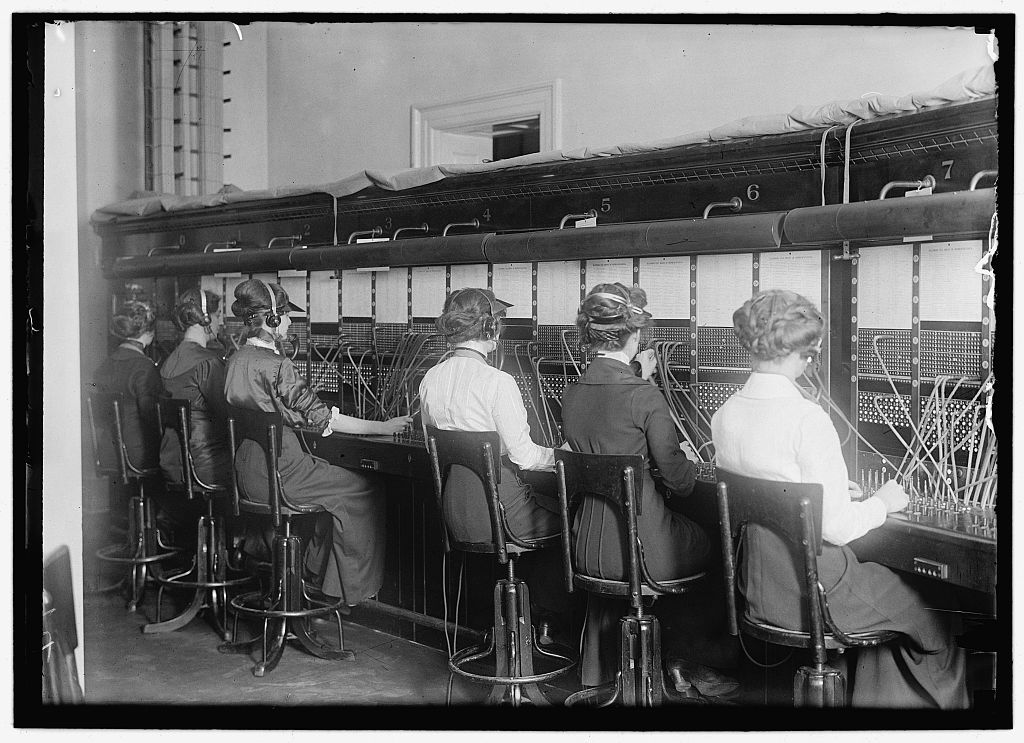
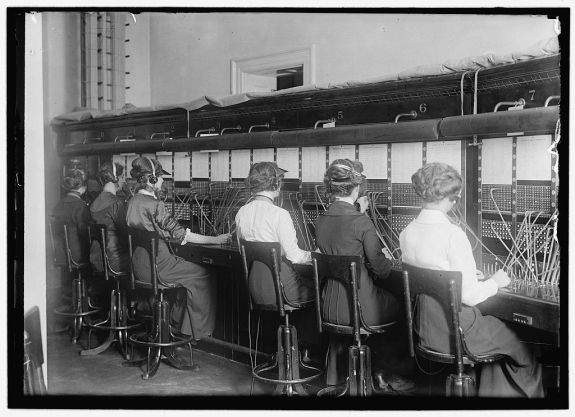
Women at work at the telephone switchboard, 1914 (Library of Congress)
In the mid-20th century, in response to the United States’ rapidly expanding telephone network, executives at the Bell System introduced a new way of dialing the phone. Until then, for the most part, it was human operators—mostly women—who had directed calls to their destinations.
04117v

Dialing systems had reflected this reliance on the vocal cord. Phone numbers weren’t numbers; they were alphanumeric addresses, named after phone exchanges that encompassed particular geographic areas. The Elizabeth Taylor movie Butterfield 8 gets its name from that system: The Butterfield exchange served the tony establishments of Manhattan’s Upper East Side. Lucy and Ricky Ricardo, should you have attempted to call their apartment, were apparently reachable with a request for “Murray Hill 5-9975.”

That system evolved, slowly. In 1955, AT&T—after it researched ways to minimize misunderstandings when it came to spoken phone directions—distributed a list of recommended exchange names featuring standardized abbreviations. (Butterfield 8 would become, under that system, BU-8; Murray Hill 5-9975 would have been shortened to MU 5-9975.) But engineers at Bell had been conducting their own research into the scalability of the name-and-number system. They had ambitions to expand the national phone network; their own research had concluded, among other things, that the country could not supply enough working women to meet its growing demand for human operators.

Automation, Bell concluded, would be the future of telephony. And “All-Number Calling”—no names, anymore, just digits—would be the way to get there.

I want to tell you about the controversy the Bell System’s embrace of numeracy provoked—how resentful some people became when their familiar method of making phone calls was taken from them. I want to tell you about why the change was necessary, and how it still informs our conception of phone calls and text messages. I want to tell you about the future of the phone number.

But first I want to tell you about the Central Coast of California.

You used to be able to access this sparkling little section of the country, over the phone, by dialing the 408 area code; in 1998, the area stretching south of San Jose, and on down the coast to King City, was split off. It all became, suddenly, 831.

California’s current code scheme (NANPA)
I grew up in Carmel, smack in the middle of the new code region; my first cell phone number—the only cell phone number I have ever had—bears that 831 preface. I have held on to those three digits through happily-multiple changes of location (New Jersey, New York, Boston, Washington) and through unhappily-multiple losses of handset. The powers that be—hardware salespeople, cell service representatives—have, at one time or another, tried to force me into a 609 and a 917 and a 617; each time, I have resisted. Because I am not, fundamentally, a 609 or a 917 or a 617. I am not even, my current residence notwithstanding, a 202. I am an 831, wherever I may be in body, and will remain an 831 until they pry those three otherwise totally meaningless digits out of my cold, dead iPhone.

I am not alone in this. As MIT Technology Review’s Brian Bergstein told me:

Of course we didn’t know it at the time, but now it seems that the atomization of area codes was a prelude to the microtargeting that fuels political campaigns and advertising: it refined our perceptions of who people are. When I grew up in the San Fernando Valley, it and all the rest of L.A. was 213. You had to travel a long way to get out of 213, which might have subtly enforced the fallacy that L.A. was actually a coherent city rather than a mere patchwork. Sure, there were always ZIP codes to differentiate fancy neighborhoods from nondescript ones, but a phone number was and is part of an introduction—it’s a calling card in itself, not merely numbers on your actual calling card. You give people your phone number if you like them, not your ZIP code.

So when the Valley became 818 when I was a kid, suddenly the Valley’s separateness became more tangible to me. We weren’t all in it together any more. If you gave someone your phone number you instantly revealed yourself as an other to someone from 213, which covered the side of the city that was cooler than the Valley and its cheesy suburban sprawl. My grandparents lived in 213 and consequently they suddenly seemed more urban to me. Even that image is outdated, though, now that L.A. has even more area codes. My grandparents’ old place has shifted from 213 to 310. The associated vibe is more specific: it’s “West side” rather than “more urban, more interesting half of town.”
Area codes, of course, weren’t always simply symbolic. When a “long-distance” call had a monetary value assigned to it, moving meant changing your phone number, almost by default: You couldn’t very well ask your new friends and acquaintances to pay long-distance fees each time they gave you a call. The rise of monthly cell service, with its flattening of the national phone grid, transformed the area code from an economic signal into a purely cultural one—and one that has the ever-more-rare virtue of connecting its owner to a physical place. You could liken an area code, now, to a sports team affiliation. Or to an alma mater. Or to an insistence that soda is properly known as “pop.”

“It feels to me a little bit like a screen name,” says Philip Lapsley, the author of Exploding the Phone: The Untold Story of the Teenagers and Outlaws Who Hacked Ma Bell. Long ago divested of its original role, the three-digit code now functions as a kind of shared social media handle, a collective identity. It’s no longer something to be remembered—we have our phones for that—but is instead something to be talked about. I meet someone at a party. We exchange numbers. “Oh, 510!” I might say. “I was in Oakland a few weeks ago!”

“And 831!” the new acquaintance might reply. “I love the Aquarium!”

***

We’d owe that conversation, in some part, to the Bell System. And to the 10-digit coding system the telecom giant introduced to, and on behalf of, the American public half a century ago. Which brings us back to 1962.

Bell had begun rolling out its numeric system, the North American Numbering Plan, a decade earlier. Recognizing that users of the phone system (as users of any technology are wont to do when transition comes along) would likely resist the change, the group did so slowly, and strategically. It built in long grace periods for people to accommodate themselves to the new numbers. It produced pamphlets methodically explaining the new system.

Still, people protested. In San Francisco, a group sprang up to battle Bell and its numbering scheme. The Anti-Digit Dialing League—consisting of thousands of members at its height, including the semanticist S.I. Hayakawa—decried Bell’s version of digital transition. The all-digit dialing system was evidence of “the cult of technology,” the League argued, not to mention that cult’s “creeping numeralism.” To make its point, the group published its own pamphlet—one that was aptly, if vaguely, titled Phones Are for People. “So far,” it noted, “17 million of the nation’s 77-million phones have lost their letters in favor of numbers. The time to reverse the trend is NOW.”

The League’s concerns weren’t merely humanistic. The 10-digit codes Bell was proposing for its system, the collective feared, would also make numbers too difficult for people to remember, encouraging dialing mistakes. Pragmatically and morally, the argument went, All-Number Calling was wrong. One of the League’s members, invoking one of the nation’s more patriotically named phone exchanges, got epic about it: “Give me Liberty,” he cried, “or take the blinking phone out.”

An ad for automation and its “secret service” (Wikimedia Commons)
The League took to an extreme the anxiety many Americans felt at the changes that Bell, the behemoth corporate interest, was imposing on their behalf. As John Brooks put it in his book Telephone: The First Hundred Years,

All-Number Calling—it is clear in hindsight—stood in the minds of many for the age of the impersonal, when people live in huge apartment buildings, travel on eight-lane highways and identify themselves in many places—bank, job, income tax return, credit agency—by numbers.
Those concerns feel familiar today, as we continue to navigate well-worn anxieties that pit human labor against automated, and things that are named against things that are numbered. Individual privacy was a concern even in those early days of telephony—one common argument against human phone operators being that automation would make surveillance of phone calls less likely. People feared, too, that phones would replace in-person interaction, that the new technology would compromise that precious, precarious thing we shorthand as “humanity.”

They didn’t fear that enough to stop Ma Bell, though. The Anti-Digit Dialing League, under the legal counsel of “King of Torts” Melvin Belli, won a brief restraining order against the phone company. It lost, however, pretty much everything else. By 1964, the defenders of the named phone exchanges had abandoned their defense. The nation and its citizens would be, from then on, identified by numbers alone.

***

Another thing that seems clear in hindsight: The massive corporation, in this case, was correct. From the earliest years of the telephony, advocates had called for an automated system of dialing—not just for reasons of privacy, but also for reasons of practicality. Human operators may have added that friendly touch, but they were relatively inefficient; automated labor, it was clear, would scale much more readily than its human-conducted counterpart.

Some trace the advent of the telephone number itself—the numeric aspects of the old alpha-numeric exchange addresses—to a measles outbreak that struck Lowell, Massachusetts, in the late 1870s. The doctor Moses Greeley Parker, a friend of Alexander Graham Bell and an investor in his then-fledgling phone company, noted that, if the town’s four phone operators ended up quarantined in the epidemic, finding and training replacements would be an almost insurmountable challenge. The system needed to minimize its reliance, he argued, on the vagaries of human memory.

People feared that phones would replace in-person interaction, compromising that precious, precarious thing we shorthand as “humanity.”
The North American Numbering Plan—the system of codes we still rely on, in augmented form, today—was a recognition of Parker’s argument. It was also, like so many other utilities we rely on for our everyday infrastructure, a corporate creation.

Engineers at Bell Labs designed the numbering scheme beginning in the early 1940s and working into the next decade. They took advantage, in that, of a supremely rare and an even more supremely geeky opportunity: to design a system, from scratch, that would ensure a maximum amount of efficiency for a maximum number of phone users. The area codes that lead our own phone numbers today—212, 202, 415—were direct results of their work.

They were also based on a particular type of hardware: rotary phones. To use those phones, you placed a finger in the hole of the number you intended to dial, then rotated the dial clockwise until you hit the phone’s finger stop. What this translated to, as far as the phone was concerned, was a series of clicks. Lower numbers on the phone, starting with 1, registered a lower number of clicks than the higher ones. What this translated to for the human user was less time required for dialing.

Flickr/janhendrik.caspers
The system Bell’s engineers devised married the hardware of the rotary phone to the machines that would provide the infrastructure for the nation’s expanding phone network. Computers, back then, were primitive. To ensure that area codes would be recognizable to the computers that were to translate the codes into geographical areas, the engineers created a system that placed either a 1 or a 0 as the second digit in each area code. (Those with 0 in the middle indicated states with only one area code—hence DC’s 202 and Florida’s 305—while those with a 1 denoted states with multiple codes.) The system meant that those early computers would be able to distinguish between a long-distance area code and a local number. Which meant in turn that they could route calls across the nation, to regions of the network and finally to local networks.

“The vine-like network of this community’s telephone plant will grow tomorrow like an atomic age descendant of Jack the Giant Killer’s beanstalk.”
When it came to creating the area codes for the country, the engineers also made their plans with maximum efficiencies in mind. New York, the most densely populated area of the nation, got 212—2-1-2 containing the lowest number of clicks possible on the rotary phone. Los Angeles got 213—the second-lowest—while Chicago got 312, and Detroit got 313. Anchorage, Alaska, on the other hand, got 907, which required 26 clicks from the person doing the dialing. To make the system even more efficient and human-confusion-proof, engineers also ensured that codes resembling each other (say, Oregon’s 503 and Florida’s 305) were distributed far apart from each other on the map.

The whole scheme “illustrates how smart the Bell engineers were back then,” Phil Lapsley points out. They were trying to design a system that was user-friendly—with the user, in this case, being the nation as a whole. They were also trying to design a system that would be, as much as possible, future-proof. There were, given the possible permutations of the rotary dial, 152 potential area codes. At first, only 86 of these were assigned. The engineers, in outfitting their new network, had given it room to grow.

***

The Bell System’s new codes were first introduced to the public in the early 1950s, as part of a larger push toward automated, or Direct Distance, dialing. Bell, true to form—and recognizing the semi-audacity of its new numbering scheme—rolled them out in a way that will feel familiar to any current user of Facebook or Twitter: through beta testing. The company chose, as area codes’ introduction city, Englewood, N.J., which was conveniently located near Bell Labs and featured, as a bonus, switch equipment that was easily adapted to automation.

From there, it proceeded cautiously, and strategically. Once the company had chosen Englewood as its test city, it began a long public-education campaign in the area, explaining—through newspaper articles and pamphlets and movie shorts—how to use the new dialing system. “To reach a distance telephone,” read a guide distributed in Englewood, “all you need do is first dial the Area Code, and then the desired telephone number. Be sure to enter the Area Code for distant points in the address book with the telephone number.”

On November 10, 1951, the official rollout of area codes took place. With 100 guests watching, Englewood Mayor M. Leslie Denning dialed a number: 415-LA-3-9727. Exactly 17 seconds later, Denning’s call was picked up by Frank Osborn, the mayor of Alameda, California. Bell engineers called the cross-continental and intramayoral conversation a “historic first in communications.” And newspapers, for their part, were even more jubilant about the proceedings. As The New York Times put it in an article announcing the Englewood test-call, “the vine-like network of this small community’s telephone plant will grow tomorrow like an atomic age descendant of Jack the Giant Killer’s beanstalk.”

***

As the network grew, it also became more complex. Splits and overlays of area codes, especially as the population of phone users grew in the 1980s and 1990s, became common. Lapsley points out that, when codes split—as 408 did in 1998, leading to 831—there can be resentment and even anger associated with the division. As the communications scholar James Katz told Gene Weingarten in 1998: “When we are assigned an area code we do not like, it feels like a loss of place or position in society. It is one means of alienation. We are losing our sense of place.”

And those lucky few who get to keep their sense of place get to gloat about it. New York’s 212 (as opposed to 917 and 718) is now a sought-after commodity; so is 415 (versus 510 for the East Bay and 925 for the East-East Bay). Pitbull brags about being not just “Mr. Worldwide,” but also “Mr. 305.” Vermont’s 802 code, for its part, has become a kind of regional meme. “Someone asked me recently if it’s a pot reference,” one seller of 802-branded t-shirts noted.

***

So who has control over the numbering system today? That honor belongs, officially, to a 12-person team working out of an office in Sterling, Virginia: the current administrators of the North American Numbering Plan. For a brief period in the 1990s, it was Lockheed Martin that oversaw that administration; after Lockheed got involved with telecom concerns, however, the FCC decided that it needed a neutral and non-governmental body to administer the nation’s numbers. Lockheed’s numbering division divested itself and became Neustar, which remains under contract with the FCC.

Any changes made to the existing system are “going to include the numbers that we have today.”
John Manning is the Senior Director of NANPA at Neustar, overseeing the nation’s numbering system on behalf of the FCC and the rest of us. He spends a lot of time thinking about phones and phone numbers. He also spends a lot of time thinking about the future of telephony—which includes, of course, the Internet. “The Internet offers up a lot of opportunities, but it also opens up a lot of issues that aren’t necessarily there today,” Manning told me. There are, for one thing, security concerns to think about—ensuring that numbers dialed over VOIP, for example, get properly routed to their intended destinations.

There are also resource concerns: As individuals, we’re getting, what with Skype and Google Voice and their many equivalents, more and more phone numbers. And the 10-digit numbering system currently in use throughout the U.S., Canada, and U.S. territories is, Manning points out, “a finite resource.” He doesn’t see that deci-digital system changing anytime soon: Like the Bell employees of the last century, Manning appreciates the power of user habit when it comes to our technological infrastructure. NANPA, he points out, takes pains to make transitions like area code splits and overlays as seamless as possible for those affected by them.

At the same time, he recognizes that the Internet has changed how we communicate—with our voices and with so much else. So while the priority, he says, “is to keep the 10-digit numbering plan for as long as possible,” it remains a question how long, exactly, that will remain possible. Some have speculated that the current numbering plan will remain sustainable only until 2038—at which point NANPA may need to add one or two digits to each phone number. The codes that have become so familiar to us—so meaningful to us—may change. Not completely, but a little bit. The history of commercial telephony, Manning points out—from those public switchboards to VOIP—has been “a continuum.” Any changes made to the existing system, he says, are “going to include the numbers that we have today.” They may simply be expanded versions of the plan that those Bell engineers laid out last century. As Manning puts it: “We have to make sure that we can continue the evolution.”
Making Mathematics Fun

Wildly detailed drawings that combine math and butterflies

By Liz Stinson, Wired
updated 7:09 AM EST, Mon February 10, 2014
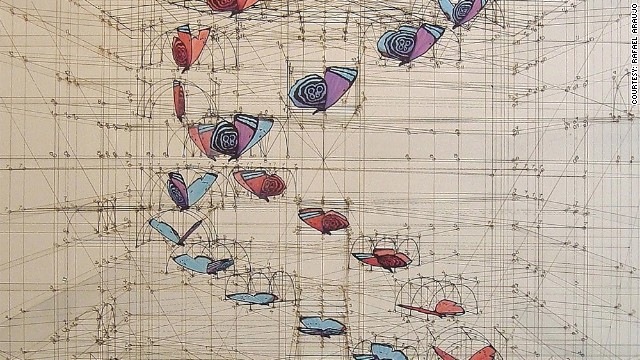
Rafael Araujo creates hyper-detailed drawings of nature using principles of geometry. Rafael Araujo creates hyper-detailed drawings of nature using principles of geometry.

STORY HIGHLIGHTS
Rafael Araujo creates stunning geometrical illustrations
He uses trigonometry and dot sequences to create da Vinci-esque drawings
Each illustration takes him more than 100 hours to complete
(Wired) — Rafael Araujo’s illustrations are bewilderingly complex – so complex that you might assume the artist uses a computer to render the exacting angles and three-dimensional illusions. And true, if you were to recreate his intricate mathematical illustrations using software, it probably wouldn’t take you long at all. But the craziest part of all is that Araujo doesn’t use modern technology to create his intricately drawn Calculations series – unless, of course, you count a ruler and protractor.
Read more: Mind-blowing portraits made of test tubes and pushpins
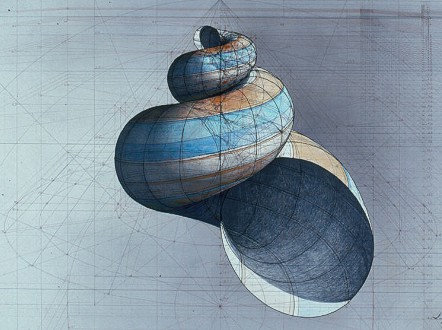
The Venezuelan artist crafts his illustrations using same skills you and I learned in our 10th grade geometry class. Only instead of stashing those homework assignments deep into the locker of his brain, Araujo uses these concepts to create his da Vinci-esque drawings. In Araujo’s work, butterflies take flight amidst a web of lines and helixes, a shell is born from a conical spiral, and the mathematical complexity of nature begins to make sense.

Rafael Araujo creates remarkable drawings, like this shell, using principles of geometgry.COURTESY

Wildly Detailed Drawings That Combine Math and Butterflies

He says perspective and angles have always come naturally to him. “When I was young I began drawing perspective almost out of the blue,” he recalls. “I loved three-dimensional drawings and liked to find out ways to locate dots in the space.” Before computer-assisted drawing, there were artists like M.C. Escher, who Araujo counts among his biggest influences. “When I first saw M.C. Escher, I was speechless,” he says. “His artwork was so akin to my geometrical taste.”

140206111850-rafael-araujo-1-horizontal-gallery

Working on an old drafting table, Araujo began drawing his own perspective illustrations, eyeballing the trigonometry to plot dot sequences that would allow him to create curved shapes like double helixes and cones. If you look closely at Araujo’s drawings, you’ll notice each of the main shapes sits within a line-drawn square or rectangle – he began adding this to his works after realizing these scaffolding boxes created a more reliable way to correctly position the dots. “There is naturally a learning curve,” he says. “And as problems are solved, you become more adept and, again, daring.”
Painting is very similar to cooking. You’ve got to be always careful!
Rafael Araujo
As Araujo became more confident in his skills, he began adding ink-drawn butterflies, insects and shells to the canvas and painting them with acrylic in order to add visual complexity to his work. Each illustration takes him upwards of 100 hours, and that’s if he doesn’t mess up. “Painting is very similar to cooking,” he says. “You’ve got to be always careful!”

140206112914-rafael-araujo5-entertain-feature

Even with the added embellishments, his work is restrained and exacting. But that scientific honesty is also what makes his illustrations so visually compelling. Scientists and mathematicians often say there’s a comfort in their work because they know there’s always a right and wrong answer. It’s the same with Araujo’s art.
There’s little gray area to be debated when it comes to angles and lines, and somehow that reliability and predictability translates into something beautiful. “I love Pollock, and enjoy very much casting paint onto a canvas without rules,” he says. “But you’ve got to make it to appear, if not “beautiful,” well done, and that is difficult.”
Read more from WIRED:

The Horrible American Diet

The Standard American Diet in 3 Simple Charts
—By Tom Philpott| Mon Jan. 20, 2014 2:55 AM GMT
147

Paola Conzonetta/Shutterstock
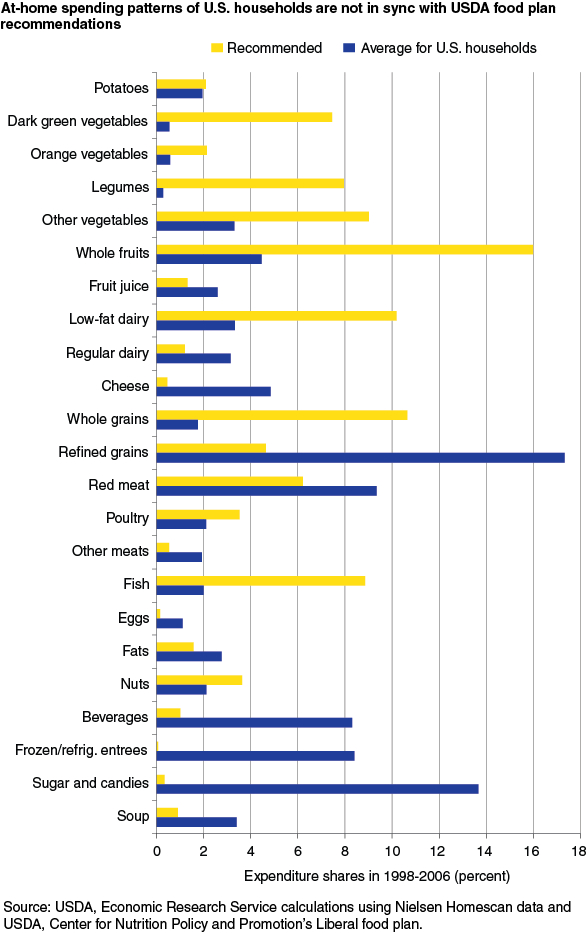
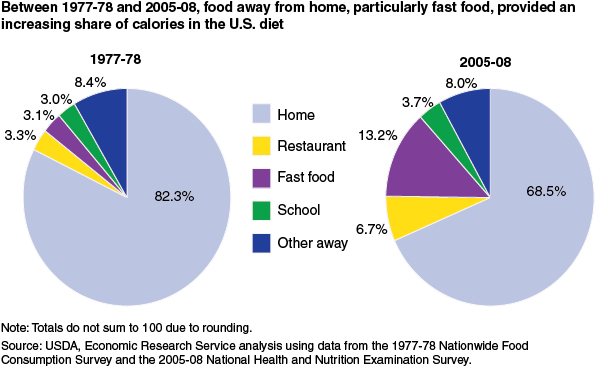
US obesity and diabetes rates are among the globe’s very highest. Why? On her blog, the NYU nutritionist and food-politics expert Marion Nestle recently pointed (hat-tip, RealFood.org) to this telling chart on how we spend our grocery money, from the USDA’s Amber Waves publication:

fast-foods-630

So, we do a pretty good job eating enough potatoes. But the healthier, more brightly colored vegetables like kale and carrots, no so much. We spend four times the amount on refined grains the USDA thinks is proper, and about a fifth of the target expenditure in whole grains. We spend nearly 14 percent of our at-home food budgets on sugar and candies, and another 8 percent on premade frozen and fridge entrees. Whole fruit barley accounts for less than 5 percent of our grocery bill. And so on—a pretty dismal picture.

USDAchart1

That chart deals with at-home expenditures. What about our food choices out in the world? The USDA article has more. This chart shows that we’re getting more and more of our sustenance outside of our own kitchens:

USDA chart2

And while the article doesn’t offer comparable data to the above at-home chart about expenditures outside the home, it does deliver evidence that our eating out habits are pretty dire as well:

Why do we eat such crap food? The USDA throws up its hands: “Despite the benefits to overall diet quality,” the report states, “it can be difficult to convince consumers to change food preferences.”

But it never pauses top consider the food industry’s vast marketing budget. According to Yale’s Rudd Center, the US fast-food chains like McDonalds, Wendy’s, and Burger King spent $4.6 billion on advertising in 2012. “For context,” Rudd reports, “the biggest advertiser, McDonald’s, spent 2.7 times as much to advertise its products ($972 million) as all fruit, vegetable, bottled water, and milk advertisers combined ($367 million).” I can’t find numbers for the marketing budgets for the gigantic food companies that stock the middle shelves of supermarkets; but according to Advertising Age, Kraft alone spent $683 million on US advertising in 2012.

By contrast, Center for Nutrition Policy and Promotion, the USDA’s sub-agency that “works to improve the health and well-being of Americans by developing and promoting dietary guidance that links scientific research to the nutrition needs of consumers,” had a proposed budget of $8.7 million in 2013.

147

Chinese Stealing Again?

The Case of the Missing Corn Seeds

KANSAS CITY, Mo. — The case of the missing corn seeds first broke in May 2011 when a manager at a DuPont research farm in east-central Iowa noticed a man on his knees, digging up the field. When confronted, the man, Mo Hailong, who was with his colleague Wang Lei, appeared flushed. Mr. Mo told the manager that he worked for the University of Iowa and was traveling to a conference nearby. When the manager paused to answer his cellphone, the two men sped off in a car, racing through a ditch to get away, federal authorities said.

What ensued was about a year of F.B.I. surveillance of Mr. Mo and his associates, all but one of whom worked for the Beijing Dabeinong Technology Group or its subsidiary Kings Nower Seed. The result was the arrest of Mr. Mo last December and the indictment of five other Chinese citizens on charges of stealing trade secrets in what the authorities and agriculture experts have called an unusual and brazen scheme to undercut expensive, time-consuming research.

China has long been implicated in economic espionage efforts involving aviation technology, paint formulas and financial data. Chinese knockoffs of fashion accessories have long held a place in the mainstream. But the case of Mr. Mo, and a separate one in Kansas last year suggest that the agriculture sector is becoming a greater target, something that industry analysts fear could hurt the competitive advantage of farmers and big agriculture alike.

The agricultural scientists are accused of giving proprietary rice seeds that contained medicinal qualities to crop researchers in their native China. Left, Wyandotte County Detention Center, via Reuters; Pulaski County Sheriff’s Office, via Reuters
“Agriculture is an emerging trend that we’re seeing,” said Robert Anderson Jr., assistant director of counterintelligence at the F.B.I., adding that the trend has developed internationally in the last two years. “It’s pretty clear cut. Before then, the majority of the countries and hostile intelligence services within those countries were stealing the other stuff.”

The defendants in the Mo case visited numerous seed testing fields in Iowa and Illinois that were used by the big agriculture companies Pioneer, Monsanto and LG Seeds, the authorities said. They bought a test plot of their own in Illinois, according to the complaint, and concealed stolen seeds in, among other things, microwave popcorn boxes and napkins from Subway restaurants.

The seeds that they were after are called inbreds, meaning they come from self-pollinating corn plants. Inbreds are eventually crossed with other inbreds to create hybrid seeds that are then sold to farmers, and they are bred to be durable in the face of drought and pests. One inbred line takes five to eight years of research and can cost $30 million to $40 million to develop, federal prosecutors said.

A company or farmer can replant a stolen inbred seed and eventually use the new seeds to cross with a separate inbred to produce a hybrid — a shortcut that avoids years of costly research.

“These are quite brazen facts,” said Jay P. Kesan, a professor at the University of Illinois who specializes in intellectual property and technology law. “What makes this different, I guess, is really the extent to which these entities seem to have gone to try to get at these trade secrets.”

Mr. Mo, 44, was arrested at his home in Boca Raton, Fl., but the other defendants are not in custody, and the authorities have declined to comment on their status. Mr. Mo’s lawyer denies that his client, a seed dealer and permanent resident who he said moved to the United States 15 years ago, did anything wrong. Mr. Mo, who was arraigned last Wednesday in Des Moines and pleaded not guilty, remains in custody.

In the other seed case, Zhang Weiqiang, of Manhattan, Kan., a rice breeder for Ventria Bioscience, a Colorado-based biopharmaceutical company, and Yan Wengui, of Stuttgart, Ark., a research geneticist for the federal Agriculture Department, are accused of giving proprietary rice seeds that contained medicinal qualities to crop researchers in their native China.

In 2012, Mr. Zhang, 47, a permanent resident, and Mr. Yan, 63, a naturalized citizen, both made trips to China, where the authorities said they discussed research they had performed in the United States with Chinese scientists. The men then arranged for a group from the Chinese Academy of Agricultural Science and the Crop Research Institute in China to travel to the United States last year. They brought the group to the Ventria facility in Kansas where Mr. Zhang worked and to his home, and to the federal agriculture facility in Arkansas where Mr. Yan worked.

The proprietary rice seeds were found in the luggage of members of the Chinese delegation as they tried to leave the country, according to the indictment, and at the home of Mr. Zhang, who, along with Mr. Yan, was arrested in December.

As seed technology has become more costly and time consuming to develop, “in some people’s eyes, it makes it more advantageous for them” to try to steal it because it “enables them to get a jump on three to five years of research on the back of somebody else’s time and effort that was put in,” said Andrew W. LaVigne, the president and chief executive of the American Seed Trade Association.

American farmers are concerned that stolen seeds could give their Chinese counterparts an unfair advantage because they could get access to the technologically advanced hybrids at lower prices, said Dave Miller, the research director for the Iowa Farm Bureau.

Foreign vegetable seeds make up 80 percent of the Chinese market, said Guo Ming, a consultant specializing in corn breeds for a Beijing-based agribusiness firm. Multinational corporations’ share of the corn seed market in China grew from a tenth of a percent just over a decade ago to 11 percent in 2011, according to an article published last year in People’s Daily, the Communist Party’s official newspaper. Although China’s domestic corn output has been growing over the years, the yield per corn plant has not grown significantly.

The Chinese have not developed a major corn hybrid since 2001, though the country’s second most popular corn, which debuted in 2007, was a collaboration between Pioneer and a Chinese company.

Analysts say one of the major problems is the fragmented seed industry in China. Much of the breeding research is done in state-funded universities and academies, and there is poor communication between them and the companies that sell and trade the seeds. So research often fails to yield strong commercial results. This structure also has fostered theft within the Chinese seed market, Ms. Guo. the breeding consultant, said.

“Some seed trading companies just went to breeding bases to steal the seeds,” she said. “Some breeding companies would outsource breeding to farmers, but when the seeds were harvested, the farmers wouldn’t sell back to the breeding company because seed trading companies pay more.”

Those trading companies would then sell the seeds at a premium, Ms. Guo continued, making an exorbitant profit on a product that cost them nothing to develop.

“That’s the ethos here,” she said.

That attitude, some say, could mean that the Chinese have long been stealing from American seed companies without getting caught. As the Chinese government encourages more innovation from seed producers, the desire to steal plant technology could grow.

“These varieties that Pioneer has, have shown to be better than the best varieties they’ve got in China,” said Carl E. Pray, a professor of agriculture, food and resource economics at Rutgers. “If they’re going to compete with multinationals, even in China, they need to get access to the basic material that multinationals are using.”

John Eligon reported from Kansas City, and Patrick Zuo from Beijing.