Great News for Womens’ Cycling

A.S.O announce women’s race at 2014 Tour de France

Amaury Sport Organisation have announced that a women’s race will take place at this year’s Tour de France. “La Course by Le Tour de France” will take place on 27th July on the Champs-Elysées in Paris. The event is destined to become an iconic race in the women’s calendar. Further details of the race and its format will be unveiled at an official launch in the spring.
For a number of months Le Tour Entier (LTE), on behalf of women’s cycling, has been working alongside ASO on plans for a women’s race at the Tour de France, beginning in 2014.

The move for a women’s race follows the launch of LTE’s manifesto for women’s cycling in September. This included a campaign for a women’s race at the Tour de France, which has generated over 95,000 online signatures.

One of LTE’s founders and current Olympic and world road champion Marianne Vos stated; “I am thrilled that A.S.O will be launching La Course at this year’s Tour de France and I am very excited to be competing in the event. This announcement marks a significant and groundbreaking moment for our sport. Le Tour is the pinnacle of professional cycling and this race is the start of an exciting new time for women’s cycling. To know that A.S.O are so committed to innovating and developing our sport is fantastic. I have no doubt that this race will help change the face of women’s cycling.”

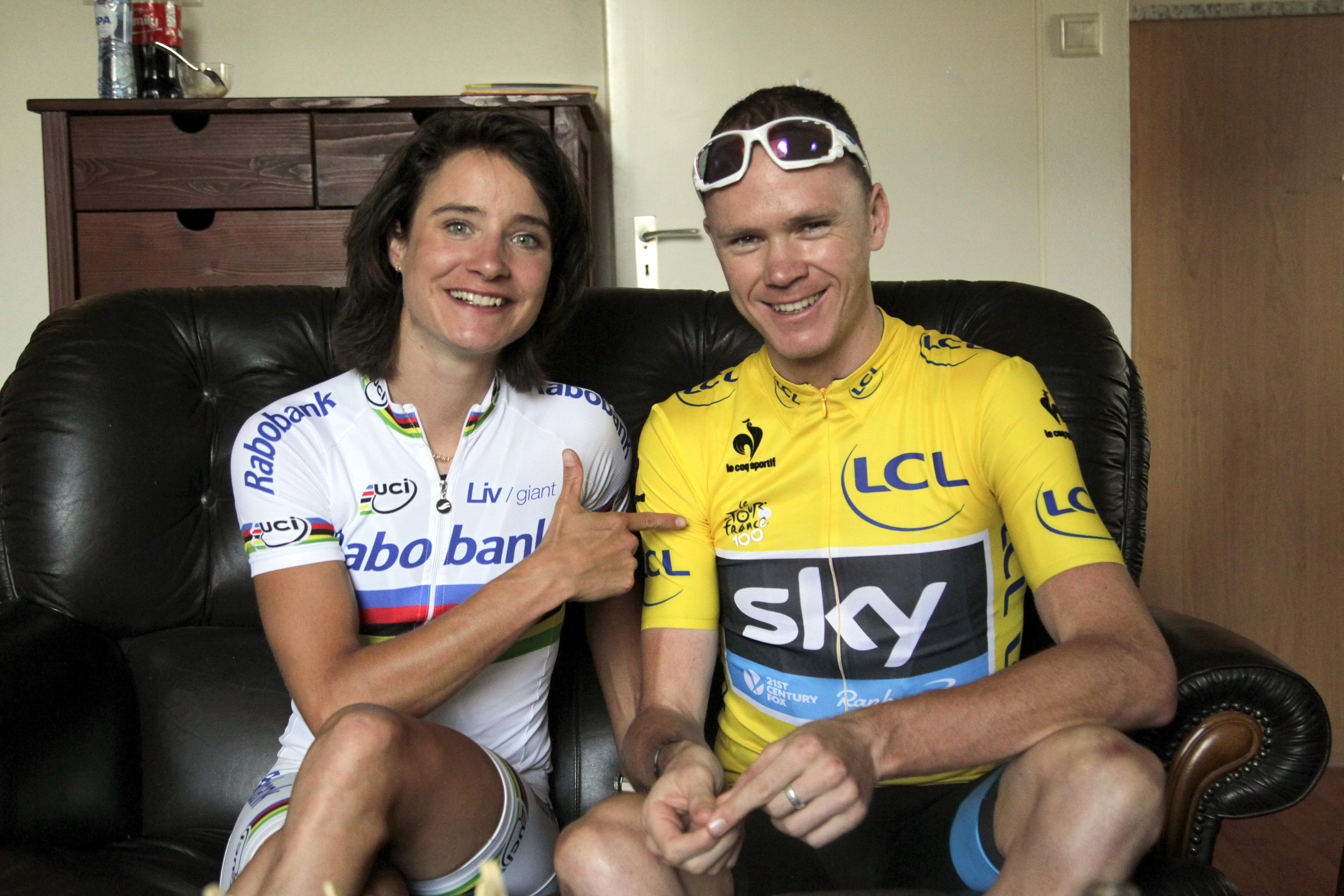
Marianne Vos with Tour de France champion Chris Froome
_AHV3470_001

Another LTE founder, four-time world ironman champion Chrissie Wellington added; “For A.S.O to organise a women’s race is like a dream come true and marks the beginning of an exciting new future for women’s cycling and women’s sport more generally. Female athletes need high profile stages on which to compete, with the associated media coverage and sponsorship, to truly enable them to shine. This race will provide that, and give women’s cycling the huge platform it needs to grow and develop, not to mention helping to encourage everyone to get on their bikes and take to the roads and trails on two wheels. It’s been an absolute honour to work with A.S.O, and all the other members of the LTE team, to develop the race and I am beyond excited that all our dreams are becoming a reality!”

The women’s race is a further step towards building a sport with greater consumer, media and commercial appeal. Racing in front of millions to a global television audience is an exciting prospect for pro riders, such as LTE co-founder and Olympic silver medalist Emma Pooley; “It’s wonderful news that A.S.O have launched La Course by Le Tour de France in 2014. As a rider, it’s a great opportunity to be involved with the greatest cycling event in the world and I’m looking forward to the race already.”

Pooley, who is also part of the UCI Women’s commission to improve women’s cycling around the world added; “It’s also a tribute to the many cycling fans who want to see more high-level women’s racing, and who supported us in Le Tour Entier. It’s fantastic that A.S.O have recognised the demand and potential for a fantastic race and are leading the way in a new era of growth in women’s road racing.”

Le Tour Entier founders Kathryn Bertine, Marianne Vos, Emma Pooley & Chrissie Wellington.

FINAL2

LTE co-founder Kathryn Bertine, three-time national champion of St. Kitts and Nevis, U.S. based pro cyclist and documentary filmmaker of “Half The Road” began the movement for a women’s Tour de France in an effort to bring parity to cycling. The mission, which she started in 2009, has now come full circle; “The arrival of a women’s race at the Tour de France goes far beyond a bike race”, she stated. “It will impact the cycling federations of every nation, paving the way to achieve parity in all countries. In the U.S., we still need women’s fields at the Tour of California, The U.S. Pro Challenge and the Tour of Utah. Now, those barriers will be easier to overcome with Le Tour de France setting an example.”

She added; “It’s also huge for smaller, developing nations. This iconic race has the ability to reach and cross cultural boundaries, showing young women across the world what is possible to achieve with their lives. We are absolutely thrilled A.S.O is innovating more opportunities for women’s cycling and will be at the very forefront of this much needed change.”


Thoughts on Life in Denver Colorado

What Denver Can Teach The World About Living Well
Posted: 02/01/2014 10:39 am EST | Updated: 02/01/2014 10:59 am EST

Our Living Well, On Location series explores cities and countries from around the world. How do other people pursue health and happiness? We’re going coast to coast, country to country to find out.

n-DENVER-SUNNY-large570

While the Denver Broncos battle the Seattle Seahawks for Super Bowl supremacy, we started thinking about other ways to measure each city’s greatness. Football team aside, Denverites have quite a few things to be smug about, especially when it comes to city residents’ health and well-being.

It may explain why everyone seems to want to move there. Denver is experiencing a boom lately. The city is the second-fastest growing in the country, with a 5 percent population growth between 2010 and 2012 alone. What’s more, the downtown area is particularly primed, growing at five times the national rate.

It’s enough to make even the most football-averse among us bow down…

It’s always sunny in Denver

o-FAMILY-PARK-570

Thanks to Denver’s position on the high plains beneath the Rocky Mountains, the town’s got a pretty ideal climate with low humidity, moderate temperatures and an average 300 sunny days a year.

Sure this claim, a stalwart of Colorado’s Chamber of Commerce is more poetic than meteorologically accurate, but it also isn’t too far off: According to the Colorado Climate Center at Colorado State University, there are about 300 days a year with at least one hour of sun — and only 30-40 days a year in which the sky is totally overcast.

Too much sun exposure is a health hazard. But the truth is that sunlight is a boon for a city’s well-being by several measures.

Denver residents stay active

By nearly every measure of physical activity, Denver meets or exceeds the mark: More Denver residents are at least moderately physically active than the national average and nearly 80 percent of residents report a tough workout within the preceding 30 days.

All this activity could be thanks to the myriad of public options available to Denver residents, including more baseball diamonds, playgrounds, parks, tennis courts and recreational centers per capita than a target set by the American College of Sports Medicine.

Overall quality of life is some of the best in the country

According to a Portfolio.com-led study, the Denver metropolitan area ranks in the top 10 in the country for quality of life, thanks to a confluence of very comfortable qualities, such as good housing options and low mortgage rates and rent prices, a high percentage of college grads, low unemployment and decent commute times.

Denver is green

Denver is among the greenest cities in the U.S. and Canada, thanks to good and improving air quality, investment in green technology and municipal initiatives.

And that isn’t just good for the environment: Green cities are good for economic development and social well-being as well, according to a Danish study. That’s because good, clean infrastructure and landscape attracts more business, more active residents and an overall greater participation in the community.

Denver is a beer town

Veronica Bechtold

Denver might be going to the Super Bowl this year, but every year they host the “Super Bowl of beers” in the form of the Great American Beer Festival.

Yes, the recent legalization of marijuana means that Denverites are more able to pick their poison than many other cities’ residents. But beer is still the drug of choice in Denver, with more beer brewed in its limits than any other American city.

And beer, when consumed in moderation, can be very good for your health thanks to its richness in vitamins, minerals and antioxidants.

Denver: 1, obesity: 0

Colorado has one of the lowest obesity rates in the country — along with low rates of inactivity and diabetes, two problems associated with a high BMI. And the state trend is no exception in the city: Denverites tend to have healthy weights, perhaps thanks to an extensive and well-funded parks system, and few suffer from associated conditions like diabetes and heart disease.

The nature scene makes you outdoorsy upon arrival

denver sunny

It can only be good for the mind, body and spirit that the most breathtaking nature in the world is in Denver’s backyard. Vail is a mere hour away and Rocky Mountain trails lead are close at hand. The city’s park system is also the envy of other American cities, thanks to 6,200 acres of parkland, 29 recreation centers and 309 athletic fields.

All that green space can only be a good thing for public health: Not only is nature an instant mood-booster, parks also improve community ties by fostering relationships between city residents. They also enhance residents’ physical fitness by providing free, accessible places to exercise. What’s more, parks help mitigate urban pollution, according to the American Planning Association.

From Denver? Tell us what we missed in the comments.

Should We be Thinking About This in the United States?

Political Science blog badge
Why we should opt out of the Government’s new patient database

The announcement of the NHS care.data scheme has attracted criticism from scientists, doctors and interest groups. With good reason, argues Edward Hockings. More than just a matter of privacy, by opting out of care.data we are exercising our right to democracy.

Edward Hockings
theguardian.com, Friday 31 January 2014 11.49 EST

Can the Government take care of our personal health data? Can the Government take care of our personal health data? Photograph: AW/Alamy

AKKA6W Stethoscope lying on a white keyboard on a white desk

We have until March to opt out of the care.data initiative. The ‘theoretical risk’ that we might be re-identified from our personal data once it is made available to third parties is a compelling reason to opt-out. However, this is not the only reason. Care.data is part of a major legislative programme that includes the Clinical Research Practice Datalink (CRPD) and the 100,000 genome project – through which whole-sequenced genomes will be put to commercial use. These major infrastructural developments have been accompanied by radical changes to privacy law that have resulted in a cultural shift in the governance of information.

These sweeping changes in privacy law were introduced without consultation, and the risks they entail will be borne by those whose medical records may be accessed without their consent. How did we get to this point? Fourteen years ago, written evidence by SmithKline Beecham to the Select Committee on Health, House of Commons, advanced the view that the “NHS represents a singular but under-utilised resource for population genetics, and healthcare informatics more generally.”

In 2007, further written evidence to the Select Committee on Health, House of Lords, by the Association of the British Pharmaceutical Industry, stated that “there is an international race for benefit and competitive advantage in research where the UK could have a significant Unique Selling Point (USP).” By 2008, a major legislative programme to secure this competitive advantage was well underway. As part of the NHS National IT Programme, electronic medical records were rolled-out across England and Wales on an opt-out basis. Although parts of the NHS National IT Programme were discontinued, the ambition – to quote from the ‘Plan for Growth’ 2012 – of “using e-health record data to create a unique position for the UK in health research” remained unchanged. The Clinical Practice Research Datalink (CPRD), which provides data services to the research and life sciences communities, was established in 2008. And in the summer of 2012, and in response to a Freedom of Information request, the Department of Health confirmed that they are to establish a “central repository for storing genomic and genetic data and relevant phenotypic data from patients”. Further correspondence led to a clear statement of the government’s position with respect to the uses of the whole-sequenced genomes held on the national repository: “we plan to capitalise on the UK’s strengths in genomics. The UK is well placed to play a world-leading role in this next phase of the biomedical revolution.” One of the “purposes of the initiative is to support the growth of UK genomics and bioinformatics companies.” Later that year, the government announced that the genomes of 100,000 people were to be sequenced over the course of three to five years. ‘Genomics England’, launched by the Department of Health, in 2013, was to oversee the sequencing of the personal genomes and the creation of a dataset of “whole genome sequences, matched with clinical data” – “at a scale unique in the world.”In addition to these developments, radical changes to information governance, such as Section 251 of the NHS Social Care Act (2006), were introduced. Overriding the common law of confidentiality and Article 8 of the Human Rights Act (2008), Section 251 makes it possible to access people’s medical records without their consent. An equally significant development was the introduction of the Health & Social Care Act 2012, through which Patient-identifiable data can be made available, via the NHS Commissioning Board and the HSCIC. So we now have care.data, and the decision we face about whether or not to opt-out.

Focusing initially on rare inherited diseases, the 100,000 genome project began the first phase of sequencing in Dec, 2013. The role of the recently established ‘Ethics Advisory Group’ is to provide the ethical guidance, and it acknowledges that “irreversible de-identification of whole genome sequence cannot be fully guaranteed for technical reasons”. In respect of limiting the kind of research conducted on the repository data, the Ethics Advisory Group claims that “it would be impractical for it to be possible for patients to place restrictions on the research undertaken on the data, for example by limiting it to ‘non-commercial research.’” As the current legal framework provides no determinate guidance regarding what are acceptable uses of whole-sequenced genomes, the ball really is in the Ethics Advisory Group’s court.

Following a request from the Secretary of State for Health, a major independent review of information sharing was launched, called Caldicott2. Through democratic consultation with all relevant stakeholders, Caldicott2 might have provided a timely, non-partisan assessment of the information governance regime. However, prior to the publication of the Caldicott2 recommendations in March 2013, the government’s ‘Strategy for UK life sciences 2012’ had already made it clear that it would move to “a more progressive regulatory environment.” Caldicott2 was therefore never going to be able to meet its aspirations to give the public a stake in deciding whether or not information would be shared.

As the Caldicott2 report claims that “genetic information should not be treated any differently from other forms of information”, can we expect a laissez-faire approach to whole sequenced genomes?

By choosing to opt out we are making an appeal to our right to democracy. We will soon face a scenario in which medical records will be linked to the whole-sequenced genomes of the population of England and Wales. The sheer scale only augments the associated risks, and when commercialisation appears to be the driving force, we find ourselves in uncharted territory. Therefore, it is more than just opting-out, but rather, taking a stand on what kind of society we want in the future.

Edward Hockings is a PhD student in bioethics at the University of the West of Scotland.

More Grist for the Tax Debate Mill

Bribing the taxpayer
Wasteful tax perks are sadly common

Jan 25th 2014 | From the print edition

ANY talk of tax reform in America quickly turns to “tax expenditures”, meaning the code’s myriad exemptions, deductions and credits. These now cost 7% of GDP. Economists deride many of them as handouts for influential firms and middle-class voters. But for just that reason, politicians are reluctant to curb them. A new paper from the IMF suggests other countries have much the same problem.

America, it turns out, is not the most profligate provider of tax breaks. Australia and Italy spend more on them, as a proportion of their GDP. Britain and Spain are not far behind. The bulk of the spending goes on individual income-tax relief for things like saving for pensions and interest payments on mortgages.

That Europe still spends lavishly on tax discounts in spite of its fiscal problems is especially striking. Italy gives away €1.8 billion ($2.4 billion) each year on tax breaks for farmers alone. Germany spends over €2 billion a year subsidizing bonus payments for working evenings and weekends—an incentive first introduced by the Nazis to boost munitions production during the second world war.

The financial crisis has been a missed opportunity to cut this sort of outdated largesse, says Pierre Leblanc of the OECD. While some countries have trimmed them to help cut their deficits, others, like Britain and France, have introduced new ones to encourage investment. Overall, they remain at a similar level to before the crisis.

The IMF argues that now is the time to roll back tax breaks to help cut budget deficits. Regular review would increase scrutiny of outdated perks. Many could be replaced with more targeted measures: most of the benefit is currently enjoyed by the rich rather than those needing help. For instance, over half of income-tax breaks in America go to the richest 20% of households, according to the Congressional Budget Office. The poorest 20% are left with just 8% of the pie.

Spain is reviewing its tax expenditures as part of its austerity drive. But Italy is a more typical case. The IMF sees scope for making savings of up to €61 billion. Yet the latest budget law, passed last month, requires tax breaks to be pruned by just €10 billion by 2017. Even that proved politically unpalatable: on January 21st the government was reported to be rescinding the planned cuts. Higher taxes, it seems, are unpopular everywhere.

From the print edition: Finance and economics

Google View of the Middle East

The Middle East according to Google Autocomplete

By Max Fisher
January 28 at 4:47 pm

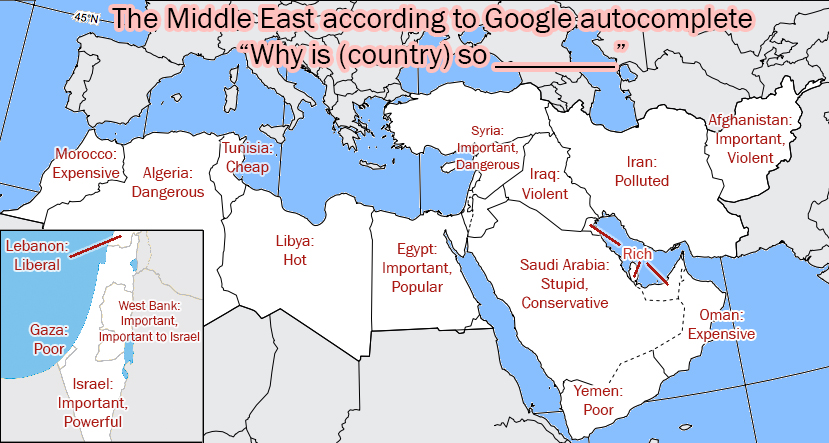
Each country shows Google’s top suggestion when you search “Why is [country] so” (Max Fisher/Washington Post)

What do Americans search for when they Google the Middle East? This map is an attempt at an answer. It shows the top results when I typed “Why is [country] so” into the Google search bar and let Google’s autocomplete function suggest how to finish my sentence. Very roughly, this lets us get a glimpse at the most frequent American searches for Middle Eastern countries.

mideast-google-auto-so

You may recognize the premise, which was inspired by Randal Olsen’s Google autocomplete map for Europe. To make the map more readable, I’ve put Israel, Lebanon and the Palestinian territories in an inset map in the bottom-left corner.

By far the most common search term for these countries was “important,” suggesting that Americans are trying to figure out what makes this part of the world so consequential (it’s a fair question). This term was so common, in fact, that in cases where it was the top suggestion, I also included the second-highest suggested search term. “Dangerous” showed up for Algeria and Syria; “Violent” for Iraq and Afghanistan.

Jordan and Turkey are not included since the top results for each clearly refer to different Jordans and Turkeys. In the latter case, the results mostly pertain to turkey the food: “dry,” “cheap,” “expensive this year.” And one important caveat is that Google autocomplete results are not universal. I searched in Chrome through “incognito” mode to depersonalize the results as much as possible, but it surely based the results in part on my IP location in Washington, D.C. If you get different results, please add them in the comments.

To be clear, I’m not endorsing these results as anywhere near accurate; some of them are outright offensive. Before you ask, I have no idea why people are googling “Why is Saudi Arabia so stupid,” particularly since Saudi education rates are some of the highest in the region. But these results are a revealing, if at times unsettling, glimpse into how Americans think about a part of the world where their government and military are deeply engaged on their behalf.

Here are the top results for Syria, Iran and Israel, which I found particularly telling:
autocompletes-syria-israel-iran
autocompletes syria israel iran

There are a few questions implicit in these autocomplete results. The first and maybe biggest is: Why do we care? Why is this so important? What makes Syria “pivotal”? The second seems to be about the fundamental power relationships of the Middle East: why is the United States aligned with Israel (“…so important to America”) and against “evil” and “powerful” Iran?

There are two ways to read this, that I can see. First, maybe Googlers are curious about, and perhaps even questioning, the basic assumptions driving U.S. policy toward the Middle East. Whether or not you support those policies, having Americans more engaged with their fundamental premises is surely a good thing. But the second way to read it is that Americans, after decades in the Middle East, still don’t understand how and why the region works as it does. That would be less encouraging, although the fact that they’re trying to find out is something.

To be fair, a lot of these questions are really complicated. If you asked a room full of Middle East experts “why is Saudi Arabia so conservative” or “why is the West Bank so important to Israel,” their first response would likely be to scoff at your ignorance. But the truth is that there is no simple, straightforward answer to these questions. If that room full of experts actually had to answer them, they’d probably all end up fighting with each other over how to even think about beginning to answer them, much less the answers themselves.

All of which is a long way of saying: keep Googling, Americans, and hopefully we in the community of journalists, academics, policy professionals and think tankers will one day be able to provide you with sufficiently insightful answers.
Max Fisher
Max Fisher is the Post’s foreign affairs blogger. He has a master’s degree in security studies from Johns Hopkins University. Sign up for his daily newsletter here. Also, follow him on Twitter or Facebook.

A Modern Day Opera Buffa

The Economist explains
Why Silvio Berlusconi still matters
Jan 26th 2014, 23:50 by J.H. | ROME

EXACTLY 20 years ago, on January 26th 1994, Silvio Berlusconi entered Italian politics. He went on to serve as prime minister three times, most recently between 2008 and 2011, but last year he was convicted of tax fraud and expelled from parliament, seemingly bringing his political career to an end. Yet on January 18th he returned in style to Italy’s political arena when the leader of its biggest party, Matteo Renzi of the Democratic Party (PD), cut him in on a deal to change the electoral law and reform the constitution. How can Mr Berlusconi continue to play a central role in Italian politics?

On August 1st 2013 the supreme court upheld his conviction for tax fraud and a jail sentence of four years. The judges also told a lower court to reconsider the length of time Mr Berlusconi should be banned from public office (it reduced the period from five years to two). Three of the four years of the former prime minister’s jail sentence were meanwhile wiped out by a pardon which had been granted by the centre-left government in 2006. And Mr Berlusconi will not serve the remaining 12 months behind bars because of a law introduced by his government in 2005, which gave sentencing tribunals the power (though not the obligation) to impose house arrest or community service on anyone over the age of 70 when convicted. Mr Berlusconi, who is 77, has asked to do community service. But the wheels of Italian justice grind slowly. The tribunal that will decide his fate will not sit until April 10th.

In the meantime, Mr Berlusconi is a free man. He is banned from holding public office and, by the terms of the law under which he was expelled from the Senate, he is also prevented from running for parliament. But that does not stop him leading his party, Forza Italia. Indeed, Italy has a long history of party leaders exerting decisive influence on the country while remaining outside government, and even parliament: neither Mr Renzi nor the leader of Italy’s second-biggest party, Beppe Grillo, sit in the legislature. The reason Mr Renzi involved Mr Berlusconi in his plan for political and constitutional reform is that he needs Forza Italia’s votes. The PD has an absolute majority in the lower house, the Chamber of Deputies, but not in the Senate. In theory, the proposed electoral law could be passed with the help of the PD’s allies in government, the New Centre Right (NCD). But the law Mr Renzi seeks is one that aims to reduce the influence of small parties like the NCD and increase the power of bigger ones like the PD and Forza Italia. To get his constitutional reform passed without a referendum, Mr Renzi needs a two-thirds majority. And without Mr Berlusconi’s party he cannot get one.

So it looks as though the eternally resilient media tycoon could remain a pivotal figure for a year or more. It is expected that the tribunal that convenes in April will agree to his doing community service, which would leave him time for politics. But Mr Berlusconi has also been convicted of paying for sex with an underage prostitute and coercing the police into helping him hush up their relationship. A lower court gave him seven years. If that sentence is upheld, he could well face house arrest and a ban on communicating with the members of his party. Only then would his influence over Italian politics come to an end.

Is this Truly Inevitable?

January 24, 2014
Will Any Democrat Even Challenge Hillary in 2016?
Posted by John Cassidy

The 2016 election is still almost three years away, but, already, it can’t be avoided. Time magazine, in its cover story this week, asked, “Can Anyone Stop Hillary?” And now comes the Times with two more cover stories devoted to the former First Lady. In Sunday’s magazine, the writer Amy Chozick splashes down on “Planet Hillary,” and provides a very readable portrait of the many strange and wonderful creatures she finds there.

The real news in on the front of Friday’s paper, though, and it comes from Nicholas Confessore, who covers money and politics. Right now, twenty-four months before the Iowa primary, and at a point when not a single serious candidate has declared that she or he is running for President, Priorities USA, the Democratic Super PAC that raised and spent wads of cash in support of President Obama’s 2012 reëlection campaign, is putting its money and expertise behind—you guessed it—Hillary Clinton.

We shouldn’t be too surprised at this journalistic onslaught, and you can’t blame it all on political reporters desperately looking for something to write about. In the post-Citizens United world, Presidential campaigns are big business, and they never take a break. As the Times story indicates, decisions are being made today that will determine who runs the country—or, at least, the White House—for four years after President Obama leaves. So, suck it up and keep reading!

The most immediate implications of the decision by Priorities USA, which was founded by two former Obama-campaign officials, Bill Burton and Sean Sweeney, are for anybody who is thinking of challenging Clinton for the Democratic nomination.

Imagine for a moment that you were one of these hopeful souls. Here’s what you’ve just been told: don’t bother! This thing is already sewn up. If you go ahead with your foolhardy pursuit, you’ll be crushed. Not only will you be confronting the candidate with the most experience and strongest poll numbers, you will also be going up against practically the entire Democratic establishment: the best campaign managers, the wiliest spinmeisters, the biggest of big-name endorsers, the most modern technology, and the deepest pockets. Forget about it. There’s always 2024, or 2020 if Hillary loses.

During the 2012 Presidential race, Priorities USA raised more than eighty-five million dollars, most of which came to them by way of wealthy donors like Jeffrey Katzenberg, the Hollywood mogul, and Steve Mostyn, a Houston trial lawyer. Under campaign-finance laws, the nominally independent Super PACs aren’t allowed to formally coördinate their television ads and other activities with the campaigns of the candidates they endorse. In practice, though, they are on the same team—in this case, Clinton’s team.

“I think the numbers clearly show that she’s the strongest presidential candidate on the Democratic side. And Priorities is going to be there for her if she decides to run,” Jim Messina, Obama’s former campaign manager, who has agreed to serve as Priorities USA’s co-chairman ahead of the 2016 election, told Confessore. Mostyn, for his part, said that he and his wife, Amber, were excited about the prospect of supporting Clinton. “The first time was kind of a leap of faith for us—it was back when no one was giving Priorities money,” he said. “I think it’ll be easier with Hillary.”

The upshot of the story is straightforward: the Obama and Clinton forces, which fought each other bitterly in 2008, are now rallying behind Hillary. Who might be willing to stand in the way of this fearsome army? The more you analyze it, the more the answer appears to be nobody, or nobody of much note.

Let’s take some of the possible challengers in turn:

Joe Biden. According to many accounts, the Vice President harbored ambitions of succeeding his boss in the Oval Office. But as the prospect of him receiving Obama’s backing recedes, he appears to be dropping out of the picture. It is difficult to imagine that figures like Messina, loyal Obamaites all, would be publicly endorsing Clinton so early in the race if they hadn’t received at least the tacit approval of the President.

Elizabeth Warren. At an appearance in New York this week, the Massachusetts senator once again demonstrated how she can tap into the populist resentment, especially among younger voters, that spurred the Occupy Wall Street movement, and Bill de Blasio’s election victory. While it is hard to see her winning the nomination, the prospect of taking on an articulate, liberal woman with strong intellectual credentials is clearly not one that Clinton backers relish. But Warren has repeatedly said that she’s not running in 2016, and there doesn’t seem to be any reason to think she’s kidding.

Andrew Cuomo. It’s an open secret in Albany that the governor, who is set to be reëlected this year, has larger ambitions. In burnishing his credentials as a tax-cutting centrist, he has appeared to have at least one eye on 2016. But as long as Clinton is in the race he is snookered. The New York Democratic Party, and the New York money, will be behind the former First Lady. Going against them would be foolish.

Martin O’Malley. The personable governor of Maryland has racked up an impressive record over the past six years, and recently he’s been busy doing things that potential Presidential candidates do, such as speaking at Washington think tanks and appearing on talk shows. If Warren stays out, he could be the candidate of the Democratic Party’s progressive wing. But does he want to earn the enmity of the Obama-Clinton forces by entering a race he’d likely lose? (He’s already annoyed some of them. One Wall Street Democrat told me he’d made a big mistake in being shown around New York by Eliot Spitzer.) Having just turned fifty-one, he can afford to bide his time.

Jerry Brown. There’d been some gossip that the governor of California, who has high approval ratings and who has already run for President three times, might give it another go. He has demonstrated over his career that he’s not the sort of fellow to be put off from doing something he wants. But, evidently, he’s not running. At a press conference in Riverside last week, Brown said, “No, that’s not in the cards. Unfortunately.” Come 2016, Brown will be seventy-eight years old. And he has apparently decided that’s too old.

Bernie Sanders. Last last year, the liberal-socialist senator from Vermont said that he might be open to challenging Hillary, especially if Warren doesn’t run. He told Playboy that the Clintons “live in a world surrounded by a lot of money,” and he said to Salon’s Josh Eidelson that, while he liked Hillary personally, “it remains to be seen whether she will be a forceful advocate for working families.” But Sanders only caucuses with the Democrats—he runs in Vermont as an independent—so he wouldn’t take part in the Party’s primaries.

Obviously, this list isn’t exhaustive. More candidates might show up, but the challenges facing them would be formidable. Ironically, the one thing Clinton has to worry about may be the growing sense that she already has the nomination wrapped up. Chozick, in her Times Magazine piece, asks David Axelrod, Obama’s chief strategist in 2008, what Clinton needed to do to win in 2016. This was the start of his reply: “She stumbled in 2007 when she was encased in a presumption of inevitability.”

Illustration by Morgan Elliot.

What Would W.C. Fields Think About This?

A Gilded Goddess Would Rather Be in Philadelphia

JAN. 22, 2014
23Blocks-span-master675
The Philadelphia museum secured a grant to have the statue, made of molded copper sheets, regilded. In November, Diana was again taking aim, but with a new coat of 23.4-karat red gold. Joe Mikuliak/Philadelphia Museum of Art

Building Blocks

By DAVID W. DUNLAP

PHILADELPHIA — Can we speak frankly? New York really didn’t deserve Diana.

To be sure, when she was young, brilliantly gilded and fresh from the workshop of Augustus Saint-Gaudens in 1893, Diana was the toast of the town.

Even moralists could not make too much of her nudity, since her lithe contours were barely discernible, except in silhouette. She did her hunting from the pinnacle of Madison Square Garden — the one on Madison Square, the one designed by Stanford White, who perished under Diana’s gaze in 1906, shot to death by the jealous Harry K. Thaw.

The Statue of Liberty envied Diana the perch from which she could watch horse shows, cat shows, sportsmen’s shows, pageants, banquets and balls. Or so O. Henry wrote in “The Lady Higher Up.” The two would exchange gossip of a quiet summer night, when they could hear each other’s voices over the great distance.

“Ye have the best job for a statue in the whole town, Miss Diana,” Mrs. Liberty said, in an unexpected Irish brogue.
Launch media viewer
Diana’s original place in New York was atop Madison Square Garden in 1893.

Answering in a clear soprano voice, Miss Diana took pity. “It must be awfully lonesome down there with so much water around you,” she told Mrs. Liberty. “I don’t see how you ever keep your hair in curl. And that Mother Hubbard you are wearing went out 10 years ago.”

Poor Diana. She was herself soon to go out of style. When she reached her 30s, New York’s ardor cooled. Madison Square Garden was razed to make way for the New York Life Insurance Company headquarters. Diana needed a new home.

But not one place could be found for the 13-foot-1-inch slip of a goddess; not in Madison Square Park, not on New York University’s campus in the Bronx (now Bronx Community College), not over the portal to the Manhattan Bridge, not above a Coney Island hotel.

Nowhere.

So after waiting seven years in storage to alight somewhere in the five boroughs, Diana finally decamped in 1932 for the Philadelphia Museum of Art.

There, she was prominently placed at the summit of the Great Stair Hall, framed by twin Ionic columns. With arrow perennially poised to fly from bow, Diana became almost as much a symbol of the museum as its griffins. (We’ll leave the Rocky statue out of this.)

Philadelphia, it was clear, knew how to treat a goddess.

It still does. In November, after five months, scaffolding came down to reveal Diana’s new coat of 23.4-karat red gold. It was the first regilding since her days on East 26th Street.

In a stroke, the sculpture had been transformed from a patinated relic back into a dazzling, daring emblem of the confident young metropolis of New York.
Launch media viewer
Diana currently stands atop the summit of the Great Stair Hall at the Philadelphia Museum of Art. David W. Dunlap/The New York Times

“Looking at it as a Greek antiquity was totally past the point of what the sculptor and architect wanted,” said Andrew Lins, the senior conservator of decorative arts and sculpture at the museum. “This is really about the Gilded Age.”

Visitors are certainly conscious of the sculpture. One middle-aged man on the staircase assumed Diana’s pose for a snapshot: left foot tiptoe, right leg slightly raised, left arm extended, right hand gripping an imaginary arrow shaft.

“It refreshes something people have been walking by for years,” said Kathleen Foster, the senior curator of American art.

Ms. Foster said it would have been unthinkable for the museum to regild the sculpture when it arrived, during the Great Depression. The idea was considered in the mid-1980s, she said, but neither time nor resources were at hand. Mr. Lins said regilding had not been a high priority because the statue itself, made of molded copper sheets soldered together, was in acceptable condition.

What permitted the regilding was a grant from the Bank of America’s Art Conservation Project. Museum officials and a public relations representative of the bank would not disclose the amount. (The recent regilding of the Sherman Monument by Saint-Gaudens in Grand Army Plaza in Manhattan cost $500,000 but was far more complex.)

In 1967, when the current Madison Square Garden was being constructed over Pennsylvania Station, New York’s mayor, John V. Lindsay, asked his counterpart in Philadelphia, James H. J. Tate, if New York might get Diana back and install her at the new Garden.

“When no one wanted this poor little orphan girl,” Mayor Tate replied, “Philadelphia took her in, gave her a palatial home and created a beautiful image for her with a worldwide reputation.” In a word: no.

New York has the gorgeous consolation prize of a 28-inch bronze cast of Diana, at the Metropolitan Museum of Art.

Ms. Foster said she was approached a few years ago by a Garden executive who wondered whether big Diana might return temporarily for an exhibition. The curator explained that the copper sheets were too malleable to withstand shipping and handling.

She was impressed by the request, however. “New Yorkers,” Ms. Foster said, “never give up.”

Surveillance Update

Privacy tools used by 28% of the online world, research finds
Concern about privacy, and frustration over censorship and content blocking is driving millions to use anonymity tools

theguardian.com, Tuesday 21 January 2014 08.22 EST
NSA surveillance program revelations continue to surface
NSA surveillance. Photograph: Alex Milan Tracy/NurPhoto/Corbis
The gathering crisis of trust around consumer web services and the fallout from Edward Snowden’s revelations is fuelling a significant uptake in anonymity tools, new research shows, as internet users battle censorship and assert their right to privacy online.

Globally, 56% of those surveyed by GlobalWebIndex reported that they felt the internet is eroding their personal privacy, with an estimated 415 million people or 28% of the online population using tools to disguise their identity or location.

Aggregating market research data from 170,000 internet users worldwide, GWI found that 11% of all users claim to use Tor, the most high profile for anonymising internet access.

On these figures, Tor could be regularly used by as many as 45.13 million people. Its biggest userbase appears to be in Indonesia, where 21% of respondents said they used the tool, followed by 18% in Vietnam and 15% in India.

Indonesia also has the world’s highest penetration of general anonymity tools among its internet users, with 42% using proxy servers or virtual private networks known as VPNs, which disguise the location of the user’s internet connection – their IP address – and therefore bypass regional blocks on certain content.

34% of Chinese using anonymity tools

The Chinese government reportedly employs as many as 2 million “internet analysts” to review and block content deemed politically or commercially inappropriate, yet GWI research estimates that 34% of the country’s online population disguise their online location so that they can bypass such filters.

Of those that use VPN or proxies, 60% say they do so to access Google’s YouTube video site, and 55% said they use it to access Facebook and Twitter.

The use of IP-masking tools means that size of China’s Facebook and Twitter userbase, for example, could be significantly larger than first thought. China’s VPN-using audience alone could be as much as 160 million people, many of whom are currently being incorrectly identified as being in another country – usually the US.

Normally, the location of a user’s IP address would be used to deliver relevant regional advertising as well as a version of the site in the local language.

Geo-located advertising ‘missing the mark’

“VPNs serve a perfect dual purpose for consumers in lots of markets, allowing them to access restricted content and better content as well as stay anonymous,” said Jason Mander, GWI’s head of trends. “It’s a perfect combination and one that is likely to see their popularity grow. It also means that the numbers using sites such as Facebook in China are likely to have been under-estimated, and that geo-located advertising is completely missing the mark for these internet users.”

“The figures also suggest that the global internet audience is a lot savvier and more concerned about this type of thing than is traditionally supposed, and chimes with the statistic that 55% are concerned about their privacy being eroded by the internet.”

In Vietnam, VPN is used by 38% of the online population and in Brazil and Thailand 36%. Mexico, India and China all reported use by an estimated 34% of the population that has access to the internet, with the UAE and Argentina on 32%.

The US, UK, Germany and Ireland meanwhile all report 17% penetration, with Japan the lowest at 5%. The data includes those aged 16-64 for the last quarter of 2013.

The data also underscores the shift from text messaging to mobile messaging apps, with WeChat seeing a 379% increase in active users between the second and fourth quarters of 2013 to around 385 million users, 78m of whom are in China.

Instagram beats Facebook for growth, and younger users

Facebook has by far the biggest audience among social networks with an estimated 1.1 billion active users, but also has a very active user base with 56% saying they visit the site at least once a day.

Facebook’s $1bn acquisition of the photo-sharing site Instagram in 2012 proved a sound bet; GWI found it had the fastest growth of any social platform in 2013 adding 23% active users from Q2 to Q4 to reach 91 million users. Instagram also led the move of younger web users away from more established social sites.

Along with Twitter, Facebook has the largest proportion of users aged 55-64, while Tumblr and Instagram have the highest share of 16-24 year olds at 45% and 39% respectively. Use by older people is compounded by the ageing of early-adopter users as well as older users being more likely to join established sites.

The most common activity on Facebook was sharing content, private messaging and commenting on posts, while the least popular activity – which doesn’t bode well for the site’s advertising strategy – included complaining or commenting on a brand or sharing brand videos.

MySpace, meanwhile, languishes at the bottom of the charts. Despite an ambitious and sophisticated redesign, the site has not integrated sharing with other networks and has struggled to regain its former glory. According to GWI it has the lowest numbers of active monthly accounts, has seen the biggest drop in user numbers for 2013 and fewer daily visits.

Scary Things About the Drought in California

6 Scary Facts About California’s Drought

—By Chris Mooney
| Sat Jan. 18, 2014 3:00 AM GMT

noaa_snowpack630px_0

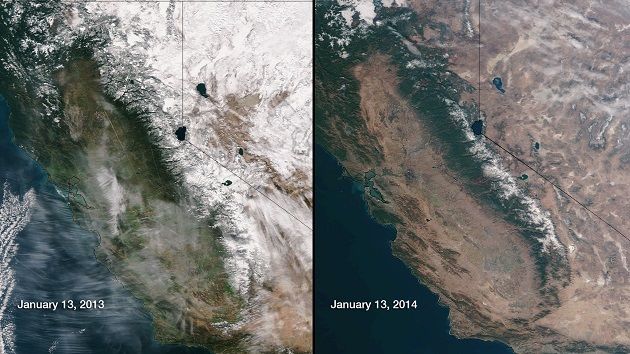
Satellite views of the Sierra Nevada, a year apart. NOAA/NASA

“Fire season just didn’t end this year.”

The comment came from Scott Miller, the Los Angeles County fire inspector, in the wake of the Colby Fire in the foothills near Los Angeles. The fire is now 30-percent contained, but it serves as the latest reminder that California is facing an increasingly alarming drought—one that yesterday prompted Gov. Edmund Brown, Jr., to declare a state of emergency.

Last year was California’s driest on record for much of the state, and this year, conditions are only worsening. Sixty-three percent of the state is in extreme drought, and Sierra Nevada snowpack is now running at just 10 to 30 percent of normal. “We’re heading into what is near the lowest three year period in the instrumental record” for snowpack, says hydrologist Roger Bales of the University of California-Merced.

Water shortages, devastating wildfires, and growing economic impacts: All could be on the way unless more precipitation arrives, and fast. Here are some scary realities about the drought:

1. It’s Bordering on Unprecedented in Some Areas. According to Christopher Burt, weather historian at Weather Underground, the City of San Francisco has received only 2.12 inches of water so far in this water year. The driest water year on record was from 1850-1851, at 7.42 inches. So as of now, San Francisco is below half of the all-time record low.

2. Time in the Rainy Season is Running Out. California doesn’t get steady rain all year round. Rather, it has a rainy season each year, and we’re currently in it. Typically, the rainy season runs through March; if major precipitation doesn’t arrive by then, it probably won’t be coming. Granted, this is also the chief source of hope right now: California can sometimes get plenty of water in February and March.

3. The Drought Could Lead to Dirtier Energy Use. Peter Gleick, president of the Oakland-based Pacific Institute, points out one less-noticed consequence of the drought: The lack of water means less available hydropower. And that has consequences: “Because renewable hydropower is among the cheapest and most versatile of electricity sources,” writes Gleick, “California ratepayers will have to pay for more costly fossil fuels to make up for the difference.” The result, he notes, is likely to be “billions of dollars in added energy costs and generating more greenhouse gases to the atmosphere.”

4. It’s Setting the Stage for a Devastating Fire Season. Hotter, drier conditions favor wildfires. Indeed, California has already seen several significant fires since the October 31 end of the traditional fire season, including December’s Big Sur fire and the ongoing Colby Fire in the Los Angeles area. That’s a bad sign. So is the fact that in just the first 11 days of January, the state saw 154 fires that burned 598 acres. That’s way above the five-year average for this time of year.

For California, seven of the 10 largest fires in state history have occurred since the year 2000. And if these dry conditions persist throughout 2014, another new fire may be added to that list.

5. It Could Pummel Agriculture. California is an agricultural powerhouse. For crops, the state accounts for 15 percent of national sales and for livestock, 7.1 percent, according to the California Department of Food and Agriculture. But now farmers are likely to have considerably less water. This won’t lead to agricultural collapse, but it will definitely take a toll. “There will be, in agriculture, fewer plantings, fewer harvests, and revenue of seasonal crops,” says UC-Merced’s Roger Bales. “There could be more expensive pumping of groundwater. And there could be just lower yields if they have less water to apply.”

6. It’s a Sign of What’s to Come. NOAA’s seasonal drought outlook projects persistent or worsening conditions in California through April:
US seasonal drought outlook. National Weather Service

Over the longer term, climate projections suggest that this risk will continue or increase. According to the draft National Climate Assessment, the US Southwest—which includes California and five other states—can expect less precipitation, hotter temperatures, and drier soils in the future, meaning that by 2060, there could be as much as a 35-percent increase in water demand. Along with that comes a 25- to 50-percent increased risk of water shortages.

So even if California gets some much needed rain in the coming months, that’ll only be a short-term reprieve. Right now, the state needs to engage in some major climate adaptation planning, to get ready for a much drier future.