Keystone XL Pipeline Update

US Secretary of State John Kerry offered no timetable on Friday for a US decision on TransCanada’s planned Keystone XL oil pipeline, saying he hopes an analysis of public comments on its environmental impact would be done soon.

He noted that after the environmental analysis is completed there will be a process to determine whether building the pipeline is in the U.S. national interest, Reuters reported.

“My hope is that before long that analysis will be available, and then my work begins,” Kerry was quoted as saying by the news wire at a news conference with his Canadian and Mexican counterparts.

Canadian Foreign Minister John Baird bluntly told the United States on Thursday to end the “limbo” on the approval process for the pipeline, conceding that Washington might veto the project.

On Friday, a spokesman for Canadian Prime Minister Stephen Harper said he still believed the United States would ultimately approve the project, which would transport crude from the Alberta oil sands to US Gulf Coast refineries.

The US State Department has yet to finalize a controversial environmental review of more than 2000 pages that it issued on 1 March. It had been expected to complete the review by midsummer.

Instead, it is reviewing and publishing in batches the more than 1.5 million public comments it received on the review.

Many of the comments focus on one of the draft review’s main conclusions: that TransCanada Corp’s 830,000 barrel per day project would not result in higher levels of emissions linked to global warming because the oil would find its way to market whether or not the pipeline gets built.

“There were a lot of questions that were raised in all of the public comment period and those comments have necessitated appropriate answers,” Kerry said. “I can promise our friends in Canada that, you know, all the appropriate effort is being put in to trying to get this done effectively and rapidly.”

After the environmental review is completed, eight federal agencies, including the Departments of Defense, Energy and Homeland Security, will have 90 days to comment on whether they believe the pipeline is in the national interest. Then the State Department will make a National Interest Determination (NID), which the agencies will have 15 days to appeal.

Baird, standing at Kerry’s side after a three-way meeting with Mexican Foreign Minister Jose Antonio Meade, suggested he and the US secretary of state would discuss the issue during a bilateral meeting later on Friday.

“Obviously, this is a tremendously important project for the future prosperity of the Canadian economy,” he told reporters at the news conference. “We hope the final State Department report is out in short order and that the administration will be in a position to make a positive decision.”

Spending to Improve the Environment

Kevin Bullis

January 17, 2014

Despite Funding Boost, We’re Spending Too Little on Energy R&D

A leaked UN climate report suggests we’re spending far too little on clean energy.

Yesterday Congress passed a spending bill that will undo the damage done to energy R&D by automatic spending cuts, and in some cases funding actually increases substantially, such as funding for nuclear research (see this breakdown). This is good news for the development of new energy technology.

Unfortunately, the spending still falls short of what many experts think is needed to solve today’s energy challenges, particularly climate change (see “Technology Is Moving Too Slowly to Make Climate-Change Target”). According to several groups–environmental ones but also groups of business leaders–energy R&D should be triple what it is now to sustain the pipeline of innovations needed to cut greenhouse gas emissions.

The lack of spending on climate change was highlighted this week in a draft of a United Nations report that was leaked to news organizations such as Reuters.

According to the leaked report, the share of the total energy supply that comes from low carbon energy sources such as nuclear and solar needs to triple or quadruple to keep temperatures from rising more than 2 degrees Celsius, a temperature some scientists think would be relatively manageable, Bloomberg reported.

We’re nowhere close to being on a trajectory for achieving that. Instead we’re going backwards. The use of fossil fuels is growing faster than renewables, and the share of nuclear power—a low carbon source of electricity—is reportedly shrinking. Governments around the world are actually spending more on subsidizing fossil fuels than on shifting to low-carbon sources of energy, the New York Times reported (see “The Enduring Technology of Coal”).

The answer is certainly not to immediately end all subsidies for fossil fuels. That would be disastrous, especially for poor that depend heavily on cheap electricity and fuel. But those subsidies need to be decreased on a predictable time scale, and new technologies need to be developed quickly to provide affordable alternatives.

7

The Aesthetic Brain

  • January 17, 2014

Cover Image: January 2014 Scientific American Magazine See Inside

MIND Reviews: The Aesthetic Brain

Books and recommendations from Scientific American MIND

The Aesthetic Brain Book Cover

Image: Courtesy of the Oxford University Press

The Aesthetic Brain: How We Evolved to Desire Beauty and Enjoy Art
by Anjan Chatterjee
Oxford University Press, 2013

Why do we covet beauty? Why does art, which seems to serve little practical purpose, feel fundamental to our lives? Such questions have long fascinated philosophers and artists. Now neuroscientists are weighing in as well.

The Aesthetic Brain explores the field of neuroaesthetics, the science of how our brain experiences and responds to art, music and objects of beauty. Chatterjee, a neuroscientist, argues that an instinct for beauty has helped our species endure. Art is a product of our quest for beauty and knowledge.

The author first walks through the complex neural mechanics of aesthetic experience. When we look at something, whether it is the Mona Lisa or a city skyline, information from nerve cells in the eye’s retina travels to the brain’s occipital lobes to process what we have seen. If we find these sights beautiful, the brain is flooded with pleasure-inducing neurotransmitters. Beauty is inexorably linked with pleasure.

Chatterjee turns to evolutionary psychology to explain why we are drawn to things of beauty, positing that this urge may have improved our ancestors’ chances of survival. Facial symmetry often signaled a better mating partner, and landscapes replete with rolling hills, waterways and blooming plants may have appealed to primitive humans because they provided safe refuge and sustenance.

Of course, our relation with art is more complex than such simplistic theories may suggest. Art is not always beautiful, at least not in a straightforward way. It can be vulgar, bizarre or abstract; it can tell a story, incite emotions or depict a given moment. Take the sculpture Piss Christ, which depicts a crucifix soaked in urine. Chatterjee explains that people viewing this artwork out of context often react with disgust, but those who know that the artist intended to show the horrors of the crucifixion tend to find a deeper meaning in it. Our response to art can be richer and more nuanced than to a pleasing vista or tableau.

Overall, The Aesthetic Brain offers an intriguing overview of the neural and historical underpinnings of beauty and art. Chatterjee, however, may tackle too much in his 244-page book. He attempts to capture the immense topics of aesthetics, pleasure and art while weaving in anecdotes about science, history and even math, which can at times cause him to lose track of his main thesis. Nevertheless, he makes a compelling case that although art and beauty may seem nonessential, they epitomize our search for pleasure and meaning in life.


This article was originally published with the title The Aesthetic Brain.


Save the Redwoods and Ancient Forests

Save the Big Trees!

A large tree grows more quickly and sucks up a lot more carbon than a smaller one, scientists find
By Sarah Zielinski
January 15, 2014 7:26PM

Not all trees are created equal. A forest full of young, small trees seems like it might be a great natural outdoor space, but compared to a grove full of big, ancient stock, it doesn’t stand up, at least on an ecological level. Big trees provide more space for sheltering animals as well as more food, for instance, and a large tree obviously holds onto more carbon than a smaller one.
Related Content

But does the rate at which a tree sucks up carbon change as it gets older? Scientists had assumed that it did, that trees slowed down their growth as they aged. And they had some circumstantial evidence of this from comparisons of stands of trees in which all the trees in a forest were of similar age. Stands of small, young trees appeared to be more productive.

Big, old trees have moved back to the top of the heap, however, with new evidence that they grow much faster and, thus, sequester a lot more carbon than young trees. The study was published January 15 in Nature.

Nate Stephenson of the U.S. Geological Survey in Three Rivers, California, and an international group of colleagues estimated growth rates of 403 species of trees by comparing repeated measures of trunk diameter of 673,046 individual trees. The trees came from tropical, subtropical and temperate areas of the world and represented samples from every continent except Antarctica (which of course has no forests there to measure).

“For all continents, aboveground tree mass growth rates (and, hence, rates of carbon gain) for most species increased continuously with tree mass (size),” the researchers write.

The largest trees, those with a trunk diameter of a meter or more, tended to be the most heavyset, adding about 10 to 200 kilograms of mass each year. That’s about three times as much mass that a tree half that diameter accumulates in a year. Or, put another way, that’s the equivalent of growing an entire tree of 10 to 20 centimeters in diameter from the ground up—something that takes years of growth.

This “is not a phenomenon limited to a few unusual species,” the team notes. “Rather, rapid growth in giant trees is a global norm, and can exceed 600 kg per year in the largest individuals.”

“In human terms, it is as if our growth just keeps accelerating after adolescence, instead of slowing down,” Stephenson said in a statement. “By that measure, humans could weigh half a ton by middle age, and well over a ton at retirement.”

On a forest scale, it’s possible for densely packed stands of young trees to win out on total carbon stored, however, simply because they can pack in more trees in the same space, the researchers note.

But big, old trees are definitely important—the researchers explain that, in forests in the western United States, trees with trunks more than a meter wide comprise only about six percent of all trees but contribute a full third of forest growth.

What should worry us, though, is that these old timers are fast disappearing. “Large old trees are declining in forests at all latitudes,” David Lindenmayer of the Australian National University and colleagues noted in Science in December 2012. Grazing lands have edged out old trees in regions of Australia, Costa Rica, Spain and the United States, for instance, but even protected areas aren’t safe. In Yosemite National Park, the density of the largest trees, they note, declined by nearly a quarter between the 1930s and the 1990s.

Standing at the base of one of these old trees, it may appear to be a permanent fixture, but it’s vulnerable to a list of threats, Lindenmayer and his colleagues explain. Droughts, wildfires, air pollution, insect attacks and competition with invasive plants can all kill these trees, but the trees are also frequently intentionally removed to make way for agriculture, as part of efforts to manage fire risk and to turn the trees into valuable timber.

Planting new trees as replacement isn’t enough. Not only do these smaller individuals not have the same ecological and climate benefits, but few of them will live so long as to reach old age. With large, old trees having such a benefit disproportionate to their number, scientists say that more needs to be done to make sure they don’t disappear any more quickly than they already are.

Read more: http://www.smithsonianmag.com/science-nature/save-big-trees-180949344/#ixzz2qbiuIpyt
Give the gift of Smithsonian magazine for only $12!: http://bit.ly/1cGUiGv
Follow us: @SmithsonianMag on Twitter

Edifice Complex

Cassandra
The World in 2014

Tall towers
Signs in the sky
Jan 15th 2014, 11:30 by M.S.L.J.

THE state-owned developer of the Shanghai Tower, a 632-metre-tall building once rumoured to be opening in China this year (now more likely to throw open its doors in 2015), looks set to hire a leasing agent in order to fill the property with tenants. The step, reported in the Wall Street Journal, may be a sign that the developer is struggling to find tenants as China’s economy slows. Neither of the two most recent tall towers to open in the city, Shanghai World Financial Center in 2008, or Jin Mao Tower a decade before, used such an agent. They both had claims to be China’s loftiest buildings at their time of opening, as the new Shanghai Tower may too.

The title depends on the development of Sky City, however, a project in the interior city of Changsha. Intended to reach to 838 metres, Sky City would be ten metres taller than the Burj Khalifa in Dubai, the tallest building in the world since its opening in 2010. Intentions to build the tower within a year have grabbed headlines, but many doubt that Sky City will see completion in 2014, thanks to bureaucratic delays and stop-start construction.

The World in 2014 ran a competition inviting readers to make a prediction for the year that might, just possibly, come true. Entrants also identified figures in a montage. Thomas Wedler was our winner, and his prediction concerns correlation between the construction of tall towers, economic crises and Chinese atrology, as seen below. Cassandra congratulates Mr Wedler, and thanks all those who entered for their ideas.

“The completion of the tallest building in Asia, and possibly the world, will herald the much anticipated popping of the Chinese property bubble—with a smallish bank-run thrown in for good measure. Much has been written about the Empire State Building, the Twin Towers, the Petronas Towers, the Burj Khalifa and others spelling doom for their respective eras, so here is a new spin on these pessimistic types of prophecy.

Arthur Gensler’s firm, architects of the Shanghai Tower, was founded in 1965. According to Chinese astrology, this was the last time a year of the fire “Earthly Branch” occurred during the “Heavenly Stem” of wood. This coincided with the “Panic of 1965” in Hong Kong when Canton bank had to be bailed out after the real-estate bubble burst. The next such constellation? 2014, of course.”

Web Neutrality

Cover Image: December 2010 Scientific American Magazine See Inside
Long Live the Web: A Call for Continued Open Standards and Neutrality

long-live-the-web_1

The Web is critical not merely to the digital revolution but to our continued prosperity—and even our liberty. Like democracy itself, it needs defending

By Tim Berners-Lee

The principle of universality allows the Web to work no matter what hardware, software, network connection or language you use and to handle information of all types and qualities. This principle guides Web technology design.
Technical standards that are open and royalty-free allow people to create applications without anyone’s permission or having to pay. Patents, and Web services that do not use the common URIs for addresses, limit innovation.
Threats to the Internet, such as companies or governments that interfere with or snoop on Internet traffic, compromise basic human network rights.
Web applications, linked data and other future Web technologies will flourish only if we protect the medium’s basic principles.

The world wide web went live, on my physical desktop in Geneva, Switzerland, in December 1990. It consisted of one Web site and one browser, which happened to be on the same computer. The simple setup demonstrated a profound concept: that any person could share information with anyone else, anywhere. In this spirit, the Web spread quickly from the grassroots up. Today, at its 20th anniversary, the Web is thoroughly integrated into our daily lives. We take it for granted, expecting it to “be there” at any instant, like electricity.

The Web evolved into a powerful, ubiquitous tool because it was built on egalitarian principles and because thousands of individuals, universities and companies have worked, both independently and together as part of the World Wide Web Consortium, to expand its capabilities based on those principles.

The Web as we know it, however, is being threatened in different ways. Some of its most successful inhabitants have begun to chip away at its principles. Large social-networking sites are walling off information posted by their users from the rest of the Web. Wireless Internet providers are being tempted to slow traffic to sites with which they have not made deals. Governments—totalitarian and democratic alike—are monitoring people’s online habits, endangering important human rights.

If we, the Web’s users, allow these and other trends to proceed unchecked, the Web could be broken into fragmented islands. We could lose the freedom to connect with whichever Web sites we want. The ill effects could extend to smartphones and pads, which are also portals to the extensive information that the Web provides.

Why should you care? Because the Web is yours. It is a public resource on which you, your business, your community and your government depend. The Web is also vital to democracy, a communications channel that makes possible a continuous worldwide conversation. The Web is now more critical to free speech than any other medium. It brings principles established in the U.S. Constitution, the British Magna Carta and other important documents into the network age: freedom from being snooped on, filtered, censored and disconnected.

Yet people seem to think the Web is some sort of piece of nature, and if it starts to wither, well, that’s just one of those unfortunate things we can’t help. Not so. We create the Web, by designing computer protocols and software; this process is completely under our control. We choose what properties we want it to have and not have. It is by no means finished (and it’s certainly not dead). If we want to track what government is doing, see what companies are doing, understand the true state of the planet, find a cure for Alzheimer’s disease, not to mention easily share our photos with our friends, we the public, the scientific community and the press must make sure the Web’s principles remain intact—not just to preserve what we have gained but to benefit from the great advances that are still to come.

Universality Is the Foundation
Several principles are key to assuring that the Web becomes ever more valuable. The primary design principle underlying the Web’s usefulness and growth is universality. When you make a link, you can link to anything. That means people must be able to put anything on the Web, no matter what computer they have, software they use or human language they speak and regardless of whether they have a wired or wireless Internet connection. The Web should be usable by people with disabilities. It must work with any form of information, be it a document or a point of data, and information of any quality—from a silly tweet to a scholarly paper. And it should be accessible from any kind of hardware that can connect to the Internet: stationary or mobile, small screen or large.

The Passing of a Great Brand?

Five Reasons Lululemon Stock Is Imploding

By Ashley Lutz
454940867-amy-steiner-leads-a-yoga-class-while-dressed-in.jpg.CROP.promo-mediumlarge

Photo by Joe Raedle/Getty Images

This post originally appeared in Business Insider.

Lululemon shares are tumbling after the company said revenue would be lower than expected. While the crash took some by surprise, insiders have seen a Lululemon implosion coming for a long time. Last year, equity firm The Oxen Group called Lululemon’s shares “strongly overvalued.” Popular blogger LuluAddict wrote that former CEO Christine Day had ruined “everything special” about the retailer.

There’s a lot going wrong at Lululemon, but here are a few major factors that led to the current predicament:

Quality-control issues. Last year, Lululemon had to recall 17 percent of its pants because they were too sheer. Even though the company claims to have fixed that issue, customers have complained that the pants pill and shred. Shoppers who spend $100 on yoga pants expect good quality, and these incidents have tarnished perception of the company.

Top Comment

I like the simplest explanation you offer the best: Lululemon was able to exploit a developing niche, expensive yoga pants, for several years before other and larger manufacturers took notice and moved into that niche. More…

Competition. A swarm of competitors came into the picture at exactly the wrong time. Gap’s Athleta, Under Armour, and Oakley, are just a few competitors making premium exercise gear. The quality issues plaguing Lululemon gave shoppers an incentive to check out other retailers.

Marketing disasters. Late last year, Lululemon founder Chip Wilson gave an interview implying that women complaining about sheer or pilling pants were too large to be wearing them. After a public outcry, he stepped down. The company has also been criticized for encouraging employees to attend a retreat that has been compared to Scientology.

Inexperience. Lululemon expanded rapidly after going public eight years ago. But the company has no experience dealing with downturns. “The company has never operated in an environment of declining sales demand,” writes John Zolidis at Buckingham Research. Zolidis says this means that the current decline won’t be an easy fix for Lululemon.

Lack of preparation. Lululemon needed to prepare an expansion plan for when business began to slow down, Brian Sozzi, chief equities strategist at Belus Capital Advisors, said. But now, the company’s new CEO has a long way to go. “The goal for him will not only be to reignite comps through new categories and global expansion, but to find ways to re-engineer the product to bring down costs and set gross margins back into expansionary territory—and then prepare them for another slowdown cycle well into the future—Sozzi said.

Ashley Lutz is a retail writer for Business Insider. Follow her on Twitter.

Global Waistline Expansion

The Global Waistline Expanision

By Joshua Keating
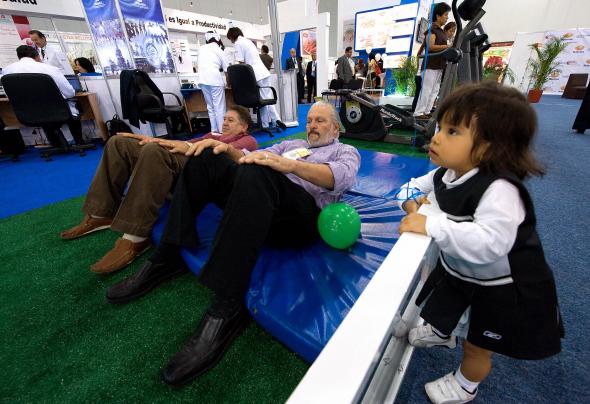
89974541-men-make-exercises-at-the-world-summit-against-obesity Men exercise at the World Summit Against Obesity in Mexico City on Aug. 20, 2009.

89974541-men-make-exercises-at-the-world-summit-against-obesity.jpg.CROP.promovar-mediumlarge

Photo by Luis Acosta/AFP/Getty Images

A new report from the Britain-based Overseas Development Group on changing global diets finds that there are now more than twice as many overweight or obese people living in the developing world as in wealthy countries. Overall, the number of affected people in developing countries “more than tripled from around 250 million people in 1980 to 904 million in 2008. By contrast, the number of people who were overweight or obese in high-income countries increased 1.7 times over the same period.”

At first glance, given the 870 million hungry people still living in the world, this might seem like a good problem to have. After all, the trend is one driven largely by the growing middle classes in emerging economies and the availability of cheap food.

But as the report’s co-author Steve Wiggins pointed out to me in a phone interview yesterday, “over the next decades we can expect much higher rates of strokes, heart disease, and some form of cancers, in the developing world. In addition to the individuals suffering illness or premature death, we’ll see economic losses due to them being ill or dying early as well as higher costs and the health service.”

Noncommunicable diseases make up an increasingly large share of the global disease burden. Eighty percent of NCD deaths were in developing countries in 2008, compared with 40 percent in 1980. Some public health advocates have even compared the relative inattention to these diseases in international development circles to the slow realization of the humanitarian impact of AIDS during the 1990s.

While much of the literature on global obesity focus on the homogenization of global diets and the impact of western culture, media, and advertising on how people eat, Wiggins notes that when you look across the emerging economies of the developing world, you can see major differences in diets and rates of obesity and overweight.”

The two extremes are “Mexico, where you’ve got 2 out of every three people are overweight or obese and you’ve got a national epidemic of Type 2 diabetes, and towards the other end of the scale you’ve South Korea with roughly one third the rate of what we’re seeing in Mexico.”

(Of course as Katy Waldman points out today, South Korea has some other rather extreme body shape issues to contend with.)

Overall, Wiggins feels that from a public policy point of view, “Most of this is bad news. Nowhere in the world, including Korea, have we found a country where when you look over the last twenty thirty years, they’ve stemmed the rise in obesity. The prevalence is going up in just about every country.”

Joshua Keating is a staff writer at Slate focusing on international affairs and writes the World blog. Follow him on Twitter.

Economic Value of Skills

The economic value of skills
Skills that pay the bills

Jan 7th 2014, 17:16 by C.W. | LONDON

HOW well are your skills rewarded? There is surprisingly little research on that question, and what does exist is pretty much entirely focused on America. A new paper* from the OECD, a rich-country think-tank, tries to fill this gap.

The research uses survey data from the Programme for the International Assessment of Adult Competencies (PIAAC), released only a few months ago. The database is a big improvement on what has come before: not only does it look at people of all ages but the sample size is large. Over 150,000 people in 24 countries were interviewed: respondents were given numerical, literacy and problem-solving tests. (The results were then standardised on a 500-point scale.) The same survey asked people about their work.

The raw results of the PIAAC survey are fascinating. South Korean high-school graduates have better numeracy and literacy skills than Italian university graduates. Younger folk in Finland do substantially better than their elders.

Overall, the effect of skills on earnings (what economists call “returns-to-skills”) is unsurprising. The authors focus on numeracy and show that people with more skills earn more. A one-standard-deviation increase in numeracy skills is associated with an 18% wage increase among “prime-age” workers (workers between 25 and 54).

But there is massive variation in returns-to-skills:

Why? The authors conduct a series of regressions and, some would argue, show the limitations of social-democratic policies:

[R]eturns to skills are systematically lower in countries with higher union density, stricter employment protection, and larger public-sector shares.
The analysis shows, for example, that a 25% point increase in union density (the difference, say, between Belgium and the United Kingdom) leads to a 3.5% point lower wage increase for each one-standard-deviation increase in numeracy skills.

But free-market types should not gloat. Pretty much unexplored in the paper is the question of whether high returns-to-skills are a good thing. Highly skilled people might simply be extracting “rents”—economists’ shorthand for earning more than they would need to continue doing what they are doing. And when the skilled do extremely well, dystopian predictions like those discussed by Tyler Cowen in a recent book are never far away.

The Dogs Of War

THE DOGS OF WAR

Cartophilia: as the centenary of the first world war looms, Max Hastings decodes a satirical classic

0314ILPL20_MIL

From INTELLIGENT LIFE magazine, July/August 2013

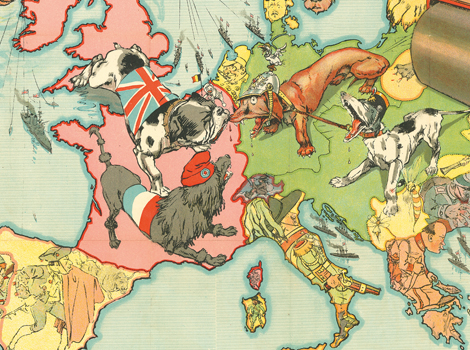
In the autumn of 1914, it was still fashionable in Britain to make excruciatingly elaborate jokes about the Great War. Walter Emanuel, a columnist for the magazine Punch, wrote a satirical column about it which initiated the doggy theme exploited in this map. Johnson & Riddle, the lithographic printers behind many of the early London tube maps, created the images in a style familiar to British audiences for half a century, with a range of German dachshunds, French poodles and Turkish curs eager for offal. It was sold as a poster with the accompanying comic commentary supplied by Emanuel.

The doughty British sailor stands offshore, holding the strings of his dreadnoughts, while only the bulldog’s forepaws are planted on the continent. It was a major delusion among British politicians in August 1914 that their country could do most of its fighting at sea. Winston Churchill, then First Lord of the Admiralty, wrote to the wavering chancellor, Lloyd George, arguing: “the naval war will be cheap.” The foreign secretary, Sir Edward Grey, told the House of Commons on August 3rd that, since Britain was a naval power, by entering the war “we shall suffer but little more than we shall suffer even if we stand aside.”

In the event, a British Expeditionary Force was dispatched to France, but this initially numbered just 52 infantry battalions, while Germany and France deployed over 1,000 apiece. British troop strength on the continent increased later, but in the early months the bulldog’s back legs remained firmly planted on English soil, which is where most of King George V’s subjects thought they belonged.

The allies pinned many military hopes upon the vaunted Russian steamroller. The tsar’s empire was thought capable of fielding at least 8m soldiers. It never did so, for lack of arms and equipment. In the winter of 1914, some influential voices in London argued that instead of expanding the army, Britain should do what it had so often done in the past: supply the weapons for others to do the fighting and dying. They cherished the notion of shipping war materiel to Russia through the Dardanelles, if these could be seized from the Turks. Though the plan foundered at Gallipoli, when this map was drawn hopes ran high.

Uncertainty persisted about whether several neutral European nations—notably Italy, Greece, Bulgaria, Romania—might join in the struggle. Then in 1915 the Rome government made a disreputable and reckless bargain with the allies: Italy would fight in exchange for Italian-speaking Hapsburg lands and the Greek-inhabited islands of the Dodecanese. By the time these prizes were secured in 1918, the butcher’s bill for them totalled 460,000 Italians dead.

This map does a military injustice to Germany, however, ignoring its 1914 conquests. The Kaiser’s armies had overrun almost all Belgium and a quarter of France, and held most of that until 1918. Likewise on the Eastern Front, German victories had frustrated Russian hopes of seizing East Prussia. Tsar Nicholas II had always feared that fighting for the Serbs would precipitate disaster for his own regime, and so it proved in 1917. The steamroller never rolled.

Every nation grossly miscalculated the consequences of war. The proximate reality was that the Germans’ mistake was worst, because they lost. But the victors found little to celebrate. By Armistice Day, it is hard to imagine that a British audience would have found a map such as this one food for much mirth. As for the Germans, who republished the war-dog map as a sample of British propaganda, they might argue that in the 21st century, the dachshund is having the last laugh.

Max Hastings is a former editor-in-chief of the Daily Telegraph and the Evening Standard

For the full map go to http://www.themaphouse.com