Good News for the Lone Star State

Texas Set to Become One of the World’s Largest Oil Producers by 2020
By Joao Peixe | Tue, 08 October 2013 22:05 | 2

Barry Smitherman, the Chairman for the Texas Railroad Commission, has said that the number of drilling permit applications being submitted in the lone star state have reached their highest level for 30 years, and that production is continuing to rise to near record levels, putting Texas on track to become one of the largest oil producers in the world before 2020.

“This year we are likely to issue more drilling permits for oil than we have since 1985.”

Fuel Fix performed a review of the drilling permit applications submitted and found that during the first eight months of 2013 the number of applications is 18% higher than in 2012. Smitherman says that this increasing number of permits has already seen daily oil production in Texas surpass 1.8 million barrels, and will likely move onto 3 million barrels a day in 2017, and 4 million a day in 2020.

Related article: US Shale Dealt a Blow as Oil Majors Struggle to Turn a Profit

“If we got to 3 million or 4 million barrels per day, we suddenly are in the club of the biggest producers in the world.”

The top crude oil producer in the world at the moment is Russia, producing 10.73 million barrels a day (12.65% of world production). Producing 3 million barrels a day would make Texas the ninth largest producer, behind Russia, Saudi Arabia, US, Iran, China, Canada, Iraq, and the UAE. Producing 4 million barrels a day would make Texas the sixth largest producer.

Texas’ resurging production levels are thanks mainly to the Eagle Ford Shale formation in South Texas, and the Permian Basin in West Texas.

Permian Basin

The Permian Basin has experienced a new lease of life as a major producing formation thanks to hydraulic fracturing, which has allowed companies to restart production at old fields, boosting the daily output to around 900,000 barrels.

Eagle Ford

The Eagle Ford has experienced an explosion in growth, producing just 352 barrels a day in 2008 it now produces 657,000 barrels a day. Smitherman predicts that, due to the number of new drilling permits, the field could start producing over 900,000 barrels a day next year.

“What has happened in our state over the last five to six years is nothing short of a technological miracle.”

By. Joao Peixe of Oilprice.com

We Can be More Proud of these People than of our Elected So-Called Leaders

U.S. Says Navy SEAL Team Stages Raid on Somali Militants
By NICHOLAS KULISH and ERIC SCHMITT
Published: October 5, 2013

NAIROBI, Kenya — A Navy SEAL team targeted a senior leader of the Shabab militant group in a raid on his seaside villa in the Somali town of Baraawe on Saturday, American officials said, in response to a deadly attack on a Nairobi shopping mall for which the group had claimed responsibility.

The SEAL team stealthily approached the beachfront house by sea before exchanging gunfire with militants in a predawn firefight that was the most significant raid by American troops on Somali soil since commandos killed Saleh Ali Saleh Nabhan, a Qaeda mastermind, near the same town four years ago.

The unidentified Shabab leader is believed to have been killed in the firefight, but the SEAL team was forced to withdraw before that could be confirmed, a senior American security official said. Such operations by American forces are rare because they carry a high risk, and indicate that the target was considered a high priority. Baraawe, a small port town south of Mogadishu, the Somali capital, is known as a gathering place for the Shabab’s foreign fighters.

“The Baraawe raid was planned a week and a half ago,” said another security official, speaking on the condition of anonymity about a classified operation. “It was prompted by the Westgate attack,” he added, referring to the mall in Nairobi that was overrun by militants two weeks ago, leaving more than 60 dead.

Witnesses in the area described a firefight lasting over an hour, with helicopters called in for air support. A senior Somali government official who spoke on the condition of anonymity confirmed the raid, saying, “The attack was carried out by the American forces and the Somali government was pre-informed about the attack.”

A spokesman for the Shabab, which is based in Somalia, said that one of its fighters had been killed in an exchange of gunfire but that the group had beaten back the assault. American officials initially reported that they had seized the Shabab leader, but later backed off that account. The first American security official said there were no reports of American casualties in the operation.

The deadly assault on the Westgate shopping mall was a stark reminder of the power and reach of the Islamist group, which has had a series of military setbacks in recent years and was widely viewed as weakened.

The F.B.I. sent dozens of agents to Nairobi after the shopping mall siege to help Kenyan authorities with the investigation. United States officials fear that the Shabab could attempt a similar attack on American soil, perhaps employing several of the group’s Somali-American recruits.

Another United States official said it was still unclear whether any Americans were involved in the Westgate mall episode, though there were growing indications that fewer attackers took part in the siege than the 10 to 15 militants the government had previously announced.

A spokesman for the Kenyan military said Saturday that it had identified four of the attackers from surveillance footage. Local news media reported their names as Abu Baara al-Sudani, Omar Nabhan, Khattab al-Kene and a man known only as Umayr. “I can confirm that those are the names of the terrorists,” said Maj. Emmanuel Chirchir, the spokesman.

The footage, broadcast on Kenyan television on Friday night, showed four of the attackers moving about the mall with cool nonchalance, no hint in their demeanor that they had stormed a shopping center and massacred dozens of people, much less that they feared an imminent counterassault from Kenyan security services.

One loitered in the grocery checkout aisle, talking on his cellphone. Another slouched in a storage room like a worker on break.

At least one of the four men, Mr. Nabhan, is Kenyan, and believed to be related to Saleh Ali Saleh Nabhan, the Qaeda mastermind killed four years ago near Baraawe.

The elder Mr. Nabhan was a suspect in the bombing of an Israeli hotel on the Kenyan coast in 2002 and the attacks on the American Embassies in Kenya and Tanzania in 1998.

He was one of the most wanted Islamic militants in Africa when American commandos killed him in September 2009 in an audacious daytime attack. Four military helicopters shot at two trucks rumbling through the desert, killing six foreign fighters, including Mr. Nabhan, and three Somali members of the Shabab.

Mr. Nabhan was of Yemeni descent but was born in Mombasa, on Kenya’s coast. Kenyan news media reported that the younger Mr. Nabhan also came from Mombasa, and was among the Kenyans who traveled to Somalia to fight with the Shabab.

Matt Bryden, the former head of the United Nations Monitoring Group on Somalia and Eritrea, said the tactics used in the Westgate attack were similar to those used by the Shabab in a number of operations in Somalia this year. But he also said that local help was needed to pull off an attack on that scale, and that several of the men identified as taking part in the attack were connected to group’s Kenyan affiliate, known as Al Hijra.

“We should certainly expect Al Hijra and Al Shabab to try again,” Mr. Bryden said. “And we should expect them to have the capacity to do so.”

The raid on Saturday appeared to have been intended to blunt those capabilities. A witness in Baraawe said the house was known as a place where senior foreign commanders stayed, though he could not say whether they were there at the time of the attack.

The witness said 12 well-trained Shabab fighters scheduled for a mission abroad were staying there at the time of the assault.

There was some confusion as to exactly what happened before sunrise on Saturday. Witnesses described the SEAL team using silencers in the initial attack, but a loud firefight afterward. Before confirmation that an American SEAL team was behind the attack, a Shabab spokesman said British and Turkish forces were involved, which both countries immediately denied.

“The attackers were not able to enter the house,” the spokesman, Sheik Abdiaziz Abu Musab, said in a telephone interview. “Our fighters were fighting very hard.”

Nicholas Kulish reported from Nairobi, and Eric Schmitt from San Francisco. Reporting was contributed by Josh Kron from Mombasa, Kenya; Sebnem Arsu from Istanbul; Michael S. Schmidt from Washington; and Mohammed Ibrahim from Mogadishu, Somalia.

While Republicans are not special, they are the first Flakes of the Winter Season

Melissa Griffin CaenWriter, San Francisco Magazine; lawyer
GET UPDATES FROM MELISSA GRIFFIN CAEN

Like
Congressional Republicans Are Not Special Snowflakes
Posted: 10/04/2013 6:06 pm
Follow
Republican Party, Government Shutdown, Politics News

Quick, who said the following?:

“I believe that we must pass a continuing resolution to fund the operations of Government and that we must resist the temptation, however strong, to add all our most deeply felt causes to this essential appropriations bill.”

It was Republican Senator John Danforth of Missouri. And he said it on September 29, 1984.

In the history of government failures to pass appropriations for federal functions, impasses are usually based on, oh you know… stuff that’s actually in the appropriations bill, like military spending levels.

That Obamacare doesn’t even need an appropriation, and is thus sputtering forward despite Congress’ failure to pass a Continuing Resolution, is all the evidence you need to see that it is not appropriately included in the CR debate. But this is not the first time a wholly separate law has held up the passage of a CR.

Nope, much as certain Congressional Republicans believe themselves to be special, special snowflakes, they are not.

In October 1984 Democrats in the Senate tried to attach the Civil Rights Act of 1984 to the CR. On October 1, 1984, the Philadelphia Inquirer described the issue thusly: “a bitter tug-of-war over civil rights legislation that has stalled action on an emergency money bill to keep most of the federal government solvent.”

At the time, Sen. Ted Kennedy made the case that Act was relevant to the CR because he didn’t want federal funds spent on institutions that discriminate. It was baloney, of course. One had nothing to do with the other; it just seemed the only way to get the dang thing passed before Election Day on November 6, 1984.

Kennedy wasn’t the only person who tried to attach non-germane pet projects like barnacles to the USS Continuing Resolution, but he was the only successful one.

At the midnight hour of a September 30, 1984 shutdown, the Senate voted to keep the government operational for two more days while an agreement was reached — the Democrats eventually removed the Civil Rights Act of 1984 from the CR and it passed on October 2, 1984. (The Civil Rights Bill wasn’t passed until 1989.)

In addition to Sen. Danforth’s statement above, here are some excerpts from the floor debate prior to the shut down. (From the Congressional Record, 98th Congress (1984) Part 2.)

“I do think the Senate should now have a chance to cast their vote for or against the so-called Civil Rights Act of 1985. If it wins, fine. If it loses, fine. But I do not particularly think encouraging this kind of action on a continuing resolution is wise at this time of the year, in this year. Nor will it be wise as a precedent in the coming years if we are going to look upon a continuing resolution as nothing but a gigantic Christmas tree to which we can, without any worry at all think about 1,200 amendments being added.”
-Sen. Barry Goldwater (R-AZ), September 29, 1984

“We are not voting on busing,* we are not voting on gun controls, we are not voting on abortion; we are voting on a continuing resolution to operate the Government past Sunday midnight. If we do not have the guts enough every now and then to do some things that are unpleasant and politically dangerous in order to keep this Government running, we have forfeited our fundamental responsibility as Members of the Senate.

My urging, Mr. President, is that we forget about the collateral issues and focus instead on the primary issue, and that is keeping this Government running.

There will be a chance and there will be adequate chance even yet this session for Members to speak on things like busing and gun control, and all the rest. But do not do it by trivializing the rules of the Senate. Do not do it by avoiding the responsibility of keeping this Government running, and do not do it 2 days before this fiscal year expires.”

*Other Senators were trying to put in provisions about abortion, gun control and school busing.

-Sen. Howard Baker (R-TN) Senate Majority Leader, September 29, 1984

“Mr. Speaker, all of these issues deserve independent consideration. They should not be tied into a continuing resolution.”
-Rep. Vin Weber (R-MN), October 1, 1984.

And as we approach a potential further shutdown on the debt ceiling:

“I know that some feel it imperative to cast another vote against the debt ceiling, but unless we are willing to shoulder the blame for shutting government down, we will have to eventually pass something.”
-Rep. Delbert Latta (R–OH), October 1, 1984.

His son, Bob Latta, now represents Ohio’s 5th district. So far, Latta Junior has voted in lockstep with the shutdown-causing GOP.

See, Republicans in this Congress aren’t the first to see the power of attaching non-germane bills to the CR. They’re just the first to go this far to gamble our republic on it.

Maybe they are special after all.

A Fashion Statement

ARMS AND THE WOMAN

Six months ago, our survey showed that fashion wasn’t giving our female readers what they wanted—especially in the triceps area. To find the answers, Isabel Lloyd takes the Style desk shopping

From INTELLIGENT LIFE magazine, September/October 2013

0513ILST16_MIL

“Don’t you have anything with sleeves on?” On a warm evening in early summer, on the ground floor of a large department store in central London, a young woman was pleading with one of the assistants in the All Saints concession. After an abrupt improvement in the weather the place was humming with post-work workers, all on the same sudden mission to find something to wear now the sun had finally come out. At the entrance to the changing rooms, the queue of women waiting for free cubicles snaked round piles of discards, a crumpled cornucopia of dresses in garden-party pinks and acid yellows, posh-utility separates in grey chiffon and navy silk, drapey tops and drainpipe jeans. The assistants were doing their best, but their smiles were fraying. And despite their help and the choice on offer, could this poor girl—not model-skinny, not fat, just average size with average hang-ups about her body—find an attractive top that wouldn’t be too hot but covered the tops of her arms? Could she heck.

The style survey we ran in the March/April issue of Intelligent Life shows she isn’t alone. We asked 40 women of different ages, backgrounds, sizes and nationalities what they really felt about fashion. Where were the holes in modern clothes? Their answers were clear. They wanted more clothes that were well made and that would last, not flop after a few washes, drop their buttons or come apart at the seams. They wanted brands that didn’t constantly churn their stock and shift their styles, but that had a consistent identity they could rely on season after season. They wanted clothes that showed some regard for the well-being of the planet and for the people employed to make them. And they wanted more sleeves. Lots more sleeves. Men might think it’s the size of our bums that women are obsessed by, but what really makes us wince when we look in the mirror is that faint wobble of blancmange just south of the triceps.

Cover it up, and we breathe a whole lot easier. Yet many designers seem unable or unwilling to help. After the department-store girl wandered off muttering “I only wanted one top…”, I did a sleeve-count of the racks of different brands. Among them were teen-pleasers like Topshop and Miss Selfridge, but also more grown-up labels such as Michael by Michael Kors and Ted Baker—and still a good 85% of the dresses and tops on offer had no sleeves. If you wanted a tad more coverage, you had to buy a jacket or cardigan as well. Maybe that was the idea.

Common sense says it can’t all be weeds in fashion’s garden. There must be some people making clothes the women we surveyed would approve of. So here at the Style desk we set ourselves the task of tracking down brands that meet at least some of the following criteria: they sell well-made clothes in a way that is sustainable and/or ethical, rather than swinging wildly between the points of fashion’s compass, they pick a direction and stick to it, they produce no more than two collections a year, and they design plenty of pieces which don’t need special bras, knickers or slips before you can decently leave the house in them. To keep things desirable, we also gave each brand marks out of ten for stylishness. Though in the same genus as fashion, style is a subtly different beast and hard to track down: what we looked for were clothes that were sharp, not stuffy. And that, preferably, had sleeves.

What follows here is the best of the labels and designs that we found. Most we turned up by grilling stylists, checking out the goods at press days, and nosing around in shops – we were those odd people peering at stitching and tugging at hems—while a few came from our own wardrobe back-stories. There are few big names, though. With some, it was slavishness to fashion that ruled them out, and the bewildering speed with which they change stock: Topshop states with some pride that it ships 300 new styles to its Hong Kong flagship every week. Slower high-street brands such as Reiss, Whistles, COS or J Crew might change their stock less vigorously, bringing about 300-400 new pieces in-store over the course of a three-month season, but they failed to distinguish themselves with particularly high quality. J Crew’s famous cashmere-in-every-colour has a tendency to bobble. I’ve had the cuff buttons break on a £150 Whistles shirt on its first day out, and all I was doing was typing.

Despite our best efforts, we couldn’t find one brand that ticked every box and got a high style score—many of the most eco-conscious brands, for instance, still sell clothes that make you look worthy rather than wonderful, and if they do get it right in style terms, they then fall down on quality or the sleeve issue. But while no one individual brand or item scored in every category, everything here scores in at least two, and some do considerably better. Who did the best? I’ll save that bit of good news for last.

Top Yellow Shakespeare silk-print dress, £953, by Georgia Hardinge; 18ct white gold and Gemfields ethically sourced emerald “Sabre” earrings, £20,100, by Shaun Leane at Couture Lab

Above Dark denim Jesse Stretch jeans, $225, by Imogene + Willie; drop tourmaline and 18ct granulated gold ring, £2,600, by Milly Swire at Wolf & Badger

Recent Statistics on Shootings in the United States

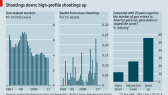
20130921_USC443_1190Gun massacres
Mass shootings are up; gun murders down

Sep 21st 2013 |From the print edition

On September 16th a former navy reservist, Aaron Alexis, shot 12 people dead at a military base in Washington, DC. Though rare, such tragedies are increasingly common in America. The past 30 years have seen 67 mass shootings (in which four or more people were killed by a gunman not involved in a conventional crime), says Mother Jones magazine. There have already been five this year, after seven last year. Massacres grab headlines, and so may explain why many Americans believe, incorrectly, that gun crime is on the rise. In fact, gun murders have fallen by half in the past 20 years. (This is in line with the general decline in crime, but also owes something to modern medicine. Hospitals have become much better at keeping gunshot victims alive, so the kind of shootings that would have been fatal 20 years ago are often not today.) Americans are still much more likely to shoot each other than are people in other rich countries, though.

Clarification: This article has been amended to include the fact that improvements in modern medicine have also helped reduce the number of gunshot deaths.

Some Good News from the Budget Office

The Deficit Is Plunging! And Nobody Cares!
America’s debt burden is falling faster than CBO projected, and, of course, this has changed nobody’s minds
Derek Thompson Sep 17 2013, 1:28 PM ET

The annual long-term budget outlook from the Congressional Budget Office is an incredible document and, at least ostensibly, a moment to reflect on U.S. government spending and taxing. Instead, every year, it acts more like a magic mirror, somehow perfectly reflecting the previous biases of each reader.

Consider the CBO’s opening chart this year, which appears at the top of this article. Stare deeply into its green and darker green hues. Squint and meticulously trace the federal spending and revenues lines. What do you see?

Fiscal conservative Jim Pethokoukis sees the case for fiscal conservatism. Don’t-worry-about-the-debt economist Brad DeLong finds cause to not worry about the debt. I think Brad is right for now and Jim less right, but who cares what I think? After writing about this stuff for a few years, it occurs to me that I will never change readers’ mind about the debt. Ever. If you locked a hundred budget wonks in a room with one simple debt graph and told them they couldn’t leave until they agreed on what it meant, cannibalism would come before consensus.

But you know who has changed its mind? The CBO. Director Doug Elmendorf admitted as much in a presentation last week.

In 2007, the CBO thought our debt burden was going to fall to hysterically low levels (see: YELLOW line). Then the Great Recession happened, and the CBO revised its projections (see: GREY). But even a year ago, it was still wrong by billions of dollars of annual deficits …

… Without warning, health care costs slowed down and Congress repeatedly flayed the discretionary budget for dubious reasons, and CBO’s debt projections fell, by many trillions of dollars, once again (see: BLUE).

Of particular note, projected spending on Medicare — perhaps the most important driver of our long-long term debt — fell sharply since the recession, but not because of the recession. “Evidence does not support a finding that demand for health care by Medicare beneficiaries was measurably diminished by the financial turmoil,” Michael Levine and Melinda Buntin wrote in a CBO working paper this spring, and “much of the slowdown in spending growth appears to have been caused by other factors.”

Debt hawks are still asking Washington to direct its valuable focus to long-term debt rather than short-term crises like long-term unemployment and wage stagnation. House Republicans are still threatening a showdown over the debt ceiling and a continuing resolution to fund government operations.

The hawkish arguments are unyielding, even as the underlying evidence is changing rapidly.

Since you made it this far, here’s my unyielding argument: In the middle of a crisis we knew we were having, we’ve sacrificed growth and jobs to insure ourselves against a crisis we thought we’d have in the future — whose imminent threat is fading by the year. The tired cliche says, Washington is miserable at thinking about the future. One sequestration, a thousand cuts, and many trillions of dollars of deficit reduction later, perhaps that cliche could lose its last three words.

An Interesting Thought on an Arcane Subject

Do Tobin taxes actually work?
Sep 9th 2013, 23:50 by C.R.

ON SEPTEMBER 2nd Italy became the first country in the world to extend its financial-transaction tax to high-frequency share trading. The Italian government hopes the tax will stabilise markets, reduce financial speculation and raise revenue for the government, as do ten other Eurozone countries considering similar policies. Such levies have been dubbed “Tobin taxes” after James Tobin (pictured),20130914_blp502 a Nobel Laureate in economics, who in 1972 first suggested taxing financial transactions. But do Tobin taxes actually work?

Tobin originally put forward his idea in a very different context to that faced by the Italian government today. He promoted it as a way of stabilising currency markets after the Bretton Woods system of fixed exchange rates collapsed in 1971. His proposed tax on currency exchanges was intended to curb de-stabilising capital flows across borders. Tobin envisaged a global tax, which was impossible to avoid by moving financial markets offshore. The proceeds would be donated to developing countries. But today Italy is implementing the tax on its own in a very different context. Its problems include a debt crisis, an uncompetitive economy and a weak banking sector, rather than exchange rate instability. The aim is not only to reduce stock market volatility, but to use the extra revenue to reduce Italy’s budget deficit.

The evidence to support Tobin taxes is thin on the ground, however. Most academic studies generally agree that they may not necessarily decrease volatility in financial markets. An experimental study in 2010 by researchers at the University of Innsbruck suggested that a global Tobin tax would have little impact on volatility. And there is not much evidence at all that unilateral Tobin taxes work. Although large markets might see a fall in volatility, smaller markets would see a rise due to a fall in liquidity. Even Barry Eichengreen, a supporter of Tobin’s original proposals, now argues that a European Tobin tax may prove a “distraction” that allows systemic risks and instability to increase in other areas. For instance, according to Harald Hau, an economist at the Swiss Finance Institute and the University of Geneva, “credit misallocation” in the economy as the result of distorting equity and bond prices may make life difficult for small and medium sized business that cannot raise finance from abroad. In practice Tobin taxes imposed unilaterally have proved unsuccessful as markets have moved abroad to avoid them. Sweden’s experiments in the 1980s with a transaction tax on shares, equity derivatives and fixed-income securities ended in failure as activity moved offshore to avoid the levies. In the first week of the fixed-income tax bond trading volumes fell by 85%; the amount eventually raised from the tax averaged only about 3% of what was predicted. By 1990 over 50% of Swedish equity trading had moved to London.

Similar difficulties may lurk in Italy. Il Sole, a financial daily, has reported that Italian traders are beginning to move their residency to Malta, which has excluded itself from any such proposed tax. This suggests that the Italian government may not raise as much revenue as it originally thought. However, by not extending the tax to bonds, the Italians have attempted to avoid the pitfall identified by the International Monetary Fund that a tax on trading government bonds might increase the cost of public borrowing. This would have been disastrous for Italy, a country faring badly in the European sovereign-debt crisis. But has it avoided all the potential adverse effects of the policy? Current academic opinion suggests that this is unlikely. The rest of Europe will no doubt be watching closely.

More Dirty Work from the NSA

Sept. 10, 2013, 4:58 p.m. EDT
NSA violated privacy protections, officials say

By Siobhan Gorman and Devlin Barrett
WASHINGTON — The National Security Agency’s searches of a database containing phone records of millions of Americans violated privacy protections for years by failing to meet a court-ordered standard, intelligence officials acknowledged Tuesday.

They said the violations continued until a judge ordered an overhaul of the program in 2009.

The revelations called into question NSA’s ability to run the sweeping domestic surveillance programs it introduced more than a decade ago in the wake of the 2001 terrorist attacks. Officials said the violations were inadvertent, because NSA officials didn’t understand their own phone-records collection program. (Read the Director of National Intelligence’s statement on the document release.)

• Breaking-news alerts: Get free email alerts the instant news breaks
“There was nobody at the NSA who had a full understanding of how the program worked,’‘ said an intelligence official.

Top U.S. officials, including NSA Director Keith Alexander, have repeatedly reassured lawmakers and the public that the phone-records program has been carefully executed under oversight from the secret Foreign Intelligence Surveillance Court court.

“This is not a program where we are out freewheeling it,” Alexander said in June. “It is a well-overseen and a very focused program.”

Until Tuesday, officials hadn’t described the period in which the program repeatedly violated court orders. They made public the violations as part of a court-ordered release of documents stemming from lawsuits by the Electronic Frontier Foundation and the American Civil Liberties Union.

The release included roughly 1,800 pages of documents, including orders from the secret court and government correspondence with the court.

This Is Change We Can Believe In – for a Change

The US government has betrayed the internet. We need to take it back
The NSA has undermined a fundamental social contract. We engineers built the internet – and now we have to fix it

Bruce Schneier
The Guardian, Thursday 5 September 2013 15.04 EDT

‘Dismantling the surveillance state won’t be easy. But whatever happens, we’re going to be breaking new ground.
Government and industry have betrayed the internet, and us.

By subverting the internet at every level to make it a vast, multi-layered and robust surveillance platform, the NSA has undermined a fundamental social contract. The companies that build and manage our internet infrastructure, the companies that create and sell us our hardware and software, or the companies that host our data: we can no longer trust them to be ethical internet stewards.

This is not the internet the world needs, or the internet its creators envisioned. We need to take it back.

And by we, I mean the engineering community.

Yes, this is primarily a political problem, a policy matter that requires political intervention.

But this is also an engineering problem, and there are several things engineers can – and should – do.

One, we should expose. If you do not have a security clearance, and if you have not received a National Security Letter, you are not bound by a federal confidentially requirements or a gag order. If you have been contacted by the NSA to subvert a product or protocol, you need to come forward with your story. Your employer obligations don’t cover illegal or unethical activity. If you work with classified data and are truly brave, expose what you know. We need whistleblowers.

We need to know how exactly how the NSA and other agencies are subverting routers, switches, the internet backbone, encryption technologies and cloud systems. I already have five stories from people like you, and I’ve just started collecting. I want 50. There’s safety in numbers, and this form of civil disobedience is the moral thing to do.

Two, we can design. We need to figure out how to re-engineer the internet to prevent this kind of wholesale spying. We need new techniques to prevent communications intermediaries from leaking private information.

We can make surveillance expensive again. In particular, we need open protocols, open implementations, open systems – these will be harder for the NSA to subvert.

The Internet Engineering Task Force, the group that defines the standards that make the internet run, has a meeting planned for early November in Vancouver. This group needs to dedicate its next meeting to this task. This is an emergency, and demands an emergency response.

Three, we can influence governance. I have resisted saying this up to now, and I am saddened to say it, but the US has proved to be an unethical steward of the internet. The UK is no better. The NSA’s actions are legitimizing the internet abuses by China, Russia, Iran and others. We need to figure out new means of internet governance, ones that makes it harder for powerful tech countries to monitor everything. For example, we need to demand transparency, oversight, and accountability from our governments and corporations.

Unfortunately, this is going play directly into the hands of totalitarian governments that want to control their country’s internet for even more extreme forms of surveillance. We need to figure out how to prevent that, too. We need to avoid the mistakes of the International Telecommunications Union, which has become a forum to legitimize bad government behavior, and create truly international governance that can’t be dominated or abused by any one country.

Generations from now, when people look back on these early decades of the internet, I hope they will not be disappointed in us. We can ensure that they don’t only if each of us makes this a priority, and engages in the debate. We have a moral duty to do this, and we have no time to lose.

Dismantling the surveillance state won’t be easy. Has any country that engaged in mass surveillance of its own citizens voluntarily given up that capability? Has any mass surveillance country avoided becoming totalitarian? Whatever happens, we’re going to be breaking new ground.

Again, the politics of this is a bigger task than the engineering, but the engineering is critical. We need to demand that real technologists be involved in any key government decision making on these issues. We’ve had enough of lawyers and politicians not fully understanding technology; we need technologists at the table when we build tech policy.

To the engineers, I say this: we built the internet, and some of us have helped to subvert it. Now, those of us who love liberty have to fix it.

• Bruce Schneier writes about security, technology, and people. His latest book is Liars and Outliers: Enabling the Trust That Society Needs to Thrive. He is working for the Guardian on other NSA stories

Daily Email

An Interesting Approach to a Huge Problem

How the Fukushima Ice Barrier Will Block Radioactive Groundwater
Japan plans to stop leaking radioactive groundwater at Fukushima with an underground wall of ice. Here’s how it would work.

By Peter Fairley on August 30, 2013

WHY IT MATTERS

Contaminated groundwater remains a huge problem at Fukushima.

Cold storage: A freeze wall created for a construction project by the company SoilFreeze.

Japanese officials desperate to contain an ever-growing crisis at the Fukushima nuclear power station are looking to use artificial permafrost to stop radioactive water from leaking. The idea is to build a mile-long wall of frozen earth around Fukushima’s toxic reactor buildings to stem the groundwater contamination; the most experienced specialists in the field say the plan should work.

The Japanese firms involved appear to be taking a go-it-alone approach. Two weeks ago, a top official at Tokyo Electric Power (Tepco) signaled that the utility behind the Fukushima disaster would seek international assistance with the Fukushima water contamination crisis. But experts at U.S.-based firms and national labs behind the world’s largest freeze-wall systems—and the only one proven in containing nuclear contamination—have not been contacted by either Tepco or its contractor, Japanese engineering and construction firm Kajima Corp.

One of these experts is Elizabeth Phillips, who managed the installation of a 300-foot-long, 30-foot-deep freeze wall to isolate radioactive waste at the U.S. Department of Energy’s Oak Ridge National Laboratory in Tennessee in 1996 and 1997. While freeze walls are commonly used to hold back groundwater to facilitate excavations at construction sites and mines, this case calls for specialized expertise, she says. “You need to make sure that whoever is doing it is analyzing everything that can go wrong,” says Phillips. “You should go with someone who has done it before.”

Every day roughly 400 tons of groundwater flowing down from the nearby mountains enters cracks in the reactor buildings damaged by the meltdowns and explosions at Fukushima in 2011, according to an April 2013 Tepco briefing document. Water that escapes from the buildings pollutes the groundwater downstream and ultimately spills into the sea. The contaminant levels are dangerously high. Last month Tepco pulled water from a sampling well downstream of the buildings containing radiation levels that were orders of magnitude higher than the levels deemed safe by the Japanese Nuclear Regulation Authority.

Tepco’s efforts to prevent that spread so far have been ineffective, risky, and ultimately unsustainable. Its primary response has been to pump contaminated groundwater into holding tanks, adding to the more than 300,000 tons of radioactive water already stored at Fukushima in hastily assembled tanks that are vulnerable to future earthquakes. Some have already leaked. Last week Japan’s Nuclear Regulation Authority recorded one recent 300-ton leak as a level-3 incident—the first incident at Fukushima that it has rated on the international nuclear event scale since 2011.

The freeze wall would be a more definitive approach to managing groundwater. As proposed by Kajima in April and endorsed in May by a Nuclear Regulation Authority expert panel, it would run 1.4 kilometers and encircle the site’s four destroyed reactors. Vertical pipes are to be drilled or driven into the ground at one-meter intervals, creating what looks like an array of sub-soil fence posts. Fourteen 400-kilowatt refrigeration plants would pump -20 °C to -40 °C coolant down each pipe to absorb heat from the ground, producing an expanding cylinder of frozen earth.

In roughly six weeks, those cylinders would fuse together to form a continuous barrier that keeps groundwater out and contaminants in. The result would be a solid barrier from the surface extending approximately 95 feet down to meet a low-permeability layer of clay and rock. And while it would require long-term chilling to endure, the wall is immune to power outages lasting days or weeks. “It would take months or years to thaw the wall out,” says Daniel Mageau, vice president and design engineer for Seattle-based contractor SoilFreeze.

Several features make freeze walls better barriers than those fashioned from steel, concrete, or clay—alternatives that the Nuclear Regulation Authority’s panel considered and rejected. A key advantage cited by Phillips is the freeze wall’s self-healing capacity. For example, water flowing into cracks caused by an earthquake—an ever-present threat at Fukushima—would freeze to reëstablish the barrier. “That’s a really great asset,” says Phillips.

The Oak Ridge experience suggests it will work at Fukushima, according to Phillips and experts at the contractors that built the lab’s wall: Rockaway, New Jersey-based geotechnical contractor Moretrench and Anchorage-based Arctic Foundations. It remains the only nuclear containment freeze wall project to date, and one that has been mischaracterized in press reports as an experiment. “It wasn’t a model. It was drilling into contaminated soils and stopping real radiologically contaminated materials from escaping and traversing down into a creek,” says Arctic Foundations chief engineer Edward Yarmak.

The Oak Ridge freeze wall fused in January 1998 and contained the same suite of elements present at Fukushima for six years—the duration specified for Fukushima’s wall by the Nuclear Regulation Authority panel—until regulators ordered the U.S. Department of Energy to remediate the site. Phillips is confident that it would have operated beyond its 30-year design life.

Joseph Sopko, director of ground freezing at Moretrench, says that Kajima’s proposed one-year timeline for installation and freezing is reasonable in light of an installation he managed for a gold mine in northern Ontario in the late 1990s that saw pipes for a two-mile long wall installed in just under one year. The scale for the Fukushima wall, meanwhile, looks downright small compared to a five-mile-long wall proposed for an oil sands operation in Alberta, for which Moretrench is currently conducting pilot studies.

One major drawback, however, is power consumption. While the walls take months or years to thaw once frozen—and are thus immune to power outages—they do require long-term refrigeration to endure. Typically, the cooling power required for maintenance is about half of what was required to form the wall.

Tepco and Kajima could save energy if they employed a technique used at Oak Ridge. Its wall incorporated passive devices known as thermosyphons that Arctic Foundations has installed across Alaska to reinforce melting permafrost under buildings and infrastructure. A coolant gas passively cycles in the tubes whenever the ground is warmer than the air above, absorbing heat at the bottom by boiling, then dumping that heat at the top by condensing and finally dripping back down the tube wall to repeat the cycle.

Thanks to the inclusion of thermosyphons, the Oak Ridge system consumed barely 100,000 kilowatt-hours of power annually—less than 10 homes would use in a year. “It’s a very efficient system for moving heat against gravity. There are no moving parts,” says Yarmak.

Still, while Yarmak would love to export Arctic Foundations’ thermosyphons to Japan, he says power consumption is not a critical issue for Fukushima. Even with the more conventional freeze wall system that Kajima has proposed, whose power consumption would be roughly 250 times larger than at Oak Ridge, the power use still looks small in context. “For the scope of the problem that Japan has, it’s not a lot of energy,” he says.

16