Peter Sagan at Stage 6 of the USA Pro Challenge

Another Stage Win for Peter Sagan of Team Cannondale

I had the pleasure of attending the finish of Stage 6 of the USA Pro Challenge at Fort Collins, CO a bit over a week ago.

I arrived at the 1 kilometer to go kite about 5 minutes before the peloton reached it. Sagan was at sixth wheel and I knew there was no way anyone would cross the finish line ahead of him.

I went to the Cannondale store and purchased a Pro Team Jersey. I was lucky to run into Peter Sagan just as he was getting ready to have his urine tested. I asked him to autograph my jersey and he did.
Saganattest lab

The photo above shows Peter Sagan on the right, just before he signed my jersey.

Sanity Prevails!

A Very Wise Decision by Obama
He moves himself, and the country, out of a corner, with two important choices.

James Fallows Aug 31 2013, 1:59 PM ET

The two crucial parts of his announcement just now:

1) No rush about doing whatever needs to be done with Syria. This is a punitive rather than a preventive action, which should be undertaken with deliberation and — if and when it happens — by surprise.

2) Recognizing the higher wisdom — for himself, for the country, for the world — of taking this to the Congress.

This is the kind of deliberation, and deliberateness, plus finding ways to get out of a (self-created) corner, that has characterized the best of his decisions. It is a very welcome change, and surprise, from what leaks had implied over the past two weeks.

When there is a transcript, will do a brief annotation. To appreciate how far we have come, consider the lead front-page headline from the WaPo just yesterday.

Update: I got a transcript, I spent half an hour going through it all with notations, then our blog system had some kind of glitch and everything disappeared. Dammit. I can’t stand to re-do that, so I’ll mention a couple of key sentences:

“The Chairman of the Joint Chiefs [known not to be enthusiastic about another engagement] has informed me that we are prepared to strike whenever we choose. [Yes! An avoidance of the apparent rush; a recognition that in a punitive raid the advantage of time, and surprise, is on his side.] Moreover, the Chairman has indicated to me that our capacity to execute this mission is not time-sensitive; it will be effective tomorrow, or next week, or one month from now. [The structure of this sentence implying an ellipsis and leaving room for, “or whenever after that.”]

But having made my decision as Commander-in-Chief based on what I am convinced is our national security interests, I’m also mindful that I’m the President of the world’s oldest constitutional democracy. [This and the preceding paragraph, back to back, were the signal that Obama had made the two crucial choices. 1) There’s no rush, and 2) involve the Congress.] I’ve long believed that our power is rooted not just in our military might, but in our example as a government of the people, by the people, and for the people. And that’s why I’ve made a second decision: I will seek authorization for the use of force from the American people’s representatives in Congress. [I stopped listening super-carefully at this point, because the big news was in.]

Over the last several days, we’ve heard from members of Congress who want their voices to be heard. [And of course Obama understands that even many of those people, plus most of the rest, were actually hoping he would ignore them. That was they could complain about his arrogant imperial overreach now, plus themselves avoid taking what can only be a difficult vote.] I absolutely agree. [Don’t throw me in that briar patch!] So this morning, I spoke with all four congressional leaders, and they’ve agreed to schedule a debate and then a vote as soon as Congress comes back into session…. And all of us should be accountable [see above. Every single Representative and Senator will either have to vote to support the Administration, or have to explain a No vote the next time Assad gasses someone] as we move forward, and that can only be accomplished with a vote.

I’m confident in the case our government has made without waiting for U.N. inspectors. I’m comfortable going forward without the approval of a United Nations Security Council that, so far, has been completely paralyzed and unwilling to hold Assad accountable. [A brush-away that is simultaneously off-hand, polite, reasonable-sounding, and utterly dismissive of the Security Council’s uselessness in cases like this. And yet, as a reader pointed out, there is that significant “so far,” allowing for the conceivability of a Russian or Chinese change.] …

Yet, while I believe I have the authority to carry out this military action without specific congressional authorization, I know that the country will be stronger if we take this course, and our actions will be even more effective. [This sentence deserves lapidary examination. The “I believe” / “I know” pairing, the assertion of presidential prerogative as a segue to requesting Congressional approval, the appeal to the high road. Nicely done.]

We should have this debate, because the issues are too big for business as usual. And this morning, John Boehner, Harry Reid, Nancy Pelosi and Mitch McConnell agreed [When have we seen those ten words in that order? Or will see them again?] that this is the right thing to do for our democracy.

If we ever resurrect the lost annotation, I’ll rework it. The leitmotif was invoking several previous times in which Obama had shifted from lackluster and puzzling to being in command of his powers. Eg politically: the disaster of his first debate against Romney, versus his comeback in debates two and three. Strategically: falling for the Afghanistan surge argument in 2009, and then correcting course and reversing the policy by 2011. And now this: a ten-day period in which he seemed out of control, leading to what is strategically and politically a much wiser course.

Are We Really Doing a Limited Strike Against Syria? Why Limited?

The U.S.’s Proof of a Syrian Army Chemical Attack Is an Intercepted Call

REUTERS

ABBY OHLHEISER 4,611 ViewsAUG 27, 2013
Here’s why the U.S. is so sure that Syrian president Bashar al-Assad’s government was behind a deadly chemical attack on August 21: U.S. intelligence listened in on a phone call between a Syrian Ministry of Defense official and someone at the country’s chemical defense unit. That call, according to a report at Foreign Policy, is more or less why the U.S. is certain that Assad’s government bears responsibility for the massacre near Damascus.

Based on the evidence, the U.S. is all but certain to take some course of limited military retaliation against the Syrian army for the chemical attacks carried out in Syria. While President Obama is still officially considering his options, there’s little evidence to suggest that the U.S. will continue to stick solely to a diplomatic approach towards the country.

Previous reports have indicated that the U.S. was relying in part on intercepted communications relating to the chemical attack in their assessment. According to CNN, an intelligence report on Syria, planned for public release in the coming days, will include intercepted intelligence along with forensic information. That report is being compiled by the Office of the Director of National Intelligence, and could be released by Thursday. Rumors of an intercepted phone call were picked up widely by the conservative press for days after the German magazine Focus spoke to an anonymous Israeli intelligence official, who claims that the intercepted phone call comes from intelligence gathered by one of their elite units. Foreign Policy, however, specifies that U.S. intelligence overheard the call.

But as Foreign Policy’s report explains, the call’s content doesn’t answer many questions still out there about the Assad regime’s culpability here:

Was the attack on August 21 the work of a Syrian officer overstepping his bounds? Or was the strike explicitly directed by senior members of the Assad regime? “It’s unclear where control lies,” one U.S. intelligence official told The Cable. “Is there just some sort of general blessing to use these things? Or are there explicit orders for each attack?”
Nor are U.S. analysts sure of the Syrian military’s rationale for launching the strike — if it had a rationale at all. … “We don’t know exactly why it happened,” the intelligence official added. “We just know it was pretty fucking stupid.”
The New York Times also picked up on the “why” angle of the Syrian chemical attack on Tuesday evening.

But the U.S. hasn’t promised to answer every question about the chemical attack before announcing a response: as Secretary of State John Kerry laid out on Monday, the burden of proof as far as the government is concerned seems to be directed toward whether the attack happened, and whether Assad’s government is somehow responsible. Now that the U.S. believes their case is strong enough on both parts, their response quickly approaches. (Update, 11:10 p.m.: CNN’s Frances Townsend reports that the National Security Council is meeting tonight on Syria)

More On President Obama’s Disgraceful NSA Prism Program

Secret Court Rebuked N.S.A. on Surveillance
By CHARLIE SAVAGE and SCOTT SHANE

WASHINGTON — A federal judge sharply rebuked the National Security Agency in 2011 for repeatedly misleading the court that oversees its surveillance on domestic soil, including a program that is collecting tens of thousands of domestic e-mails and other Internet communications of Americans each year, according to a secret ruling made public on Wednesday.

The 85-page ruling by Judge John D. Bates, then serving as chief judge on the Foreign Intelligence Surveillance Court, involved an N.S.A. program that systematically searches the contents of Americans’ international Internet communications, without a warrant, in a hunt for discussions about foreigners who have been targeted for surveillance.

The Justice Department had told Judge Bates that N.S.A. officials had discovered that the program had also been gathering domestic messages for three years. Judge Bates found that the agency had violated the Constitution and declared the problems part of a pattern of misrepresentation by agency officials in submissions to the secret court.

The release of the ruling, the subject of a Freedom of Information Act lawsuit, was the latest effort by the Obama administration to gain control over revelations about N.S.A. surveillance prompted by leaks by the former agency contractor Edward J. Snowden.

The collection is part of a broader program under a 2008 law that allows warrantless surveillance on domestic networks as long as it is targeted at noncitizens abroad. The purely domestic messages collected in the hunt for discussions about targeted foreigners represent a relatively small percentage of what the ruling said were 250 million communications intercepted each year in that broader program.

While the N.S.A. fixed problems with how it handled those purely domestic messages to the court’s satisfaction, the 2011 ruling revealed further issues.

“The court is troubled that the government’s revelations regarding N.S.A.’s acquisition of Internet transactions mark the third instance in less than three years in which the government has disclosed a substantial misrepresentation regarding the scope of a major collection program,” Judge Bates wrote.

One of the examples, was redacted in the ruling. Another involved a separate N.S.A. program that keeps logs of all domestic phone calls, which the court approved in 2006 and which came to light in June as a result of leaks by Mr. Snowden.

In March 2009, a footnote said, the surveillance court learned that N.S.A. analysts were using the phone log database in ways that went beyond what the judges believed to be the practice because of a “repeated inaccurate statements” in government filings to the court.

“Contrary to the government’s repeated assurances, N.S.A. had been routinely running queries of the metadata using querying terms that did not meet the standard for querying,” Judge Bates recounted. He cited a 2009 ruling that concluded that the requirement had been “so frequently and systematically violated that it can fairly be said that this critical element of the overall … regime has never functioned effectively.”

The Electronic Frontier Foundation, a free speech and privacy rights group, sued to obtain the ruling after Senator Ron Wyden, an Oregon Democrat who sits on the Senate Intelligence Committee, fought last summer to declassify the basic fact that the surveillance court had ruled that the N.S.A. had violated the Fourth Amendment.

In a statement, Mr. Wyden — an outspoken critic of N.S.A. surveillance — said declassification of the ruling was “long overdue.” He argued that while the N.S.A. had increased privacy protections for purely domestic and unrelated communications that were swept up in the surveillance, the collection itself “was a serious violation of the Fourth Amendment.”

Mark Rumold of the Electronic Frontier Foundation praised the administration for releasing the document with relatively few redactions, although he criticized the time and the difficulty in obtaining it. But he also said the ruling showed the surveillance court was not equipped to perform adequate oversight of the N.S.A.

“This opinion illustrates that the way the court is structured now it cannot serve as an effective check on the N.S.A. because it’s wholly dependent on the representations that the N.S.A. makes to it,” Mr. Rumold said. “It has no ability to investigate. And it’s clear that the N.S.A. representations have not been entirely candid to the court.”

(Page 2 of 2)

A senior intelligence official, speaking to reporters in a conference call, portrayed the ruling as showing that N.S.A. oversight was robust and serious. He said that some 300 N.S.A. employees were assigned to seek out even inadvertent violations of the rules and that the court conducted “vigorous” oversight.

The ruling focused on a program under which the N.S.A. has been searching domestic Internet links for communications — where at least one side is overseas — in which there are “strong selectors” indicating insider knowledge of someone who has been targeted for foreign-intelligence collection. One example would be mentioning a person’s private e-mail address in the body of an e-mail.

Most of the time, the system brings up single communications, like an e-mail or text message. But sometimes many messages are packaged and travel in a bundle that the N.S.A. calls “multi-communication transactions.”

A senior intelligence official gave one example: a Web page for a private e-mail in-box that displays subject lines for dozens of different messages — each of which is considered a separate communication, and only one of which may discuss the person who has been targeted for intelligence collection.

While Judge Bates ruled that it was acceptable for the N.S.A. to collect and store such bundled communications, he said the agency was not doing enough to minimize the purely domestic and unrelated messages to protect Americans’ privacy. In response, the N.S.A. agreed to filter out such communications and store them apart, with greater protections, and to delete them after two years instead of the usual five.

A Justice Department “white paper” released with the ruling shed new light on N.S.A. surveillance of communications streaming across domestic telecommunications networks. Such “upstream” collection, which still must be targeted at or be about non-citizens abroad, accounts for about 10 percent of all the Internet messages collected in the United States, it said; the other 90 percent are obtained from Internet companies under the system the N.S.A. calls Prism.

The administration also released a partly redacted semiannual report about “compliance” incidents, or mistakes involving the privacy rights of Americans or people in the United States. It found that there had been no willful violations of the rules, and that fewer than 1 percent of queries by analysts involved errors.

The document also showed that the government recently changed the rules to allow N.S.A. and C.I.A. analysts to search its databases of recorded calls and e-mails using search terms designed to find information involving American citizens, not foreigners — an issue that has long concerned Senator Wyden and that was mentioned in a document leaked by Mr. Snowden and published by The Guardian.

The number of “selectors” designed to filter out and store communications targeted at foreigners had gone up steadily, the document said, although the numbers were redacted. And its increase is expected to “accelerate” because the F.B.I. recently made the ability to nominate people for such collection “more widely available to its field office personnel.”

Exciting News for Television Viewers

Sony and Viacom Reach Tentative Internet TV Deal
By BRIAN STELTER
Published: August 15, 2013

Viacom has tentatively agreed to let its popular cable channels — like Nickelodeon and MTV — be carried by an Internet TV service in the works at Sony, a deal that could signal the start of a new era of competition for entrenched cable and satellite providers.
Add to Portfolio

The agreement is believed to be the first of its kind between a major programmer and any of the technology giants that are trying to disrupt the traditional television model. Viacom and Sony declined to comment on Thursday, but a person directly involved in the negotiations confirmed a Wall Street Journal report about the agreement, which still must be wrapped up by the two companies.

Most households today have only a few choices for television service: whatever cable company serves their local area, be it Comcast, Time Warner Cable or others, and two satellite providers, DirecTV and Dish Network. (In some parts of the country, television through Verizon or AT&T is also available.)

Sony and rivals like Intel and Google want to change that, with a goal of selling a bundle of cable channels, the way Comcast and DirecTV do, via the Internet, and make the TV experience more convenient, the way Netflix does with personalization features and a fancy interface.

To do that, the upstarts need the permission of programmers, and that’s why the Viacom deal is a breakthrough. Viacom has more than 20 channels, including big ones like Comedy Central and small ones like Centric. Altogether the channels account for about 15 percent of American cable television viewing.

The person involved in the negotiations insisted on anonymity on Thursday because the companies were not prepared to comment on the record, but having the news spread was advantageous for Sony. Having Viacom on board — even just on a preliminary basis — will most likely help Sony complete other carriage deals. The company is known to be in negotiations with some of the other biggest programmers in the country, like the Walt Disney Company and Time Warner.

That Viacom was the first to agree to support Sony’s fledgling service isn’t necessarily surprising, since the company has a reputation for contentious relationships with cable and satellite companies. Last year, Viacom channels were blacked out in DirecTV households for nine days. Sumner Redstone controls both Viacom and the CBS Corporation, which is currently blacked out in three million Time Warner Cable households because of a contract dispute.

Sony has said almost nothing about its Internet TV intentions, but the company has been interested in selling channels through its PlayStation video game console for years. The PlayStation, with tens of millions of units hooked up to television sets worldwide, gives the company a distinct advantage over other new competitors. The Sony cable channel service could also be made available in the future via smartphones, tablet computers and other devices.

Sony hopes to start selling the service in the fourth quarter of 2013 or the first quarter of 2014, according to a media company executive briefed on the plans for it.

If Sony’s service (or another one like it) gets off the ground, incumbent cable companies like Comcast and Time Warner Cable are also likely to sell their own versions, furthering this new type of TV competition. Cox, a privately-held cable company, is already testing such an “over-the-top” service — so named because the programming rides over the top of existing broadband cables — in Southern California.

What no one knows — but everyone in the television industry wonders — is whether these Internet cable services would steal market share from incumbents; entice people who do not currently pay for any channel bundle to sign up; or fail to sign up customers at all.

Similar questions were asked when Verizon and AT&T started selling television nearly a decade ago. While those companies have taken market share away from cable and satellite, the overall number of American households paying for television has remained remarkably steady, even as companies like Netflix have provided new ways to consume TV.

A study released earlier this month by the Leichtman Research Group, which specializes in the media and entertainment industries, found that 86 percent of American households pay for some form of television, down from a historic peak of 88 percent in 2010.

More on Civil Liberties

Kevin Drum
Previous | Next
→ Civil Liberties, Military
The NSA Is Reading Every Email Sent To and From the United States

—By Kevin Drum
| Thu Aug. 8, 2013 8:34 AM PDT

Charlie Savage reports today that the NSA doesn’t just monitor communications between Americans and terrorist suspects overseas. It monitors every communication sent overseas, searching for keywords linked to foreigners already under surveillance:

The N.S.A. is not just intercepting the communications of Americans who are in direct contact with foreigners targeted overseas, a practice that government officials have openly acknowledged. It is also casting a far wider net for people who cite information linked to those foreigners, like a little used e-mail address, according to a senior intelligence official.

….To conduct the surveillance, the N.S.A. is temporarily copying and then sifting through the contents of what is apparently most e-mails and other text-based communications that cross the border. The senior intelligence official, who, like other former and current government officials, spoke on condition of anonymity because of the sensitivity of the topic, said the N.S.A. makes a “clone of selected communication links” to gather the communications, but declined to specify details, like the volume of the data that passes through them.

….The official said that a computer searches the data for the identifying keywords or other “selectors” and stores those that match so that human analysts could later examine them. The remaining communications, the official said, are deleted; the entire process takes “a small number of seconds,” and the system has no ability to perform “retrospective searching.”

The official said the keyword and other terms were “very precise” to minimize the number of innocent American communications that were flagged by the program.

The justification for this revolves around a close parsing of the word “target”: As long as no Americans are specifically targeted, NSA can trawl through our email as much as it wants. After all, the keywords it’s looking for may come from emails we send, but they’re targeted at foreigners:

The rule they ended up writing, which was secretly approved by the Foreign Intelligence Surveillance Court, says that the N.S.A. must ensure that one of the participants in any conversation that is acquired when it is searching for conversations about a targeted foreigner must be outside the United States, so that the surveillance is technically directed at the foreign end.

Maybe so. But if you send an email to a pal in Berlin, be careful. Mention the wrong name or talk about the wrong subject, and you could end up in the NSA’s dragnet.

Hard to Conceive

HARD TO CONCEIVE

The Music of Science: People are starting to dream about life off Earth. But, wonders Oliver Morton, have they thought about the babies?

From INTELLIGENT LIFE magazine, July/August 2013

At the beginning of the 1970s, when literary science fiction was as interested in breaking taboos as in breaking the surly bonds of Earth, Kurt Vonnegut wrote a story about a rocket loaded with enough freeze-dried sperm to inseminate the Andromeda galaxy. “The Big Space Fuck” was not the subtlest of satires. But its central conceit did at least nod to the idea that sperm—and, presumably, eggs—have some sort of role in securing a human future, even if all the characters in the story do end up being eaten by giant mutant lampreys.

Would that all space visionaries were as up-front about the facts of life. There has recently been a new wave of speculation and hype about the possibility of human habitats beyond the Earth. The Mars One foundation is talking about establishing a colony on Mars in the 2020s; Elon Musk, the entrepreneur behind the rocket company SpaceX, says he dreams of making a similar voyage himself, though not quite yet; Eric Anderson, chairman of a company that puts paying customers on to the International Space Station and founder of another which aims to mine asteroids, recently told the journalist James Fallows that he expects “irreversible human migration to a permanent space colony” within three to six decades—that is, in a time as close or closer to today as today is to the launch of Sputnik in 1957.

Not all of this is as technologically nutty as it sounds. Mars One’s notion that it could put together human interplanetary missions in ten years, with the cash generated by selling media rights, is prima facie absurd. The idea that Musk (42 this June) could be in a position to take a trip to Mars in his later years is more plausible; SpaceX has demonstrated an impressive ability to lower the costs of spaceflight, and might well be able to extend its capabilities too.

The nuttiness comes when you start talking colonies. Any “irreversible settlement” needs more than freeze-dried sperm. It needs babies. In the early 1960s Arthur C. Clarke—after whom the jizzship in Vonnegut’s story is named – wrote a short story of his own entitled, more decorously, “Out of the cradle, endlessly orbiting”. The title is a tribute both to Walt Whitman and Konstantin Tsiolkovsky, the visionary who established the dream of a cosmic destiny in the Russian imagination with gnomic utterances such as “the Earth is the cradle of the mind, but one cannot stay in the cradle for ever”. The sting of the story comes with the unexpected cry of the first baby born beyond the Earth, a cry more powerful to the protagonist than the roar of any rocketship.

At the moment that cry is no nearer being heard than it was in 1962. There is no evidence that people can have healthy babies—or, for that matter, any babies—away from Earth. The role that the Earth’s gravity plays in human pregnancy is unknown, but the chances that it is limited to encouraging backache seem remote. And evolution had no cause to optimise the process for other gravities, and when evolution doesn’t need to do something, it tends not to bother. Full-grown humans spending time in orbit, where they experience what’s known as “microgravity”, undergo a number of changes with quite serious medical consequences, such as muscle wasting, brittle bones and changes in pressure within their eyes. Some of this can be avoided with exercise and appropriately constrictive hosiery. Neither prophylactic is much use in utero, where making bones and balancing fluid pressures matter quite a lot.

What do animal studies reveal about the problem? Not much. Though humans have had rudimentary space stations since the 1970s, they have not been used to rear little microgravity-born mammals. Plans to install a centrifuge on the International Space Station which would have allowed long-term studies of life under Martian gravity as well as in microgravity came to naught. If you think this shows a lack of interest in permanent space colonies among those who have been paying for research in orbit, you could be right.

The would-be colonists may feel that when they turn their minds to solving such problems, solved they will be (there are plenty of rocket scientists on tap, after all). If so, they could be in for a shock—there is no guarantee that a way can be found for pregnancy to work off the Earth without, at the very least, the sort of experiments from which people would rightly blanch. But it seems more likely that they are not thinking much about the problem at all.

As Vonnegut was scabrously saying, fantasies of space travel are not, for the most part, fantasies about expanding the seamless human world of life and love which has, until now, had no option but to be Earth-bound. They tend towards something colder: fantasies about leaving the world behind, or starting it anew on the other side of the sky. They are ways of thinking about the future as something less like a birth than a death—which is, after all, the oldest established way out of one world and into another. Indeed, much of the humans-in-space enthusiasm around at the moment is about one-way trips, such as those touted by Mars One. There is an undeniable, if somewhat self-indulgent, romance to such ideas of radical sundering—but no obvious place for babies.

Oliver Morton is the briefings editor of The Economist, author of “Eating the Sun” and former editor of Wired

Descending from a Mountain Top on a Road Bike

What Goes Up at the Tour, Descends Dangerously Fast

Pascal Guyot/Agence France-Presse — Getty Images
For racers on bikes traveling 40 miles per hour, the road descending from la Rochette into Gap is terrifying.
By JAMES DAO
Published: July 16, 2013

GAP, France — The road descending from la Rochette into Gap is picture-book pretty. A valley dotted with red-tile roofs and tawny wheat fields opens before it. The snowy crags of the high Alps rise behind. Rustic farmhouses and purple wildflowers line its shoulders.

Overall leader Christopher Froome of Britain, left, and Spain’s Alberto Contador, right, sped down a pass in the last kilometers of the sixteenth stage of the Tour de France on Tuesday.
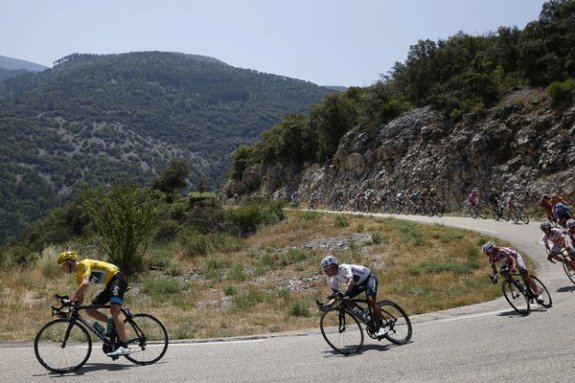
descent-articleLarge

For hikers, it is idyllic. For drivers, tricky. For racers on bikes traveling 40 miles per hour, terrifying. The road is twisting and steep, too narrow for compact cars to pass, with switchbacks that arrive shockingly fast. Innumerable ridges and barely-filled potholes in the pavement jolt even heavy vehicles.

It was here during the 2003 Tour de France that a top rider, Joseba Beloki, let fly, hoping to drop the race leader, Lance Armstrong. Instead, his front wheel slid on tar softened by the July heat and sent him tumbling. The crash effectively ended Beloki’s promising career and provided a stark reminder of an old saying: races are rarely won on descents, but they can be lost.

On Tuesday, as the 16th stage of the Tour came storming through these Alpine foothills, the dangerous descent from la Rochette almost took another big victim: Chris Froome of Sky, the race leader, who went off the road while swerving around the third-place rider, Alberto Contador of Saxo-Tinkoff.

In a near replay of the 2003 crash, Froome had been chasing Contador after the Spanish rider had tried to pedal away before the summit of the Col de Manse, hoping to trim his deficit and, perhaps, force the leader into a rash move. But when Contador momentarily lost control on a hairpin turn, Froome was forced into the grass.

Neither man was hurt and they leapt back on their bikes to finish with another group of contenders who, following Tour etiquette, had slowed to let them catch up. As a result the top three places in the race remained unchanged, with Froome retaining the yellow jersey, followed by Bauke Mollema of Belkin 4 minutes 14 seconds back and Contador 4:25 behind.

But after the race Froome made clear his displeasure with Contador for taking chances on an unsafe descent. “I personally think teams are starting to get desperate now and therefore taking uncalculated risks,” he told reporters.

Rui Costa, a Portuguese rider with Movistar, won the stage after joining a breakaway of about two dozen riders that built a lead of more than seven minutes on the main field. Costa, who has won the last two Tours of Switzerland, accelerated away from the group on the final climb and won by 42 seconds.

On Wednesday, a hilly time trial is expected to play to Froome’s strengths. But the stage is also likely to feature a fierce battle among the riders trying to reach the podium in Paris. Thursday will provide perhaps the most awaited stage of the Tour: a double ascent of towering Alpe d’Huez.

Between the two climbs, the riders will face a treacherous descent, off the Col de Sarrene along a back road that has never been used in the Tour before. Several riders, including Tony Martin of Omega Pharma-Quick Step, have raised concerns about the safety of the road, which is bumpy and lacks guard rails.

“It is a very dangerous descent,” Froome said Tuesday. “It’s not smooth, that’s for sure. There aren’t any barriers on the corners. If you go over the corner, you will fall down a long way.”

“Like we’ve seen today, this race is far from over,” he added. “One incident, one mechanical, or one crash in the wrong moment and your Tour can be over.”

Indeed, at this point in the three-week race, when the leader is trying to stay safe while his rivals are trying to pressure him into dangerous mistakes, descents become all the more crucial. Yet, descending remains the forgotten stepchild of bike racing, with far more attention given to climbing, sprinting and time trialing.

To casual observers, riders flying at speeds in excess of 50 miles per hour downhill may appear to be taking a break after a hard climb. But far from it. With so many dangers to worry about, including gravel, holes, wet spots and unexpectedly sharp turns, the riders must remain intensely focused. A crash would not just cost a rider time; it would probably end his race.

(Page 2 of 2)

“Descents are tough on the riders,” said Michael Barry, a former Grand Tour rider from Toronto who retired from the sport last year. “It’s not like you can relax and coast. The television doesn’t capture the speed the riders are descending at, how close they are to each other. And how fast they accelerate to catch each other.”

Though Beloki’s crash is the best known cautionary tale about descending, it is not the only case of a downhill affecting a race. In the 2011 Tour, Andy Schleck, a top contender, not known for his descending skills, lost time on the climb to la Rochette and then even more on the descent. He finished second that year to Cadel Evans.

And in May, the reigning Tour de France champion, Bradley Wiggins, lost time while descending with great caution after a crash during the Giro d’Italia. Wiggins, who is not riding in this year’s Tour, dropped out of the Giro, citing problems with his descending as a reason.

But descents can also work in favor of those who are bold and skillful enough to attack them. After losing valuable seconds on a climb during this year’s Tour of Switzerland, Peter Sagan of Cannondale regained time by descending aggressively. His swift descent allowed him to contest the final sprint, which he won.

Sagan is best known as a sprinter, but he is also widely considered among the best descenders on the Tour. Weight — as in, more of it — helps. At about 160 pounds, Sagan carries at least 10 pounds more than some of the skinniest climbers. His strong bike handling skills are also essential.

But other Tour riders point to an intangible as the most important factor in descending: fearlessness.

“A huge part of it is up here,” Andrew Talansky, a 24-year-old American rider with Garmin-Sharp, said, pointing to his head. “People like Sagan are just not afraid. And part of that is confidence. If you tap your brakes at the wrong time in a corner you crash. If you think you’re going to crash, you crash.”

Talansky, who is on his first Tour de France, said he found it difficult to practice descending because, even on roads closed to car traffic, a rider never experiences the pure terror, desperation and desire that one feels in the heat of a race.

“You just wouldn’t push it quite the same because there is nobody forcing you to do that,” he said. “There’s not this: I have to be in the front here.’ ”

The techniques of descending are, in theory, simple. On straight roads, riders will try to tuck themselves into the most aerodynamic position possible, even getting out of their saddles to sit directly on their bike frames. On turns, they will search for the straightest possible lines, starting wide and then slicing across the bend to exit wide on the other side. They will barely move the handle bars, turning by leaning, and they will tap the brakes as lightly as possible.

Staying relaxed is a huge part of the skill. Fearful riders are usually stiff riders, making them more prone to the kinds of herky-jerky movements that can destabilize a bike.

Riders who are not comfortable on screaming downhills are the most likely ones to crash, Sagan said. “When you see fear in his eyes, then he’s rigid,” he said in an interview before the race.

As for his own technique? Sagan, a 23-year-old Slovak for whom English is his third language, thought for a moment before boiling it down to this: “Not risk too much and come first down.”

More on Civil Liberties

Civil liberties
Robocops

How America’s police armed itself to the teeth
Jul 13th 2013 |From the print edition

Bobbies on the beat
Rise of the Warrior Cop: The Militarisation of America’s Police Forces. By Radley Balko. PublicAffairs; 382 pages; $27.99. Buy from Amazon.com

RADLEY BALKO’S writing has long been read by people who care about civil liberties. First for the Cato Institute, a libertarian think-tank, then for his own blog, “The Agitator”, now part of the Huffington Post, he has written about criminal-justice policy, with a focus on police abuses: not corruption so much as the excesses that have become inherent in ordinary policing.

Mr Balko manages to avoid the clichés of both right and left, and provokes genuine outrage at the misuse of state power in its most brutal and unaccountable form: heavily armed police raiding the homes of unarmed, non-violent suspects on the flimsiest of pretexts, and behaving more like an occupying army in hostile territory than guardians of public safety.

“Rise of the Warrior Cop”, Mr Balko’s interesting first book, explains what policies led to the militarisation of America’s police. To his credit, he focuses his outrage not on the police themselves, but on politicians and the phoney, wasteful drug war they created.

After the obligatory backward glances to the colonial era—in which the sort of social shaming possible only in small, homogeneous communities obviated the need for standing police forces—and the American civil war, Mr Balko’s story really begins with the Supreme Court’s 1963 ruling in Ker v California, which allowed the police to enter someone’s home without a warrant and without knocking or announcing themselves. That was the first in a long series of rulings that gutted the Fourth Amendment’s protection against unreasonable searches and seizures.

The social upheaval of the 1960s caught the attention of ambitious politicians and led them to focus on crime. Daryl Gates, then a rising star in the Los Angeles Police Department, created America’s first SWAT team in 1965 (he would eventually become the LAPD’s chief in 1978, call drug use “treason” and state that casual drug users “ought to be taken out and shot”). Richard Nixon ran successfully for president on a law-and-order ticket in 1968, bolstered by a “Silent Majority” which, in Mr Balko’s view, “began to see a link between drugs, crime, the counter-culture and race”.

Ronald Reagan made Nixon’s drug policies tougher. He dramatically increased both federal involvement in combating drugs and asset forfeiture, which allows law enforcement to seize goods and property believed to be used in crime or, more controversially, purchased with the proceeds of crime. This gave the police an incentive to find connections between property and drug activity, often at the expense of more serious crimes. As Mr Balko notes, “Closing a rape or murder case didn’t come with a potential kickback to the police department. Knocking off a mid- or low-level drug dealer did.”

Financial incentives also came through drug-war grants and, after the attacks of September 11th 2001, homeland-security grants that allowed police departments to buy surplus military hardware of dubious utility. Fargo, North Dakota, has received $8m in grants to buy goodies such as an armoured truck with a rotating turret—used “mostly for show, including at the annual city picnic, where police parked it near the children’s bouncy castle”.

Mr Balko is adept, in “Rise of the Warrior Cop”, at finding outrageous examples of SWAT-team misuse, such as deploying heavily armed police to break up small-stakes poker games, raid fraternity parties suspected of serving alcohol to underage patrons and arrest barbers for operating without licences. But he is too dismissive of arguments that stricter policing may have helped produce the remarkable drop in America’s crime rate. Thanks to his book, Americans will be more aware of the costs of those methods. But they—and he—should also consider possible benefits.

From the print edition: Books and arts

Environmental Update

Environment
→ Energy, Health, International, Top Stories
China’s Coal Reliance Reduces Life Expectancy by 5.5 Years, Study Says
High levels of air pollution will cause 500 million people to lose an aggregate 2.5 billion years from their lives.

—By Jonathan Kaiman
| Tue Jul. 9, 2013 1:15 PM PDT
7

Laoye Temple Mine LHOON/Flickr

This story first appeared on the Guardian website.

Air pollution causes people in northern China to live an average of five and a half years shorter than their southern counterparts, according to a study released on Monday that claims to show in unprecedented detail the link between air pollution and life expectancy.

High levels of air pollution in northern China—much of it caused by an overreliance on burning coal for heat—will cause 500 million people to lose an aggregate 2.5 billion years from their lives, the authors predict in the study, published in the journal Proceedings of the National Academy of Sciences.

The geographic disparity can be traced back to China’s Huai River policy, which, since it was implemented between 1950 and 1980, has granted free wintertime heating to people living north of the Huai River, a widely acknowledged dividing line between northern and southern China. Much of that heating comes from the combustion of coal, significantly impacting the region’s air quality.

“Using data covering an unusually long timespan—from 1981 through 2000—the researchers found that air pollution…was about 55% higher north of the river than south of it,” the MIT Energy Initiative said in a statement.

“Linking the Chinese pollution data to mortality statistics from 1991 to 2000, the researchers found a sharp difference in mortality rates on either side of the border formed by the Huai River. They also found the variation to be attributable to cardiorespiratory illness, and not to other causes of death.”

The researchers, based in Israel, Beijing, and the Massachusetts Institute of Technology, gauged the region’s air quality according to the established metric of total suspended particulates (TSP), representing the concentration of certain airborne particles per cubic meter of air.

The study concluded that long-term exposure to air containing 100 micrograms of TSP per cubic meter “is associated with a reduction in life expectancy at birth of about 3.0 years.”

Air pollution has been the subject of widespread public outrage in China since January, when Beijing’s air quality index (AQI)—a similar metric to TSP—regularly exceeded 500, the scale’s maximum reading, for weeks on end. On January 12, Beijing’s AQI hit a record 755, 30 times higher than levels deemed safe by the World Health Organization.

Past studies have established a link between air pollution and reduced life expectancy. One recent large-scale study concluded that air pollution contributed to 1.2 million premature deaths in China in 2010.

Yet according to Michael Greenstone, an economics professor at MIT and one of the study’s authors, this study is the first to precisely quantify their relationship. “Demonstrating that people die a bit earlier [because of pollution] is interesting and helps establish that pollution is bad,” he said. “But the most important question, the next question that needed to be answered, is what’s the loss of life expectancy? How much should society be willing to pay to avoid high levels of pollution? This study was structured so we could answer that question.”

China’s central authorities are keenly aware that environmental degradation has become one of the country’s leading causes of social unrest. Last month, China’s cabinet revealed 10 new measures intended to combat air pollution, and state media reported that Chinese courts can now impose the death penalty on serious polluters.