Tidings From the Food Industry

Dear American Consumers: Please don’t start eating healthfully. Sincerely, the Food Industry
By Patrick Mustain | May 19, 2013 | 17

Share Email Print

Dear Consumers: A disturbing trend has come to our attention. You, the people, are thinking more about health, and you’re starting to do something about it. This cannot continue.

Sure, there’s always been talk of health in America. We often encourage it. The thing is, we only want you to think about and talk about health in a certain way—equating health with how you look, instead of outcomes like quality of life and reduced disease risk. Your superficial understanding of health has a great influence over your purchasing decisions, and we’re ready for it, whether you choose to go low-calorie, low-fat, gluten-free or inevitably give up and accept the fact that you can’t resist our Little Debbie snacks, potato chips and ice cream novelties.

Whatever the current health trend, we respond by developing and marketing new products. We can also show you how great some of our current products are and always have been. For example, when things were not looking so good for fat, our friends at Welch’s were able to point out that their chewy fruit snacks were a fat free option. Low fat! Healthy! Then the tide turned against carbohydrates. Our friends in meat and dairy were happy to show that their steaks, meats and cheeses were low-carb choices. Low carbs! Healthy!

But we’re getting uneasy.

In 2009, Congress commissioned the Inter-agency Working Group (IWG) to develop standards for advertising foods to children. The IWG included the Federal Trade Commission (FTC), the Centers for Disease Control and Prevention (CDC), the Food and Drug Administration (FDA) and the United States Department of Agriculture (USDA).

Congress identified these organizations as having “expertise and experience in child nutrition, child health, psychology, education, marketing and other fields relevant to food and beverage marketing and child nutrition standards.”

We were dismayed when the IWG released its report in 2011. The guidelines said that foods advertised to children must provide “a meaningful contribution to a healthful diet.” For example, any food marketed to children must “contain at least 50% by weight one or more of the following: fruit; vegetable; whole grain; fat-free or low-fat milk or yogurt; fish; extra lean meat or poultry; eggs; nuts and seeds; or beans.”

This report was potentially devastating. These organizations, experts in nutrition, were officially outlining what constituted “a meaningful contribution to a healthful diet.” Thankfully, we have a ton of money and were able to use it to get the IWG to withdraw the guidelines.

In a public comment posted on the FTC website, our friends at General Mills pointed out that under the IWG guidelines, the most commonly consumed foods in the US would be considered unhealthy. Specifically, according to General Mills, “of the 100 most commonly consumed foods and beverages in America, 88 would fail the IWG’s proposed standards.” So you see? If you people start eating the way the nutrition experts at the CDC and USDA recommend that you eat, that would delegitimize almost 90 percent of the products we produce! Do you realize how much money that would cost us?

According to the General Mills letter, if everyone in the US started eating healthfully, it would cost us $503 billion per year! That might affect our ability to pay CEOs like General Mills’ Ken Powell annual compensations of more than $12 million.

But revamping the food environment will also cost you money. The General Mills letter stated “a shift by the average American to the IWG diet would conservatively increase the individual’s annual food spending by $1,632.” Sure, we’ve heard talk about costs to the individual that arise from being obese. One 2010 paper from the George Washington University School of Public Health and Health Services estimated that the annual costs to an individual for being obese can be upwards of $8,000. We like to think of this as a small price to pay for consumer freedom.

Of course, we don’t necessarily want you to be unhealthy. It’s just that it’s so much more profitable to provide foods that happen to be unhealthy. We’ve been able to industrialize the food system so that we can produce massive amounts of the cheapest ingredients available, in the cheapest, most efficient way possible.

On top of that, we understand human biology. Humans evolved in situations in which food was scarce. This led to an evolutionary adaptation that causes you to crave salty, sugary and fatty foods. Consuming foods with these characteristics actually lights up the same pleasure centers in the brain as cocaine. Who wouldn’t play upon that biological craving to increase profits? If one company didn’t, their competitors would, so we all kind of have to do it.

We are also able to provide you with perceived value. Because it doesn’t cost us that much more to make a soda, say, 42 ounces instead of 22, we can almost double the size of a beverage and only charge you 20 percent more. How could you resist a deal like that? You can’t. Trust us, we know.

So you see, dear consumer, everything is fine. We’ve got a good thing going here. There’s no need for you to start worrying about the industrial food system. If you do start thinking about your weight, check out our line of Healthy Choice frozen meals. If that doesn’t work, our friends over in the pharmaceutical industry, the health and fitness industry and the healthcare industry will be happy to help you to continue to fulfill your role as an American Consumer.

Images: by the author

Medicare Projections Plummeting

Don’t Look Now, but Our Medicare Spending Projections Are Plummeting
Predictions are hard, especially about health care inflation
DEREK THOMPSONMAY 14 2013, 4:07 PM ET
Screen Shot 2013-05-14 at 3.53.22 PM

Screen Shot 2013-05-14 at 2.50.36 PM
Here’s the story budget wonks will tell from today’s Congressional Budget Office report: The deficit is poised to shrink to its lowest level since 2008. Good news? Yes, if you’re a deficit hawk. Bad news? Yes, if you think (as I do) the deficit is falling too quickly, especially at a time of high unemployment and declining household debt.

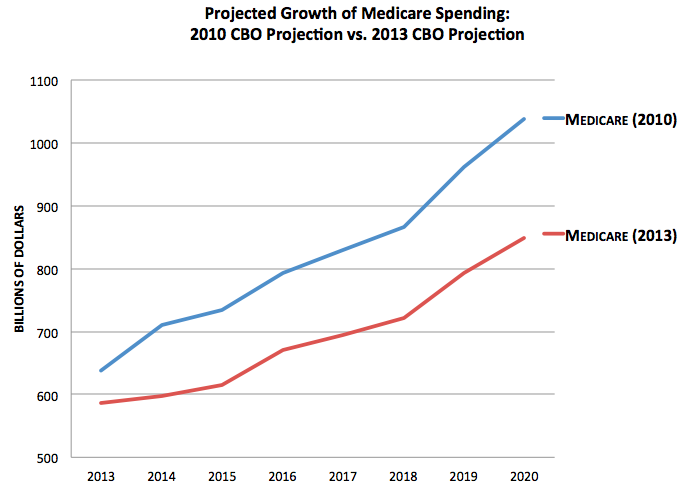
Here’s the story I wish more people would talk about: Our incredible shrinking Medicare projections. Since August, CBO has now revised down its projections of mandatory health care spending by nearly $500 billion, as Michael Linden pointed out. Since the 2010 CBO report, projected Medicare spending between 2013 and 2020 has fallen by just over $1 trillion … or 16%.

Here’s the graph comparing 2010’s Medicare projection to 2013’s …

… and here’s the graph comparing cumulative Medicare spending over that time. In three years, we’ve taken projected Medicare spending in the twenty-teens down from about $6.5 trillion to about $5.5 trillion.

So many numbers. Why should you care?

Two reasons. First, the “runaway” growth of health care costs has been a motivating reason for responsible Washingtonians to ignore the unemployment crisis and focus on our deficit. But lo-and-behold, we’ve cut more than ONE TRILLION DOLLARS from projected Medicare spending — and much more if you project out for the full decade. Many of the cuts have come from laws, like the Affordable Care act. Others came from lower growth in overall health care spending.

Second — and this is the really important point I wish I could make more often — this is an invaluable lesson in the folly of long-term budget projections (yeah, I appreciate the irony that I’m graphing budget projections to make this point). In a world where all predictions about the future of U.S. government spending turn out to be true, it makes a lot of sense to pay rapt attention to 10- and 20-year forecasts of spending and revenue. But in a world where the most exquisitely delicate change in hospital cost inflation suddenly saves hundreds of billions of dollars, it makes projections impressionistic, at best. In the future, there are budget crises that some people think might happen. In the present, there is a long-term unemployment crisis that we know is happening.

Why should impressionistic statistics about the future win that fight for Washington’s attention?

Hugo Chavez’ Sorry Legacy

Venezuela’s election aftermath
Cry havoc

As political and economic crises deepen, the army waits in the wings
May 11th 2013 | CARACAS |From the print edition

WITH a narrow and disputed election victory last month and an accelerating economic crisis, the man who succeeded Hugo Chávez as Venezuela’s president got off to an inauspicious start. Now Nicolás Maduro’s efforts to establish authority are making matters worse at home, and setting alarm bells ringing abroad.

After appearing to promise a full audit of the election results, as demanded by Henrique Capriles, the candidate of the Democratic Unity (MUD) coalition, the government backtracked. Human-rights groups say that more than 200 protesters, including teenagers, were detained by the military and many beaten up. Antonio Rivero, a retired general and leading opposition member, was arrested. He is on hunger strike, charged with “inciting hatred” and “criminal association”. Mr Capriles, who has asked the supreme court to annul the election, is threatened with jail.

There was violence even in the National Assembly. The MUD’s 67 legislators were barred from speaking and had their salaries blocked for refusing to acknowledge Mr Maduro as president. When they unfurled a banner decrying the “legislative coup” and blew whistles and vuvuzelas, the government’s congressmen attacked. María Corina Machado, an independent, needed a three-hour operation for facial injuries. The government blamed opposition “provocation” and claimed that one congressman’s bloodied face was the result of make-up. Members’ mobile-phone videos showed otherwise. (Government TV cameras pointed at the ceiling during the fracas.)

The neighbours are worried. Some members of Unasur, a South American political block, are smarting over the government’s U-turn on the election audit, which it seems was promised in return for their attendance at Mr Maduro’s inauguration. Since then Mr Maduro has accused Álvaro Uribe, a former Colombian president, of plotting to assassinate him (Mr Uribe has threatened to sue), and lashed out at Peru’s foreign minister, who had called for “tolerance and dialogue”. He made his foreign-policy priorities clear by seating Raúl Castro, Cuba’s president, in a prominent position at his swearing-in, and making Havana his first foreign trip.

Food shortages are worsening and inflation is nearing 30%. Falling oil prices have eroded foreign reserves, roughly 70% of which consist of gold, another tumbling commodity. The government has acknowledged the crisis by replacing Jorge Giordani, the hard-line finance minister, with Nelson Merentes, a moderate. But without a change of course, Venezuela is heading for social unrest.

Diosdado Cabello, the speaker of the Assembly and a former army lieutenant, is seen as Mr Maduro’s main rival within the chavista movement. Many on the radical, civilian left view him as a dictator-in-waiting. His contemporaries in the army are now generals. Some fear that Mr Cabello is trying to engineer violence that would leave him holding the whip hand. Mr Maduro appears to have little room for manoeuvre. In contrast to Mr Chávez’s one-man show, government decisions are taken by a shadowy junta known as the “political-military command”.

For the first time, analysts are speaking of a split in the armed forces. Rocío San Miguel of Citizens’ Control, a think-tank, says street violence requiring army intervention “could oblige the armed forces to take a [political] position”. The government says this is alarmist talk put about by the opposition and Venezuela’s foreign enemies. But the crisis seems ever more real.

From the print edition: The Americas

3D Printing in the News

3D printing: coming to a high street near you

An American student last week fired a gun made with the new technology. Next up: jewellery and art from your local copyshop

The Observer, Saturday 11 May 2013 18.32 EDT

A pair of shoes created using 3D technology
A pair of shoes created using 3D technology by the company Inner Leaf. Photograph: Jane Mingay/Rex Features

It has been used to make weapons, life-saving body parts and even sex toys, but now 3D printing is moving from the industrial estate to the high street.

One of the world’s first 3D printing shops opened in London last week just as an American student demonstrated to the world’s media how to use the technology to make a working gun.

Dr Greg Gibbons, an expert in 3D printing at Warwick University said customers would soon be able to walk into a shop and have their own jewellery, artworks or machine parts printed.

“We will see 3D print shops like we would have photocopy shops in the past. They would have four or five different machines with several different types of material,” he said.

“Customers could go in with a computer-aided design [CAD] file or a dishwashing machine part to be scanned and leave with a three-dimensional copy.”

Cody Wilson’s fabrication of a gun last week in Austin, Texas highlighted the capabilities and accessibility of 3D printing. He made several parts of a gun with a secondhand 3D printer which cost him £5,000 and added a metal firing pin before firing a standard bullet.

Marcus Fairs, editor of Print Shift magazine, which focuses on 3D printing, said the gun should not obscure the real technological developments in 3D printing. “It takes something shocking to make people realize that technology that has been under people’s noses is transformational,” he said,

Fairs’s magazine features the use of 3D printing in medicine, house-building, food, fashion, archaeology and building military components.

Three-dimensional printing, also known as additive-layer manufacture, was first developed in the 1980s but has been slow to move out of engineering to other industries. The technology works by building up layer upon layer of material – typically plastic – to construct complex solid objects.

Andy Millns, a director of Inition, a London-based 3D printing company, says his company has created objects for clients ranging from advertisers to car makers. Items include models of buildings, sculptures based on data from survey results and social media activity and replicas of sculptures from the Fitzwilliam Museum in Cambridge.

“We won’t be printing out cutlery because it would be more expensive and less attractive than mass-produced versions. But 3D printing liberates development from traditional prototyping which is very expensive. 3D allows designers to work more independently,” he said.

The iMakr store in Clerkenwell, London, which opened this month, sells 3D printers and services. Sylvain Preumont, the owner, said his store aimed to educate customers in the use of 3D printing. “Any school metal workshop can produce a gun, but 3D printing can do far more things,” he said. “The technology was pioneered by large corporations, has been picked up by techies and is ready for the third wave: ordinary people.”

At iMakr, customers can scan an object and have it printed and learn about CAD and other aspects of 3D printing. A person’s head could be scanned and reproduced for around £120.

But there are more serious uses for 3D printing. It can be used to produce synthetic bones for transplants and doctors can produce models of organs to prepare themselves for carrying out surgery.

Gibbons said 3D printing was important in “high-value” low-output manufacturing such as the space, aerospace and niche car industries. The US army has developed printers to make parts in remote outposts. The sex toy industry offers bespoke toys.

But at 3Dprint UK of south London, Nick Allen is keen to demolish some of the 3D printing hype. “It’s a slower and more expensive way of manufacturing items and the product is far lower quality than something mass produced.

“It’s great for key rings but very expensive for most things. I do prototypes and one-offs and that’s where it is strongest. It’s a very useful tool but it will not revolutionize manufacturing.””

A Faulty Education System in the United States Allows Our Political Leaders to Take Advantage of Us

The United States has the highest corporate tax rate on the planet. According to data from KPMG, a global consultancy, the US corporate tax rate for 2013 is 40 percent. The average global rate for 2013 is less than 25 percent.

This difference in tax rates has a significant impact on the US economy and on its residents and citizens. You might ask why this is the case. This is where our faulty education system allows our political leaders to treat us as idiots (according to word derivations the term idiot is derived from the Greek language and denotes someone being ignorant of civic matters). This is true because corporations can locate manufacturing, selling, and distribution facilities wherever they can best afford. In selecting places in which to operate a corporation will consider matters such as real estate value, supply chain proximity, wage rates, an educated labor force,and overhead costs. Among the overhead costs considered will be the corporate income tax. Since our tax rate is more than one-third higher than most developed countries, we are at a huge competitive disadvantage. This is why many US corporations have sent jobs overseas for the past 30 years or so. Unless things change, the situation will only get worse. My main question here is why our schools do not make this clear to students in our high schools and universities.

There are some people who think we ought to tax corporations heavily. Some of these people are totally oblivious to the reality that, economically speaking, corporations do not pay taxes. Why is this? It is because income taxes are a cost of doing business and are, therefore, passed on to buyers in the purchase price. The higher the rate of taxes the more US consumers pay for products produced by corporations. This reality was clearly illustrated when the US government eliminated the depletion allowance for large integrated oil companies. As soon as that elimination became law, the price of oil and gas at the pump increased by an amount roughly equal to the tax benefit of the lost depletion allowance. By having a high rate of corporate income tax we are essentially sticking it to ourselves. Why would we do that? Because we do not know any better. This is one case where I believe our governor has it right. We must reduce corporate income taxation to level out the playing field so we can keep more jobs of all skill levels in the United States.

So, why do our elected leaders not push for lower corporate taxes. The answer is simple. Corporations do not vote. Our shameless political leaders believe, and they are probably right in many cases, that we are a nation of fools who do not understand that by increasing corporate taxes Congress is indirectly increasing taxes on individuals. As corporate profits go up, consumer prices go up in lockstep. How is this any different from increasing taxes on individuals? Of course the flip side is that if corporate taxes go down, the US work force might actually increase and payroll and individual taxes would go up. Who could be opposed to this? No one should be, the gutless wonders in the District of Columbia care about nothing other than being re-elected. Increasing corporate taxes plays well with an undereducated electorate. Moreover, they can blame the job losses on greedy corporations who, again, do not vote.

What can we do? Writing letters will not help. It almost never does. The only thing that will help will be kicking out the career politicians at every election and demanding more and better leadership from the new people. Once they are elected, we should make sure that they know we are watching them and will actually show up and vote at every opportunity. We should also demand state conventions to change our constitution so there will be term limits on all political offices. The day of careers in elected office should end; the sooner the better.

We should supplement political action with changes in high school curricula so that the next generation of adults will have the political savvy, knowledge and, hopefully, the will to manage their elected officials and not just letting incumbents win from year to year. We should bring back civics classes as well as classes dealing with basic principles of income taxation.

Still Rehashing the Last Election

Obama’s Vaunted Ground Game Might Have Been Incredibly Overrated

A Harvard study finds the president only outperformed Romney by 1.6 points in swing states. But is that good or bad news for the GOP?
MAY 8 2013, 1:48 PM ET
 
obamadoorhang.banner.reuters.jpg.jpg

Reuters

What if we were all wrong about the Obama campaign’s vaunted technological edge?

That’s what two Harvard researchers are suggesting. In a new head-to-head comparison of voter turnout in battleground states, what many believe gave President Obama an edge — his data-driven efforts at getting out the vote(GOTV) — might not have mattered much after all.

In fact, the researchers discovered, when it came to turning out his swing-state base, Mitt Romney actually performed about as well as Obama did. The difference came down to little more than a percentage point. If those numbers are right, then either Obama’s ground game was less effective than everyone says, or Republicans aren’t quite at the disadvantage they think.

Compared to their counterparts in non-battleground states, swing-state voters turned out at a significantly higher rate — 4.5 percentage points higher, to be exact. And when you break it down by party, the results are even more pronounced. Team Obama managed to turn out more Democrats in swing states than it did in safe states, by a margin of 15.4 percentage points. Registered swing-state Republicans, meanwhile, were 13.8 percentage points more likely to visit the polls than those across state lines. Here’s how the study went down. There are 38 media markets in the United States that each cover a portion of a swing state and a portion of a non-swing state. Cross-referencing that with a national voter file, political scientists Ryan Enos and Andrew Fowler were able to identify 42 million individual voters. All of them were seeing the same ads on TV but, depending on which side of the border they lived on, they were getting different GOTV treatments, or personal outreach from campaigns encouraging them to vote, from either campaign.

So Obama bested Romney on swing-state turnout by 1.6 percentage points. In a closer race, that might be enough to flip a state. (What actually happened: Only four swing states were decided by less than a five-point margin. The race justwasn’t that close.) But instead of focusing on whether 2012 could’ve ended differently, it’s better simply to conclude that the figure contains a whole range of possible stories.

“You see a lot of talk in the media,” Enos told me. “You know, ‘Obama has a vastly superior technological campaign’ and stuff. If it was vastly superior, it was 1.6 percentage points vastly superior.”

Does that match up with the post-election narrative? Not really. A lot of ink has been spilled analyzing what Republicans did wrong, and what Democrats did right. One of the major lessons both sides drew from the experience was that data and behavioral analysis were key factors in the outcome — an idea propelled by political journalists infatuated with the novelty of Big Data. (I’m as guilty of this as anyone.) That conclusion has done a lot to shape parties’ behavior in 2013. Republicans, for example, are busy building a new data warehouse to compete with Democrats.

None of this is to suggest that data and A-B testing and understanding what motivates people is a worthless enterprise. But it does imply that the marginal utility of doing all these things isn’t as great as we might assume. In light of that, perhaps the digital deficit Republicans think they face isn’t so serious after all. But the bad news for them is that if technology doesn’t explain why they lost, the party’s demographic and policy shortcomings become much more of a problem.

Maybe you think 1.6 percentage points is actually a lot. Or maybe you think it isn’t a lot but that Obama’s massive investments in GOTV were worth it nonetheless (the “every bit counts” argument). Maybe you think technology made a difference in other ways (fundraising, signing up new voters or persuading people who may have been on the fence). That’s something people will have to decide for themselves.

Update: A number of astute readers have pointed out that studying GOTV efforts only gets at partisan behavior and doesn’t address a crucial swing-state constituency: independents. Even if Obama’s technological innovations didn’t make a huge difference in driving people to the polls, surely it must have had some role to play in convincing the undecideds. But, Enos told me, partly due to media narratives that play up the importance of uncommitted Americans, we tend to assume that persuasion happens more often than it actually does. Here’s Enos, writing in by email:

There are ways of doing this — e.g. surveys, exit polls, looking at aggregate election returns, but that is not our undertaking here for a couple of reasons: 1) research tells us that persuasion is a very minimal part of campaigns because it is really hard to do — most people already know who they are going to vote for by the time the campaign starts (research by Jackman and Vavreck on 2008 showed that was no different; my guess is that the research by Sides and Vavreck for this election will show the same thing). 2) Probably because of #1, campaigns focus on GOTV of their own voters (Democrats GOTV Democrats and Republicans GOTV Republicans) and that is especially where a lot of the press coverage has aimed. Academics have made a lot of progress is learning effective GOTV techniques in the last ten years and the Obama campaign was largely the first to adopt those according to press accounts (e.g. Sasha Issenberg’s book) and our interaction with campaign also tells us that is true.

Of course, saying that persuasion tends not to matter and may not have mattered this time obscures one big danger. This time could have been different — a possibility that shouldn’t be ignored, especially if the goal at the outset is to find out whether something applied so liberally as technology might have helped Obama in new and different ways.


BRIAN FUNG is the technology writer at National Journal. He was previously an associate editor at The Atlantic and has written for Foreign Policy and The Washington Post.


Movie Review for the Great Gatsby

PRINT
MORELeonardo DiCaprio and Carey Mulligan in Baz Luhrmann’s new movie. Illustration by Ron Kurniawan.
KEYWORDS
“THE GREAT GATSBY”; BAZ LUHRMANN; MOVIES; 3-D; F. SCOTT FITZGERALD; EDITH WHARTON; MAX PERKINS
When “The Great Gatsby” was published, on April 10, 1925, F. Scott Fitzgerald, living high in France after his early success, cabled Max Perkins, his editor at Scribners, and demanded to know if the news was good. Mostly, it was not. The book received some reviews that were dismissive (“f. scott fitzgerald’s latest a dud,” a headline in the New York World ran) and others that were pleasant but patronizing. Fitzgerald later complained to his friend Edmund Wilson that “of all the reviews, even the most enthusiastic, not one had the slightest idea what the book was about.” For a writer of Fitzgerald’s fame, sales were mediocre—about twenty thousand copies by the end of the year. Scribners did a second printing, of three thousand copies, but that was it, and when Fitzgerald died, in 1940, half-forgotten at the age of forty-four, the book was hard to find.

The tale of Fitzgerald’s woeful stumbles—no great writer ever hit the skids so publicly—is suffused with varying shades of irony, both forlorn and triumphal. Fitzgerald was an alcoholic, and no doubt his health would have declined, whatever the commercial fate of his masterpiece. But he was a writer who needed recognition and money as much as booze, and if “Gatsby” had sold well it would likely have saved him from the lacerating public confessions of failure that he made in the nineteen-thirties, or, at least, would have kept him away from Hollywood. (He did get a fascinating, half-finished novel, “The Last Tycoon,” out of the place, but his talents as a screenwriter were too fine-grained for M-G-M.) At the same time, the initial failure of “Gatsby” has yielded an astounding coda: the U.S. trade-paperback edition of the book currently sells half a million copies a year. Jay Gatsby “sprang from his Platonic conception of himself,” and his exuberant ambitions and his abrupt tragedy have merged with the story of America, in its self-creation and its failures. The strong, delicate, poetically resonant text has become a kind of national scripture, recited happily or mournfully, as the occasion requires.

In 1925, Fitzgerald sent copies of “Gatsby” to Edith Wharton, Gertrude Stein, and T. S. Eliot, who wrote thank-you notes that served to canonize the book when Wilson reprinted them, in “The Crack-Up” (1945), a miscellany of Fitzgerald’s writing and letters. All three let the young author know that he had done something that defined modernity. Edith Wharton praised the scene early in the novel when the coarsely philandering Tom Buchanan takes Nick Carraway—the shy young man who narrates the story—to an apartment he keeps for his mistress, Myrtle, in Washington Heights. Wharton described the scene as a “seedy orgy.” With its stupid remarks leading nowhere, its noisy, trivial self-dramatization, the little gathering marks a collapse of the standards of social conduct. In its acrid way, the episode is satirical, but an abyss slowly opens. Some small expectation of grace has vanished.

FROM THE ISSUECARTOON BANKE-MAIL THIS
I thought of Wharton’s phrase when I saw the new, hyperactive 3-D version of “The Great Gatsby,” by the Australian director Baz Luhrmann (“Strictly Ballroom,” “Moulin Rouge!”). Luhrmann whips Fitzgerald’s sordid debauch into a saturnalia—garish and violent, with tangled blasts of music, not all of it redolent of the Jazz Age. (Jay-Z is responsible for the soundtrack; Beyoncé and André 3000 sing.) Fitzgerald’s scene at the apartment gives off a feeling of sinister incoherence; Luhrmann’s version is merely a frantic jumble. The picture is filled with an indiscriminate swirling motion, a thrashing impress of “style” (Art Deco turned to digitized glitz), thrown at us with whooshing camera sweeps and surges and rapid changes of perspective exaggerated by 3-D. Fitzgerald wrote of Jay Gatsby, “He was a son of God—a phrase which, if it means anything, means just that—and he must be about His Father’s business, the service of a vast, vulgar, and meretricious beauty.” Gatsby’s excess—his house, his clothes, his celebrity guests—is designed to win over his beloved Daisy. Luhrmann’s vulgarity is designed to win over the young audience, and it suggests that he’s less a filmmaker than a music-video director with endless resources and a stunning absence of taste.

The mistakes begin with the narrative framing device. In the book, Nick has gone home to the Midwest after a bruising time in New York; everything he tells us of Gatsby and Daisy and the rest is a wondering recollection. Luhrmann and his frequent collaborator, the screenwriter Craig Pearce, have turned the retreating Nick into an alcoholic drying out at a sanatorium. He pulls himself together and, with hardly any sleep, composes the entire text of “The Great Gatsby.” He types, right on the manuscript, “by Nick Carraway.” (No doubt a manuscript of “Lolita by Humbert Humbert” will show up in future movie adaptations of Nabokov’s novel.) The filmmakers have literalized Fitzgerald’s conceit that Nick wrote the text—unnecessarily, since, for most of the rest of the movie, we readily accept his narration as a simple voice-over. Doubling down on their folly, Pearce and Luhrmann print famous lines from the book as Nick labors at his desk. The words pop onto the screen like escapees from a bowl of alphabet soup.

When Luhrmann calms down, however, and concentrates on the characters, he demonstrates an ability with actors that he hasn’t shown in the past. Tobey Maguire, with his grainy but distinct voice, his asexual reserve, makes a fine, lonely Nick Carraway. He looks at Leonardo DiCaprio’s Gatsby with amazement and, eventually, admiration. As Nick slowly discovers that his Long Island neighbor is at once a ruthless gangster, a lover of unending dedication, and a man who wears pink suits as a spiritual project, some of the book’s exhilarating complexity comes through. (The love between Nick and Gatsby is the strongest emotional tie in the movie.) DiCaprio, thirty-eight, still has a golden glow: swept-back blond hair, glittering blue-green eyes, smooth tawny skin. The slender, cat-faced boy of “Titanic” now looks solid and substantial, and he speaks with a dominating voice. He’s certainly a more forceful Gatsby than placid Robert Redford was in the tastefully opulent but inert adaptation of the book from 1974. DiCaprio has an appraising stare and he re-creates Fitzgerald’s description of Gatsby’s charm: that he can look at someone for an instant and understand how, ideally, he or she wants to be seen.

“ALL THAT JAZZ” CONTINUES
PAGE OF 2 NEXT >
VIEW AS A SINGLE PAGE

Isn’t It Time to Clean Up College Athletics and Wrest Control of Football from Conference Presidents?


It is time to tax Division One Athletic Programs like the businesses they are.

OP-ED COLUMNIST
The Chancellor’s Lament
By JOE NOCERA
Published: May 6, 2013 1 Comment

REPRINTS

By most measures, Holden Thorp’s five-year tenure as the chancellor of the University of North Carolina at Chapel Hill, which is coming to an end next month, was a roaring success. The university went from 19th to 9th in federal research grants. Undergraduate applications rose 43 percent. And, at a time when university budgets are under extreme pressure, Thorp helped keep U.N.C. an affordable public university.
Enlarge This Image

Fred R. Conrad/The New York Times
Joe Nocera
Go to Columnist Page »
Joe Nocera’s Blog »

Connect With Us on Twitter
For Op-Ed, follow @nytopinion and to hear from the editorial page editor, Andrew Rosenthal, follow @andyrNYT.
Readers’ Comments
Share your thoughts.
Post a Comment »
Read All Comments (1) »
But you won’t find a lot of people giving Thorp, 48, a pat on the back. For the last three years, North Carolina was mired in an athletic scandal. And the fact that it took place on Thorp’s watch overshadows everything else he did.

Though it started out as an N.C.A.A. rules-violation investigation, it morphed into an academic scandal when it was discovered that the chairman of the African and Afro-American Studies Department had long allowed students — athletes very much included — to take no-show classes.

For a university that had long held itself out as one of the “good schools” athletically, the scandal has been humiliating. The N.C.A.A. meted out penalties to the football team. The football coach, Butch Davis, was fired. The athletic director resigned. Even the college accrediting agency got involved.

By his own admission, Thorp was shellshocked by the experience of dealing with the scandal. As a lifelong North Carolina partisan, he had bought into the myth of the university as a place that harvested genuine student-athletes. The scandal showed him a reality he never before had to face.

It also engulfed him. If you are a college chancellor or president, you can’t delegate when there is a problem in the athletic department. “The governing board, the newspaper, the fans, the faculty, they all expect you to sort it out,” he said. He was spending, literally, half his time dealing with the football team. Yet he had no real experience with the business of college athletics — nor, for that matter, do most college presidents.

He found himself buffeted this way and that. At first, he supported his coach, but then he finally felt he had to fire him. He did so at the worst possible moment: on the eve of a new season. His press conferences dealing with the scandal were, by his own admission, “terrible.” He was, to be blunt, in over his head.

And as he departs U.N.C., his message is that virtually all college presidents are in over their heads when it comes to their athletic departments. They have no background, no experience, that would prepare them for overseeing the $6 billion entertainment complex that big-time college sports has become. In he early 1990s, the Knight Commission on Intercollegiate Athletics issued a series of reports saying that college presidents needed to regain control of their athletic departments and restore “integrity.” The N.C.A.A. adopted this position.

But today, notwithstanding this supposed reform, the system is as morally corrupt as ever — and far more awash in money. It’s conference presidents, not college presidents and chancellors, who run college sports. The prototypical modern athletic director is David Brandon at the University of Michigan. His previous job — are you sitting down? — was chairman and chief executive of Domino’s Pizza. He is an unabashed revenue maximizer. Compared with the hard-nosed businessmen who control college sports, the presidents and chancellors are babes in the woods. The main thing they offer everyone else in the system is cover.

Not surprisingly, Thorp’s comments have not exactly been embraced. At U.N.C., there is still a lot of indignation, some deserved, at the way Thorp handled the scandal. Some people think he is trying to shuck his responsibility.

People associated with the Knight commission are also upset. Hodding Carter III, a former president of the Knight Foundation, which finances the commission, was quoted as saying that Thorp was “wrong on every count.” But he’s not. Even the Knight commission has begun to examine whether the system is so broken that it can’t be reformed.

That is what Thorp now thinks. He is not ready to go as far as I do, namely, end the hypocrisy and start calling “student-athletes” what they really are: employees who deserve to earn a paycheck for their labors. But he does believe athletes should be allowed to attend school after their playing days are over. And, he said, “the concept of amateurism” — the current bedrock of college athletics — “needs to be examined.” For a college chancellor, those are radical words.

Thorp himself will soon move to Washington University in St. Louis, a first-rate academic institution that no one will ever mistake for the University of North Carolina athletically. It is in Division III, meaning, among other things, it doesn’t offer athletic scholarships.

Not long ago, when he was being taken around the Washington University campus, Thorp remarked, “I hear that the football stadium seats 3,500.”

“Yes,” came the response, “but it’s never been tested.”

“I’m looking forward to Division III,” Thorp told me.

Inside the Democracy Alliance, the Liberal Answer to the Koch Donor Network
—By Andy Kroll| Mon May. 6, 2013 12:46 PM PDT
5

Facebook cofounder Chris Hughes, who owns the New Republic magazine, is a member of the Democracy Alliance.

Once or twice a year, Charles Koch, the billionaire industrialist and one-half of the “Koch brothers” duo, invites several hundred donors, big-name politicians, and conservative thinkers to a posh resort somewhere classy like Palm Springs or Aspen or Vail. The Kochs and their allies discuss how best to elect their favored politicians and spread their free-market ideas, and they hear pitches from conservative activists trying to carry out that strategy on the ground. Then the attendees make a pledge to fund the groups fighting for their causes. The Koch donor retreats are, by now, well known in political circles, and a magnet for reporters and protesters.

What’s often left unmentioned in coverage of the Kochs’ gatherings is that Democrats and progressives do the same thing. The Democracy Alliance is an exclusive group of about 100 funders, founded in 2005 by Democratic strategist Rob Stein. Members include billionaire financier George Soros and Facebook cofounder Chris Hughes, who owns the New Republic magazine. Matea Gold of the Los Angeles Times was recently given a rare glimpse inside the Alliance’s operations, and she came away with a useful, fascinating story.

Since 2005, the Alliance has directed roughly $500 million to left-leaning organizations, including the Center for American Progress think tank, the watchdog Media Matters for America, and the political data firm Catalist. The Democracy Alliance, as an organization, does not make donations; instead, leaders of left-leaning organizations pitch the group’s members, and the Alliance recommends which causes its wealthy members should support. Members must give at least $200,000 annually to Alliance-backed organizations, on top of a $30,000-a-year membership fee.

The Alliance recently met over five days at a hotel in Laguna Beach, Calif., not far from the Koch donor meeting at the Renaissance Esmeralda golf resort in Palm Springs. At the Laguna Beach retreat, Gold reports, Alliance members pledged $50 million to an array of organizations.

Two story lines emerged out of the latest Alliance event. One was an intense focus on immigration reform among Alliance members as Congress considers bipartisan legislation to overhaul the country’s immigration system. The other big news was the Alliance’s endorsement of Organizing for Action, the nonprofit devoted to enacting President Obama’s second-term agenda. OFA has said it wants to raise $50 million this year, but it raked in less than $5 million in the first three months of 2013. The Alliance’s decision to back OFA, then, couldn’t have come at a better time:

Among those on hand to pitch to the donors was Jon Carson, executive director of Organizing for Action, who stressed the ways in which his group is partnering with other liberal advocacy organizations.

“One thing we’ve made very clear to everyone is we’re going to work very collaboratively with everyone out there in the progressive infrastructure,” Carson said. “We’re going to focus on the pieces we bring to the table and not duplicate things.”

[Alliance chairman (and former Mother Jones board member) Rob] McKay said Carson assuaged worries that Organizing for Action, run by former Obama campaign officials, would compete with other groups. “The biggest concern would be if OFA was just going to try to re-create the wheel in a bunch of areas where we felt significant investments have been made,” he said.

The pro-Obama group, which had already received some donations from Democracy Alliance members, was recommended for funding for one year. It will be reconsidered next year but was not included in the three-year portfolio.

The hottest topic of the conference was immigration reform, as leaders of the Service Employees International Union and other advocates emphasized that comprehensive legislation could pass this year.

“The partners were really impressed with how close we are on this, and yet how tenuous it is, even at this stage,” McKay said. “We’ve got to get this done.”

The full story is one of the better detailed accounts I’ve seen of the Democracy Alliance, which will continue to play a crucial role on immigration, gun control, and other pressing issues on Congress’ to-do list.

On the Frontline Fighting Cybercrime

On the frontline of the fight against cybercrime
Symantec’s Dublin hub, with 800 workers including 60 in its security division, plays a key part in global computer security

Henry McDonald in Dublin
guardian.co.uk, Sunday 5 May 2013 10.37 EDT

Orla Cox in the secure room of Symantec’s office in Dublin. Photograph: Kim Haughton for the Guardian

Inside the tightly controlled security area of Symantec’s Dublin headquarters, a screen on the wall flashes up hacking hotspots as they are detected around the world. Last year the company estimated it blocked nearly 250,000 cyber-attacks. One out of every 532 websites was infected with viruses, it said, and 1.6 million instances of malware were detected.

Overall, cyber-attacks were up 42% in 2012. They range from “hacktivist” targeting of industries such as defence to the fast-growing area of “ransomware” blackmail attempts, but more than a third of attacks focused on small- to medium-size businesses employing fewer than 500 people.

Orla Cox, the senior manager of security response at Symantec’s office in north-west Dublin, said hackers – including criminal gangs, individuals and even states – regarded smaller enterprises as “stepping stones” to enable them to attack larger corporations.

In a briefing last week, Cox also said Twitter was perceived as a weak link. Last month Syrian hackers claimed responsibility for a bogus tweet from an Associated Press account that sent stock markets into temporary freefall. “The security of Twitter is not strong and Twitter is going to have to do something about that,” Cox said.

Symantec’s Dublin hub, with 800 workers including 60 in its security division, plays a key part in global computer security because in terms of timezones it lies between the company’s two other main operations, in California and Tokyo.

The Irish office was the first to detect the Stuxnet virus, which has caused severe damage to the Iranian nuclear programme in Natanz. The virus, which entered the country’s nuclear industry system via computers sold to Iran from Europe, caused centrifuges used in uranium enrichment to spin out of control. Symantec is reluctant to state its view on the origin of the highly sophisticated virus but most security analysts believe Israel was behind it.

Cox said Stuxnet was probably not the end of it. She predicted those behind the virus were probably developing a new “son of Stuxnet” in the campaign to sabotage Iranian nuclear efforts.

Ransomware has become a bigger challenge in the last 12 months, according to Symantec. The company has identified 16 cybercrime gangs using ransomware, which in the space of 18 days in 2012 alone infected 500,000 computers.

“It works by shutting down your computer with a virus and then sending out a bogus warning that a user has been looking at something illegal,” Cox said. “They tell the user they can only get the computer back running if they pay a ransom, in some cases of $100, usually by buying a moneypack voucher and then sending the code transferring the amount to the gang. If the user for instance has been browsing a porn site they are going to believe the warning and pay up.

Such scams netted the 16 gangs about $5m in 2012, she said. In many cases paying through an anonymous money transfer system did not necessarily ensure an infected computer was unlocked, the company pointed out. In some cases ransomware can capture images of the targeted user via webcam, which is displayed when a computer screen is frozen to intimidate the victim.

Cox said there were now online toolkits hackers could buy on the internet to enable them to break into bank accounts. She said hacking into the financial system and online banking theft was mainly the work of gangs from Russia, Ukraine and other former Soviet states.

Symantec also expressed concern about teenagers and young adults being targeted on Twitter, Facebook and other social networks because they were less guarded about their personal data and in particular their usernames and passwords. The company said the intersection of smartphones and social media would become an important security battleground.

Cox said Symantec believed Apple products were less prone to attack, with iPhones for instance being safer because they are “completely locked down”. However, she said Apple Macs are “not impervious” to hacking.

In the last weekend of April the Guardian also came under a cyber-attack from Syrian hackers who have targeted a series of western media organisations in an apparent effort to cause disruption and spread support for Bashar al-Assad’s dictatorship. The Syrian Electronic Army (SEA) claimed responsibility for the Twitter-based attack, having previously also targeted the BBC, France 24 TV, and National Public Radio in the United States.

Cyber-attacks believed to emanate from North Korea have recently caused disruption to media organisations in South Korea.