More Thoughts on Peak Oil

Forget Peak Oil, Worry About Financial Limits By Gail Tverberg | Mon, 01 April 2013 22:51 |

The Free  Resource limits are invisible, so most people don’t realize that we could possibly be approaching them. In fact, my analysis indicates resource limits are really financial limits, and in fact, we seem to be approaching those limits right now. Many analysts discussing resource limits are talking about a very different concern than I am talking about. Many from the “peak oil” community say that what we should worry about is a decline in world oil supply. In my view, the danger is quite different: The real danger is financial collapse, coming much earlier than a decline in oil supply. This collapse is related to high oil price, and also to higher costs for other resources as we approach limits (for example, desalination of water where water supply is a problem, and higher natural gas prices in much of the world).

The financial collapse is related to Energy Return on Energy Invested (EROEI) that is already too low. I don’t see any particular EROEI target as being a threshold–the calculations for individual energy sources are not on a system-wide basis, so are not always helpful. The issue is not precisely low EROEI. Instead, the issue is the loss of cheapfossil fuel energy to subsidize the rest of society. If an energy source, such as oil back when the cost was $20 or $30 barrel, can produce a large amount of energy in the form it is needed with low inputs, it is likely to be a very profitable endeavor. Governments can tax it heavily (with severance taxes, royalties, rental for drilling rights, and other fees that are not necessarily called taxes). In many oil exporting countries, these oil-based revenues provide a large share of government revenues. The availability of cheap energy also allows inexpensive roads, bridges, pipelines, and schools to be built.

As we move to energy that requires more expensive inputs for extraction (such as the current $90+ barrel oil), these benefits are lost. The cost of roads, bridges, and pipelines escalates. It is this loss of a subsidy from cheap fossil fuels that is significant part of what moves us toward financial collapse. Renewable energy generally does not solve this problem. In fact, it can exacerbate the problem, because the cost of its inputs tend to be high and very “front-ended,” leading to a need for subsidies. What is really needed is a way to replace lost tax revenue, and a way to bring down the high cost of new bridges and roads–that is a way to get back to the cost structure we had when oil (and other fossil fuels) could be extracted cheaply.

The Way Resource Extraction Reaches Financial Limits are very hard to see When a company decides to extract a resource such as oil, gold, or fresh water, it looks for the least expensive source available. After many years of extraction, the least expensive sources become depleted, and the company must move on to more expensive resources. It always looks like there are plenty of resources left; they are just increasingly expensive to extract. Eventually an extraction limit is reached; this limit is a price limit. As easy to extract resources become more depleted, it becomes necessary to invest more resources of every type in extraction (for example, manpower, oil, natural gas, fresh water), in order to extract a similar amount of the resource.

I have called this the Investment Sinkhole problem. The need to use greater resources in the process of resource extraction leaves fewer resources available for other purposes. Prices adjust to reflect this out of balance. If there is no substitute available for the resource that is reaching limits, the economy adjusts by contracting to match the amount of resource that is available at an affordable price. Some economists might call the situation “reduced demand at high price”. What the situation looks like, in terms most of us are used to using, is recession or depression. Part of the confusion is that many people completely miss the fact that there is a close connection between cheap energy supply of the exact type needed (for example, gasoline for cars, diesel for trucks, electricity for many factory applications) and the ability of the world economy to make goods and services. If the price of energy of the type a particular manufacturer or service provider uses increases (say gasoline or diesel or natural gas or electricity), that manufacturer or service provider in the short term has no choice but to pay the increased price, because there is no substitute for energy of the right type. If the manufacturer or service provider tries to pass these higher costs on to its customers, there is likely to be a cutback in demand, leading to a need for layoffs.

Alternatively, with longer lead time, the company may be able to find a way around the problem of increased costs, by using more automation, or by outsourcing production to a country where costs are cheaper. Any of these responses leads to reduced US employment and recessionary impacts. What History Says about Prior Collapses Until fossil fuels came into widespread use, civilizations regularly grew until they reached limits of some sort, and then collapsed. There are many books looking at this issue. David Montgomery, in Dirt: The Erosion of Civilizations talks about the role soil erosion and soil degradation play in bringing civilizations down. Sing Chew, in The Recurring Dark Ages, talks about how ecological stress, deforestation, and climate change have led to long periods of collapse and low economic activity. Joseph Tainter, in The Collapse of Complex Societies, talks about how increasingly complex solutions to the problems of the day lead to ever-higher administrative costs that eventually become too expensive to afford. Peter Turchin and Surgey Nefedov in the book Secular Cycles take more of an analytical approach. They look at how cycles actually played out, based on financial and other detailed records of the day. Their analysis considered eight economies, the earliest of which began in 350 B. C. E..

The pattern they found looks disturbingly like the pattern that the world has been going through since the widespread use of fossil fuels began about 1800: A civilization starts its existence when a new resource becomes available, for example by deforesting land to be used for agriculture (or in our case, finding ways fossil fuels could be used). A civilization experiences Growth for 100+ years as the population is able to grow with the new resource available to it. Eventually the civilization reaches a Stagflation period. This happens when the civilization starts reaching limits. Population is much higher, the size of the governing class is much larger, and feedbacks like erosion and soil depletion start to play a role. In my view, Stagflation period began for the United States around 1970, when US oil production began to fall. Relative article: Why the High Oil Prices if Supplies Really are Abundant? Turchin and Nefedov found that during the Stagflation period, population growth slows and wages stop rising. Wage disparity increases, and debt grows. The cost of food and other resources becomes more variable, and begins to spike. The level of required taxes grows, as the number of government administrators grows and as armies increase in size. (Joseph Tainter refers to this growth in government services as a product of increased complexity.)

Eventually, after 50 or 60 years, a Crisis Phase begins, when it is no longer possible to raise taxes enough to cover all of the governmental costs. In this period, wages of commoners drop to such a low level that nutrition declines, leading to epidemics and a higher death rate. Commoners often revolt, leading to government collapses. Wars for resources are sometimes fought. The Crisis Phase lasts a variable length of time, typically 20 to 50 years, with the length of time seeming to be shorter in the more recent cycles analyzed. There is considerable die-off from illness and warfare in the Crisis Phase. It seems to me that the United States, most of Europe, and Japan are now very close to the point where they will enter the Crisis Phase of a similar cycle. The Nature of the Financial Predicament We Are Reaching At the beginning of this post, I mentioned that rising investment costs lead to what I call an investment sinkhole problem, as we extract fuels and ores that require increasingly expensive inputs near the bottom of Figure 1. An examples might be tight oil, that is extracted using “fracking”. While we hear much about the hoped-for higher supply, we don’t hear that the newer types of oil are available only because oil prices are high. They can’t be expected to bring oil prices down.

An investment sinkhole means that our dollar of investment doesn’t go as far; it is precisely the opposite of increased productivity. When we were still far from reaching resource limits, efficiency improvements could more than make up for the loss of efficiency that comes from the Investment Sinkhole effect. But as we get closer to limits, the situation is reversed. Efficiency improvements are outweighed by the ratcheting up of extraction costs, because of the Investment Sinkhole effect. This means that instead of increased wealth being added to the system by efficiency improvements over time, we find the Sinkhole effect predominates. The common worker needs to spend an increasing proportion of his paycheck on necessities, leaving less for discretionary items. The result is recession, or very slow economic growth. When the Investment Sinkhole problem starts to predominate, financial models suddenly don’t work very. Central banks react by cutting interest rates, in an attempt to stimulate economic growth. They also try to stimulate the economy by Quantitative Easing. This adds more money to the economy, and attempts to reduce longer-term interest rates. Of course, if the problem is really structural, there is no bounce-back to economic growth. The temporary fix becomes a bridge to nowhere.

A Long-Term View of our Financial Problems In the previous section, we talked about our immediate problems. But what about our longer-term problems? Figure 2. Author’s view of how various limits might work together to produce different symptoms, of the type seen by Turchin and Nefedov. Today’s financial system is based on the assumption that individuals and businesses can make and keep financial promises. This system worked well, when resource prices were flat or declining, as was the case prior to 2000. It was possible for businesses and governments to take out loans under the expectation of continued prosperity, and for individuals to buy houses and cars under the expectation that they would continue to have jobs, so that they could continue to make auto loan or mortgage payments. The situation changes dramatically, if the long-term expectation is for oil prices and other commodity prices to keep ratcheting upward. We don’t really have substitutes for oil and other commodities, so if we want to keep obtaining them, we need to pay the ever-higher cost. Even devices such as more efficient cars are affected by higher prices, because they too, use fossil fuels in their construction, and depend on ever more expensive technology. In a period when commodity prices are ratcheting upward, businesses find it increasingly difficult to forecast whether new facilities will continue to be economic 10, 20 or 40 years.

Businesses find that customers gradually have less discretionary income, instead of more, so it becomes increasingly difficult for these customers to afford the products which are being sold. This makes business planning much more difficult. If a bank makes a long-term loan, it needs to include a much larger provision for the expected cost of loan write-offs. These higher loan write-off provisions causes interest rates to rise, making long-term loans unaffordable for many (or most) people and businesses. Governments are hugely affected as well. Without access to cheap loans, and with resource prices (especially oil, but sometimes desalinated water instead of well water, and natural gas) ratcheting upward, business failures rise. This leads to more layoffs, and more defaults on mortgages and auto loans. Interest rates on these can be expected to rise as well. All of these effects mean that debt-financing becomes much less attractive. Debt defaults, such we have just seen in Cyprus and Greece, become more common. This is not a temporary passing phase; it is a permanent long-term situation, caused by the ratcheting up of oil and other commodity prices, as resource extraction becomes more expensive.

In such an environment, the amount of goods and services available tends to decline over time. Continued economic growth changes to continued economic contraction. If governments issue fiat money, it declines in value over time as well. (Money is sometimes defined as a “store of value,” but this becomes less possible.) One way this decline could occur is if those holding money have an expectation for continued inflation. Alternatively, money can be subject to an automatic downward adjustment that reduces its value on a monthly or annual basis. With such a system, individuals discover that if they have money, the best strategy is to spend it immediately, rather than to try to save for retirement or some distant goal. Investments in stock markets, or in stocks of new companies, are likely to decline. Without the availability of debt at a reasonable cost, businesses find it much more difficult to expand or to begin from scratch. New businesses tend to be small ones, that can finance their own operations by bootstrapping–that is, self-financing by using the profits on early sales to pay for materials needed for later sales, and hopefully for a little expansion as well. All of these issues mean that if there is a financial collapse, picking ourselves up afterward will be quite difficult. Our current financial system would need substantial modification to work in such a system. The size of the current financial sector would likely shrink dramatically. If the various countries of the world set up different financial systems to deal with the new realities, connecting them into a world system is likely to be difficult.

Political stability is likely to be lower in a system such as this. How does one arrange long-term contracts, when there is a very real possibility that the government of the country that is party to an agreement may have collapsed, prior to the end of the contract? What Brings the Whole System Down? It is easy to think of a long list of things that might bring the system down. In fact, there are so many contenders that if any one of them starts the collapse, it seems likely others will push it on its way. Clearly one of the issues is the wide gap between US Federal Government revenue and government expenditures. US . If the US government (or the government of any of the many countries who are having difficulty balancing their budgets) tries to raise taxes or cut benefits, to get revenue and expense back in line, the outcome is likely to be more recession and more layoffs.

Debt defaults are likely to rise, putting banks into financial difficulty. There will then be a need for more bank bailouts, and a rerun of the problems we saw in 2008, but with governments in poorer financial condition to solve these problems. Another possible way the system could be brought down is by rising interest rates for governments, perhaps because of all of the failures elsewhere around the globe. Rising interest rates will mean that a government’s budget is even more unbalanced than it was before, because the higher interest rates translate to higher government expenses. These higher government interest rates would quickly be reflected in other interest rates, such as mortgage interest rates and interest on corporate loans. Sale of homes would drop dramatically, as interest rates rise. Prices of homes would likely drop as well. Business investment would drop dramatically. Much of the “stimulus” that the government has put in place would disappear. We likely would be headed back into major recession. A third possibility relates to the Quantitative Easing that has been done recently, and the artificially low interest rates that have resulted, even for longer-term loans. Investors who have to contend with these low interest rates will try to find ways around them, and in the process, create bubbles in asset prices.

These bubbles invariably burst, with bad outcomes. For example, the WSJ recently published an article titled, “Investors pile into housing, this time as landlords.” Of course, when something goes wrong (like mis-estimating returns, or oil prices rising higher, leading to more pressure on renters’ ability to pay), the same investors are likely to pile right back out, puncturing the new bubble. Commercial investors rushing out will pull down property values, leading to yet more mortgage defaults as homeowners again find their loans “underwater”. A fourth possibility is that oil prices will ratchet upward again. Alternatively, natural gas may rise from its current artificially low price level in the US, to more like European or Japanese levels. Either of these would lead to more financial pressures on citizens, and more debt defaults.

Banks would likely again be in difficulty, needing bail outs. A fifth possibility is that the Euro ceases to be a currency. Alternatively, some of the debtor nations could drop out of the Euro, allowing the Euro to rise for remaining nations, thus putting the remaining nations in a worse position for selling their exports. In either of these scenarios, the European crisis could be exported to the US, partly as reduced demand for our goods, and partly through exposure of banks to European defaults. A sixth possibility is the effects of ObamaCare will destabilize an already weak economy, as businesses attempt to circumvent its effects by substituting more part-time workers for full-time workers. A seventh possibility is that pensions start running into real financial difficulty, because of artificially low interest rates. The US government may be called in to bail out pension funds, or the Pension Benefit Guaranty Corporation, at high cost. An eighth possibility is that states start leaving the United States, because they feel that they would be better off on their own, as taxes and mandatory programs (such as ObamaCare) become increasingly difficult to deal with. What does the shape of the decline look like? Many people who base their views on geological depletion of oil expect that the decline will be somewhat slow, matching geological decline.

I don’t think geological decline rates will have much to do with the shape of the decline, except for perhaps setting an upper bound as to how well things might, in theory, work out. The big question in my mind is how well the international financial system will hold together. There is a close corollary question: How successful will be at replacing it on a timely basis if it does fall apart? My concern is that if banks are suddenly closed, businesses of all types will fail. This could include companies extracting oil as well as companies selling electric power and companies providing fresh water. If there are long-term problems with the financial system, international trade is likely to be greatly reduced. Businesses making trades are likely to want greater assurances that they will actually be paid than is the case today. This could take the form of bilateral trade with trusted partners, or “I’ll ship you Product A if you will ship me Product B,” as a form of barter. A slowdown in world trade could have dramatic repercussions quickly with respect to our ability to keep basic services in good repair, because we are now dependent on international trade for replacement parts of products we use every day (such as cars and trucks). Nearly everything that is manufactured today incorporates raw materials from around the world, and uses machines that depend on parts from around the world. Another question is whether there will be huge political disruptions.

If banks are closed, someone usually is blamed. We have seen many ways these political disruptions can take place. Some examples might include Syria, Egypt, the Former Soviet Union, and Greece. One scenario I can imagine is that some parts of a country are subject to more disruption than others. In one part of the country, banks may be closed, while in another part, states may be able to reopen closed banks. Or electricity outages may occur following a storm, and never be repaired, while other locations nearby are doing fairly well. There may be political riots, but these are often located in areas where politicians are located, not in other areas. Perhaps it is just as well that we don’t know exactly what the decline will look like. Not knowing gives us some chance for optimism. By. Gail Tverberg


Camera Technology and the Smart Phone

GALLERIES DITCH THE COMPACT The Sceptical Shopper:

After a slow start, smartphone cameras are getting better all the time. So where does that leave your old point-and-shoot? Our undercover expert zooms in From INTELLIGENT LIFE magazine, March/April 2013

It may have already replaced your address book and diary. It hopes one day to make your wallet and keys redundant. And in the meantime, the next victim of the smartphone—that digital equivalent of the Swiss Army knife—may well be the compact digital camera. The first phones to have cameras appeared a decade ago and were painful to use: they produced images like grainy postage-stamps, and their feeble processing power often brought a long delay between pressing the shutter button and taking a picture. That may have put many people off. But today’s smartphones are in a different league, with far more processing power and greatly improved optics.

When it comes to image quality, top-of-the-range smartphones can now put up a fight against compact cameras—at least when the light is right. They perform much less impressively when things get dim and dark, however—chiefly because they use much smaller lenses and sensors than dedicated cameras, and so have much less light-gathering power. Using the flash is pointless. Even more than camera flash, it makes pictures look worse. But things are improving rapidly: in low light, the iPhone 5 is streets ahead of the iPhone 4S, and the Samsung Galaxy S III is better still. Besides, poor low-light performance may not be that much of an Achilles’ heel. It’s often possible to fix pictures that are too dark, using downloadable apps. And poor low-light performance may be outweighed by the advantage of always having your smartphone camera with you.

It depends where you’re taking it, though. You can buy waterproof, extra-rugged compact cameras, but you’d be unwise to use a smartphone to take snaps in the sea, or to record your latest foray into adventure sports. Yet its camera will be as simple—if not simpler—to control, because of its touch-screen interface. Initially the phone will focus and expose on whatever is in the middle of the viewfinder. Tapping elsewhere makes it refocus and adjust the exposure, which means you can make fine adjustments to brightness. Smartphones have fancy advanced features rarely seen on compact cameras, such as panoramic shooting or high dynamic range, which combines multiple images at different exposures, and is particularly good at bringing out detail in the sky. Some phones even let you combine multiple group shots, to make sure everyone looks good.

All of this used to require a lot of messing around with a computer; now, it’s a doddle. That is before you start to consider the thousands of additional apps. Snapseed (for Apple and Android devices) provides an easy-to-use set of tools for image enhancement, allowing you to adjust brightness, contrast and saturation. It can also apply retro-style vintage filters, convert colour to arty black-and-white, and apply selective blur to simulate the shallow depth of field associated with a high-end camera. Big Lens mimics the effect of different lenses to make your smartphone snaps look as though they were shot with a giant Nikon. Other apps let you add text to photos (Over, Phonto) and share them quickly (Facebook, Twitter, Instagram). If that isn’t enough, you can add hardware accessories, such as snap-on fish-eye, wide-angle or macro lenses.

Yet such gadgets violate the simplicity of smartphone photography—the whole point of which is to avoid carrying lots of gear. If the convenience and flexibility of smartphone cameras outweigh their drawbacks—particularly if you can afford a high-end model—which should you buy? If your concern is image quality, five mega-pixels are plenty for most purposes; colour fidelity, sharpness and low-light performance are more important. In a side-by-side comparison with a Canon Powershot S100, the models that acquitted themselves well on this front were the Galaxy S III (from £440) and iPhone 5 (from £529), plus the Nokia Lumia 920 (from £490), HTC One X (from £277) and Sony Xperia T (from £290). Ditch your compact camera for one of these, and you may well go one of two ways. You’ll either become a phone-photography convert, or you’ll decide to upgrade to a proper camera, with a viewfinder and interchangeable lenses, and keep the phone for snaps. Either way, the need to resort to point-and-shoot is vanishing fast.

New Role for Caroline Kennedy?

Caroline Kennedy Is Seen as Likely Choice for Japan Envoy By MICHAEL D. SHEAR Published: April 1, 2013

Caroline Kennedy, the daughter of President John F. Kennedy, is likely to be the next United States ambassador to Japan, according to people familiar with the appointment process.

The vetting of Ms. Kennedy by the White House is almost complete, and an appointment could be announced in the coming weeks, along with the names of several other choices for important diplomatic posts. Ms. Kennedy, 55, was an early supporter of President Obama in the 2008 presidential election and offered forceful backing as he battled Hillary Rodham Clinton for the Democratic nomination. She also served as a co-chairwoman of Mr. Obama’s 2012 re-election campaign.

The diplomatic assignment would vault Ms. Kennedy, a lawyer and the author of 10 books, into the kind of public life that her family has embraced for nearly 75 years, including in the diplomatic corps. Ms. Kennedy’s grandfather Joseph P. Kennedy Sr. served as ambassador to Britain from 1938 to 1940. Esther Newberg, the agent for Ms. Kennedy’s current book, a compilation of poetry for young children, declined to comment on the author’s behalf. “She is on her book tour, actually, and that’s the only thing she is talking about,” Ms. Newberg wrote in an e-mail.

White House officials also declined to comment on Ms. Kennedy. Jay Carney, the press secretary, said he had “no personnel announcements to make” about ambassador appointments. Asked to comment on Ms. Kennedy’s qualifications to serve as ambassador to Japan, Mr. Carney declined. Ms. Kennedy does not have any obvious connection to Japan, but she would arrive in Tokyo as a kind of celebrity — a member of one of America’s most famous families and someone close to the president. Sending her to Tokyo would continue a long presidential tradition of appointing well-known American political figures to the post.

Former American ambassadors to Japan include Walter F. Mondale, the former vice president; Mike Mansfield, the former Senate majority leader; and Thomas S. Foley, the former speaker of the House. Ms. Kennedy is the president of the John F. Kennedy Library Foundation and the chairwoman of the senior advisory committee at the Institute of Politics at Harvard’s Kennedy School of Government. She would replace John V. Roos, the former chief executive officer of a Silicon Valley law firm. Bloomberg News and The Washington Post first reported that Ms. Kennedy was under consideration for the ambassadorship.

If nominated and confirmed, Ms. Kennedy will face a nation still working to recover from the tsunami and nuclear disaster in 2011. The ambassador will also be on the front lines of the president’s efforts to refocus American diplomacy on Asia. The next envoy will arrive in Japan as North Korea’s new leader, Kim Jong-un, makes increasingly aggressive moves toward the United States and South Korea. In 2009, Ms. Kennedy was thought to be a likely candidate to replace Mrs. Clinton in the Senate upon her confirmation as secretary of state. But after a brief venture into the contact sport of New York politics, Ms. Kennedy took herself out of the running for the seat, citing a “very private family matter.” White House officials declined to give a timeline for an announcement about the Japan post.

It is possible that Ms. Kennedy’s nomination will be announced with appointments to other diplomatic posts. Marc Lasry, a billionaire hedge fund manager and Obama supporter, is said to be the president’s pick to be ambassador to France. Former President Bill Clinton told attendees at a pair of fund-raisers last month that Mr. Lasry was set to get the job. John R. Phillips, a Washington lawyer, is frequently mentioned as a possibility for ambassador to Italy. Several people familiar with the process have said in recent weeks that Matthew Barzun may be appointed as the ambassador to Britain. The job was once thought to be going to Anna Wintour, the editor in chief of Vogue magazine, who was a prodigious fund-raiser for Mr. Obama. Ms. Kennedy is married to Edwin Schlossberg and has three children. If confirmed by the Senate, she would become the first woman to represent the United States in Japan.

The Color Black

WHY MANET WENT FOR BLACK ~ Posted by Rebecca Willis, March 7th 2013

The fact that Manet did not throw in his lot with the Impressionists—he refused to take part in the 1874 show that later became known as the “First Impressionist Exhibition”—has not stopped a constant rumble of debate about whether he was one or not. Having just seen the exhibition “Manet: Portraying Life” at the Royal Academy, I am tempted to conclude for once and for all that he was not, and the reason for that is his use of black paint.

Black was anathema to Impressionists with a capital “I”, who believed that light was broken up into colours and achieved greys and dark tones by mixing complementary colours. Manet used black—which is actually the absence of colour—as a colour in its own right. A striking number of Manet’s works have large, flat areas of black, which take on an almost abstract quality, like the graphic darkness of women’s elaborate hairstyles in the Japanese paintings he admired: Leon’s coat, for example, in “Luncheon in the Studio”; the riding habits worn by some of his sitters; the men’s frock coats in “Déjeuner sur l’herbe” and (with top hats) in “Music in the Tuileries”. The black notes chime through these and a huge number of the other paintings in this show.

His famous portrait of Berthe Morisot (above) is juxtaposed with another powerful one of her in mourning. The backdrop, the brushwork, the sitter’s complexion and the emotional impact of these two images are very different. But her clothing is not. Manet’s people seemed to wear a lot of black. This thought sent me back to a fascinating book, “Colour: Making and Using Dyes and Pigments”, which I’d used for research when I was writing about wearing black. It explains that natural black dyes were originally obtained by mixing a very dark red-brown with a dark blue, but that “in the 18th century, improved black dyes were made based on indigo and the tinctorial woods of logwood and sumac. These arrived just in time for the 19th century, in which black clothing, with its connotations of morality and modesty, was much prized.”

Perhaps deep, intense blacks seemed very modern at the time that Manet was painting: they were definitely a sign of the times when it came to clothing. Certainly I can’t help wondering what his paintings would have been like in a different sartorial era. The history of portrait painting and the history of fashion are always twined around each other. If he’d been born a hundred years earlier, or later, would Manet have found black quite so fascinating and would his portraits have been so characterised by the the sharply delineated black areas they contain?

Rebecca Willis is associate editor of Intelligent Life. Her recent posts for the Editors’ Blog include Blankets don’t chip easily and Let there be darkness

Saving the Opera of Rome

Maestro’s Steady Hand Helps Resurrect Rome Opera By DANIEL J. WAKIN Published: March 31, 2013

The work was by Verdi. Three fine young singers held the Rome Opera’s stage. But the spotlight, one night last month, was unmistakably on the maestro in the pit, Riccardo Muti.

The conductor Riccardo Muti stays in the spotlight. And not just figuratively. It might have been a trick of the gloomy lighting of Werner Herzog’s production of “I Due Foscari,” but at the opening-night performance two spotlights trained on the conductor’s stand seemed at times to illuminate Mr. Muti more than anybody else, casting a sheen on his jet-black mane. Theater officials said they had not noticed, and Mr. Muti said he had nothing to do with the lighting. But this is not the only way Mr. Muti, 71, looms large at the Teatro Dell’Opera di Roma. His prestige and musical gravitas have helped resurrect this once down-at-heel theater and nudge it back toward former glory. The Muti Effect has led to full houses, a much-improved orchestra and the first invitation for the Rome Opera to perform this summer at the prestigious Salzburg Festival in Austria. Foreign critics are paying attention, and the local ones are kvelling. (“One of the most beautiful evenings of my life,” the cantankerous Paolo Isotta of Corriere Della Sera gushed about “Foscari.”)

Mr. Muti’s presence has produced an oasis of labor peace in the notoriously strike-plagued world of Italian opera, at least for the time being, and a measure of protection for the government subsidies on which performing-arts institutions here depend. For Mr. Muti the theater has become a metaphor for how Italy can actually work in a landscape gripped by political gridlock, bureaucratic tangle and economic crisis. “It’s an island in this mess,” he said over lunch several days after the “Foscari” opening. “In a city so difficult like Rome the opera house is an island of artistic discipline and good will. This is a sign of hope. Nothing is completely lost.” Mr. Muti’s journey to the Rome Opera began in 2005, when he left the Teatro Alla Scala in Milan, where he was master for nearly two decades. It was an ugly affair, a result of soured relationships and political infighting. And it left Mr. Muti without an Italian operatic anchor.

The mayor of Rome, then the left-leaning Walter Veltroni, soon asked him to conduct at the Rome Opera, and he began with a production of Verdi’s “Otello” in 2008. “I accepted to give a hand,” Mr. Muti said. “My relationship with the musicians was immediately strong and constructive.” But he had just agreed to take the job of music director at the Chicago Symphony Orchestra, and he declined to add a full-time post in Rome. “I couldn’t do it justice,” he said. The next mayor, the center-right Giovanni Alemanno, and the new superintendent of the opera company, Catello De Martino, continued the courtship, even traveling to Salzburg to lobby Mr. Muti for an increased role. “I said I cannot be music director, but if you want me to be more attached, you have to find a formula,” Mr. Muti said. They negotiated the title “honorary conductor for life,” which entails no administrative duties but the promise of his musical involvement. For Mr. Muti the relationship means he has a home to prepare operas in a deeper, more detailed way than is possible as a guest conductor flitting from house to house. His presence is inescapable. The opening pages of the handsome hardcover program guide for “Foscari” feature advertisements for Mr. Muti’s new book on Verdi and a recent recording.

The top name in the administrative hierarchy is his, above that of Mayor Alemanno, who is chairman of the board. At the performance, the loudest applause was reserved for Mr. Muti. “I am not encouraging my ego,” Mr. Muti said. “I have the courage to say what I think.” He generally conducts two operas and a concert each season in Rome, although because of the Verdi anniversary in 2013, the 200th of his birth, this season Mr. Muti will have done three: “Simon Boccanegra” last fall, “Foscari,” and “Nabucco” in the summer. Mr. De Martino also claims a hand in the company’s resurrection, which company members say has its roots in the previous administration. Under his stewardship, the superintendent said, a deficit of $14 million in 2008 has been eliminated. Expanded performances at the Baths of Caracalla ruins have raised income. Ticket sales rose to a predicted $11.6 million this season from $8.9 million in 2008. The opera has started a summer youth orchestra and choral academy to go with its existing ballet school, as well as programs to serve schoolchildren. A higher caliber of guest conductors seem to pass through, orchestra members say. This season they included James Conlon and Charles Dutoit. “The dream is being realized, to bring this theater back to its importance,” Mr. De Martino said. Certainly all is not perfect at the theater, the company where Puccini’s “Tosca” and Mascagni’s “Cavalleria Rusticana” had their first performances, where great names like Victor de Sabata, Herbert von Karajan, Arturo Toscanini and Maria Callas appeared.

The national government, which provides the bulk of financing for opera in Italy, has cut back on the company’s subsidies, to $26.9 million from $33.3 million since 2009. The resulting uncertainty makes it hard to book the biggest stars three or four years in advance, the norm. Nor does the Rome Opera yet have the international prestige of La Scala. A performance in Rome still has its share of cheerful chaos, with the public-address system, presumably asking patrons to turn off their cellphones, inaudible during the pre-overture hubbub, and audience members loudly shouting, “Sit down,” as the lights darken. But gone are the days of creaky seats, faded décor and musical mediocrity. The orchestra playing “Foscari” was first rate, rich in color and tightknit. Mr. Muti said nine new hires, some key players, have come on his watch. “What has changed dramatically is the attitude of the musicians,” he added. “All the critics have been praising the musicians, so they feel very proud. The fact that my name is connected to them, they are very proud.” Mr. Muti has succeeded in changing the theater’s culture, orchestra members said, so that musicmaking comes first. Koram Jablonko, a co-principal violist, went to a reception room just after the “Foscari” performance to check with the maestro on her rendition of the haunting duet with the principal cellist at the beginning of Act II. “He actually said, ‘Bravissima,’” recounted Ms. Jablonko, who has been playing with the orchestra for 18 years. “It’s difficult for this orchestra to shake off the bad reputation that it ended up having in the ’80s,” she said.

Now, she added, “there’s more attention, more discipline, more happiness to be part of the team.” Mr. Muti has sought to raise standards in less obvious ways. In the past office doors left open meant that noise would filter into the hall during rehearsals. The maestro put a stop to that. He now has the orchestra stand in unison when the conductor enters the pit and unfailingly thanks them after performances. In rehearsal Mr. Muti has been demanding. His attention to detail was on display in the “Foscari” performance. As a desolate clarinet solo wafted up from the orchestra, the notes seemed to materialize without attacks. Mr. Muti said he worked specifically with the principal clarinetist, Calogero Palermo, to achieve the effect. Giovanni Gavazzeni, a music critic for the Milan daily Il Giornale and a grandson of the prominent conductor Gianandrea Gavazzeni, a Rome Opera veteran, said Mr. Muti has had a “galvanizing effect.” “The Teatro Dell’Opera today has become a reference point,” he said. “You go to the theater to see shows because Maestro Muti has given it a strong electric shock.” A version of this article appeared in print on April 1, 2013, on page C1 of the New York edition with the headline: Maestro’s Steady Hand Helps Resurrect Rome Opera .

Down Syndrome Research Update

Brain Protein Linked To Down Syndrome May Be Cause Of Learning & Memory Problems


The Huffington Post  |  By Sara Gates

Posted: 03/26/2013 9:18 am EDT  |  Updated: 03/26/2013 12:47 pm EDT

It’s well-established that Down syndrome results when a person is born with an extra 21st chromosome, but so far, scientists haven’t pinned down what causes the condition’s symptoms.

New research, however, brings us one step closer to understanding Down Syndrome’s molecular biology.

Researchers at the Sanford-Burnham Medical Research Institute in California suggest that the cognitive and developmental problems associated with the syndrome are linked to a key brain protein.

The researchers came to this idea by studying mice that lacked one copy of the “SNX27” gene, which is responsible for encoding the protein of the same name. That protein helps keep neurons functioning properly, and the team found that a lack of SNX27 led to impaired learning and memory in the mice.

Seeing the similar characteristics between people with Down syndrome and SNX27-deficient mice, researchers hypothesized that a protein deficiency may contribute to symptoms associated with Down syndrome.

“In Down syndrome, we believe lack of SNX27 is at least partly to blame for developmental and cognitive defects,” Dr. Huaxi Xu, a Sanford-Burnham professor and lead author of the study, said in a statement.

But what brings about the loss of the SNX27 protein?


To further the research, Xu told The Huffington Post that his team plans to see if they “can identify any small molecule compounds that are able to down-regulate miR-155 or up-regulate the SNX27 protein.”
The answer may lie in a small RNA molecule called miR-155, which is encoded in the extra chromosome possessed by people with Down syndrome. The researchers found that an increase in miR-155 correlated with a decrease in the key protein.

“The disease is far more complicated than we can anticipate,” Xu said, “it involves so many genes, so many pathways.”

Although a cure may not be possible, Xu said he hopes that with further study of this specific mechanism, his team can find a way to “rescue the loss of learning and memory” associated with Down syndrome. He added, the research is still years away from human testing.

Sara Hart Weir, vice president of advocacy and affiliate relations for the National Down Syndrome Society, expressed her optimism with the researchers’ recent findings.

“The extra copy of chromosome 21 present in Down syndrome continues to teach scientists and researchers so much,” Weir told HuffPost. “We are excited to see if this study will lead to new ways to improve learning and memory in all individuals with Down syndrome.”

The research, entitled “Loss of sorting nexin 27 contributes to excitatory synaptic dysfunction by modulating glutamate receptor recycling in Down’s syndrome,” was published in the journal Nature Medicine on March 24.


North Korea’s Dangerous Game

The Korean Crisis: Kim’s Dangerous Game

Posted by
kim-jong-un-generals-580.jpg

Because we do not generally associate the Russian political class with understatement, it was easy to miss Foreign Minister Sergey V. Lavrov’s observation, this week, that things in North Korea could potentially “descend into the spiral of a vicious cycle.” If the Russians—who have vastly more knowledge of the new North Korean leader, Kim Jong-un, than we do—are concerned that things are about to get worse, we should brace for a long spring.

The crisis on the Korean peninsula has descended so steadily, amid so many other hot zones competing for attention, and with such a sense of déjà vu about it, that it’s easy to lose sight of how North Korea’s threats to the United States and South Korea are now being made, as Scott Snyder of the Council on Foreign Relations put it, on “unprecedented levels and with greater intensity than ever before.” It is now at its most acute moment in years.

In barely three months, North Korea has launched long-range rockets, conducted an underground nuclear test, signalled its withdrawal from the 1953 Korean armistice, and threatened a preëmptive nuclear strike against the United States. In a rhetorical innovation beyond its old promise to turn South Korea into a “sea of fire,” the North’s spokesmen have vowed to “break the waists of the crazy enemies, totally cut their windpipes and thus clearly show them what a real war is like.” But North Korea, by virtually all accounts, does not have the capability it is vowing to use. It has tested nuclear devices, but has no ability to make a nuclear warhead small enough to fit on a ballistic missile, and most experts believe it is several years away from a long-range missile with a guidance system capable of striking targets in the mainland United States. (Some analysts suspect the North might use this crisis as an excuse to test-launch the new and potentially more powerful KN-08 or Musudan missiles.)

The U.S. responded by carrying out an unusual practice exercise this week, sending B-2 and B-52 bombers across South Korea, which led Kim and his military command to order rocket forces onto the “highest alert,” prepared to strike South Korean and American targets. He announced that it was time “to settle accounts with the U.S.,” and the official Korean Central News Agency released an unusually showy photo of Kim huddled with generals over what the caption described as “plans to strike the mainland U.S.,” complete with a chart in the background depicting trajectories of North Korean missiles hitting American cities.

The rhetoric and the stagecraft has reached such a tragicomic level that it is easy to overlook the depth of the threat beneath. It has forced people to ask: At what point do we take North Korea at its word?

The answer, beyond any doubt, is not yet. Korea-watchers can tick off some of the factors that have probably driven North Korea to this point: a young, untested new leader desperate to prove his rhetorical chops around the sixtieth anniversary of the end of the Korean War; a new leader in Seoul who is ripe to be tested, too; U.N. sanctions that were harsher than North Korean leaders likely anticipated; a round of joint U.S.-South Korea military exercises; the establishment of a U.N. Commission of Inquiry into North Korea’s human-rights record at the very moment Kim is trying to establish his reputation in the world.

The greatest concern hangs on what we don’t know. Kim Jong-un is simply so new and unknown that it’s not clear if he has the subtle command of his forces to prevent a miscalculation, or whether he truly understands what Snyder calls “the ritualistic rules of the inter-Korean ‘threat-down.’ ”

The stream of stagey propaganda stills depicting Kim in an overcoat, staring grimly into the distance like a dinner-theatre performer in the role of MacArthur, leave unclear whether he is part of a performance he does not fully control. That scenario—that Kim has lost ground in an internal political crisis—is the worst of them, the one with the greatest likelihood of war. And it is one the Pentagon has no choice but to take seriously: U.S. military commanders used their Winter Wargames last month to play out what would happen if Kim’s regime were to collapse in a coup or civil unrest, leaving his nuclear arsenal exposed. “It’s a scenario that some believe is more likely than a North Korea attack on the South,” ABC News reported. (Previous studies have suggested that the U.S. would need at least a hundred thousand troops to secure the nukes, and three times that to begin to sustain and stabilize the country—more than peak commitments in Iraq and Afghanistan combined.)

For the moment, though, the reality is that North Korea’s objectives appear fundamentally unchanged: the North Korean regime, for all its threats, knows that a missile strike on the U.S. would amount to suicide, and it is not, as far as we know, suicidal. On the contrary, it is desperate to force the United States to the negotiating table, and to win a soft line from the new South Korean President. Jean Lee, the Pyongyang A.P. bureau chief and one of the few Western reporters on the ground, reported Friday that, even amid the latest threats, “Inside Pyongyang, much of the military rhetoric feels like theatrics.” Business was going as usual, and, she noted, “in a telling sign that even the North Koreans don’t expect war, the national airline, Air Koryo, is adding flights to its spring lineup and preparing to host the scores of tourists they expect.”

This very well may lead to a naval skirmish, perhaps off the Koreas’ western coast, where the two Koreas have battled before. Or perhaps a missile test, which is sure to bring the crisis even closer to a point with a dangerous risk of miscalculation. But neither scenario can be mistaken for the attack it has threatened on the United States. As unappealing as it sounds, the United States is in the position of waiting for North Korea to show its hand.

Photograph: Reuters/KCNA

White Sneakers

I took this during South by Southwest in Austin, Texas.

whitesneakers

Thinking About San Francisco

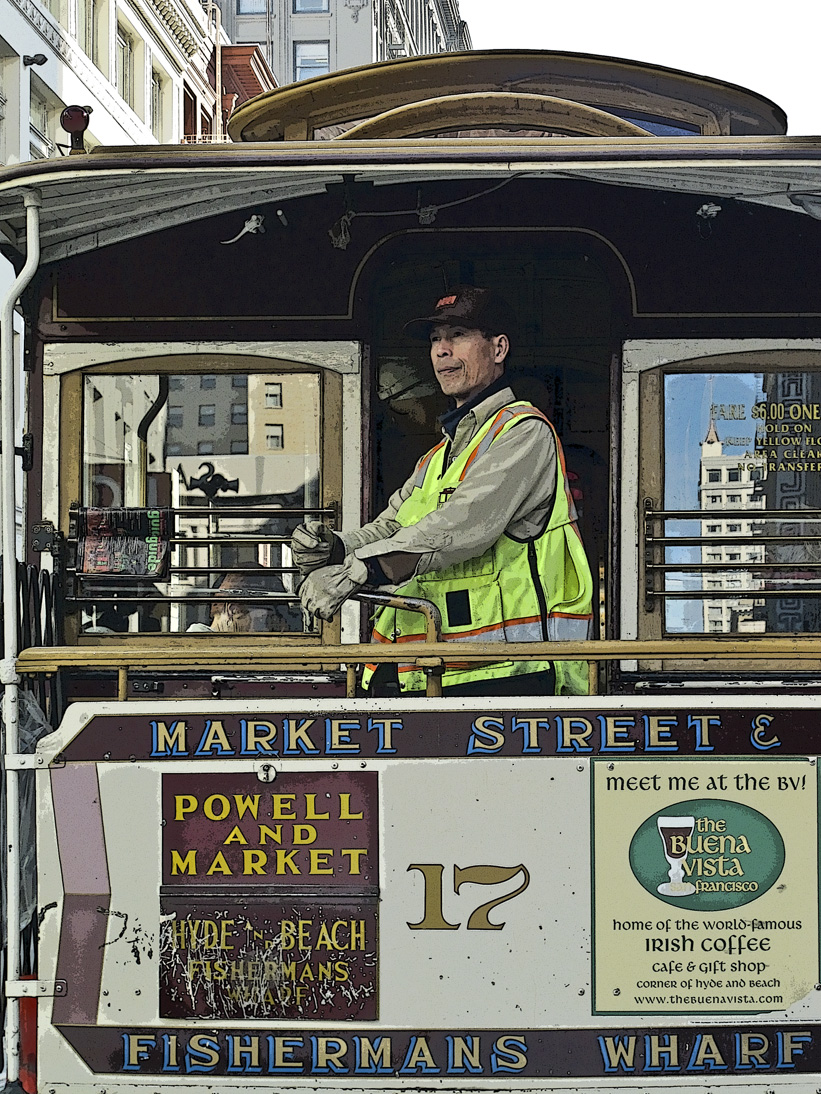
I took this picture last January on a trip to Carmel-by-the Sea, Monterey, and San Francisco.  Riding on the cable cars is my favorite way to see the city with its diverse neighborhoods.  The Buena Vista Cafe (sign on cable car) is a wonderful place to view Alcatraz and have a bit of Irish Coffee.

cablecar

Fixing Primary Elections Debates

What the GOP Autopsy Proves

by  Mar 28, 2013 4:45 AM EDT

The RNC’s report on the state of the Republican Party was resoundingly on point. Stuart Stevens, Mitt Romney’s chief 2012 strategist, on how to fix the phony debates and the troubling influence of corporate money.

  • The Republican National Committee’s post-2012 election analysis (which the RNC wisely elected not to call an autopsy) was an unusually honest and smart self-critique. One of the problems it addressed was the troubling explosion of primary debates. In 1988 there were seven Republican primary debates. In 2000, there were 13. In 2012, the number soared to 20.

Presidential Debate
President Barack Obama smiles as Republican presidential nominee Mitt Romney speaks during the third presidential debate at Lynn University on Oct. 22, 2012, in Boca Raton, Fla. (Rick Wilking/AP)

This debate escalation is somewhere between silly and dumb and serves no public good. We pick a president with three general-election debates but it takes 20 debates to understand that maybe Ron Paul wants to blow up the Federal Reserve? Other important national questions are decided more expediently: it only takes 12 shows for The Bachelorette and The Bachelor to pick a mate.

The RNC report recommends cutting the number of debates in half and shortening the debating season. That’s a good start. But I think we should go further. To improve the quality of the debates and eradicate the commercial toxicity tainting the events, news organizations should get out of the business of sponsoring debates.

Let’s don’t kid ourselves. These “debates” have become phony entertainment spectacles not serious news events.

Here’s how Wolf Blitzer touted the Republican primary debate in September 2011, hosted by the Tea Party and CNN:

“Tonight, eight candidates, one stage, one chance to take part in a groundbreaking debate. The Tea Party support and the Republican nomination, on the line right now.”

This is how World Wide Wrestling is promoted. The only thing accurate about this breathless hype is that, yes, there was one stage. But there wasn’t “one chance” (for crying out loud, there were three debates in less than three weeks), it wasn’t remotely “groundbreaking” and every fifth grader watching knew that neither Tea Party support nor Republican nomination weren’t remotely on the line.

Don’t blame Wolf Blitzer, who is one of the more serious journalists on the air. Blame the system that forces Blitzer into this role. In a different era, it might not have mattered if CBS or NBC sponsored a debate. But in today’s hyper competitive economic environment, with every network and cable news channel fighting hand-to-hand for each eyeball, the pressure to tart and hype is irresistible.

There are many reasons to run for president. But being used to help generate profits and ratings for the news divisions of large multi-national corporations and to promote the careers of on air talent are pretty low on the list. At a certain point, this becomes terribly close to a news organization starting a fire to cover the fire.

How should it work? That’s easy. It should work like everything else in news and politics. The proper role of a news organization is to cover an event, not manufacture it and then cover it. We don’t have NBC-sponsored campaign rallies or CBS-sponsored bus tours, at least not yet. The current model for debates is not a news model, it’s a NASCAR model. Your corporate money buys the right to brand and promote a car and/or an event.