Top Syrian General Defects


Top Syrian General Defects as War Enters Third Year


BEIRUT, Lebanon — A high-ranking Syrian general who once led a military intelligence office widely believed to be a torture site has defected from the army, he said Saturday, a day after the rebels’ top military commander again called for members of the armed forces to join the uprising against President Bashar al-Assad, now entering its third year.


Multimedia


Watching Syria’s War


But there were no reports of unusually widespread or decisive defections in response to a video address in English and Arabic released Friday by Gen. Salim Idris, who defected last July and is now the leader of the Free Syrian Army’s unified military command. Instead, Mr. Assad’s government went on the political offensive, calling on Brazil, China, India and other developing powers to help stop the Syrian conflict and find a political solution to the uprising.

Protests across Syria to observe the uprising’s two-year anniversary were small and muted compared with the exuberant demonstrations that initially set off the revolt, underscoring the growing sense that the war is nowhere near an end. The government remains dug in and is willing to use extreme force, and a political solution appears remote.

The request for political support from developing nations came in a letter delivered by an Assad adviser, Bouthaina Shaaban, to the president of South Africa, who is hosting a meeting next week of the so-called BRICS nations: Brazil, Russia, India, China and South Africa.

As Europe and the United States weigh stronger action to aid the Syrian rebels, including directly arming them, Mr. Assad appeared to be appealing to those nations’ aversion to Western military interventions; all opposed the action that helped topple Col. Muammar el-Qaddafi in Libya.

“President Bashar al-Assad asks for intervention by the BRICS to stop the violence in his country and encourage the opening of a dialogue, which he wishes to start,” Ms. Shaaban told Agence France-Presse, adding that the South African president, Jacob Zuma, “was very positive and deplored the destruction affecting this beautiful country.”

Before the uprising, Ms. Shaaban portrayed herself as an advocate for reform and modernization, but she has rarely been seen since she offered her support for the security forces during the early days of the crackdown.

The uprising began peacefully, but elements of the opposition eventually took up arms after security forces fired on protesters.

The new defector, Brig. Gen. Mohammed Nour Ezzedeen Khallouf, the army’s chief of supplies and logistics, appeared briefly on Saturday in a broadcast on Al Arabiya.

“Arrangements for the defection from the current Assad regime started a while ago,” he said. “There was coordination with several sides from various factions of the Syrian revolution.”

His acceptance into the rebels’ ranks underscores their assertion that they will welcome anyone who switches sides even now, so deep into the conflict. General Khallouf previously commanded the Palestine Branch of the military intelligence department, a Damascus headquarters where, according to rebels and watchdog groups, many opposition members have been tortured.

Antigovernment activists said that while his high rank was notable among defector, his departure would not change things for the government, which could easily replace him.

As the conflict continues, the Syrian government has increased its use of cluster bombs, which are widely banned because those that do not explode on impact often injure civilians who find them, the international watchdog group Human Rights Watch said in a report issued Saturday. It was based on field investigations and an analysis of more than 450 videos posted online, largely by antigovernment activists.

In the past six months, the Syrian government has dropped 156 cluster bombs in 119 places, said Human Rights Watch, which is based in New York. Two recent strikes alone killed 11 civilians, including two women and five children, the group said.

 

Hania Mourtada and Hwaida Saad contributed reporting.


Preserving Our Cultural Heritage

The Copyright Rule We Need to Repeal If We Want to Preserve Our Cultural Heritage

MAR 15 2013, 11:34 AM ET 4
The anti-circumvention section of the Digital Millennium Copyright Act threatens to make archivists criminals if they try to preserve our society’s artifacts for future generations.

Perhaps by now you’ve heard about the campaign to repeal the anti-circumvention section (1201) of the Digital Millennium Copyright Act. This most recent challenge to the DMCA arose from a recent decision by the Librarian of Congress to discontinue a three-year exemption that made cell phone unlocking legal.

Opponents of the DMCA anti-circumvention provision claim that the law threatens consumer control over the electronic devices we buy, and they’re right. But the stakes are much higher than that. Our cultural history is in jeopardy. If the DMCA remains unaltered, cultural scholarship will soon be conducted only at the behest of corporations, and public libraries may disappear entirely.

That’s because the DMCA attacks one of the of the fundamental pillars of human civilization: the sharing of knowledge and culture between generations. Under the DMCA, manmade mechanisms that prevent the sharing of information are backed with the force of law. And sharing is vital for the survival of information. Take that away, and you have a recipe for disaster.

The DRM Problem

In the last decade, more and more commercial cultural products have become available for purchase (or, more accurately, license) over the Internet — works like music, movies, video games, apps, TV shows, novels, and educational texts. They arrive free of any fixed media as a stream of bits coming in through a network cable.

To protect these cultural products against unauthorized duplication and distribution, most vendors of digital goods wrap them in encrypted data formats as part of digital rights management (DRM), a form of copy protection. Most DRM systems tie the “ownership” of digital goods to a certain user account or a certain device which is then verified by a connection to a remote server on the Internet.

The DMCA makes it illegal and punishable by a $500,000 fine or up to five years in prison to circumvent copy control and access control technologies like DRM.

Common wisdom would tell you, “Don’t copy things without permission, and everything will be fine.” But just as DRM-based copy protection prevents unauthorized users from making copies of digital goods, it also prevents cultural institutions from making copies for archival purposes. Every encrypted cultural work is locked, and to get the key, you have to pay the content owner.

Certain big publishers and copyright aggregators will immediately point out that DRM-protected cultural works will remain available to cultural institutions because they will gladly license the rights to use them. Currently, most US libraries have agreements like this with book publishers to provide e-book access to their patrons.

But this scenario gives content holders undue powers over the of machinery of cultural scholarship and preservation. When shrouded in DRM and license agreements, a cultural work is never truly and legally in the possession of the libraries, meaning that libraries cannot properly preserve them for use by future generations.

What’s worse, not all cultural works — take, for example, iOS Apps, Steam games, and Xbox Live titles — are available for license to cultural institutions. So they’re inaccessible from legitimate scholarly study and preservation even at present, never mind 100 years from now.

The anti-circumvention provision of the DMCA was created primarily to protect DVDs; it did not anticipate our rapid shift to media-independent digital cultural works, so it is absurdly myopic when it comes to digital preservation.

To properly preserve digital works, libraries must be able to copy and media-shift them with impunity. It may sound strange, but making a DRM-free copy of a digital work is the 21st century equivalent of simply buying a copy of a paper book and putting it on a shelf. A publisher can’t come along and take back that paper book, change its contents at any time, or go out of business and leave it unscrambled and unreadable. But publishers can (and have done) all three with DRM-protected works.

So why don’t librarians just defeat DRM, as it is often possible to do, and jailbreak Kindles and iPads to collect these materials? Because it’s illegal, of course. And if these chronically under-funded institutions want to keep their funding, they need to stay above the board.

DMCA Makes Piracy Culturally Important

To complicate things, there is a way to legally circumvent the anti-circumvention part of the DMCA. Every three years, the Librarian of Congress may review and implement temporary exemptions to the anti-circumvention provision based on suggestions from the public.

Cultural institutions have taken advantage of this the best they can, but it’s been a frustrating exercise in endless legal petitioning and campaigning every three years when the exemptions come up for review. At present, the current slate of DMCA exemptions don’t cover nearly enough, and law-abiding archivists are forced to sit on their hands while digital cultural works come and go, missing opportunities to legitimately archive them for future study.

In the course of my reporting on similar issues, I’ve recently spoken to a number of cultural historians and archivists, and they universally take issue with section 1201 of the DMCA, citing it as a major barrier to their work.

“DMCA is a mess,” says Henry Lowood, Curator for History of Science & Technology Collections at Stanford University Libraries. “It’s basically putting cultural repositories in positions where they either have to interpret very murky scenarios or they have to decide that they are going to do something that they realize is forbidden and hope that nobody’s going to notice.”

Lowood says that Stanford stays on the murky (but legal) side of things, so unless the law changes, his university and others will be forced to rely on the work of amateurs who break the law to free cultural works from DRM, collecting them in underground archives that will some day become available to scholars.

Thanks to the DMCA, the future of our cultural history will be based on the work of people who ignored the law — the same people that many copyright holders would call “pirates.” How ironic that the pirates will be the ones that save the day when they’re supposed to be the bad guys. If librarians wanted to do the same thing, they’d be branded as criminals.

Repeal Section 1201 of the DMCA

Digitally distributed cultural works are here to stay, and it is very possible that such works will subsume every information-based cultural format over the next decade. Some books are now only published as e-books, and even TV shows are beginning to show up only on the Internet, such as Netflix’s House of Cards series.

So we’re looking at a future where 100% of all major cultural commercial works could be protected with DRM, taking 100% of those works out of the flow of cultural history until they become public domain, at which point they will likely already be lost due to technological obsolescence and media decay. (Interestingly, this will tilt our future understanding of the history of this period toward those works that never relied on DRM for copy protection.)

This status quo is simply unacceptable and must change, or we have to be willing, as a society and a nation, to say goodbye to libraries and the concept of universal public access to knowledge.

It’s time to repeal the anti-circumvention provision of the DMCA. It unfairly dictates how consumers can use electronic products they own, and it jeopardizes our cultural history while providing only marginal protections to copyright holders.

Let’s not make this generation the one where cultural scholarship dies.

Still More From the Dismal Kingdom


U.S. to Boost Missile Defenses in Response to North Korea


The Pentagon is preparing to strengthen its missile defense systems on the West Coast in response to increased threats from North Korea and rising tensions on the Korean peninsula. Julian Barnes and Michaela Dodge, Heritage Foundation defense policy analyst, join The News Hub. Photo: AP/KCNA.

WASHINGTON—The Pentagon is preparing to strengthen its missile-defense systems on the West Coast in response to increased threats from North Korea and rising tensions on the Korean peninsula.


image

The U.S. plans to boost its ground-based missile interceptors in Alaska and California by nearly 50%, adding 14 additional systems at Fort Greely, Alaska, to the 30 already in place on the West Coast, Defense Secretary Chuck Hagel announced Friday. The interceptors, which will cost about $1 billion, should be in place by 2017.


Mr. Hagel did not say when the Pentagon believes North Korea will have an ICBM that can carry a nuclear warhead, but said the Pentagon would stay ahead of Pyongyang’s military developments.


Pentagon officials cited recent developments in North Korea—a long-range missile test, a nuclear test and demonstration of a mobile launcher —that suggested the country’s missile technology is advancing faster than earlier predicted.


In January the U.S. Missile Defense Agency successfully conducted a flight test of a ground-based Interceptor. Interceptors are launched to intercept intercontinental missiles in flight. The last successful test was in December 2008. Photo: U.S. Dept. of Defense.

“The United States has missile defense systems in place to protect us from limited ICBM attacks, but North Korea in particular has recently made advances in its capabilities and is engaged in a series of irresponsible and reckless provocations,” Mr. Hagel said.


The administration decision to beef up the missile defense system comes four years after President Barack Obama put a hold on the plan after taking office. Republican lawmakers said Friday they agreed with the enhancements, but said the administration was wrong to freeze the system in 2009.


“Four years ago, the Obama administration began to unilaterally disarm our defenses and deterrent in the hope our enemies would follow suit,” said Rep. Mike Rogers (R., Ala.), chairman of the House Armed Services Subcommittee on Strategic Forces. “President Obama is finally realizing what President Reagan taught us 30 years ago—the best way to keep the peace is through strength.”


Responding to the criticism, James Miller, undersecretary of defense for policy, the U.S. approach is to “stay ahead of the threat,” based on North Korean capabilities and not on the regime’s rhetoric or intent.


Adm. James Winnefeld, the vice chairman of the Joint Chiefs of Staff, said that the system was meant to dissuade North Korea’s new leader, Kim Jong Eun, from toying with the idea of an attack.


“We believe this young lad ought to be deterred…and if he is not, we will be ready,” Adm. Winnefeld said.


The U.S. interceptors have failed in some recent tests, with the last fully successful test occurring in 2008. Mr. Hagel said the U.S. wouldn’t purchase the new weapons until there are successful tests of the interceptors. Interceptors are vehicles that are launched to intercept intercontinental missiles in flight.


Friday’s decision comes as North Korea has issued a series of threats to attack the U.S. and South Korea over new international sanctions and joint military exercises in the region.


In addition to the interceptors, Mr. Hagel mentioned Pentagon plans to install a second advanced radar system in Japan to more quickly detect North Korean missile launches.


The Pentagon is also examining a location for a third U.S. site for interceptor missiles. Officials said they are looking at two unidentified locations on the East Coast, as well as a second field at Fort Greely.

China New Leader in PV Power Usage

China Set to Overtake Germany as the World’s Largest Consumer of PV Power

By Charles Kennedy | Thu, 14 March 2013 22:37 | 0

A new report written by NPD Solarbuzz has predicted that China will overtake Germany to become the largest consumer of photovoltaic power in the world this year.

It states that the top ten countries will still account for around 83% of installed PV capacity, but that for the first time ever Germany will not be the market leader. This is because rising demand from China has coincided perfectly with the decreasing demand in Europe.

A reduction to the incentive programs that ran in previous years throughout the EU have led to a significant drop in PV demand, as much as a 12GW decline according to the report. This contrasts with new policies in the Asia-Pacific region which will cause a 50% increase in demand from the likes of China, Japan, and India.

Related article: Study Finds Libya has More Solar Resources than Oil

Michael Barker, a senior analysts at Solarbuzz, said that “the Chinese end-market will largely compensate for the downturn in demand from Germany, which previously led P.V. demand.”

The report also mentioned that whilst emerging nations will account for less than 8% of global demand this year, that share is expected to double over the next four years, driven by developments in South Africa, Saudi Arabia, Thailand, Israel, and Mexico.

By. Charles Kennedy of Oilprice.com

Be the first to comment on this article.

Leave a comment

Name:
Email:
Captcha
Comment:

Russia After Stalin


Russia after Stalin

Do and die

The pervasive pain of Russia’s past

Warped Mourning: Stories of the Undead in the Land of the Unburied. By Alexander Etkind. Stanford University Press; 328 pages; $85 and £77.50 (hardback); $25.95 (paperback) . Buy from Amazon.comAmazon.co.uk

GHOSTS of the unburied dead are not only a supernatural phenomenon. As Alexander Etkind’s superb study of Russian cultural memory makes all too clear, they affect literature, art, public life and mental health too.

Mr Etkind—shortly to leave Cambridge University for a post in Italy—won acclaim for his previous book, “Internal Colonisation: Russia’s Imperial Experience” (2011), which showed how the country’s rulers in past centuries treated their own people as badly as other empires have treated their colonies. His new book, “Warped Mourning”, looks at the memory of the Stalinist terror: different from the Holocaust, he argues, because of its suicidal and random nature. Those persecuted by Adolf Hitler typically knew the reason, however hateful and twisted, for their suffering. Most of Josef Stalin’s victims had no idea. They included the hapless victims of the authorities’ requirement for quotas of subversives, those named in random denunciations, and loyal communists; even those who until recently had been implementing the purges.

The result, Mr Etkind argues, is a double mourning: for lost lives and years on the one hand, and, for many, lost ideals too. Uncertainty compounds suffering. Many loved ones simply disappeared. Their relatives did not know why they had been taken, whether they would return, who would follow them, and who might be taken next.

Mr Etkind ranges expertly through cultural theory, finding in film, literary criticism, linguistics, art and philosophy the effect of the Stalinist trauma on later Soviet and now Russian generations. He sees a taste for grotesque magical realism as one of the consequences: vampires and walking beef steaks, or, to take an example from Alexander Solzhenitsyn, a giant frozen salamander discovered in the tundra, roasted and devoured by starving prisoners. Another strand is absurd pseudo-historical encounters—magical historicism—epitomised by Alexei German’s 1998 film “Khrustalyov, My Car!”, where a doctor, the victim of gang-rape in one of the gulag prisons, is summoned to attend to a dying Stalin.

Excursions into high theory (readers who know the work of Walter Benjamin, a German-Jewish critic, will feel quite at home here), are punctuated with searing personal testimonies, some from Mr Etkind’s own family. When his grandfather returned from the gulag, his own son pushed past him, not recognising the shabby old man sitting on the stairs.

The author highlights some extraordinary attempts by gulag inmates to make psychological and moral sense of their fate. Yulian Oksman, for example, was a prominent historian (a risky profession in the Stalin era) who spent nine years in some of the harshest camps. After he was released he devoted himself to the detailed textual analysis of an obscure document: a letter from a 19th-century critic, Vissarion Belinsky, to the novelist, Nikolai Gogol, criticising his “sermons” in a country where serfdom was tantamount to slavery. What Russia needed, said Belinsky, was “the awakening in the people of a sense of their human dignity lost for so many centuries amid dirt and unfreedom.”

Mr Etkind describes it as an “astonishing letter…one of the strongest appeals for freedom that has been written in Russian.” After surmounting multiple obstacles over many years, Oksman’s monograph proving the letter’s authenticity (and sharpening its meaning) was published in the Soviet Union: a small victory, but a heroic one.

But the lingering impression of Mr Etkind’s book is absence. Germans pick over their Nazi past remorsefully and remorselessly. Nothing like this happens in Russia. The “work” of mourning started in the Khrushchev years, and again in the late Soviet era, but then fizzled out. Little effort is made now, within what Mr Etkind calls Vladimir Putin’s “oily grip”. Memorials to the victims of Stalinism are rare and typically low-key and cryptic. It is hard to make sense of something so painful and pervasive, and all the harder when so few want to talk about it.

First Southern Pope


Pope Francis

The first southern pope

Pope Francis inherits a mess but has great opportunities. He will need to act quickly


EVEN non-believers and non-Catholics should care about the election of Cardinal Jorge Mario Bergoglio of Buenos Aires as Pope Francis. The church which he will now head matters. Its unique privileges in the secular world (such as statehood and a voice at the UN) open it to secular scrutiny. Its good works (such as orphanages and hospitals) are vital. It matters in diplomacy, especially in behind-the-scenes peacemaking. It helped destroy Soviet communism, a global evil. Its stubborn defence of religious freedom is a headache for China’s rulers.

Outsiders should mind when Francis’s church does harm too. Opposing the use of condoms in Africa may have made sense in theological terms (though even believers often found the stance baffling). But the result was to help HIV to spread, consigning many innocent people to needless pain and death. The church’s cover-up of sexual abuse over past decades in many countries was illegal and compounded the victims’ hurt. The Vatican Bank, another quirky privilege of the Holy See’s special status, has failed to curb money-laundering. And, from sectarian chants at Scottish football matches to the outgoing Pope Benedict’s clumsy criticisms of Islam, tensions with other religions can turn into violent strife.

Yet it is as the world’s largest membership organisation that the church has its biggest role. It makes its 1.2 billion people—rich and poor, of all ages and conditions—feel that they are part of some sort of larger world order; that even in the poorest and most benighted country, their hopes and fears count and that someone in authority is listening to them.

For this last reason alone, Francis is an earthquake (see article). Just as the election of a Pole in 1978 helped presage the fall of the iron curtain and the reunification of Europe, the Argentine’s election heralds the shift in economic—and political—power from north to south. With John Paul II, the papacy stopped looking like a club for Italians; with Francis it is no longer a club for Europeans. The sight of a southerner in the Vatican will be as important, in its way, as the arrival of the first black man in the White House.

All this symbolism will count for little, though, if nothing changes. Despite his age and his closeness to the conservative Benedict, Francis may be a reformer. It is hard to imagine a man who ditched his limousine and palace in Buenos Aires and took the bus to work from a humble flat putting up with nonsense from Vatican smoothies. In Europe religion may be declining; in Latin America Christianity—albeit of many kinds—is still thriving. He is also an outsider in another sense: the first Jesuit to become pope.

Holy writ

What should he do? A secular newspaper has to divide its suggestions into two groups: reforms to church doctrine that many conservative Catholics, including Francis, may disagree with; and managerial ones that all Catholics can support.

In terms of doctrine, the list of rules that the church defends with great cost and mixed success begins, from our perspective at least, with priestly celibacy. Many priests are married—ex-Anglicans, and the Byzantine-rite Catholics of eastern Europe. All the scriptural evidence suggests that the first pope, Peter, had a wife. Allowing other clergy to do likewise would help stem the decline in the priesthood and relieve a great burden of suffering and loneliness. With that taboo gone, others could follow, such as the ban on artificial contraception.

This may be too much for Francis. But there should be no debate about the urgent managerial need to clean up and modernise the Vatican. The church is scandalously badly run. Francis will have only a short time to make urgently needed changes, sorting out the squabbling cliques of clerical civil servants who drove Benedict to distraction. He needs to confront both the sex-abuse scandal and the financial scandals (especially in America). As the first southern pope, he should also surely move more of the church closer to its congregation. Ditching his Italian holiday residence for a southern one, in Latin America, Asia or Africa, would be a start. Rejigging the college of cardinals, a third of whom are Italian, should be a priority. Deal with these, and Francis will have a better chance of getting across his central messages of love and justice.

When to Worry About Deficits

The Evans Rule For Deficits: Let’s Worry at 6.5% Unemployment

By Derek Thompson


inShare1 Mar 13 2013, 2:44 PM ET 25

Washington might be awful at coming together to pass budgets, but it’s rather good at coming together to talk about budgets. Today, The Atlantic is hosting a massive economic conference to debate The Debt, in all its shades — good and bad, short-term and long-term, public and private, ours and the world’s.

Today, I spoke with Alice Rivlin, the first director of the CBO who has worn more hats than I can name — at the Federal Reserve, the OMB, Brookings, the president’s deficit commission, and on the list goes. Her position on the debt is pretty clear. She supports high deficits today, and she supports lower deficits in the next decade. To get there, she wants a balanced approach between discretionary spending cuts, tax revenue increases, and entitlement reforms that save us money, not only in the next 10 years, but in the 10 years after that (… and after that).

What she said didn’t surprise me, on a sentence-by-sentence basis, but the sum her statements raises a larger question. She said the Paul Ryan budget reminded her of every other Paul Ryan budget, and not in a good way. She said she had fewer objections to the president’s budget, but that she would still like to see more eagerness among Democrats to change entitlements. She said she didn’t want to cut spending too dramatically now. She said that the sequester was a dumb idea. She said she didn’t agree with Paul Krugman (and other critics of deficit hawks), because she’s worried about the long-term right now.

I agree with Rivlin. And I agree everybody else who worries about long-term deficits. I believe that current spending trends, projected over the next 10 or 20 years, point to a risky future for U.S. finances. They don’t guarantee a debt crisis. But they dramatically raise the odds.

I just don’t agree with her now.

What I’d like for deficits is an Evans Rule.

What does that mean? Late last year, the Federal Reserve adopted a proposal by Chicago Fed President Charlie Evans, who said our central bank should announce that it won’t tighten monetary policy until unemployment fell under 6.5 percent (or inflation rose to 2.5 percent).

Once unemployment hits 6.5 percent, I’ll root for Washington to sit down at a table with Rivlin, whose deficit reduction plan with the Bipartisan Policy Center was a nice framework for a balanced approach to long-term deficit reduction. Until then, attention paid to the future deficit crisis is attention not paid to the current jobs crisis. I wish that weren’t the case, but it is.

Rivlin says she hopes Washington can pass a long-term deficit-reduction budget that preserves high deficits today to protect the recovery. But recent history suggests Washington lacks the will or the faculty to be so bifocal. The Budget Control Act is law, and it cuts the debt by about $1 trillion. The sequester is law, it cuts the debt by about $1.2 trillion. The American Jobs Act and its multi-billion-dollar stimulus? Gone in a blur. The president’s budget asking for hundreds of billions of dollars spent right away? Hardly considered, easily forgotten.

Since we started talking about high deficits today and low deficits tomorrow, we’ve just gotten lower deficits today. Washington would like to think it could walk and chew gum at the same time. It can’t.

The sooner the economy recovers, the sooner I’ll go from agreeing with Alice Rivlin 50% to agreeing with her 100%.

Glass Ceiling Index

Daily chart
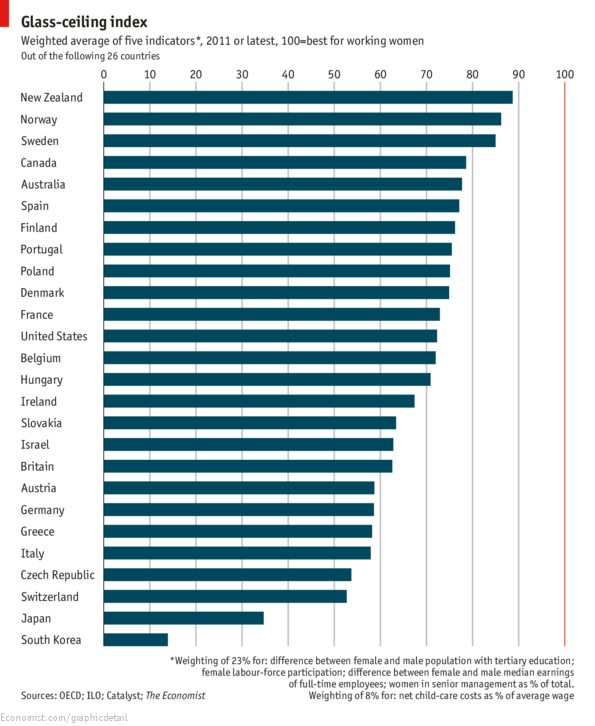
The glass-ceiling index
Mar 7th 2013, 14:31 by Economist.com

Where is best to be a working woman in the rich world

IF YOU are a working woman, you would do well to move to New Zealand—or if that is a little out of the way, you could try one of the Nordic countries. To mark International Women’s Day, The Economist has compiled its own “glass-ceiling index” to show where women have the best chance of equal treatment at work. Based on data mainly from the OECD, it compares five indicators across 26 countries: the number of men and women respectively with tertiary education; female labour-force participation; the male-female wage gap; the proportion of women in senior jobs; and net child-care costs relative to the average wage. The first four are given equal weighting, the fifth a lower one, since not all working women have children. New Zealand scores high on all the indicators. Finland does best on education; Sweden has the highest female labour-force participation rate, at 78%; and Spain has the smallest wage gap, at 6%. The places not to be are South Korea and Japan, partly because so few women hold down senior jobs (though the new president of South Korea is a woman).

20130309_gdc194

Natural Gas Vehicles

Have Natural Gas Vehicle’s Finally Reached the Point of No Return?

By Barry Stevens | Mon, 11 March 2013 22:29 | 0

We tried or at least discussed this many times before. That is, an exodus from gasoline and diesel fuel. We have yet to find the promised land of an abundant domestic resource that that is more financially sound, environmentally friendlier, market ready and convenient. The path includes just about every primary energy resource in the world’s energy inventory.

Most have failed to support the customer base at the desired cost level. EVs looked like it got the checkered flag. EVs sound good, but it too has some fundamental issues hindering growth. Loss of incentives and questions on their consumer readiness has stalled recent sales projections. Also, as long as electricity, a secondary source of energy, is primarily generated from coal and natural gas, EVs by no means have a zero carbon footprint.

Even Hybrids, the sensible bridge, are under scrutiny. The EPA is reevaluating how it rates gas mileage for hybrids to make sure the estimate gas mileage matches real-world driving. “The agency’s action comes after Consumer Reports wrote that its gas mileage in real-world use of Ford’s new C-Max crossover and Fusion sedan hybrids, 37 mpg and 39 overall, respectively, fell far short of their EPA ratings of 47 in mixed driving.”[1]

Below the radar, at least in the U.S., is natural gas fueled vehicles, NGVs for short. Definitely abundant, cheaper and cleaner than petroleum, natural gas seemed to make a lot of sense as an alternate fuel for the transportation sector.  Also, it asked little of the customer base in terms of driving behavior. Interest was impacted by an undeveloped infrastructure and the cost to upfit a vehicle to natural gas.

The shale gas gold rush in the U.S. and the associated concern over hydraulic fracturing, “fracking,” made it nearly impossible to keep natural gas out of the limelight. Beyond electrical generation, the export market and the competitive advantages natural gas provides industrial users, there are not many more sectors where it can be absorbed by the U.S. economy. In many instances, use of natural gas only converts one domestic resource for another and does little to affect energy independence and security. For this to happen, the transportation sector, the driver of imported petroleum, must convert over to natural. It is noted that as natural gas replaces coal to generate electricity, EVs can indirectly change the need for foreign oil.

Looking at the global landscape of NGVs and CNG fueling stations, the United States although the world leader in both unconventional natural gas production and number of driver’s is ranked 15th with only 123,000 NGVs and 6th in terms of CNG fueling stations, see Figure 1. Iran, Pakistan (2,859,386 NGVs, 1,574 stations) Argentina, Brazil and China have significantly more NGVs and CNG fueling stations.

Related article: Buffett Banks on Natural Gas Trains

NGV Vehicle and Fuel Station Count
NGV Vehicle and Fuel Station Count 1
Figure 1

The playing field may finally be changing for NGVs! This week, the Star-Telegram and AP reported:[2]
“….. the sales of NGVs are rising”
“…..  Ford sold a record 11,600 natural gas vehicles last year, more than four times the number it sold two years ago”
“….. natural gas is making inroads as a transportation fuel, particularly for truck fleets, buses and taxis. The consumer market is tougher to crack, but sales are gaining there as well.”
“GM and Chrysler recently added natural gas pickup trucks to their lineups.”
“Honda is seeing more interest in its natural gas Civic — with record U.S. sales of nearly 2,000 last year…..”
“….. 20,381 natural gas vehicles were sold in the U.S. in 2012.”

The Best Intelligence

The Best Intelligence Is Cyborg Intelligence

The best services arise from the combination of machine and human intelligences.  As algorithmic entities explode across the web, humans remain central to their operation. Automation only goes so far and for all Watson’s Jeopardy wins, there are still many, many tasks on which computers are terrible and humans are effortlessly amazing. Like understanding language, say, or knowing what’s happening in a photograph. We noted this phenomenon in our work on Google Maps, which has a team of thousands of humans who hand correct every single map.

There is an analogy to be made to one of Google’s other impressive projects: Google Translate. What looks like machine intelligence is actually only a recombination of human intelligence. Translate relies on massive bodies of text that have been translated into different languages by humans; it then is able to extract words and phrases that match up. The algorithms are not actually that complex, but they work because of the massive amounts of data (i.e. human intelligence) that go into the task on the front end.

Google Maps has executed a similar operation. Humans are coding every bit of the logic of the road onto a representation of the world so that computers can simply duplicate (infinitely, instantly) the judgments that a person already made. The Times story is well worth reading for its catalog of similar operations at other companies like Twitter, Apple, IBM, and some startups. The point is not that machines are not powerful or that humans are irreplaceable in some fixed sense. The point is that the best services are cyborg: they arise from the combination of machine and human intelligences. As Manfred Clynes and Nathan Kline, the co-coiners of the term “cyborg,” wrote in 1960, “The purpose of the Cyborg, as well as his own homeostatic systems, is to provide an organizational system in which such robot-like problems are taken care of automatically and unconsciously, leaving man free to explore, to create, to think, and to feel.” Fifty-three years later, I think the jury is still out on whether or not his initial hope was correct.