An image of a drawing at Eastside Pies in Austin, Texas. Most have been by a happy patron.
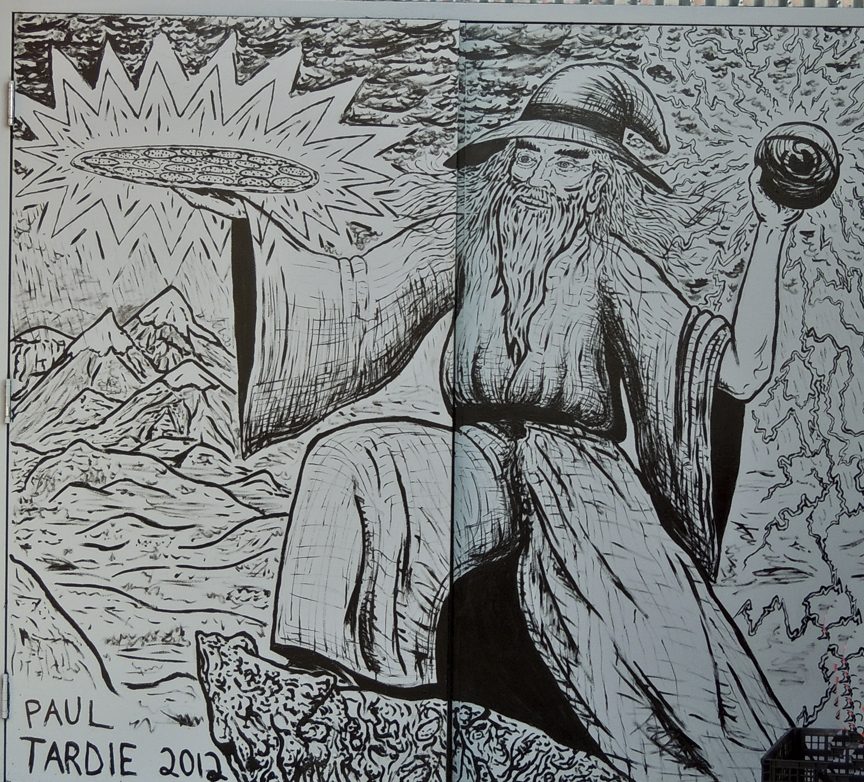
An image of a drawing at Eastside Pies in Austin, Texas. Most have been by a happy patron.
Master Limited Partnerships have been on fire since the beginning of the year. Once the deal on the “Fiscal Cliff” was done, and these instruments’ special tax treatment protected, it was off to the races. These unique and versatile instruments combine the tax benefits of a limited partnership with the liquidity of publicly traded securities.
The explosion in demand has created a new issue boom. SunCoke Energy Partners (SXCP) makes coking coal used in the steel production process, came to market this week boasting an 8.25% yield. Then, CVR Refining (CVRR), which specializes in petroleum refining in Texas and Oklahoma, upped the ante with an eye popping 18.8% yield. These things can’t be that high risk!
Enbridge Energy Partners (EEP) is run by some of my former colleagues at Morgan Stanley and offers a 7% yield. Kinder Morgan Energy (KMP) posts a healthy 5.8% yield, while Trans Mountain (TLP) ups the ante with an 8% return. Linn Energy goes all the way up to a healthy 6.3% yield.
Why the enticing cash flow? The problem is that these partnerships suffer from their guilt by association with Texas Tea, which is notorious for its volatility. Although they have no direct exposure to the price of oil, investors tend to incorrectly classify them as energy stocks and dump them whenever oil falls. The great thing about these high yields is that you get paid to wait until crude makes a comeback, which it will always do, as long as there is a China. Not a bad game to play in a zero return world.
To qualify for MLP status, a partnership must generate at least 90 percent of its income from what the Internal Revenue Service deems “qualifying” sources. For many MLPs, these include all manner of activities related to the production, processing or transportation of oil, natural gas and coal.
Energy MLPs are defined as owning energy infrastructure in the U.S., including pipelines, natural gas, gasoline, oil, storage, terminals, and processing plants. These are all special tax subsidies put into place when oil companies suffered from extremely low oil prices. Once on the books, they lived on forever.
In practice, MLPs pay their investors through quarterly distributions. Typically, the higher the quarterly distributions paid to LP unit holders, the higher the management fee paid to the general partner. The idea is that the GP has an incentive to try to boost distributions through pursuing income-accretive acquisitions and organic growth projects.
Because MLPs are partnerships, they avoid the corporate income tax, on both a state and federal basis. Instead of getting a form 1099-DIV and the end of the year, you receive a form K-1, which your accountant should know how to handle. The only problem with this set up is that the partnerships are required to send you a K-1 for every state in which they do business. Own enough of these, and your tax return will end up as thick as the Houston telephone book.
Additionally, the limited partner (investor) may also record a pro-rated share of the MLP’s depreciation on his or her own tax forms to reduce liability. This is the primary benefit of MLPs and gives MLPs relatively cheap funding costs.
The tax implications of MLPs for individual investors are complex. The distributions are taxed at the marginal rate of the partner, unlike dividends from qualified stock corporations. On the other hand, there is no advantage to claiming the pro-rated share of the MLP’s depreciation (see above) when held in a tax deferred account, like an IRA or 401k. To encourage tax-deferred investors, many MLP’s set up corporation holding companies of LP claims which can issue common equity.
Since 2003, MLPs as an asset class have grown astronomically, from $30 billion to over $250 billion, and have also been the best performing asset class in the world over the last 10, 5, and 3 year periods. The recent discovery of new, massive gas and oil fields in the US and the rapid expansion of shale fracking should auger well for the rising popularity of this instrument.
If you don’t want to bet the ranch putting all you money into a single issue, you might consider the JP Morgan Alerian MLP Index ETN (AMJ), with a 5.35% yield. You give up some yield here in exchange for a broader diversification of risk across many issues in this quasi index fund. For many, it will be worth it to just to sleep at night.

(Click chart to enlarge.)

(Click chart to enlarge.)
By. Mad Hedge Fund Trader
I have Siri on my i phone 4S. I haven’t used it. It pops up once in a while, all on its own.

“Character-driven dialogue” will help the virtual assistant evolve, says an Apple job ad.

Apple’s virtual assistant Siri may have its roots in a Pentagon-funded artificial intelligence research project, but algorithms aren’t everything and the Cupertino company is now turning to writers to make Siri smarter. A job ad posted by Apple on LinkedIn appeals for:
“[S]omeone who combines a love for language, wordplay, and conversation with demonstrated experience in bringing creative content to life within an intense technical environment.”
They’ll need “experience in writing character-driven dialog”, a good vocabulary, and ideally knowledge of more than one language. The end result, says the ad, will “evolve and enrich Siri…known for ‘her’ wit, cultural knowledge, and zeal to explain things in engaging, funny, and practical ways.”
Many of the changes Apple made to Siri when it bought the technology from the startup of the same name were in a similar vein. As my colleague Will Knight wrote in an in depth look at how Siri is designed: “Siri may not be the smartest AI in the world but it’s the most socially adept.” Giving the system a style that suggests tact, charm, and even wit makes its limitations and errors easier to bear (see “Social Intelligence”).
That approach isn’t unique to Apple. In recent years winners of the Loebner Prize, in which chatbots try to convince judges they are human, have often been those that use relatively simple tactics focused on humor and mimicry rather than deep learning.

David Attenborough’s new series is one nobody else could have made. He tells Samantha Weinberg about the changes he has seen—and the one he wants to see…
From INTELLIGENT LIFE magazine, September/October 2012
When David Attenborough joined the BBC, 60 years ago this September, Britain had only one television channel. Cameras had to be wound up like a clock and could only film live or in 20-second bursts. There was no way to capture sound and vision at the same time, or to broadcast from anywhere but the studio. Attenborough, like most people, did not own a television set; he thinks he had seen only one programme in his life. He had applied for a job in radio, as a talks producer, and been turned down, and it was only by chance that his CV was seen by a television executive, the head of factual broadcasting, Mary Adams. She gave him a chance—but when he first went in front of the camera, she said his teeth were too big.
By 1956, Attenborough had persuaded the BBC to let him try a new way of filming—from and of the natural world. With only a cameraman and animal expert for company, he would go off for months to remote lands in search of rare beasts. In Borneo, some days’ walk from civilisation, he was on the trail of orangutan when he spied a man paddling up the river, wearing only a sarong and bearing a message tucked in a cleft stick. It was from the BBC, giving instructions on how to use their new toy: colour film. What started in a makeshift fashion with “Zoo Quest” matured over the decades into “Life on Earth”, “The Private Life of Plants”, “Life in Cold Blood”, “Frozen Planet” and many more. With Attenborough, the phenomenon of natural-history film-making was born.
He did so well that he became controller of BBC2, in 1965, and then BBC director of programmes—but had a clause written into his contract to make sure he could carry on making films himself, and within a few years he returned to his vocation. Now, aged 86 and still going strong aside from a gammy hip, he has revisited some of his early haunts to make a series of three films looking back over the six decades. “The BBC decided they wanted to do something to mark it, and I just hoped to goodness it wasn’t going to be a dinner,” he said. “A series sounded like more fun, but I wanted to shift the focus from me, to look at the changes in natural-history film-making, science and the natural world.” The self-effacement is typical, but immaterial: the story of his life is the history of his genre.
He enthuses about the tiny cameras that let us peek into a mouse’s love life, the underwater cameras that take us into the ocean deep, and the science that has enhanced our understanding of the natural world. “When I was at university, there was no such thing as genetics, nothing was known about DNA, and my geology professor dismissed continental drift as moonshine. The way in which our knowledge has expanded is extraordinary, and the pace of change is astounding.”
But it is the changes in the natural world that preoccupy him. While he brushes off the suggestion that he has a message to convey, his recent programmes, particularly the ones he has authored rather than just fronted, have shown a growing urgency, a determination to lay bare the planet’s plight. “The world is in terrible trouble,” he says. “According to the UN, over half the world’s population is now urbanised. Apart from rats and pigeons, they have probably never seen a wild animal. How are these people supposed to act? How are they supposed to feel it’s worth preserving unless they know what it is that keeps them alive, unless they understand the extent to which we are dependent on the natural world, and that we are doing terrible things to it by our very presence?”
It is the media, he believes, that hold the key to our salvation. While this won’t be to everyone’s taste in the age of phone-hacking, Attenborough sees no other way. “The media need to keep people informed. If not, why would they agree to politicians devoting tax money and passing legislation aimed at preserving our planet? We have to convey the facts that scientists know very well, and impress on people and politicians that we have to act now.
“Am I optimistic about the future? No, not at all. But that’s irrelevant. It’s imperative that you do something, even if you don’t think it’s going to do any good.”
That is not the sort of talk we expect from a man we associate with enthusiasm, with passion, empathy and baby animals. Attenborough’s breathy tones, as he plays grandmother’s footsteps with a penguin, or gasps at the display of a bird of paradise, have brought knowledge and wonder into our sitting rooms. “Attenborough: 60 Years in the Wild” provides an irresistible excuse to replay the highlights and revel in those close encounters with silverback gorillas, aggressive elephant seals and bat guano that have become integral to the way we understand the natural world. As each programme kicks off, he is sitting at the front of a wooden boat, gliding gently along the brown waters of the Kinabatangan river in Malaysian Borneo, speaking with the clarity that has been a hallmark of his work. In the face of the desecration of that area, it comes across initially as gold-tinted, nostalgic, but when, in the last of the series, the camera pulls back to reveal the vast palm-oil plantations just beyond the river’s fringe, Attenborough does not mince his condemnation: “Again and again, I have seen the impoverishment and desolation caused by the way we have ruthlessly taken what we want from the land, regardless of the cost.”
In a 2009 Reader’s Digest survey, Attenborough was voted the most trusted person in Britain (a position even “Polar Beargate”, the revelation that some of the bears filmed for “Frozen Planet” were born in a zoo, will have done little to dislodge). Despite his advancing years—perhaps because of them—he is using that capital now to give his viewers some home truths. It was not always thus: until a few years ago, Attenborough was unwilling to speak out about climate change.
He is not entirely despairing. “It is surprising how fast pennies can drop. Big change will only happen when human beings begin to realise that wasting energy and destroying the environment is sinful, that it’s a crime to throw away a bit of plastic. Nonetheless it’s a moral issue. A hundred and eighty years ago it was acceptable to keep other human beings as slaves. The shift in moral perception and attitude against slavery was remarkably swift. There has to be a comparable change now in attitudes about the environment.”
Which is where the mouse cams and 3D cams and the heli-mounted gyrostabilisers that enabled those extraordinary close-ups of polar bears in the Arctic come in. The technological advances over the decades have enabled Attenborough to introduce us to the miracles of the natural world. And once we know what we have, he hopes, we will not willingly throw it away. As he concludes in the last episode of the new series: “I’ve spent my life filming the natural world and I’ve travelled to some pretty remote and exciting places to do so… But every journey seems to have got quicker and shorter. It’s as if the world has shrunk – but then sadly so have the wild places. The increasing size of the human population is having a devastating effect on the natural world. Fortunately people are becoming more aware of that and are doing something about it. I’d like to think natural-history programmes have helped in that process.”
Attenborough: 60 Years in the Wild BBC1, October
Samantha Weinberg is our assistant editor and a former commissioning editor at Eureka on the Times. She is the author of “A Fish Caught in Time”.
Picture: David Attenborough in 1956 (Getty)
THE FLUSH TOILET IS THE GREATEST INVENTION
The Economist’s cover story this week asks if we will ever again invent anything as useful as “the humble loo”. When we devoted a Big Question to the best inventions, it was also the one chosen by Nick Valéry
From INTELLIGENT LIFE magazine, January/February 2012
More even than the miracle of antibiotics, the flush toilet has done most to rid us of infectious disease. Without plumbed sanitation within the home to dispose of human waste, we would still be living in a brutal age of cholera, dysentery, typhus and typhoid fever—to say nothing of bubonic plague.
The flush toilet was invented, and re-invented, many times. Indoor toilets first appeared in the Indus Valley over 4,000 years ago. The Romans built their latrines over drains carrying running water that discharged into a fetid Tiber. Legend has it that Queen Elizabeth I was too embarrassed to use the flush toilet built for her by her godson, Sir John Harington, for fear that the roar of the rushing water would inform the palace of the royal bowels being evacuated.
But it is only in the past century and a half that the water closet has graced more humble abodes. After Prince Albert died of typhoid in 1861, a grief-stricken Queen Victoria demanded that piped water and sewage treatment be installed throughout Britain. A decade later, her son Prince Edward came close to dying of the same disease, and word about the need for flush toilets went out across the land. From Britain, it spread to France, and thence the rest of Europe and the world.
The father of the modern lavatory was not, as myth would have it, Thomas Crapper, whose name, in blue Gothic script, embellished the inside of many a Victorian lavatory bowl. If anyone can lay claim to the title, it is Alexander Cummings, a watchmaker in Bond Street, who was granted the first patent for a flush toilet in 1775. The popular toilets made by Crapper’s workshop in Chelsea were based on a later siphon design, patented in 1819 by an employee named Albert Giblin.
The lavatory has changed little since Crapper’s time. Water trapped in an S-shaped bend keeps the stench at bay, while allowing the waste to be siphoned off. Pulling a chain, or pressing a handle, opens a valve that causes water in a cistern to gush into the bowl. When it is empty, a floating ballcock closes the valve, and the tank refills under pressure from the water supply. Tweaks over the years have simplified the valve system and reduced the water needed. The flushing toilet still hasn’t reached everyone, but it has done billions a great service.
Do you agree? For more thoughts on the greatest inventions read Tom Standage on writing, Roger Highfield on the scientific method, Edward Carr on the blade, Samantha Weinberg on the internet and Nnaemeka Ikegwuonu on the transistor radio.
Nick Valéry writes a technology column for The Economist. He edited Intelligent Life when it was an annual, from 2004 to 2006
Picture credit Getty
MIT engineers have developed a new polymer film which can take advantage of the chemical energy in a water gradient and turn it into mechanical energy; which in turn can then be converted into electricity.
The film is made from an interlocking network of polypyrrole, which forms a hard but flexible matrix that provides structural support, and polyol-borate, which is a soft gel that swells when it absorbs water.
When the plyol-borate (which is on the bottom of the polymer film) absorbs water, even the tiniest amount, it expands, forcing the film to curl up and move away from the surface. Once exposed to the air it then dries out as the moisture evaporates, somersaults forward, and then begins the process again. By connecting the polymer to a piezoelectric material, the mechanical motion can be converted into electricity, enough to power nanoelectronic devices.
Related Article: A Look at China’s Renewable Energy Progress
Mingming Ma, a postdoc at MIT’s David H. Koch Institute for Integrative Cancer Research and one of the lead authors of the paper, explained that “with a sensor powered by a battery, you have to replace it periodically. If you have this device, you can harvest energy from the environment so you don’t have to replace it very often.”
Robert Langer, another lead author and Professor at the David H. Koch Institute, said that, “we are very excited about this new material, and we expect as we achieve higher efficiency in converting mechanical energy into electricity, this material will find even broader applications.”
By. James Burgess of Oilprice.com
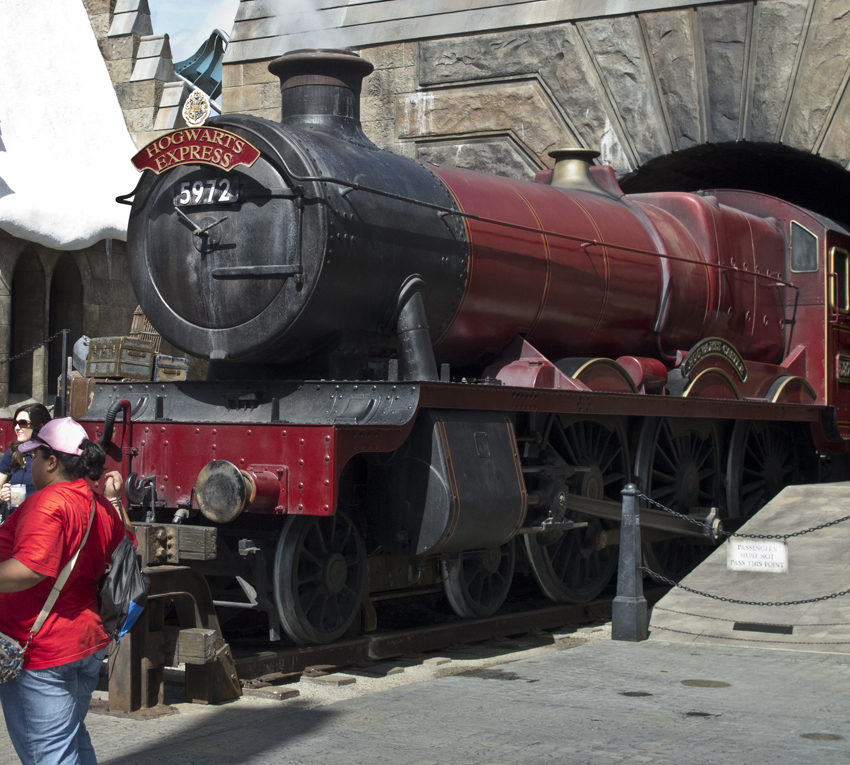
An image of Hogwarts Express at the Harry Potter section of Universal Studios in Florida.
THE BEST MONTH IS BRUMAIRE
The Big Question: in the final choice from our six writers, Ann Wroe picks a month that was invented during the French Revolution…
From INTELLIGENT LIFE magazine, January/February 2013
Brumaire is the second month of the twelve-month French revolutionary calendar; it runs from mid-October to mid-November. Its heyday lasted long enough to leave one date in history, 18 Brumaire (in Year VIII, roughly 1799), when Napoleon established the consular government that led to his despotism. Otherwise, like its companions—snowy Nivôse and rain-sprinkled Pluviôse, garlanded Floréal and Germinal of the green, growing shoots—it has faded into the fogs of human arrangements past.
It’s not just perversity that makes me choose it, but also a sense of dissatisfaction with Western months as they are: a dull march of gods, emperors and numerals, with no flavour or scent of the seasons they are meant to represent. Bengalis know that in Phalgun the dust flies like a harum-scarum boy down village lanes, and in Sraban the loud monsoon soaks the thatch; just as, in revolutionary France, Frimaire brought hoar-frost creaking under the sabots, and Ventôse the blasts of late winter roaring through the oaks.
Brumaire expresses—rather than marks—Keats’s season of mists and mellow fruitfulness. It is the quintessence of autumn, damps as well as brights, in a way neat October or pure November can never be. Its essence is stillness: the lull before the storm, the lit pipe, the comfort of apples laid up in newspaper and heavy barn doors shut. A quiet cloak of vapour announces the day, gathered in bushes and hanging in the trees. Through that mist colours appear, glowing like separated flames. The same fog enshrouds the sky, which clears slowly to a cold, deep blue before, in mid-afternoon, the air thickens perceptibly, as if filled with smoke from the pinkly burning sun.
Leaves still crowd the boughs, but they are falling fast, the trees shedding and reflecting themselves on the muddy ground. It was in Brumaire, give or take a day or two, that Dorothy Wordsworth saw her favourite birch tree, bright yellow against the dark mountains, swept by a “flying sunshiny shower”, to become a spirit-tree. This is the moment the autumn palette spreads across the woods. Pale gold, dark crimson, yellow ochre, burnt umber, now join with lingering green, as if the leaves turned over in their minds their memories of the sun. Beside fresh-ploughed fields, stray straws and stubble still glint golden in the sunlight before bonfires consume them and the night mists rise.
This is a month of scarves and boots, when hope of any brief return to summer is finally put away. We batten down, and turn our faces towards the dissolving and vaporizing and falling away of things. It is a month of letting go, as the trees do, the lighter to leap towards the spring—as if the dead weight of winter did not lie in between.
Which month do you think is the best? Have your say by voting in our online poll. Read Charles Nevin on December, James Lasdun on April, A.D. Miller on May, John Burnside on July and Kathleen Jamie on October.
Ann Wroe is the obituaries editor of The Economist and author of “Orpheus: The Song of Life”
IDEAS ANN WROE INTELLIGENCE JANUARY/FEBRUARY 2013 THE BIG QUESTION
ARTICLE TOOLS
Email this page Printer-friendly version Delicious StumbleUpon Facebook
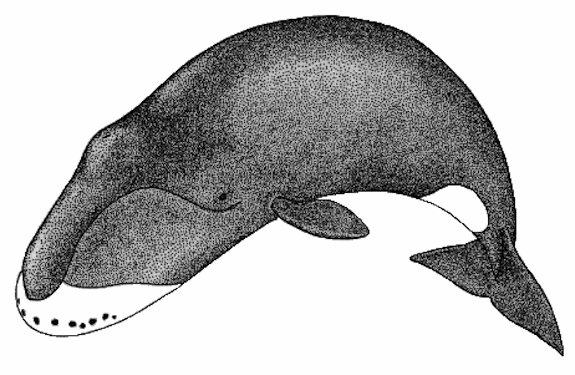
Image: David G. Stanton of the Scientific Publications Office
In Alaska’s North Slope, the population of bowhead whales seems to be recovering. But that’s really not the coolest part of this Alaska Dispatch story. Instead, it’s this, noticed by Geoffry Gagnon:
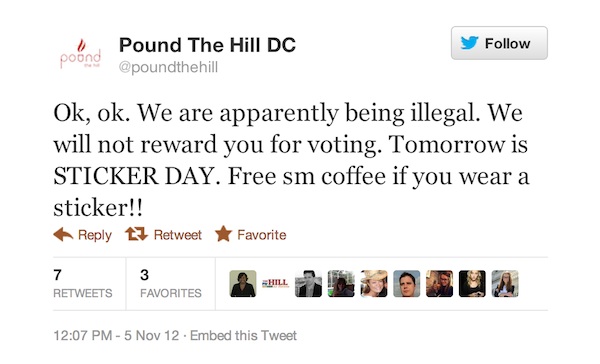
Image: Twitter
That’s right, some of the bowhead whales in the icy waters today are over 200 years old. Alaska Dispatch writes:
Bowheads seem to be recovering from the harvest of Yankee commercial whaling from 1848 to 1915, which wiped out all but 1,000 or so animals. Because the creatures can live longer than 200 years — a fact [Craig] George discovered when he found an old stone harpoon point in a whale — some of the bowheads alive today may have themselves dodged the barbed steel points of the Yankee whalers.
Herman Melville wrote Moby Dick in 1851, after a brief stint on a whaling ship. (You can hear the whole book read aloud here.) Sparknotes summarizes the trip this way:
Finally, driven to desperation at twenty-one, Melville committed to a whaling voyage of indefinite destination and scale on board a ship called the Acushnet. This journey took him around the continent of South America, across the Pacific Ocean, and to the South Seas, where he abandoned ship with a fellow sailor in the summer of 1842, eighteen months after setting out from New York. The two men found themselves in the Marquesas Islands, where they accidentally wandered into the company of a tribe of cannibals. Lamed with a bad leg, Melville became separated from his companion and spent a month alone in the company of the natives. This experience later formed the core of his first novel, Typee: A Peep at Polynesian Life, published in 1846. An indeterminate mixture of fact and fiction, Melville’s fanciful travel narrative remained the most popular and successful of his works during his lifetime.
Thirty four years ago, scientists counted 1,200 whales. Today there are about 14,000 of the mammals out there. Bowhead whales get their name from their heads, says NOAA:
The bowhead whale has a massive bow-shaped skull that is over 16.5 feet (5 m) long and about 30-40% of their total body length. This large skull allows the bowhead whale to break through thick ice with its head. The bowhead whale also has a 17-19 inch (43-50 cm) thick blubber layer, thicker than any other whale’s blubber.
None of the whales in Alaska, as far as we know, are white.
More from Smithsonian.com:
Read more: http://blogs.smithsonianmag.com/smartnews/2013/01/there-are-whales-alive-today-who-were-born-before-moby-dick-was-written/#ixzz2HsFTZMDs
Follow us: @SmithsonianMag on Twitter


 Passing Through . . . .
