Devising Passwords

Online passwords: keep it complicated

By now, you probably have about 20 different passwords you’re struggling to remember. There must be an easier way. How do you stay one step ahead of the hackers – and still stay sane?

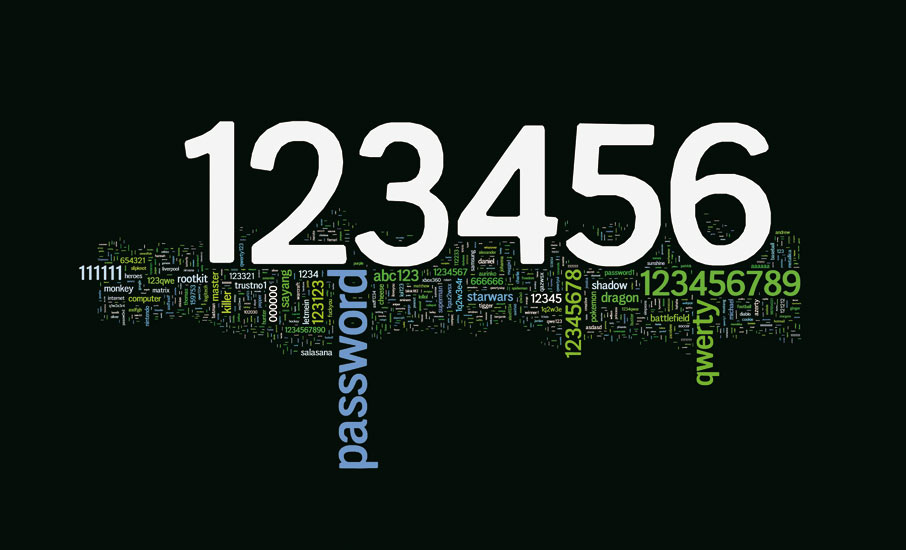
passwords illustrationView larger picture

This word cloud shows the most commonly used passwords, with greater prominence given to those used most frequently. Published in InformationWeek BYTE ‘Top 5 Password Managers’. Dazzlepod. Disclosure Project,dazzlepod.com/disclosure/

Let me hazard a wild guess: the system of passwords you use on the internet – for accessing online banking, email, shopping sites, Twitter and Facebook accounts – is a mess. You know perfectly well what you ought to be doing: for each site you visit, you should be choosing a different, complex sequence of letters, numbers and symbols, and then memorizing it. (That’s rule number one of the conventional wisdom on passwords: never, ever write them down.) But you don’t do this, because you weren’t blessed with a brain that’s capable of such feats. So instead you use the same familiar words for every site – your dog’s name, the name of your street – with occasional ingenious permutations, such as adding “123” at the end. Or maybe you do try to follow the rules, in which case you’re probably constantly getting locked out of your bank account or trying to remember the answers to various absurd security questions. (“What was your favourite sport as a child?” I’m now asked, though my real favourite sport was finding ways to dodge PE. One question at the iTunes Store asks users to nominate their “least favourite car”.) And things are getting worse: these days, you find yourself forced to choose passwords with both upper- and lower-case letters, and what normal human being can remember multiple combinations of those? Not you, that’s for sure.

One reason not to feel too guilty about your bad password behaviour is that it seems to be almost universal. Last month, an analysis of leaked pin numbers revealed that about one in 10 of us uses “1234”; a recent security breach at Yahoo showed that thousands of users’ passwords were either “password”, “welcome”, “123456” or “ninja”. People choose terrible passwords even when more is at stake than their savings: among military security specialists, it’s well-known that at the height of the cold war, the “secret unlocking code” for America’s nuclear missiles was 00000000. Five years ago, Newsnight revealed that, until 1997, some British nuclear missiles were armed by turning a key in what was essentially a bike lock. To choose whether the bomb should explode in the air or on the ground, you turned dials using an Allen key, Ikea-style. There weren’t any passcodes at all. Speed of retaliation, in the event of an enemy attack, counted for everything.

The parlous state of our passwords is the result of a different arms race, between malicious hackers and “white-hat” security testers. But when you talk to some of the people most deeply involved, it soon becomes clear that the conventional wisdom is flawed. For example: writing down your passwords may be an excellent plan. Employers who insist on their staff changing passwords every 90 days probably aren’t increasing security, and may be making things worse. The same goes for some of the password rules that your bank insists you follow – no more than 12 characters, spaces not allowed, etcetera. At the bottom of all this is the truth that passwords, as a method for keeping our most private data secure on the internet, are fundamentally broken. When I asked the veteran security researcher Bill Cheswick if there was a way to solve the problem once and for all, he thought about it, then suggested, “Burn your computer and go to the beach.” But though the system may be in chaos, there are things you can do to stay both safe and sane. It’s just that they are not necessarily the things you’ve been told.

Password hacking takes many different forms, but one crucial thing to understand is that it’s often not a matter of devilish cunning but of bludgeoning with brute force. Take the example of a hacker who sneaks on to a company’s servers and steals a file containing a few million passwords. These will (hopefully) have been encrypted, so he can’t just log into your account: if your password is “hello” – which of course it shouldn’t be – it might be recorded in the file as something like “$1$r6T8SUB9$Qxe41FJyF/3gkPIuvKOQ90”. Nor can he simply decode the gobbledygook, providing “one-way encryption” was used. What he can do, though, is feed millions of password guesses through the same encryption algorithm until one of them – bingo! – results in a matching string of gobbledygook. Then he knows he’s found a password. (An additional encryption technique, known as “salting”, renders this kind of attack impractical, but it’s unclear how many firms actually use it.)

This is where the length of your password makes an almost unbelievable difference. For a hacker with the computing power to make 1,000 guesses per second, a five-letter, purely random, all-lower-case password, such as “fpqzy”, would take three and three-quarter hours to crack. Increase the number of letters to 20, though, and the cracking time increases, just a little bit: it’s 6.5 thousand trillion centuries.

Then there’s the question of predictability. Nobody thinks up passwords by combining truly random sequences of letters and numbers; instead they follow rules, like using real words and replacing the letter O with a zero, or using first names followed by a year. Hackers know this, so their software can incorporate these rules when generating guesses, vastly reducing the time it takes to hit on a correct one. And every time there’s a new leak of millions of passwords – as happened to Gawker in 2010 and to LinkedIn and Yahoo this year – it effectively adds to a massive body of knowledge about how people create passwords, which makes things even easier. If you think you’ve got a clever system for coming up with passwords, the chances are that hackers are already familiar with it.

The least hackable password, then, would be a long string of completely random letters, numbers, spaces and symbols – but you’d never remember it. However, because length matters so much, the surprising truth is that a longish string of random English words, all in lower case – say, “awoken wheels angling ostrich” – is actually much more secure than a shorter password that follows your bank’s annoying rules, such as “M@nch3st3r”. And easier to remember: you’ve already formed a memorable image of some noisy wheels waking up an ostrich fishing by a riverbank, haven’t you? As the popular geek comic XKCD put it last year, making exactly this point, “Through 20 years of effort, we’ve successfully trained everyone to use passwords that are hard for humans to remember, but easy for computers to guess.”

It gets worse: because passwords are too hard to remember, we’ve added account recovery processes involving security questions that are far too easy for the hackers to answer. That’s how Sarah Palin’s personal email was hacked in 2008: the intruder correctly guessed information about her postal code and high school. A related weakness in account recovery was also to blame for a vicious hacking assault on the Wired magazine writer Mat Honan in August. Hackers managed to commandeer his Google account, send racist messages under his name on Twitter and remotely wipe all the data on his laptop, phone and iPad. All this happened, one of the hackers later told Honan via online messages, because Amazon’s customer services line was happy to give out the last four digits of his credit card number – which was what Apple’s customer services needed in order to reset access to his Apple iCloud account.

Some websites will let you use a passphrase, like the one about the angling ostrich. But many won’t – and in those cases, several security experts agree, you should defy your bank and write them down. Their logic is simple: when you know you can’t commit something to paper, you keep it simple, so you end up choosing insecure passwords. (The same applies to the advice – sometimes a requirement – to change your password regularly: the more passwords you have to remember, the more pressure to choose easy ones.) “I have 68 different passwords,” a Microsoft security specialist named Jesper Johansson told a conference several years ago. “If I am not allowed to write any of them down, guess what I am going to do? I am going to use the same password on every one of them.” The cryptographer Bruce Schneier, another advocate of writing down passwords, points out that most of us are pretty good at maintaining the security of small scraps of paper. Whether you can trust your spouse, or your housemates, is the kind of security calculation you’re qualified to make. Whether your bank account might be at risk from a Russian hacking collective really isn’t.

When I put this argument to Neil Aitken, a spokesman for the UK Payments Council – which oversees, among other things, the inter-bank transfers system and the Link network – he did a remarkably good job of remaining calm. The problem, he explained, is that the laws on fraud impose certain responsibilities on bank customers. If somebody swipes money from your account, you’ll have a harder time getting it back if you’re deemed to have been “grossly negligent” in protecting your passwords. “You could have the most difficult-to-interpret password in the world, but if you tell someone else what it is, you’ve blown it.” The council strongly advises British consumers never to write down or share their passwords.

Both sides have a point. That’s the problem with security: it’s always a matter of trade-offs. More convenience means less security; more protection from remote attacks means less protection from a sneaky housemate. Would you rather run a slightly higher (but hard to quantify) risk of losing your money, or condemn yourself to years of password-related hassle? It’s a question almost as perplexing as, “What’s your least favourite car?”

Bill Cheswick – “Ches” to his friends – is far from alone in believing that we’re descending, as a society, into password chaos. What makes him unusual is that he’s willing to accept responsibility for being partly to blame. In 1994, as a member of AT&T’s fabled research division, Bell Labs, he co-wrote a book with the evocative title of Firewalls And Internet Security: Repelling The Wily Hacker. (He also coined the term “proxy server”, one of several things that makes him, in internet circles, a minor deity.) The book helped lay the foundations for modern online security. But now, he says, when we meet in a Manhattan coffee bar, passwords have become “a pain in the ass! Who can keep track of all these things?” It’s a subject on which Cheswick, a volubly enthusiastic man at most times anyway, grows so animated that people at other tables start to look up from their laptops. “And all these rules! You have to mix symbols, cases, numbers…”

Cheswick calls these “eye-of-newt” rules because they resemble recipes for magical potions, although sometimes, when getting carried away giving speeches, he has been known to call them “password fascism”, too. “I have 25 different accounts, so now I have to remember 25 different eye-of-newt passwords? That’s not gonna happen!

Besides, he argues, the focus on making passwords more complex is rapidly becoming irrelevant, because the more serious threat is from keyloggers – software surreptitiously installed on your computer, via the internet, that monitors the keys you’re pressing. “I don’t care how good your password is – if I’m watching you type, I got you,” he says. You can reduce the risk by using a Mac, or by upgrading from the insecure Windows XP to Windows 7, and installing anti-virus software. But the only real guarantee is never to visit the kinds of sites where such “malware” resides. And “if the grandkids come round, and the teenage son types in one bad address? You’re done.” Hardly less sinister are “phishing” attacks, the topic of much media hype, in which an email or website that resembles something reputable, such as the log-in page of your bank, tricks you into parting with your password. (The basic anti-phishing advice is to check your browser address bar; to hover over links with your mouse to make sure they’re what they claim to be; and never to provide your password in response to an email.)

One day, we may not have to worry about any of this: there are innovations in development that might replace passwords entirely. Touchscreens could be configured to detect subtle aspects of your interactions with your computer – the distances between your fingers, the speeds at which you tap and scroll. Technologists at Rutgers University in New Jersey have built a prototype of a ring, worn on the finger, that would send tiny bursts of electricity through the user’s skin to the screen, vouching for his or her identity. Fingerprint readers, built into some laptops already but with too many flaws to be taken seriously, could be improved. But don’t hold your breath. “Passwords aren’t going away” for the foreseeable future, Cheswick says. “I can wish as hard as I want, but they’re just too convenient.”

In the meantime, he recommends doing what I did, after thoroughly scaring myself researching this article: install a piece of software known as a “password wallet”, such as LastPass or 1Password. These generate fiendishly random passwords for each of the sites you visit, storing them all behind a single master password. I installed LastPass and chose a fairly long sequence of English words with digits. I am now in the disorienting position of not knowing, and never having known, the password to my email, for example, but it doesn’t matter: LastPass provides it whenever it’s needed.

It’s not a perfect solution. LastPass is secure to an almost problematic degree: since it conducts all its encryption and decryption on users’ own computers, my master password is unknown to the company, which means no one will be able to help me should I forget it. (There’s no recovery process based on security questions, either.) And so – yes – I’ve written it down, in coded form, on a scrap of paper, which I’ve carefully hidden. I hope to have the password memorised soon. There’s no such thing as total security, let alone total security plus total convenience, but this feels like a workable compromise. I’d just better not forget where I hid that piece of paper.

Frank LLoyd Wright and Japanese Art – from the Economist

Frank Lloyd Wright and Japanese art

Heaven, closer to earth

Oct 12th 2012, 14:59 by A.Y. | CHICAGO


FRANK LLOYD WRIGHT is best known as a revolutionary American architect. A hallmark of his work is sensitivity to the natural environment—Fallingwater, the house he built over a waterfall, is a prime example. But Mr Wright had a second career as a collector of and dealer in Japanese block prints, continuing this business until his death in 1959 at the age of 91. At times, he made more money selling prints than he did from architecture.

A small but insightful exhibition at the Art Institute of Chicago, comprising prints, architectural drawings from Mr Wright’s studio and archival objects, highlights the Japan’s deep influence on his work.

Mr Wright was first captivated by Japanese art in 1893, when he saw Japan’s pavilions at the sprawling world fair in Chicago. His interest in Japan’s art and culture blossomed during several trips there starting in 1905. He opened an office in Japan in 1915 and lived there for a few years while building the Imperial Hotel in Tokyo. “At last I had found one country on earth where simplicity, as nature, is supreme,” he wrote.

He returned from his first trip to Japan with hundreds of ukiyo-e prints, planning to sell them in America. Mr Wright often sold his clients art to hang on the walls he had built, explaining that they complemented his streamlined interiors. Japanese prints, especially traditional bird and flower images, had easily understandable motifs.

The prints were a commercial hit but Mr Wright was also personally enthralled by them. “A Japanese artist grasps form always by reaching underneath for its geometry, never losing sight of its spiritual efficacy,” he wrote in “The Japanese Print”, a slim, 35-page book published in 1912. “These simple coloured engravings are indeed a language whose purpose is absolute beauty.”

According to Janice Katz, associate curator of Japanese art at the Art Institute of Chicago, Mr Wright favoured prints by Utagawa Hiroshige, a Japanese artist who emphasised environment over human structures. Prints such as Mr Hiroshige’s “Goyu: Women Stopping Travellers” (pictured above) show buildings from a wide perspective. The flattened space and naturalistic detail of prints influenced architectural drawings in Mr Wright’s studio.


For instance, a vertical scroll-like drawing called “Perspective of Frank Lloyd Wright’s Thomas P. Hardy House, Racine, Wisconsin” leaves most of the brown page blank except the top right corner where a house perches precariously. A flowering branch, like those in bird and flower prints, pokes into the blank space. The draft was made by Marion Mahony Griffin, who worked for Mr Wright. An architect in her own right, Ms Griffin later incorporated elements of Japonism in own work. Another drawing, “Perspective View of Marion Mahony Griffin and Walter Burley Griffin’s Rock Crest/Rock Glen, Mason City, Iowa” (pictured right), shows clouds and buildings nestled among lush foliage. It is rendered in gouache on a horizontal slice of pale green satin with two side panels that echo Japanese hand scrolls.

Mr Wright was also influential in cultivating American interest in Japanese prints. In 1906 he exhibited his collection of Hiroshige prints at the Art institute. Two years later he loaned several pieces to the institute for what Ellen Roberts, associate curator of American art at the institute, reckons was the largest display of Japanese prints in America at the time. Mr Wright designed the installation for that exhibition, including sleek furniture and special frames reminiscent of screens.

It is unfortunate then that the institute’s current show lacks pointed comparisons between Japanese design and actual Wright buildings. Still, it sheds new light on Mr Wright’s signature works. The long horizontal lines of the Robie House in Chicago’s Hyde Park reflect the flat landscape of America’s mid-west—yet they also evoke Japan’s minimalist sensibility. Closeness to the earth is the stuff of expansive American prairies but also of traditional Japan. As Mr Wright wrote in his autobiography: “Why are we so busy elaborately trying to get earth to heaven instead of seeing this simple Shinto wisdom of sensibly getting heaven decently to earth?”

The Formation of the Japanese Print Collection at the Art Institute: Frank Lloyd Wright and the Prairie School” is at the Art Institute of Chicago until November 4th


Why This Progressive Republican Will Not be Voting for Mitt Romney

My parents and grandparents were Republicans all of their lives; so have I.  Tired of the financial chicanery enabled by the Republican Party’s push to deregulate the financial industry, I voted for Obama in 2008.  At this point I am undecided about whether I will vote for any of the candidates.  I think President Obama has done a fairly good job given the hand he was dealt.  The worst cards in his hand were not just the dismal economy which he did inherit, but the fact that the extreme liberal wing of his party kept him from achieving most of his economy by opposing the Republican House majority at every turn.  Not that Boehner and his buddies who let the Tea Party and Grover Norquist, perhaps the most mean-spirited faux human being of any age join with Pelosi and Reed in playing Monkey in the Middle with Obama.  I want to be clear here, I am not using the term monkey in the middle as a racist comment – it was a game I played as a child.  Here we are now with what are supposed to be our leaders playing Monkey in the Middle, not only with the economy but with us taxpayers.  We should all call a pox on all of their houses.

As I see it, Obama’s signature accomplishments during his first term include: stabilizing the economic freefall and helping create an environment where businesses are cautiously beginning to hire people, getting GM and Chrysler through the bankruptcy process more quickly than most people thought he could, getting the Iraq War wound down and creating a timetable for getting us out of Afghanistan.  His health care program while not perfect is a welcome start.  I wish both parties would begin a productive dialog to cure the defects in our health care system.  On the downside, I have yet to see real “Change I Can Believe In.”  But, it takes two to compromise.  I believe our President was open to compromise but his extreme liberal wing worked in lockstep with the Tea Party to prevent that happening.

So, what is my problem with the party of my ancestors and my political past.  First, they really are doing nothing for the citizens of this country.  My party was the party of pragmatic compromise – sometimes you have to acknowledge that you do not have total wisdom and insight on every topic and make decisions, that while distasteful personally at least get the ball rolling in something of the right direction.  You can come back later, assess the situation and negotiate adjustments.  What they are doing now, is playing Monkey in the Middle, along with the extreme liberal Democratic Wing, and we, the citizens and taxpayers are being treated as monkeys.

Now let’s get to Mitt Romney.  Remember just a few short months ago the party was trying to nominate anyone rather than Mitt.  He won out, mostly by not taking any controversial positions or performing badly in debates.  Now he is the last man standing.  I might have voted Republican were Paul Ryan heading the ticket and if I was not so concerned by his being dominated by the Tea Party.

Doesn’t Mitt Romney want the job just a bit too much?  The guy changes his positions about as often as most people change their linen.  What about his health care program in Massachusetts?  He broke ground on a new Public Television Property while governor of Massachusetts.  He has disavowed both.  When do disavowals rise to the level of lies?

Do you really want your President to be the Tax Evader in Chief?  His effective tax rate for the years he is willing to make public is less than 14%.  The story he gives, is that most of his income is from capital gains and dividends which are subject to a 15% rate.  As an aside, thanks to a quirk in the Alternative Minimum Tax,most taxpayers having much less income than Mitt Romney pay an effective tax rate of 26%.  Now about those capital gains.  Taking advantage of a legal loophole called the Carried Interest Rule Mitt any other people carrying out management activities through partnerships have found the new alchemy, the New Jerusalem even, of taxation.  Voila!  They can treat management fees as capital gains.  Should you or I manage property on behalf of others our income would be ordinary income taxed at much higher tax rates.  Now this is not something Mitt thought up for himself.  Bill Clinton has carried interest deals.  I would think any politician worth his or her salt would get hired as a consultant for a buy-out fund like Bain Capital and get a carried interest.  Over the past few years there have been proposals to eliminate the carried interest exception.  Does anyone really think a politician will really support these proposals – perhaps Ron Paul…..

What Romney has done, however, goes way beyond the carried interest rule.  How many American citizens do you know that have offshore bank accounts in Panama, the Cayman Islands, Switzerland.  Panama is probably the tax haven of choice for drug dealers and gun runners.  Why would Mitt put his money there?  Well, drug dealers and gun runners put it there to evade taxes and keep the proceeds of ill-gotten gains from US Federal authorities.  I am not suggesting that Mitt has ill-gotten gains, but why is his money parked in such unsavory locations?  There are only two reasons I know for US citizens using offshore bank accounts.  One would be that they are uncertain about political and economic stability.  If this is Mitt’s reason, do you want a President who has already hedged his losses so he can jump ship before it hits the iceberg?  I suspect his reason is the traditional one.  He might be hiding income.  I also suspect that part of the reason he will not release tax returns for earlier years is that he paid zero tax in many of them.

Now, just what has Mitt done for the good of our country, a country whose freedom and well-being was bought by the blood of fathers, sons, mothers and daughters.  Has he or any of his family done military service? NO!  Now being Mormon they have done missionary work, which is commendable.  But our guy Mitt is all too willing to carry the big stick and endanger everyone else’s sons and daughters.  Not being satisfied with having more than most other mere mortals, he wants our sons and daughters to make the sacrifice to allow his progeny to prosper.  And, should our sons and daughters not successfully defend his progeny’s freedom, the Romney family’s money is safely offshore.

Getting back to Grover Norquist.  He is the epitomizes the Plantation mentality of pre-civil war days.  He really wants a world where 2 percent (or less) of the population controls 98 of our country’s wealth; so long as he is safely ensconced in the 2%.  Isn’t it curious that the Party of Lincoln and Theodore Roosevelt has become the party of former landed gentry of the rural south?  Teddy Roosevelt lead the charge up San Juan hill.  He put himself and his family in harm’s way to protect our country that had been so good to him and his ancestors.  Where’s Waldo, I mean Mitt.  Roosevelt was the trust buster of his age, keeping the playing field level.  The Mitt and his crew work constantly to protect and enable oligopolies that suck the income from the working classes.  Every time there is talk about raising taxes on higher income people, the rich (Norquist and his cabal talk about class warfare.  Doesn’t anyone realize that the wealthy have been carrying out economic warfare on the lower classes from the beginning of time.  We have not had a middle class all that long.  Would we have had a middle class had the wrecking crew that is today’s Republican Leadership been in charge.

There is no longer a progressive wing in the Republican Party.  Our two female senators from Maine are the last of the best of the Party.  For me, until the Republican Party returns to its roots I will be an independent.

I am thankful for my parents who taught me a better (socially) way of living.  My mother taught me to take pride in the accomplishments of others and to show compassion for those having less than I.  George W. Bush, who history will remember more kindly than he is currently treated by his own party, said he was a compassionate conservative.  I believe him.  I also believe William F. Buckley was of the same breed.  I have enjoyed reading his work and have learned much from his writing and experience.  I am also thankful for those of you who have read this rant.  I will appreciate any and all questions and counter arguments.  We really must try to find away despite the best efforts of our faux political leaders.

Cyber Warfare Continuing Unabated

U.S. Suspects Iranians Were Behind a Wave of Cyberattacks

<nyt_byline>

By  and 
Published: October 13, 2012 48 Comments

WASHINGTON — American intelligence officials are increasingly convinced that Iran was the origin of a serious wave of network attacks that crippled computers across the Saudi oil industry and breached financial institutions in the United States, episodes that contributed to a warning last week from Defense Secretary Leon E. Panetta that the United States was at risk of a “cyber-Pearl Harbor.”

Jacquelyn Martin/Associated Press

Defense Secretary Leon E. Panetta warned Thursday of the risk of a “cyber-Pearl Harbor.”

World Twitter Logo.

After Mr. Panetta’s remarks on Thursday night, American officials described an emerging shadow war of attacks and counterattacks already under way between the United States and Iran in cyberspace.

Among American officials, suspicion has focused on the “cybercorps” that Iran’s military created in 2011 — partly in response to American and Israeli cyberattacks on the Iranian nuclear enrichment plant at Natanz — though there is no hard evidence that the attacks were sanctioned by the Iranian government.

The attacks emanating from Iran have inflicted only modest damage. Iran’s cyber warfare capabilities are considerably weaker than those in China and Russia, which intelligence officials believe are the sources of a significant number of probes, thefts of intellectual property and attacks on American companies and government agencies.

The attack under closest scrutiny hit Saudi Aramco, the world’s largest oil company, in August. Saudi Arabia is Iran’s main rival in the region and is among the Arab states that have argued privately for the toughest actions against Iran. Aramco, the Saudi state oil company, has been bolstering supplies to customers who can no longer obtain oil from Iran because of Western sanctions.

The virus that hit Aramco is called Shamoon and spread through computers linked over a network to erase files on about 30,000 computers by overwriting them. Mr. Panetta, while not directly attributing the strike to Iran in his speech, called it “probably the most destructive attack that the private sector has seen to date.”

Until the attack on Aramco, most of the cybersabotage coming out of Iran appeared to be what the industry calls “denial of service” attacks, relatively crude efforts to send a nearly endless stream of computer-generated requests aimed at overwhelming networks. But as one consultant to the United States government on the attacks put it several days ago: “What the Iranians want to do now is make it clear they can disrupt our economy, just as we are disrupting theirs. And they are quite serious about it.”

The revelation that Iran may have been the source of the computer attacks was first reported by The Associated Press on Friday.

The attacks on American financial institutions, which prevented some bank customers from gaining access to their accounts online but did not involve any theft of money, seemed to come from various spots around the world, and so their origins are not certain. There is some question about whether those attacks may have involved outside programming help, perhaps from Russia.

Mr. Panetta spoke only in broad terms, stating that Iran had “undertaken a concerted effort to use cyberspace to its advantage.” Almost immediately, experts in cybersecurity rushed to fill in the blanks.

“His speech laid the dots alongside each other without connecting them,” James A. Lewis, a senior fellow at the Center for Strategic and International Studies, wrote Friday in an essay for ForeignPolicy.com. “Iran has discovered a new way to harass much sooner than expected, and the United States is ill-prepared to deal with it.”

Iran has a motive, to retaliate for both the American-led financial sanctions that have cut its oil exports nearly in half, and for the cybercampaign by the United States and Israel against Iran’s nuclear enrichment complex at Natanz.

That campaign started in the Bush administration, when the United States and Israel first began experimenting with an entirely new generation of weapon: a cyberworm that could infiltrate another state’s computers and then cause havoc on computer-controlled machinery. In this case, it resulted in the destruction of roughly a fifth of the nuclear centrifuges that Iran uses to enrich uranium, though the centrifuges were eventually replaced, and Iran’s production capability has recovered.

Iran became aware of the attacks in the summer of 2010, when the computer worm escaped from the Natanz plant and was replicated across the globe. The computer industry soon named the escaped weapon Stuxnet.

Iran announced last year that it had begun its own military cyberunit, and Brig. Gen. Gholamreza Jalali, the head of Iran’s Passive Defense Organization, said the Iranian military was prepared “to fight our enemies” in “cyberspace and Internet warfare.” Little is known about how that group is organized, or where it has bought or developed its expertise.

<nyt_author_id>


Typhoon Tip in 1979

Earth’s Strongest, Most Massive Storm Ever

On October 12, 1979, Typhoon Tip generated peak wind speeds of 300 kph and could stretch from Dallas to New York City

By Meghan Evans and AccuWeather
AccuWeather

earth's strongest typhoon, typhoonImage of Typhoon Tip at its strongest on Oct. 12, 1979, from NOAA.Image: NOAA

On Oct. 12, 1979, Super Typhoon Tip’s central pressure dropped to 870 mb (25.69 inches Hg), the lowest sea-level pressure ever observed on Earth, according to NOAA. Peak wind gusts reached 190 mph (306 kph) while the storm churned over the western Pacific.

Besides having unsurpassed intensity, Super Typhoon Tip is also remembered for its massive size. Tip’s diameter of circulation spanned approximately 1,380 miles (2,220 km), setting a record for the largest storm on Earth. The storm’s huge diameter was exactly the same as the distance from New York City to Dallas.

A total of 40 U.S. Air Force aircraft reconnaissance missions flew into Typhoon Tip, making it one of the most closely monitored tropical cyclones, according to a post-analysis written by George Dunnavan and John Diercks.

Typhoon Tip slowly weakened before making landfall in southern Japan on Oct. 19, 1979. However, the typhoon was still the most intense to hit Japan’s main island of Honshu in more than a decade. Tip claimed the lives of 86 people and injured hundreds of others.

The extreme winds of Tip knocked over a gasoline storage tank, causing an explosion and fire that spread rapidly through a U.S. Marine Corps camp at Mt. Fuji. The Associated Press reported that one person was killed and dozens of others were injured.

Typhoon Tip, strongest Typhoon ever

Extensive flooding destroyed more than 20,000 homes in Japan, while hundreds of mudslides occurred.

High-rise buildings in Tokyo swayed from the high winds as the typhoon struck.

Typhoon Tip, strongest Typhoon everImage of Typhoon Tip at its strongest on Oct. 12, 1979, from NOAA.

From AccuWeather.com (find the original story here); reprinted with permission.
AccuWeather


Jane Austen – How Prejudice Turned to Pride – from the Wall St. Journal

Emma Jane Laskin, 43, a child and adolescent psychiatrist from Great Neck, N.Y., was named for one of Jane Austen’s heroines and for the author herself. Her mother, Muriel Laskin, 83, a psychoanalyst and Austen lover, chose the name Emma for her daughter because “Emma is one of the first characters—if not the first—in a novel to analyze themselves.”

The Laskin women joined some 700 other Austen lovers this past weekend at the Annual General Meeting (AGM) of JASNA, the Jane Austen Society of North America. This year’s theme was “Sex, Money and Power in Jane Austen’s Fiction.” The conference, held at the New York Marriott at the Brooklyn Bridge, sold out months ago.

I myself came late to Austen. As a teen, the age at which many girls first become smitten with Mr. Darcy, I found “Pride and Prejudice” an unfailing soporific—even that magnificent first sentence. In my twenties, I decided to try again. It was guilt that made me do it—how could I consider myself well-read with such a glaring omission? I still couldn’t get past page 4. So I tried listening to P&P on tape in the car. No dice—I nearly fell asleep at the wheel.

So why are so many readers so taken by Austen?

A few basic Austen facts: She was born in 1775 and died in 1817 at age 41. She lived most of her life in the English countryside, never married, and wrote six (complete) novels. These works have been turned into movies or TV shows no less than 20 times, and have inspired countless sequels, prequels, spinoffs, mashups, fan fiction, and a gay romance novel or two.

Anna Quindlen, whose keynote address, “Jane Austen Is My Homegirl,” cites Austen’s lasting appeal in both who she was and what she did. Before Austen, Quindlen said, novelists wrote from the outside looking in, but Austen “is writing from the inside out.” She understood the “the art of the detailed miniature,” which was necessary to write about the quiet lives of Regency women—“those who sit, and wait, and watch.” When she first read Pride and Prejudice at age 12, Quindlen recalled, “it became possible to imagine myself.” Austen’s “utter confidence”—apparent in that first, authoritative sentence of P&P—overcame her circumscribed existence and allowed her to become “an ordinary woman who became immortal simply by pushing a pen across paper.”

Holly Zabitz of Long Island City, NY, noted that Austen’s characters were also ordinary people. “I think everybody relates to the Bennet family,” she said in a discussion with other Janeites before Saturday night’s banquet and Regency ball. “I think her characters go on journeys. It may not be an odyssey, but they change, they struggle, they feel very deeply.” The conversation turned from the Bennets of Pride and Prejudice to the Bertrams and Crawfords of Mansfield Park. Zabitz easily shifted into a comparison between Mary Crawford and Samantha Jones of Sex and the City.

As the discussion progressed, the lobby began to fill with people in Regency dress. The opportunity to dress like Austen and her characters is a big draw for many JASNA members. Some sew their own costumes and arrive at the AGM with suitcases full of day dresses, bonnets and headpieces as well as ball gowns; others have been able to buy the custom-made Regency dresses of their dreams from artisans on Etsy.com. Lisa Brown, co-chair of the JASNA-Syracuse Region chapter, expert on Regency clothing and proprietor of Regency Rentals, opened her hotel room to attendees who wished to rent a costume or accessories. She herself wore several different outfits throughout the AGM.

Shoes often present a problem for those fans who are sticklers for Regency accuracy. One member of the JASNA-Central New Jersey chapter did quite a bit of research trying to find appropriate footwear to go with the dresses she sewed for herself and a friend. “Reproduction shoes don’t look right,” she said. Instead, she found a pair of Steve Madden ballet flats at Nordstrom and sewed black satin ribbons on them, which she planned to remove after the conference.

As people gathered for the pre-ball promenade, a chance to show off and admire Regency finery, gowns were not the only costumes on display. There may not have been many men in attendance, but those that were there commanded a great deal of attention in their waistcoats, cravats, and regimental wear. A few men dressed as captains from the royal navy wore hats so massive they could they could not possibly have fit into the subway, or even cabs. Perhaps they arrived by sea.

Surely they would agree it was worth the effort, though. As Brooklyn resident Paige Blansfield, 29, observed, “I’m a sucker for a man in a frock coat and breeches.”

I had my unfortunate experience with Austen on tape about 15 years ago, when I had no patience for the languor of a nineteenth-century sentence.  My life has changed a great deal since then; I’m now a mostly-stay-at-home mother of two.  I am a maker of lunches, a resolver of squabbles, a remover of stains.  I have a greater understanding of the steadfastness of love in all its forms, and a greater appreciation of the nobility of doing the right thing, even when it goes against one’s own self-interest.  And I do love a happy ending.

More Republican Nonsense on the September Jobs Report

No, Darrell Issa Didn’t Call For an Investigation Into the “Jobs Number Conspiracy”

—By 

| Thu Oct. 11, 2012 1:03 PM PDT

On Thursday, Fox Business Network reported that Rep. Darrell Issa (R-Calif.), chairman of the House Oversight and Government Reform Committee, was preparing to convene a hearing on September’s positive jobs report. The surprising drop in the official US unemployment rate, from 8.1 percent in August to 7.8 percent last month, inspired something of a “job truther” movement—a group comprising the likes of ex-GE CEO Jack Welch and tea party congressman Allen West (R-Fla.) that has put forth the theory that the Obama administration cooked the books in an election year to make the economy seem far rosier than it actually is. (If you’re looking for a swift debunking of this claim, click here.)

Here’s the clip of Fox Business breaking the story, using an excerpt from an interview with Greta Van Susteren:


ThinkProgress, going off the Fox Business segment, reported that Issa was preparing a “congressional investigation into [the] September jobs number conspiracy,” and that Issa was “buying into a widely-discredited conspiracy theory” when he “promised to look into the matter.”

The claim was widely circulated on Twitter and picked up by other news outlets.

There’s just one problem: Nowhere in the Fox clip does Issa actually say he’s going to hold a hearing on any jobs report “conspiracy” involving the Bureau of Labor Statistics, or that he believes the Obama administration orchestrated a massive conspiracy. Fox Business reported that Issa had told Van Susteren he “wants to have hearings” on the “fluky” jobs report and methodology, but the report does not include a soundbite of Issa saying so.

Issa does raise doubts regarding the BLS’s methodology and frequent revisions to previous jobs reports (as he has done before): “The way it is being done with the constant revision—significant revision—tells us that it is not as exact a science as it needs to be,” Issa said. “There’s got to be a better way to get those numbers, or don’t put them out if they will be wrong by as much as half a point.”

On Thursday afternoon, Rep. Issa’s office sent over the following statement:

While Chairman Issa, in response to a question asked yesterday, did state that he believes there are legitimate questions about the Department of Labor’s method for calculating unemployment, the Oversight Committee has not announced or decided to hold hearings on the September unemployment report. Chairman Issa specifically pointed to the frequent revisions that the Department of Labor often makes to its own numbers in questioning whether more can be done to ensure that they accurately reflect the state of our nation’s job market. At no point did he say he has made plans to convene a hearing on this subject.

So Darrell Issa still thinks that the Department of Labor is flawed and incompetent—which is how he has long viewed much of the federal government.

It is true that Issa has in the past called for congressional hearings of a partisan, sometimes conspiracy-minded nature. In February, he held the “religious freedom” sausage-fest hearing on access to birth control that brought Sandra Fluke into the public eye. He spent weeks trying to nail the Obama administration for its alleged anti-Catholic bias. And he enthusiastically led the investigation into the “Fast and Furious” gunwalking operation—a scandal that many on the right believe to be “Obama’s Watergate,” but has proven pretty far removed from the inane conspiracy-mongering.

But in this particular case, there is no reason to believe Issa will convene a high-profile hearing on The Great Obama Jobs Report Plot. “Issa’s capable of some nutty stunts, but he’s not that far gone,” MSNBC’s Steve Benen initially blogged in disbelief, after catching word of Issa’s nonexistent plans. Benen’s instinctive reaction was the correct one.

Lost Art of Handwriting – from Intelligent Life

THE LOST ART OF HANDWRITING


~ Posted by Simon Willis, October 8th 2012

The novelist Philip Hensher has a new book out. It’s called “The Missing Ink” and it’s all about handwriting, which Hensher fears is becoming a lost art. He discussed the book this morning on BBC Radio 4’s “Start the Week”, along with the poet Wendy Cope, the writer and editor Diana Athill and the philosopher Nigel Warburton.

Cope revealed that she begins all poems by hand, perhaps out of superstition, she said, but mainly for convenience: a notebook is easier to carry around than a laptop. Diana Athill said that when she begins a book review, she often doesn’t know exactly what she’s going to say. Writing by hand, she thinks, helps her work that out. Nigel Warburton said there’s a danger of writers who prefer pen and ink generalizing from their own experience, and becoming prescriptive.

And then there’s the matter of personality. When he was 15, Hensher explained, he spent some time in hospital. His sister had visited one day and at some point during her visit, Hensher had fallen asleep. She’d tucked a little handwritten note inside his copy of Thackeray’s “Vanity Fair”, which he was reading at the time. It didn’t say much—just that he’d fallen asleep and she’d come back later. Hensher recently rediscovered the note inside the book, and even though the message was banal, his sister’s personality shone out from the handwriting.

It was a point Ann Wroe made last year, in a piece about handwriting for Intelligent Life:

Though ostensibly silent, a handwritten letter from someone we know speaks with the voice—querulous, joking, ardent, tinged with an accent from Padua or Bulawayo—of its author.


We’re republishing her elegy for handwriting on the homepage today. Whether one is sad to see its passing or not, handwriting is certainly on the way out. Wroe noted that the writing test in America’s National Assessment of Educational Progress now requires students to type on a computer.

Simon Willis is apps editor of Intelligent Life. His recent posts for the Editors’ Blog include Lucian Freud’s wish and The bus to Wutai Shan


Evergreen Lake House

First snow in Evergreen, Co.  I shot these at the Lakehouse, which is the focal point of the town

The Art of Solar War

From Sun Tzu’s “Art Of War”…

“To fight and conquer in all your battles is not supreme excellence: supreme excellence consists in breaking the enemy’s resistance without fighting.”

Sun Tzu
Sun Tzu

The US would hope to break the resistance of the Iranian regime without a fight. But that doesn’t look likely either. UN imposed sanctions are squeezing Iran and there is rioting in the streets because of the deteriorating economy and the devaluing Iranian currency.

But there are Shiite/Sunni wars raging on Iran’s borders in Syria and Iraq. Tossing a nuke on Tel Aviv would not only eliminate the Zionist State, it would establish Iran as the dominant military power in the Middle East. The clerics who run the country appear willing to have Iran’s citizens sacrifice towards that aim.

Benjamin Netanyahu showed a primitive diagram of a bomb to the UN General Assembly to demonstrate how close Iran has come to building a nuke. The message was blunt. Israel is not going to wait till the enemy is fully ready.

Sun Tzu wrote … “Attack him where he is unprepared, appear where you are not expected.”

The rest of the world is busy dealing with deflated economies and high unemployment. This new trouble brewing in the Middle East is a secondary issue for most.  But it’s likely that sooner rather than later another war will be fought close to the veins of petroleum that run from the Persian Gulf. And a higher price for energy could be collateral damage.

Related Article: Panel Up: The Top 6 Commercial Solar Users

In a different kind of conflict, in May of this year the US Department of Commerce imposed tariffs on solar panels manufactured in China.  Chinese solar panel makers are accused of dumping their product on the US market below cost in order to kill the US manufacturing competition. The tariffs of roughly 31% are retroactive to February.

Some Chinese manufacturers will challenge the tariffs.  But with American solar companies hurting and some going bankrupt, it will be a difficult fight to rescind these penalties.

A number of Chinese panel manufacturers were exhibiting at the Solar Power International conference in Orlando last month. I was told by representatives from a few of these companies that they were circumventing the tariffs by doing some of their manufacturing in Taiwan.

There is a loophole in the tariff structure. Chinese manufacturers can produce silicon wafers, ship them to Taiwan to have the wafers made into solar cells, and then ship those cells back to China to have them finished into panels. This system circumvents the tariffs as they now stand.

Sun Tsu wrote “All warfare is based on deception”

But there is a move in Congress to close these loopholes. Worse yet for the Chinese solar manufacturers is that they are now facing similar action from Europe – a much bigger market for solar modules than the US. The European Commission is considering whether to impose tariffs on solar panels imported from China. Europe could impose higher tariffs than the US with fewer loopholes.

Some Chinese companies are taking preliminary steps to partner with European companies to avoid future tariffs.

It may be that Chinese solar panel manufacturers have been predatory. Their goal may have been to annihilate the competition.  But now after price wars and trade wars these companies are just trying to hang on and survive. They can continue to produce panels for the local Chinese market and for other countries that don’t have local panel manufacturing businesses. But there is still massive overcapacity and most companies will have to cut production and it’s likely some big companies will go out of business as has already happened in Europe and the US.

The stocks of Chinese solar manufacturers that trade in the US have been battered by the tariffs on top of the cutthroat pricing competition that has every solar panel manufacturer producing at a loss.

It’s important to look at the balance sheets before buying any of these stocks. Assuming the numbers are reasonably accurate, there are some companies that aren’t too badly leveraged and are thus better able to weather this storm. The prices of these stocks are down huge. For those who are inclined to bottom fish, this is the time to toss in a line.

Trina Solar Ltd.

Solar Cells
Modules Made By Trina Solar

Trina Solar has been in business since 1997. The company is fully integrated – it produces silicone ingots, wafers, cells and modules. Trina likes to pride itself on technical innovation. The company holds almost 350 patents related to solar manufacturing. Solar panel manufacturing is a game of incremental gains. Small edges in efficiency and price can be the difference between winners and losers. Trina is determined to succeed in the technological battle.

As of June 30, Trina had about $2 billion US in current assets, and total liabilities of $2.1 billion. So the money in the bank, as it were, came close to all outstanding debts. That’s a solid position, but those numbers have certainly deteriorated in the months since because the company is losing money like all its competitors.

Trina is a big manufacturer. The company expected to ship between 450 and 480 Megawatts of solar panels in the quarter that just ended . Trina is busy developing the Chinese market – making deals with municipalities to build utility scale solar power plants.

Trina’s stock closed in New York at $4.62 on Friday. In April of last year it traded at about $30.

Related Article: What the US can Learn from China’s Solar Industry

Hanwha Solar One

Hanwha Solar One is a somewhat different company – a Chinese manufacturer that is partially owned by a large Korean conglomerate – Hanwha Group.  Hanwha Solar is not one of the biggest players in the solar module market, but they are growing.  The company shipped over 230 Megawatts of solar panels in the second quarter that ended June 30. Sales were made in 25 different countries.

Hanwha Solar One 2 Year Chart
Hanwha Solar One 2 Year Chart: Source – Bigcharts.com

Hanwha Solar’s panel sales increased 12% over the same quarter last year, though it is still losing money on these sales.

Hanwha Solar One announced recently that its parent Hanwha Group has purchased the bankrupt German solar manufacturer – Q-cells. This appears to be a pre-emptive move to avoid any European tariffs by basing some manufacturing there.

It also means that solar cells manufactured in Q-cells plants can be used in solar panels manufactured by Hanwha in China and shipped to the US tariff free (assuming the tariff rules aren’t changed) .

The company is losing money like the rest, but the balance sheet is relatively strong. As of June 30, the company had about $200 million US in Working Capital versus about $390 million in long term debt. A fairly healthy picture. The stock closed at $1.06 on Friday.

Jinko Solar Holding Co Ltd

Jinko Solar is a fully integrated manufacturer. The company likes to point out that it has highly automated manufacturing facilities with an emphasis on precise quality control.

In the quarter ending June 30, Jinko Solar shipped 302 Megawatts worth of solar modules, wafers and cells. This was a 45% increase over the same quarter of 2011. However the company lost $48 million US in the process.

Jinko Solar has been a big seller to Western Europe, but has been trying to diversify away from that market. As an example, the company just announced a deal to partner with a Chinese government agency to build Kenya’s largest solar project – a 50 Megawatt solar farm.

As of June 30, Jinko Solar had a Working Capital deficit of $175 million – not a good sign. However Jinko has a relatively low level of long-term debt – about$123 million. So the company could potentially find a means to work through the current malaise.

Last Thursday, Jinko’s stock had a quick move up of about 20%. The company released a statement to say only that it doesn’t comment on stock moves and the stock fell back on Friday, to close at $3.97

Sun Tsu wrote …

“It is only one who is thoroughly acquainted with the evils of war that can thoroughly understand the profitable way of carrying it on”

The solar industry is shaking out around the world. Not all Chinese solar module manufacturers will survive. But some will.  It would be best to use a shotgun approach with these stocks, buying a bit of a few different companies with the hope that one or two winners will more than make up for any losers. The winners could eventually win big. The losers may lose everything.

By. Dave Zgodzinski