Killing Osama bin Laden – from the New York Times

A SEAL’s Own Story, Bin Laden and All

‘No Easy Day’ by Mark Owen Tells of SEAL Raid on Bin Laden

Warrick Page for The New York Times

The compound in Abbottabad, Pakistan, where members of the Navy SEALs apprehended and killed Osama bin Laden in May 2011.

<nyt_byline>

By 

The Navy SEALs who killed Osama bin Laden on May 2, 2011, learned from ABC News that they had “gazelle legs, no waist, and a huge upper body configuration,” not to mention calloused hands and gigantic egos. They learned from other American news sources that they had taken part in a 45-minute firefight and that an armed bin Laden, once cornered, had tried to defend himself in his final moments, staring straight at the fighters who would shoot him. Their raid was being turned into a bad action movie.

NO EASY DAY

The Firsthand Account of the Mission That Killed Osama bin Laden

By Mark Owen with Kevin Maurer

Illustrated. 316 pages. Dutton.$26.95.

These distortions seemed funny at first. But “Mark Owen” (the pseudonym of one gutsy, transgressive member of the SEALs, who served 13 consecutive combat deployments) began to want to set the record straight. He hoped to deliver firsthand a visceral and often surprising version of the bin Laden raid and other SEAL stories. The emphasis of his “No Easy Day,” written with Kevin Maurer, is not on spilling secrets. It is on explaining a SEAL’s rigorous mind-set and showing how that toughness is created.

The bin Laden story is the marquee event in “No Easy Day,” of course. But the formative steps in the author’s own story are just as gripping. In a prologue the author, who grew up in Alaska and earned his SEAL Trident in 1998, writes about reading a book about SEALs (“Men in Green Faces” by Gene Wentz) as a junior high school kid, realizing that this was his vocation and hoping that he too could one day write a book that would inspire others. Mission accomplished.

“No Easy Day” gets off to a worrisomely formulaic start: A pumped-up prologue on the flight to the bin Laden compound in Abbottabad, Pakistan, then a potentially dull flashback to the author’s early SEAL training. (“If I failed the situps, I was done.”). But it quickly becomes an exciting, suspenseful account of how his fighting skills were honed.

In the first contentious days of this book’s arrival the author’s real identity has been outed: He is Matt Bissonnette, and the Defense Department has threatened to prosecute him for violating confidentiality agreements. But his book is careful to avoid all but the most basic information about his SEAL experiences, and its emphasis is on the close-up experience of a team member in action not on the big picture policy questions that determine how he has been deployed.

That basic material is hugely illuminating in its own right. Just by describing the model of a kill house in which he trained to raid buildings, he conveys the ferocious pragmatism of SEAL thinking. Years ago, in Mississippi, he repeatedly raided this modular structure, which could be reconfigured as conference rooms, bathrooms or even a ballroom.

“We rarely saw the same layout more than once,” he says. Meanwhile instructors overhead on catwalks watched the trainees perform, eliminating the group’s weaker members as if they were failed contestants on a reality show. Mr. Owen made one false move that might have gotten him booted out during such exercises. He learned never to make it again.

While deployed in Iraq (though most of his service was in Afghanistan) he was part of a team in Baghdad that mistakenly landed on the wrong roof. The raid’s target is discreetly identified as “a high-level weapons facilitator, just another link in the chain funding the insurgency.” The book describes how quickly the team adapted to turn the error to its advantage and speculates about how much worse the outcome would have been had it hit their original landing site.

What he gained from this experience was a healthy understanding of the importance of luck. For the tightly controlling Type-A personality that is apparently common to some members of the SEALs this was humbling indeed.

Although “No Easy Day” gives a strong sense of SEAL camaraderie and even the team members practical joking (who knew they could be punked with glitter?), the author’s fellow fighters are identified strangely at best. One is said to have a big head. Another has “hands as big as shovels.” A third resembles a taller version of the dwarf Gimli from “The Lord of the Rings,” and that’s about it for distinguishing characteristics. Before the bin Laden mission, the author says, he was present at the 2009 SEAL rescue of Richard Phillips, the captain of the cargo ship Maersk Alabama, from the hands of Somali pirates.

It is only after the George W. Bush presidency that the author begins complaining about the slow-moving “Washington machine” that members of the SEALs found frustrating. That irritation mounts in 2011, when the SEALs anxiously awaited their signal to raid Abbottabad, but this account is determined to steer clear of serious politics or leave itself open to election-season manipulation. The worst it has to say about President Obama is that none of the fighters who caught bin Laden wanted to help re-elect him, and that he never followed through on a promise to invite them to the White House for a beer.

Mr. Owen’s new information about the Abbottabad attack adds a human element to much of what has been previously reported. Even reporting like Peter L. Bergen’s in his meticulous book “Manhunt” does not have this new book’s perspective. Mr. Bergen knew what the men had done, but this author knows what at least one of them was thinking. Why were they able to shoot bin Laden’s son Khalid on a staircase in the building where his father was also hiding? This book cites the fact that one assaulter recognized Khalid from a very brief glimpse and whispered, “Khalid,” causing Khalid to peek out of his hiding place one time too many.

The manner in which bin Laden died, in this book’s version, differs crucially but not materially from other accounts. The author says that his team’s point man shot bin Laden — who also peeked at the SEALs and showed himself to a sniper — before the team even entered his living quarters; that bin Laden was shot again as he lay on the floor with a grievous head wound; and that the SEALs shot to kill.

Much more shocking and revelatory is the way the author describes his own handling of the “dead weight,” as the men hustled the body bag to the helicopter. Yes, he had a sense that this was an event of great historical import. But he also had a job to do. And in a set of actions that came as the culmination of all that he had learned from experience, he pulled bin Laden’s beard left and right in order to get the best possible identification photo. He took out a booklet of pictures to help him realize that the Qaeda leader’s nose was his best remaining identifying feature.

He went through a dresser in the bedroom, finding it extremely neat, just like his own. When he found that bin Laden’s guns were not loaded, he felt a SEAL’s contempt for the dead man: “There is no honor in sending people to die for something you won’t even fight for yourself.” And on the helicopter ride out of Abbottabad he sat with bin Laden’s body at his feet while another raider sat on top of it. The flight was overcrowded, he reports.

There is no better illustration in “No Easy Day” that SEALS are ruthless pragmatists. They think fast. They adapt to whatever faces them. They do what they have to do.
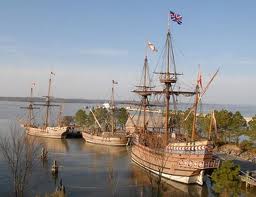


Jamestown Settlement – Jamestown, VA

We recently returned from a visit to Williamsburg, Yorktown, Virginia Beach and Norfolk Virginia.  We really enjoyed the various historical sites, but believe that the Jamestown Settlement was the best of the entire lot.  The exhibits were first-rate with recreations of historical sites and ships and with period antiques.  If you are ever in that part of the United States, a visit to the Jamestown Settlement would be interesting and informative.

I did not have my camera with me – we rode bikes from Williamsburg to the Jamestown Settlement.  This photo is from google images.

The British Way with Umbrellas – from More Intelligent Life

THE BRITISH WAY WITH UMBRELLAS


~ Posted by Charles Nevin, August 31st 2012

One of the more prominent features of this sodden British summer has been the umbrella, unfurled incessantly against the inclemency, and, moreover, starring in the opening ceremonies of both the Olympics and Paralympics. The latter is a reminder that the umbrella is unequalled in instantly conjuring the British character in nearly all of its aspects, including the comic, the cautious and the class-conscious, and as such has been utilised to fine effect by writers as various as Dickens (Mrs Gamp in “Martin Chuzzlewit”), Defoe (“Robinson Crusoe”), P.L. Travers (“Mary Poppins”) and Brian Clemens (John Steed in “The Avengers”).

Its adoption and popularity here is at once surprising and not. Obviously, and particularly recently, it does rain quite a lot; but why a country which has prided itself on no-nonsense practicality should take to such a fussy piece of equipment rather than rely on hat and cape is not immediately clear.

After all, it’s difficult to imagine those brave British forbears at, say, Agincourt carrying them (the longbow men in particular would have got in quite a tangle). Against that, though, is the example of Major Allison Digby Tatham-Warter at Arnhem, who carried one throughout the engagement because, as he explained, he could never remember passwords and the umbrella would make it perfectly clear he was British. The key here, I think, is that much proclaimed but elusive native quality, eccentricity. Nevertheless, the Major disabled an enemy armoured car on at least one occasion by poking his umbrella through a slit and blinding the driver.

Even so, Jonas Hanway, the umbrella’s popularizer in Britain, did not have an entirely easy ride with his novel contraption, having to endure “the contemptuous gestures of his shocked compatriots” as he strolled about London. It evidently cut no ice that he had come across the umbrella among rebellious and quite violent tribesmen in Persia. (Interestingly, some years ago, I encountered a Kurdish guerilla opposed to rule from Tehran who, in addition to his Kalashnikov and bandolier, also carried a shortie umbrella tucked into his belt.)

But, despite such heroes as Major Tatham-Warter and John Steed, the umbrella has continued to have problems. For what impulsive, devil-may-care fellow takes an umbrella out with him in case of rain? What is prudence among women is pathetic among men. Not even Bulgarian brollies with poisoned tips have countered the image. I suspect, for one, that Hanway has left a long shadow: he was also a campaigner, writer and prolific pamphleteer who has been described as “one of the most indefatigable and splendid bores of English history”.

And, of course, there’s class. Not a working man’s implement, exactly. Even here, though, and as usual, you have to be careful with the nuances. A friend of mine (employing an umbrella, as it happens) once encountered a grand acquaintance dressed in tweed hurrying to his London home through torrential rain, and rather wet. “Why,” asked my friend, pointing to his own, “no umbrella?” The man looked shocked. “What, with country clothes?!” I, however, shall continue to use, and fairly often lose, one, fortified by a fine remark from Major Tatham-Warter when a comrade counselled caution against a concerted mortar attack: “Don’t worry, I’ve got an umbrella.”

Charles Nevin is a frequent contributor to Intelligent Life, who spent 25 years on Fleet Street. He is the author of “The Book of Jacks”

Photograph: the Opening Ceremony of the London 2012 Paralympic Games (Getty)

Aggressive Finance Firms – from the New York Times

Inquiry on Tax Strategy Adds to Scrutiny of Finance Firms

Fred R. Conrad/The New York Times

Eric Schneiderman subpoenaed more than a dozen firms seeking documents that would reveal details about their tax strategies.

<nyt_byline>

<nyt_text><nyt_correction_top>The New York attorney general is investigating whether some of the nation’s biggest private equity firms have abused a tax strategy in order to slice hundreds of millions of dollars from their tax bills, according to executives with direct knowledge of the inquiry.

Andrew Harrer/Bloomberg News

The Washington office of the Carlyle Group, which The Carlyle Group has stated in regulatory filings that their partners have not diverted management fees into investments in their funds.

Evan McGlinn for The New York Times

Bain offices in Boston. According to financial statements, Bain partners saved more than $200 million in federal income taxes and more than $20 million in Medicare taxes.

The attorney general, Eric T. Schneiderman, has in recent weeks subpoenaed more than a dozen firms seeking documents that would reveal whether they converted certain management fees collected from their investors into fund investments, which are taxed at a far lower rate than ordinary income.

Among the firms to receive subpoenas are Kohlberg Kravis Roberts & Company, TPG Capital, Sun Capital Partners, Apollo Global Management, Silver Lake Partners and Bain Capital, which was founded by Mitt Romney, the Republican nominee for president. Representatives for the firms declined to comment on the inquiry.

Mr. Schneiderman’s investigation will intensify scrutiny of an industry already bruised by the campaign season, asPresident Obama and the Democrats have sought to depict Mr. Romney through his long career in private equity as a businessman who dismantled companies and laid off workers while amassing a personal fortune estimated at $250 million.

Some executives at the firms said they feared that Mr. Schneiderman, a first-term Democrat with ties to the Obama administration, was seeking to embarrass the industry because of Mr. Romney’s roots at Bain. Others suggested that the subpoenas, which were issued by the attorney general’s Taxpayer Protection Bureau, might be part of an effort to recover more revenue for New York under state tax law. The attorney general’s office does not have the power to enforce federal tax laws.

A spokesman for Mr. Schneiderman declined to comment.

The tax strategy — which is viewed as perfectly legal by some tax experts, aggressive by others and potentially illegal by some — came to light last month when hundreds of pages of Bain’s internal financial documents were made available online. The financial statements show that at least $1 billion in accumulated fees that otherwise would have been taxed as ordinary income for Bain executives had been converted into investments producing capital gains, which are subject to a federal tax of 15 percent, versus a top rate of 35 percent for ordinary income. That means the Bain partners saved more than $200 million in federal income taxes and more than $20 million in Medicare taxes.

The subpoenas, which executives said were issued in July, predated the leak of the Bain documents by several weeks and do not appear to be connected with them. Mr. Schneiderman, who is also co-chairman of a mortgage fraud task force appointed by Mr. Obama, has made cracking down on large-scale tax evasion a priority of his first term.

As a retired partner, Mr. Romney continues to receive profits from Bain Capital and has had investments in some of the funds that documents show used the tax strategy.

The campaign issued a statement saying that Mr. Romney did not, however, benefit from the practice. “Investing fee income is a common, accepted and totally legal practice,” said R. Bradford Malt, a lawyer for Mr. Romney who manages his family’s investments and trusts. “However, Governor Romney’s retirement agreement did not give the blind trust or him the right to do this, and I can confirm that neither he nor the trust has ever done this, whether before or after he retired from Bain Capital.”

Managers at a typical private equity firm or hedge fund collect from their investors management fees based on the size of the fund. But most of their compensation comes as a share of the profits earned by the fund. The Internal Revenue Service allows those profits to be considered “carried interest,” taxed at the capital gains rate typically reserved for investments.

The tax strategy used by Bain and other firms to convert management fees — the compensation normally taxed as ordinary income — into capital gains is known as a “management fee waiver.” The strategy is widely used within the industry: 40 percent of the 35 buyout firms based in the United States surveyed in 2009 by Dow Jones said their partners used at least some of the firm’s fees to make investments in their funds.

But some prominent firms appear to avoid the practice. The Carlyle Group and Blackstone Group have stated in regulatory filings that their partners have not diverted management fees into investments in their funds.

In the varied world of private equity, some firms may have lawyers who are not aware of the strategy or have steered their clients away from it, said a lawyer at one firm who has used the strategy for his clients. Others, he said, may not have the operational capabilities to handle the complex transactions.

Apollo Global Management, the buyout firm co-founded by Leon Black and now publicly traded, is among those that use the conversion strategy. Between 2007 and 2011, Apollo converted more than $131 million in fees into investments in its funds, according to S.E.C. filings. A spokesman for the firm declined to comment.

Likewise, K.K.R. converted more than $180 million in fees between 2007 and 2009, according to its filings. Kristi Huller, a spokeswoman for the firm, declined to comment about any regulatory matter, but said in an e-mail that K.K.R. had not used the tax strategy “for the past few years.”

Other firms that received subpoenas include Clayton, Dubilier & Rice; Crestview Partners; H.I.G. Capital; Vestar Capital Partners; and Providence Equity Partners. Representatives for all these firms declined to comment.

Tax lawyers have justified the arrangements by arguing that converting the management fees into carried interest, which could lose some or all of its value if a fund does poorly, entitles the managers to the lower capital gains rate, which is intended to help mitigate the risks taken by investors.

“They’re risking their management fee — they’re giving up the right to that management fee in any and all events,” said Jack S. Levin, a finance lawyer whose firm has represented Bain on some matters. Mr. Levin said he did not consider the practice risky or even aggressive.

“The I.R.S. has known that private equity funds have been doing this for 20 years,” he said.

In 2007, the agency began taking a closer look at suspected tax abuses at hedge funds and private equity firms. In a statement at the time, an I.R.S. spokesman said that management fee conversions were among several “areas of possible noncompliance.” But no formal ruling appears to have emerged.

Some private equity firms take what tax experts consider a less aggressive approach to the conversions, waiving fees on all of a given fund’s investments over the lifetime of the fund, which can be 10 years.

But other firms choose which funds or even which particular investments to waive fees on frequently, like every year or every quarter. Such arrangements may allow the executives to apply the waiver only when they believe their funds are more likely to appreciate in value, substantially reducing their investment risk.

Mr. Schneiderman is also looking at whether private equity executives treated management fees as a return of invested capital — potentially escaping taxation entirely — or deferred payouts of the converted fees in ways that improperly reduced their tax liabilities.

Executives at three of the firms subpoenaed by Mr. Schneiderman, who asked for anonymity because they were bound by confidentiality agreements, said that disclosures to their investors clearly stated that the waived fees were allocated equally to all the investments in a fund.

The leaked documents show that Bain has in recent years waived management fees in at least eight private equity and other funds, including one formed as early as January 2002. The documents stated that Bain executives had the right to decide either annually or each quarter whether to waive some or all of their management fees; they also had the ability to convert the waived fees into investments in particular companies held by the funds.

Victor Fleischer, a law professor and finance expert at the University of Colorado who has been critical of the tax rules for private equity firms, said he believed Bain had waived management fees into investments with so little risk that the arrangement would not qualify for the capital gains rate if challenged by the I.R.S.

“There is a tension between economic risk and tax risk that is supposed to be inversely proportional,” Mr. Fleischer said. “The way Bain set it up there’s not much risk at all, so it’s hard to see how this income should receive capital gains treatment.”

<nyt_author_id>

Michael Luo contributed reporting.


Not So Fast Mr. Ryan – from the AtlanticWire

Not So Fast, Mr. Ryan

AP

Paul Ryan takes fitness very seriously. He takes it so seriously there is real demand to see him with his shirt off. But when he told a radio host his best marathon time was under three hours, Runner’s World went looking for the truth.

Radio host Hugh Hewitt asked Ryan what he was like in high school. “Were you a speech and debate guy? Were you a bandie? What were you?” he quizzed. Ryan mentioned he was a distance runner. When Hewitt asked for his best marathon time, Ryan gave quite the answer:

HH: Are you still running?

PR: Yeah, I hurt a disc in my back, so I don’t run marathons anymore. I just run ten miles or yes.

HH: But you did run marathons at some point?

PR: Yeah, but I can’t do it anymore, because my back is just not that great.

HH: I’ve just gotta ask, what’s your personal best?

PR: Under three, high twos. I had a two hour and fifty-something.

An under three-hour marathon is, like, really good. But, after his questionable RNC speech, there was demand for a fact check.

Runner’s World‘s Scott Douglas caught wind of Ryan’s claim and noticed that, if true, it would make Ryan the fastest marathon runner on a Presidential ticket, ever. ” John Edwards has run 3:30; George W. Bush has run 3:44; Sarah Palin has run 3:59; and Al Gore has run 4:58,” he writes. When a campaign spokesperson told RW that Ryan ran “Grandma’s Marathon in Duluth, Minnesota, while a college student in 1991,” Douglas found a Paul D. Ryan that finished with 4 hours, 1 minute and 25 seconds. Which, oops.

Apparently Douglas wasn’t the only person giving Ryan a hard time about his revisionist history. His brother Tobin, who ran a 3:34 in the 2011 Boston Marathon, acted as the family fact checker:

“The race was more than 20 years ago, but my brother Tobin—who ran Boston last year—reminds me that he is the owner of the fastest marathon in the family and has never himself ran a sub-three. If I were to do any rounding, it would certainly be to four hours, not three. He gave me a good ribbing over this at dinner tonight.”

Want to add to this story? Let us know in comments or send an email to the author at connorbsimpson@gmail.com. You can share ideas for stories on the Open Wire.

Great News for Coal Investors – from Oilprice.com

Scientists Discover Process to Reduce Co2 Emissions from Coal Plants by 90%

By Futurity | Fri, 31 August 2012 00:25 | 0

Benefit From the Latest Energy Trends and Investment Opportunities before the mainstream media and investing public are aware they even exist. The Free Oilprice.com Energy Intelligence Report gives you this and much more. Click here to find out more.

Refrigerating coal-plant emissions would reduce carbon dioxide emissions by more than 90 percent—at a cost of 25 percent efficiency.

Based on computations done on a spreadsheet and published in the journal Physical Review E, scientists project a dramatic reduction in levels of carbon dioxide and other dangerous chemicals coming from coal-fueled electricity-generation plants.

Coal Plant
“The estimated health costs of burning coal in the US are in the range of $150 billion to $380 billion, including 18,000-46,000 premature deaths, 540,000 asthma attacks, 13,000 emergency room visits, and two million missed work or school days each year,” says physicist Russell J. Donnelly. (Credit: vxla/Flickr)

Such an “energy penalty” possibly would raise electricity costs by about a quarter—according to the scientists’ separate, unpublished economic analysis—but reap huge societal benefits through reductions of health-care and climate-change costs associated with burning coal.

An energy penalty is the reduction of electricity available for sale to consumers if plants used the same amounts of coal to maintain electrical output while using a cryogenic cleanup.

“The cryogenic treatment of flue gasses from pulverized coal plant is possible, and I think affordable, especially with respect to the total societal costs of burning coal,” says University of Oregon physicist Russell J. Donnelly, whose research team was funded by the US Department of Energy for the work detailed in the published journal article.

According to the journal paper, carbon dioxide would be captured in its solid phase, then warmed and compressed into a gas that could be moved by pipeline at near ambient temperatures to dedicated storage facilities that could be hundreds of miles away. Other chemicals such as sulfur dioxide, some nitrogen oxides, and mercury also would be condensed and safely removed from the exhaust stream of the plants.

“In the US, we have about 1,400 electric-generating unit powered by coal, operated at about 600 power plants,” Donnelly says. That energy, he adds, is sold at about 5.6 cents per kilowatt-hour, according to a 2006 Congressional Budget Office estimate.

“The estimated health costs of burning coal in the US are in the range of $150 billion to $380 billion, including 18,000-46,000 premature deaths, 540,000 asthma attacks, 13,000 emergency room visits, and two million missed work or school days each year.”

Costs to society

In their economic analysis, Donnelly and research assistant Robert E. Hershberger, also a co-author on the journal paper, estimate that implementing large-scale cryogenic systems into coal-fired plants would reduce overall costs to society by 38 percent through the sharp reduction of associated health-care and climate-change costs.

Donnelly experimented with such cooling in the 1960s with a paper mill in Springfield, Oregon, to successfully remove odor-causing gasses. Subsequently the National Science Foundation funded a study to capture sulfur dioxide emissions—a contributor to acid rain—from coal burning plants. The grant included a detailed engineering study by the Bechtel Corp. of San Francisco.

The Bechtel study showed that the cryogenic process would work very well, but noted that large quantities of carbon dioxide also would be condensed, a consequence that raised no concerns in 1978. “Today we recognize that carbon dioxide emissions are a leading contributor to climate-warming factors attributed to humans,” Donnelly says.

Calling upon that earlier work, Donnelly pursued a two-year project to update his thermodynamic calculations and create “a spreadsheet-accessible” formula for potential use by industry.

While the required cooling machinery might be the size of a football stadium, the cost for construction or retrofitting, he says, would not be dramatically larger than building present systems that include scrubbers, which would no longer be necessary.

The US Environmental Protection Agency in December issued new mercury and air toxic standards (MATS), calling for the trapping of 41 percent of sulfur dioxide and 90 percent of mercury emissions. A cryogenic system, Donnelly says, would capture at least 98 percent of sulfur dioxide and virtually 100 percent of mercury in addition to the 90 percent of carbon dioxide.

Co-authors with Donnelly and Hershberger on the journal article are: Charles E. Swanson, who earned his doctorate in physics from the University of Oregon and served as postdoctoral researcher under Donnelly; John W. Elzey, a former research associate in Donnelly’s Cryogenic Helium Turbulence Lab and now a scientist at GoNano Technologies in Moscow, Idaho; and John Pfotenhauer, who earned his doctorate at the University of Oregon and now is in the mechanical engineering department at the University of Wisconsin, Madison.

By. Futurity

Isaac’s Impact – from the Scientific American

Isaac’s Impacts: Destruction from ‘Just a Cat 1’ Storm

Along with wind speed, the sheer size of a storm, how quickly it is moving and the angle at which it’s approaching land also influence its potential to wreak havoc. Isaac possessed some of the most menacing of these qualities

By Andrea Mustain and OurAmazingPlanet


In waning daylight, a satellite snapped Hurricane Isaac at 6:46 p.m. local time as the massive storm made landfall at Plaquemines Parish, about 95 miles (153 km) east of New Orleans.Image: NOAA
When Hurricane Isaac swept ashore as a Category 1 storm, its destructive power seemingly took some by surprise. As images of submerged houses and news of dramatic rooftop rescues made the rounds, the Web was abuzz with expressions of disbelief that a mere “Cat 1” storm could be the culprit for the catastrophe unfolding before people’s eyes.

“Man that’s just too much water to be a Category 1 or tropical storm,” wrote @KeepNUpWithMike, reflecting the sentiments of many Twitter users.

Yet these labels — Category 1 hurricane, tropical storm— are based only on top sustained wind speeds. And although that’s important, it’s by no means the only factor that determines a storm’s appetite for destruction, explained Tim Schott, a meteorologist at National Weather Service headquarters in Silver Spring, Md. “There are other factors that can be critical as well,” he told OurAmazingPlanet.

However, none of these other factors are used to rank hurricanes on the Saffir-Simpson Scale. And some scientists argue that since the labels reflect only one facet of a storm’s destructive power, it’s time to change the way we categorize tropical storms and hurricanes.

Yet all forecasters emphasized that storms that are comparatively low on the hurricane scale can still cause horrific damage.

“A lot of the news media and people in general have noted this is only a Category 1 storm, but [Isaac’s effects] show that Category 1 is just the description of the winds,” Schott said. [Images: Hurricane Isaac Packs a Punch]

Causes of destruction

Along with wind speed, the sheer size of a storm, how quickly it is moving and the angle at which it’s approaching land also influence its potential to wreak havoc. Isaac possessed some of the most menacing of these qualities.

First, Isaac is simply a big storm, said Chris Landsea, the science and operations officer at the National Hurricane Center in Miami. “Ever since it formed, it’s been a large tropical cyclone,” he told OurAmazingPlanet.

Bigger storms have a wider reach, affecting more people, and they’re also tied to more severe storm surge, or “the ocean being pushed ashore,” as Landsea described it.

“Isaac’s storm surge is extended all the way to the Florida panhandle,” Schott said, adding that parts of Louisiana have seen inundation as high as 11 feet (3 meters).

Isaac is also moving slowly. The storm crept along at about 6 mph (9 kph) for most of Tuesday and Wednesday, and is moving at 8 mph (13 kph) today (Aug. 30) — a snail’s pace for a storm. That means it’s hammering the same areas with heavy downpours for hours, even days, at a time.

Even relatively wimpy storms can cause terrible damage if they stay parked in place, Landsea and Schott said, since the unending rains can spark inland flooding. Isaac has reportedly dropped some 23 inches (58 centimeters) of rain near Gretna, La., according to unofficial numbers from the National Hurricane Center.

The direction of a storm’s approach also plays a role in its destructive power — certain angles promote greater storm surge, said Robert Henson, a meteorologist who works as a science writer for the University Corporation for Atmospheric Research, in Boulder, Colo.
2 Next »


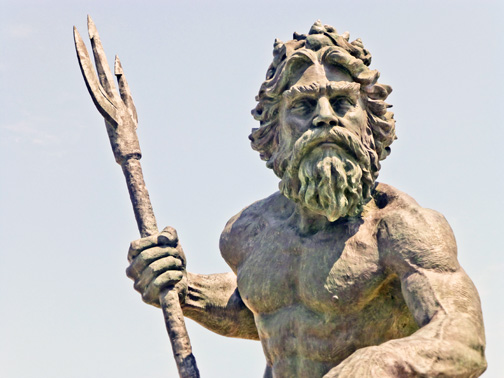
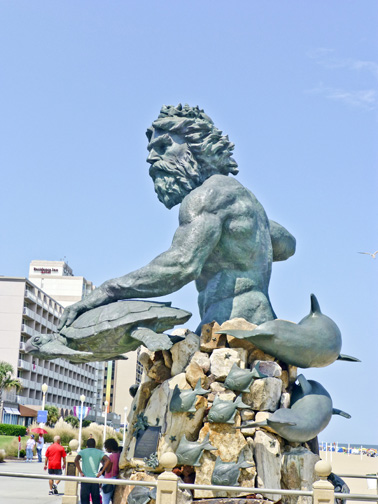
Neptune Bronze at Virginia Beach, VA

We were visiting family at Virginia Beach, VA and they took us to see this marvelous bronze rendering of Neptune.

I especially like this profile shot below


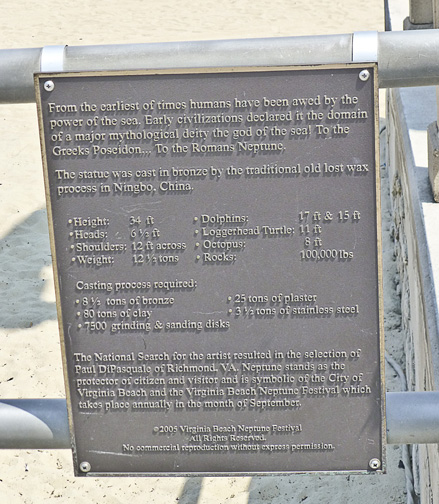
For those interested in this work’s provenance, I took this picture of the plaque

Fallout from the Samsung/Apple Decision

Apple/Samsung: The Verdict on Innovation

The uncertainty over Android could slow the development of technology.

12 comments

DAVID TALBOT

Wednesday, August 29, 2012

Knockoff?: The Samsung Galaxy S, left, next to Apple’s iPhone 4 in a store window last year in Seoul, South Korea. Last week a U.S. jury found that 21 Samsung phones and tablets infringed on Apple patents.
AP/Ahn Young-joon

A $1 billion U.S. jury verdict last week did more than determine that Samsung’s smartphones and tablets violated Apple’s patents—it also clouded the future of products and research based on Google’s open-source Android operating system.

Android, which is built into Samsung’s products, is used in more than 60 percent of the nearly 700 million smartphones expected to be sold worldwide this year, according to IDC, a leading technology research firm. In the months before the verdict, Google was already taking major steps to shore up its patent portfolio in order to protect Android, including by buying Motorola Mobility (see “Why Google Wants Motorola” and “Google’s Troubled Search for Valuable Patents“).

So the verdict (see “Apple Wins Big in Major Patent Trial“) has likely been a shock to many handset manufacturers, researchers, and product developers. Indeed, because Android is an open-source platform, it often serves as a major research test bed for next-generation wireless technology.

For example, anyone who wants to use now-familiar techniques like “pinching” and tapping a screen to zoom in on an image—which the jury decided violated Apple patents—will now have to think about whether this will trigger costly legal problems.

While the big smartphone players ultimately have incentives to settle matters and work together, that sort of concern dampens innovation, says Daron Acemoglu, an economist at MIT whose work includes a recent examination of the connection between the strength of patent protection and innovative output. “The implications for innovation are bad. This will block innovation because people cannot use promising ideas easily, and it will make everything much more bureaucratic, which is a huge problem already,” he says. “It’s a terrible verdict. It makes a mockery of patents. If anything good will come out of this, it is that we will take the idea of abolishing software patents more seriously.”

But others experts disagree, saying the decisions could enhance innovation by signaling that new ideas—especially ideas surrounding design and user interfaces—are worth investing in. “My own guess is this is probably a net add for innovation,” says R. Polk Wagner, a professor who specializes in intellectual property law at the University of Pennsylvania.

Features like pinch-to-zoom feel obvious precisely because of the commercial success of the iPhone, he points out. Its natural feeling “makes it seem crazy that you could patent something like that,” he says, but that overlooks the fact that before Apple patented it, nobody was doing it. In any event, some of these design problems can be overcome with alternative approaches, he predicts. “Pinch-to-zoom and momentum scrolling, those sorts of things—my view is they’re more ornamental rather than fundamental aspects of operating smartphones.”

Still, the verdict is giving pause to some researchers who work on the Android platform. Anything that threatens to distract Google’s Android team from improving the core of Android, and thus keep up with competing operating systems, stands to hurt such research, says Ivan Seskar, an associate director and researcher at Winlab at Rutgers University (see “Do Patents Slow Down Innovation?“).

“Most probably, this will slow down technology development quite a lot,” he says. “It will do two things—it will force Google and others who are heavily invested in Android to circumvent the stuff that looks like iPhone. They will have to make something that looks different—having nothing to do with technology, but with appearances. And people who were thinking about developing Android-based products will start looking at RIM [Research in Motion, makers of Blackberry] and Windows, not because they are necessarily better technology, but they don’t look like iPhone and chances are they won’t be sued.”

With additional reporting by Rachel Metz in San Francisco

About Hurrican Isaac – from Scientific American

Why Did Isaac Take So Long to Become a Hurricane? Isaac encountered and ingested a system of dry air that prevented the storm’s eye wall from forming, a key step in a storm’s intensification By Douglas Main and OurAmazingPlanet 0 in Share Tropical Storm Isaac at 10:25 a.m. EDT on Aug. 28, just before being declared a hurricane. Image taken by NOAA’s GOES-13 satellite. Image: NASA The Best Science Writing Online 2012 Showcasing more than fifty of the most provocative, original, and significant online essays from 2011, The Best Science Writing Online 2012 will change the way… Read More » Tropical Storm Isaac has now officially become Hurricane Isaac, the National Hurricane Center announced this afternoon (Aug. 28). This strengthening had been expected for more than 24 hours, however — so why did it take so long? Tropical Storm Isaac was still intensifying early yesterday (Aug. 27) when it encountered a system of dry air, said Tim Schott, a hurricane specialist with the National Oceanographic and Atmospheric Administration. The dry air was sucked into the cyclone and prevented the eye wall (the border surrounding the cyclone’s center, or eye) from forming, a key step in a storm’s intensification, he told OurAmazingPlanet. It’s also a large storm, with tropical storm force winds extending for nearly 200 miles (320 kilometers). Larger storms sometimes do not intensify as quickly as smaller, more compact cyclones, Schott said. Furthermore, forecasters still do not understand all the physics that control how or why hurricanes intensify, Schott said. But whether or not it passed the hurricane threshold doesn’t really matter, he said — either way it would be a very large system that will have wide-ranging effects. “Everybody likes to put everything into neat little boxes, but it doesn’t matter that it’s intensified from 70 to 75 miles per hour. The difference is really not very consequential.” The cyclone finally achieved hurricane strength this afternoon and currently has winds of 75 mph (120 kph), just over the hurricane threshold, according to the National Hurricane Center. It could intensify slightly in the next 12 to 18 hours, but not by much, according to the NHC. Isaac has limited time and room over ocean waters before it makes landfall, after which it will begin to weaken. The dry air has weakened the storm’s pattern of convection, the rising air that forms the thunderstorms that make up a tropical cyclone. The dry air is still within the system, and may prevent it from strengthening as much as it otherwise would have. The storm is currently moving to the northwest at 10 mph (16 kph) and the center of the storm could make landfall as early as this evening. It’s expected to produce a storm surge between 6 to 12 feet (1.8 to 3.7 meters) in Mississippi and southeastern Louisiana. As of the latest update from the U.S. National Hurricane Center, Isaac’s center was located about 165 miles (260 km) southeast of New Orleans. A hurricane warning is currently in effect from east of Morgan City, La., to the Mississippi-Alabama border, an area that includes New Orleans. The storm is bearing down on New Orleans seven years to the day after Hurricane Katrina devastated the city. Hurricane watches and tropical storm warnings and watches have been issued for other areas of the Gulf Coast. The NHC has warned that the impacts from Isaac’s storm surge are likely to be significant and that the storm could bring large amounts of rain, as well as the possibility of tornadoes in some places. Hurricane Isaac is the fourth hurricane of the 2012 Atlantic season. Storm Season! How, When & Where Hurricanes Form Video: Birth of Tropical Storm Isaac 2012 Atlantic Hurricane Names