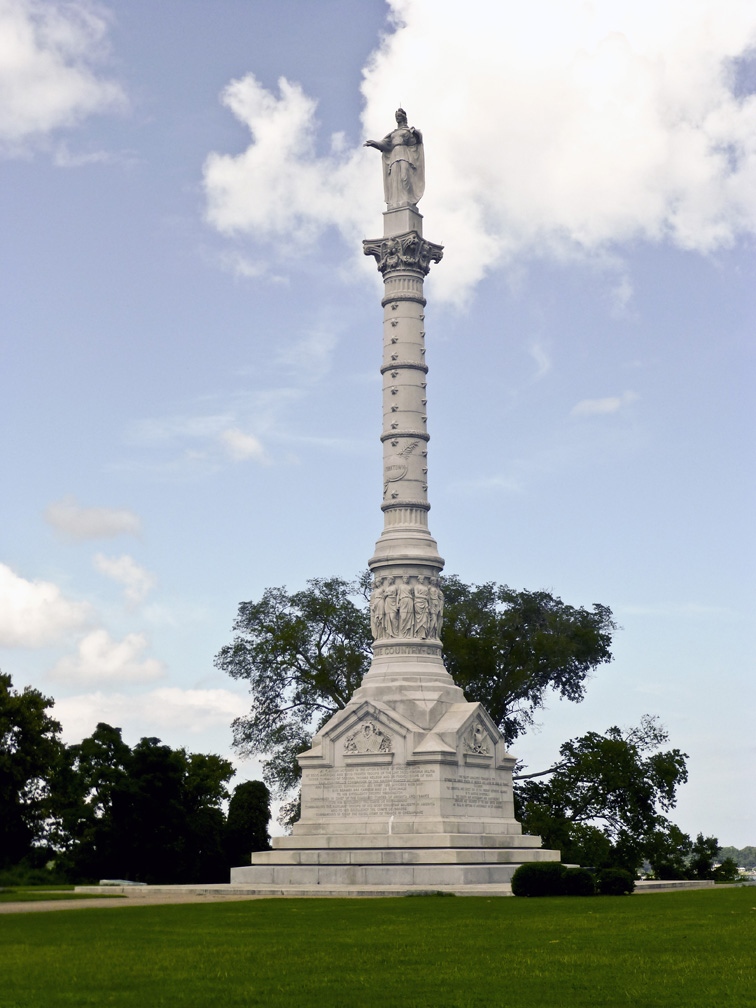
Victory Memorial – Yorktown, VA, USA

We toured the Yorktown, VA battlefield yesterday as part of our trip to Williamsburg, VA.  This picture is of the memorial commemorating the victory of the Colonial forces under General George Washington defeating Lord Cornwallis and accepting his unconditional surrender, ending what we call the American Revolution.  This victory was partially achieved with the help of a French Fleet lead by the French Admiral Comte de Grasse.

The Underlying Cause of Oil Price Fluctuations – from Oil Price.com

The Underlying Causes of Oil Price Fluctuations

By MasterResource | Sun, 26 August 2012 00:00 | 0

Benefit From the Latest Energy Trends and Investment Opportunities before the mainstream media and investing public are aware they even exist. The Free Oilprice.com Energy Intelligence Report gives you this and much more. Click here to find out more.

After oil and gasoline prices continued their relentless march up earlier this year, it was nice to have some relief at the pump in May and June. However, since the end of June, prices of WTI crude oil is up over 15%, Brent crude oil is up about 25%, and retail gasoline is up over 7%. Oil and gasoline prices reached three-month highs last week and the Energy Information Administration (EIA) increased their 2012 forecasts of these prices.

There is no doubt that these higher prices will grab the attention of news outlets, policy makers, and the public. With this increased attention, political rhetoric regarding fantasies of governmental regulations and market manipulations will likely reemerge as catalysts to lower these prices.

The less likely scenario is increased awareness on the impacts that central banks, particularly the Federal Reserve, have on these petroleum prices by changes in the money supply. Over the period of this substantial rise in petroleum prices, central banks around the world have taken action from the dismal economic outlook in many global regions.

The U.S. GDP growth rate of only 1.5% in the 2nd quarter of 2012 and unemployment rate of 8.3% in July concern the Fed about economic stability, which several Fed governors recently called for additional quantitative easingmeasures—purchase of long-term bonds by printing more money. Although the Dallas Federal Reserve Bank President Richard Fisher opposes these additional measures (there are few marginal benefits versus costs), I examine the costs of monetary easing policy based on the relationship between gold and oil prices.

One measure of aggregate money supply, M1—includes currency and demand deposits, increased by 4% since late June. In addition, petroleum prices increased (see above) and the price of gold is up by 2.7% over this period. If there was a direct relationship between the prices of gold and oil, commodity traders, entrepreneurs, and the Fed could benefit from knowing using this relationship to forecast the future spot price of oil. A recent article in the Washington Times outlines a direct relationship between these commodity prices and provides a simple calculation to forecast the price of oil with the price of gold.

Here is the statistical relationship found by the author of the article:

“Downloading daily gold and West Texas oil price data from readily available sources, one can perform a calculation to estimate the price of oil based on the price of gold. For example, if the price of gold for the given day is $326.30, multiply that number by .0602 ounces of gold to get a value of $19.643 per barrel…On a sample of daily interval data from January 2, 1986 to March 3, 2012 (6,457 matching intervals), using basic statistics, a 2-sample t test was performed and the results are eye-opening…We can say that .0602 ounces of gold times the price of gold produces the price of a barrel of oil, with a standard error of just .421%, or an average difference of just $6.10 dollars between the calculated price and the actual price since 1986. For the last 26 years, the price of gold dictated the price of oil with 99.579 percent accuracy.”

Although historically there have been periods when this may be true, Figure 1 illustrates that there are many periods since 1986 when the movements of these prices diverged and were not positively correlated.

Figure 1: Gold and Oil Prices Historical Relationship

Gold Price and oil price
Source: Fed FRED

Since these values in Figure 1 are in logs, the change between two periods is the percentage change. If no other market fundamentals affected these prices except for the value of the dollar, considering that both commodities are priced in dollars, then these two should fluctuate closely together. Clearly, these prices do not always move in tandem. Moreover, correlation does not prove causation, as the author of the article seems to suggest. In other words, it is possible that the price of oil causes movements in the price of gold. The data indicate there is a relationship between the two, but there are many times when this link is not as strong. Since these prices are measured in dollars and in the long run, however long that may be, they should revert to an average relationship. The article notes this relationship to be “.0602 ounces of gold times the price of gold produces the price of a barrel of oil”.

Using this simple calculation with the price of gold closing at $1,623 per ounce last Friday, then multiplying this price by .0602 provides an oil price of $97.70 per barrel. However, oil closed at $93.39 per barrel that day. This $4.31 difference between the projected and actual oil prices indicates that there are other oil market fundamentals at work.

Economic research indicates that the fundamentals of supply and demand in the oil market are important to understand for short run and long run fluctuations. In particular, these fundamental changes allow more pricing information for entrepreneurs to decide which investments are profitable. Moreover, the primary source of oil price fluctuations are not from financial speculation but from oil supply, oil demand, or precautionary oil demand—expected oil supply disruptions, such as the concern about a disturbance in Iran’s oil production—can lead to significantly different economic effects.

Oil supply constraints from the bottlenecks in Cushing, OK, have certainly had an impact on the Brent and WTI prices of oil. Furthermore, this divergence between these two oil prices since early 2011 appears to have changed the relationship with these oil prices and the price of gasoline as well. Before 2011 when these oil prices typically moved lockstep with one another, either of these oil prices could be used to fairly predict the future gasoline price. However, the Brent oil price has been the better indicator of the gas price since last spring, which is around the time of the Arab Spring and supply constraints in Cushing began. With this change, Economist James Hamilton provides a simple forecasting model to predict the price of retail gasoline from the Brent price, which using Friday’s closing price of $113.03 forecasts the national average price of gas of $3.66 compared with Friday’s actual average of $3.675. In my research, the ability of spot and futures prices of oil prices to forecast the gas price has not predicted the future gasoline price better than the gas futures price during different periods of gas price volatility. However, my research did not include the Brent oil price and this is a key research that should be explored.

Although historically there are several oil price spikes from oil supply disturbances, these disruptions are typically short-lived because of production changes around the globe to profit from price changes. However, aggregate demand shocks, such as from China and India during the 2000s, last longer. In my research, I find that a global demand for oil shock, represented by a real global economic activity measure that reflects global demand for commodities, has significantly greater U.S. economic effects on the unemployment rate, real GDP growth, and the inflation rate than other oil market disturbances.

These caveats bring me back to my main point of what impact the Fed has on commodity prices because other central banks tend to follow the Fed’s actions and these actions impact the global demand for oil. In particular, this synchronization of monetary policies would affect the value of the dollar—reflected reflected by the price of gold—and change relative prices, which change U.S. economic variables that are not reflected by only oil price fluctuations. Simply, the price of oil does not matter much. The sources of oil price movements are what matters. In addition, the Fed’s contribution to these underlying causes from its impact on gold, the U.S. dollar, and global demand for oil also change the macroeconomic effects of an oil price shock.

As noted in the Washington Times article above, the author’s simple gold-oil price calculation was wildly off over time. Nominal commodity prices, like all nominal prices, are subject to wild swings that are dependent on a number of variables. What we should focus on are real prices. Therefore, the price of gold gives a valuation of the value of the dollar and provides an indication of the price of oil, all else constant, but it is not perfect. Oil market fundamentals are helpful in determining what is driving the price of oil.

However, these underlying causes of oil price fluctuations may be determined by Fed policies from flows of newly printed dollars into different investments. The Fed distorts interest rates when their policies do not reflect market fundamentals in the loanable funds market. Specifically, the Fed’s discretionary policies of purchasing government bonds and creating artificial bond prices that do not reflect supply and demand in the loanable funds market distort the allocation of resources to different maturating assets. This creates malinvestments along the production process. When we think about how government policies impact gold and oil prices, we must consider those from the Federal Reserve.

By. Vance Ginn
5th Stage of 2012 USA Pro Challenge

These are a few days late, but I was having camera problems.

Cyclist

My grandson Richard and I were at the finish line of Stage 5 of the USA Pro Challenge.  We had a great location about 50 yards from the finish line and we were up front banging on the barriers as the riders went past.  Our favorite rider in this race Vicenzo Nibali went out early on a long break-away and lead until the final circuit.  While he did not win the race, he did get the most aggressive rider jersey which was well-deserved.

I do not have access to the pictures I took, but will post some of them when I do.  This is a picture of my grandson proudly wearing his 2012 official t-shirt and hat.

Romania and Russia Sparring Over Energy

Romania and Russia, Sparring over Energy

By John Daly | Thu, 23 August 2012 20:16 | 0

Benefit From the Latest Energy Trends and Investment Opportunities before the mainstream media and investing public are aware they even exist. The Free Oilprice.com Energy Intelligence Report gives you this and much more. Click here to find out more.

Geography has a major impact on energy issues. Pipelines and energy imports frequently have massive influence on the relations of neighboring states, none more so than those between the Russian Federation and its former Soviet republics, as well as the Eastern European countries they dominated following World War Two.

These issues are particularly acute in the case of the Russian Federation’s relations with Romania, separated by Moldova, a former Soviet republic consisting of Romanian territory unilaterally annexed by Stalin in 1940 and subsequently incorporated into the USSR. Moldova now has the dolorous reputation of being the poorest of the former USSR’s European republics.

With independence fracturing the USSR in December 1991, factories closed and a strip of Moldova, known as Transnistria, east of the Dniester River, seceded. Transnistria was Moldova’s most industrialized section and its most Russified. Moscow intervened to stop a civil war over the secession, which killed over 700 people and since 1992 Russian troops have watched over a “frozen conflict” that leaves Transnistria isolated, unrecognized by any nation, and Moldova sundered.

In the two decades of political and economic chaos the World Bank notes, “Moldova’s unemployment rate rose from 4 percent in 2008 to 7.4 percent in 2010, and with more than one-quarter of its residents living below the national poverty line —the rate topping 36 percent in urban areas— Moldova is Europe’s poorest country.” The World Bank Development Research Group has calculated Moldova’s annual GNP per capita at $1,800.

Neighboring Romania, in contrast, has gone from strength to strength, joining NATO in March 2004 and the European Union three years later, both developments that deeply disturbed Moscow. With a GNP per capita in 2011 of $12,476, Romania now has an upper-middle income country economy, which Moldova’s citizens can only admire from afar.

Russian imports, provided by the Russian Federation’s natural gas monopoly Gazprom, are increasingly expensive, as the company regularly pegs its prices to the global market.
As the European Bank for Reconstruction and Development noted in its February 2012 report on Romania, “Romania has domestic reserves of oil and gas, but chiefly relies on Russia for its imports. There is a need to promote energy security via diversification.”
All of which makes a wide-ranging interview by Golos Rossii (“The Voice of Russia”) radio station with Romanian President Traian Basescu a must-read.

After stating, “Your radio station is engaged in a misinformation campaign, at least that’s true for your Romanian webpage,” Basescu added, “I want to make it clear that, though Romania has been stepping up national security, this policy has never been aimed at Russia. Today, we don’t believe that the Russian Federation could pose a threat to the Romanian national security.”

As for Russian concerns about possible Romanian claims over Moldova Basescu said, “I believe that the citizens of Romania and the citizens of the Republic of Moldova are one and the same nation. But we live in two independent states.”

Basescu was also questioned, “I want to ask you about the gas as well, about the “South Stream.”

South Stream is a proposed natural gas pipeline designed to transport Russian natural gas through the Black Sea to Bulgaria and further onwards to Greece, Italy and Austria, as an alternative to the proposed Nabucco pipeline, with construction scheduled to begin in December 2012, with the pipeline to be completed three years later.

In a lengthy answer Basescu replied,” We support the version of the South Stream project that is supported by the EU. And we are a part of the EU. Thus, for us the Nabucco project is a priority. We are taking part in that project; Romania owns 16% of the project. But we will never be against the South Stream project. And when we received an offer from Russia to make the first exploration tests in Romania’s economic zone, our answer was positive. But we are a part of the European energy policy. For how long the Russian Federation sell its natural gas to us – directly or via intermediaries – taking into account that there is a Gazprom pipeline going through the territory of our country. Of course, the Russian Federation is our partner, and we offered Gazprom an opportunity to set up its underground gas storage facility on the Romanian territory. The issue became especially acute when there were problems with Ukraine. We preserve our wish to remain Gazprom’s partner. And when you want to find out something about Romania, please contact me directly..”.

So, long and short of it? Romania is now firmly ensconced in the Western camp, and Moscow had better get used to it. That said, Bucharest is not so xenophobic so as to sever its relationships with a neighbor and the energy field is regarded as one area where cooperation can not only continue, but deepen. Accordingly for Putin, Romania is offering more than half a loaf, and South Stream represents a future source of Revenue for the Kremlin, unlike Nabucco.

By. John C.K. Daly of Oilprice.com

It Must Really be Bad in Europe!

 From the Wall Street Journal

Buzz Kill: Europeans Cut Back on Coffee

Continent’s Economic Woes Upend Futures Market for Beans 

By LESLIE JOSEPHS And NEENA RAI

[image]Bloomberg NewsEuropeans are making fewer visits to coffee bars. Above, a customer at a cafe terrace in Madrid, Spain.

MADRID—Deepening economic troubles have reached the soul of Southern Europe: the local café.

Across Southern Europe, consumers are forsaking daily visits to the local café as unemployment, wage cuts and higher taxes slash household budgets. Dow Jones’s Neena Rai reports. Photo: Getty.

Across the region, consumers are forsaking daily visits to local coffee bars—considered by many to be the cornerstone of social life—as unemployment, wage cuts and higher taxes slash household budgets.

While Europe’s per-capita coffee consumption remains the highest in the world, demand for less expensive options is growing. This trend has upended coffee markets, where coveted arabica coffee had traded at a hefty premium to its bitter counterpart, robusta, for more than two years.

Prices for arabica beans have dropped 30% so far this year while the cost of robusta has climbed 18%, moves that traders attribute largely to shifting demand in Europe. Meanwhile, the gap between the prices of the two coffees recently had shrunk to its smallest since July 2009, when the continent’s debt problems were developing.

On Wednesday, arabica coffee for delivery in September finished 1.1%, or 1.7 cents, lower at $1.5895 a pound on the ICE Futures U.S. exchange. Robusta on London’s NYSE Liffe fell 1.3%, or $28, to $2,081 a metric ton.

Robusta coffee, the less-expensive, easier-to-grow cousin of arabica, is often used in instant coffee and blended into ground coffee to lower the cost. Arabica beans are used in the gourmet blends usually served in coffeehouses.

It is unlikely that European consumers will switch back to more expensive coffee blends any time soon, said James Hearn, head of agriculture at brokerage Marex Spectron.

Getty ImagesPrices for the cheaper robusta coffee beans, above, are up 18% this year.

“The blends with higher robusta incorporation are cheaper, and the consumer appears happy with the flavor,” Mr. Hearn said.

Nelson Sánchez, a 43-year-old father of three, was laid off from a construction company 18 months ago and considers himself lucky to have found work as a porter in an apartment building in central Madrid. But when his monthly pay fell from €1,500 to €910, his daily visits to the café had to end, he said.

“Before I would go every day. Now I go two days, maximum,” said Mr. Sánchez as he carried a replacement light bulb from a local hardware store. “You have to think about the future. You have to think long and hard about how you spend every euro.”

Predictably, some coffee drinkers are reluctant to give up their caffeine buzz. Ángel López Castillo, a 67-year-old travel agent, says he still can spare a few euros for his daily ritual.

“We can drink coffee,” Mr. López said of his fellow Spaniards. “We just can’t buy cars.”

Tea, typically a cheaper albeit less potent alternative, isn’t expected to gain ground due to Europe’s economic woes, said Joe Simrany, president of the Tea Association of the USA, a trade group. Apart from countries like Ireland and the U.K., “tea is not a big player” in Europe, Mr. Simrany said.

While coffee imports across the European Union as a whole were flat in the six months ended April 2012 compared to the year-earlier period, the latest data available from the International Coffee Organization, the figures from the most troubled economies tell another story.

Coffee imports by Spain fell by 6.6% and Italy imported 2.9% less. In more economically stable Germany and France, coffee imports rose 0.4% and 1.3%, respectively, according to the ICO.

Europe imports more than half of the world’s coffee produced each year, the ICO says.

Spain has the highest unemployment rate in the European Union, with nearly one-quarter of the labor force out of work. But more austere coffee-drinking habits also are evident in other economically troubled nations like Italy.

“Since the beginning of the year most of our regulars cut their coffees from around four to two a day,” said Luigi Cinquini, owner of a café in the center of Milan. “Sometimes, instead of getting a cappuccino or other types of more expensive coffees, they just have an espresso. This is the effect of the crisis.”

Traders at major commodity trade houses said they have seen an uptick in demand for robusta coffee. It is a shift from a year ago, when arabica coffee prices rose to a 14-year high and roasters added more robusta to combat the higher costs.

By the end of July, stockpiles of exchange-certified arabica coffee were at their highest level since October 2010, an indication of waning demand. Robusta inventories were at their lowest point since May 2009.

In a report this month, consumer research consultancy Euromonitor International said, “The overwhelming mood of frugality which now dictates the spending habits of many Spanish consumers” will mean Spaniards will look for less expensive alternatives to coffee this year, such as store-name brands.

At El Escudo, a modest café in central Madrid, business is down by 50% over the past year, said owner Juanma Domínguez.

“If business doesn’t get better,” said Mr. Domínguez, “we’ll be forced to close.”

—Manuela Mesc

Stage 5 of the USA Pro Challenge

Driving down to Colorado Springs this morning with my grandson Richard to watch the finish of Stage 5 of the USA Pro Challenge, the premier stage race in the United States.  This stage begins in Beaver Creek, CO with an uphill climb and finishes with a long descent into Colorado Springs.  This may be a day for the sprinters.  Picture below is a podium from last year’s race.

Saudi Arabia Going After Iran

The Endless War: Saudi Arabia Goes on the Offensive Against Iran

By Felix Imonti | Wed, 22 August 2012 17:55 | 0

Benefit From the Latest Energy Trends and Investment Opportunities before the mainstream media and investing public are aware they even exist. The Free Oilprice.com Energy Intelligence Report gives you this and much more. Click here to find out more.

Saudi Arabia has gone on the offensive against Iran to protect its interests.  Their involvement in Syria is the first battle in what is going to be a long bloody conflict that will know no frontiers or limits.

Ongoing Disorders in the island kingdom of Bahrain since February of 2011 have set off alarm bells in Riyadh.  The Saudis are convinced that Iran is directing the protests and fear that the problems will spill over the twenty-five kilometer long COSWAY into  oil rich Al-Qatif, where The bulk of the two million Shia in the kingdom are concentrated.  So far, the Saudis have not had to deal with demonstrations a serious as those in Bahrain, but success in the island kingdom could encourage the protestors to become more violent.

Protecting the oil is the first concern of the government.  Oil is the sole source of the national wealth and it is managed by the state owned Saudi Aramco Corporation.  The monopoly of political power by the members of the Saud family means that all of the wealth of the kingdom is their personal property.  Saudi Arabia is a company country with the twenty-eight million citizens the responsibility of the Saud Family rulers.

The customary manner of dealing with a problem by the patriarchal regime is to bury it in money.  King Abdullah announced at the height of the Arab Spring that he was increasing the national budget by 130 billion dollars to be spent over the coming five years.  Government salaries and the minimum wage were raised.  New housing and other benefits are to be provided.  At the same time, he plans to expand the security forces by sixty thousand men.

While the Saudi king seeks to sooth the unrest among the general population by adding more government benefits, he will not grant any concessions to the eight percent of the population that is Shia. He takes seriously the warning by King Abdullah of Jordan back in 2004 of the danger of a Shia Crescent that would extend from the coast of Lebanon to Afghanistan.  Hezbollah in Lebanon, Assad in Syria, and the Shia controlled government of Iraq form the links in the chain.

When the Arab Spring reached Syria, the leaders in Riyadh were given the weapon to break the chain.  Appeals from tribal leaders under attack in Syria to kinsmen in the Gulf States for assistance could not be ignored.  The various blinks between the Gulf States in several Syrian tribes means that Saudi Arabia and its close ally Qatar have connections that include at least three million people out of the Syrian populations of twenty-three million.  To show how deep the bonds go, the leader of the Nijris Tribe in Syria is married to a woman from the Saud Family.

It is no wonder that Saudi Foreign Minister Prince Saud al-Faisal said in February that arming the Syrian rebels was an “excellent idea.”  He was supported by Qatari Prime Minister Hamad bin Jassim al-Thani who said, “We should do whatever necessary to help [the Syrian opposition], including giving them weapons to defend themselves.”  The intervention has the nature of a family and tribal issue that the prominent Saudi cleric Aidh al-Qarni has turned into a Sunni-Shia War by promoting Assad’s death.

The Saudis and their Qatar and United Arab Emirate allies have pledged one hundred million dollars to pay wages to the fighters.  Many of the officers of the Free Syrian Army are from tribes connected to the Gulf.  In effect, the payment of wages is paying members of associated tribes.

Here, the United States is not a welcomed partner, except as a supplier of arms.  Saudi Arabia sees the role of the United States limited to being a wall of steel to protect the oil wealth of the Kingdom and the Gulf States from Iranian aggression. In February of 1945, President Roosevelt at a meeting in Egypt with Abdel Aziz bin Saud, the founder of modern Saudi Arabia, pledged to defend the kingdom in exchange for a steady flow of oil.

Since those long ago days when the U.S. was establishing Pax Americana, the Saudis have lost their trust in the wisdom or the reliability of American policy makers.  The Saudis urged the U.S. not to invade Iraq in 2003 only to have them ignore Saudi interests in maintaining an Iraqi buffer zone against Iran.  The Saudis had asked the U.S. not to leave a Shia dominated government in Baghdad that would threaten the Northern frontier of the Kingdom, only to have the last American soldiers depart in December 2011.  With revolution sweeping across the Middle East, Washington abandoned President Mubarak of Egypt, Saudi Arabia’s favorite non royal leader in the region.

Worried by the possibility of Iranian sponsored insurrections among Shia in the Gulf States, the Saudis are asserting their power in the region while they have the advantage.  For thirty years, they have been engaged in a proxy war with the Islamic Republic of Iran.  Syria is to be the next battlefield, but here, there is a critical difference from what were minor skirmishes in Lebanon, Yemen, and elsewhere.  The Saudis with the aid of Qatar, and the UAE is striking at the core interests of Tehran; and they have through their tribal networks the advantage over an isolated Islamic Republic.

Tribal and kinship relations are being augmented by the infusion of the Salafi vision of Islam that is growing in the Gulf States.  Money from the Gulf States has gone into the development of religious centers to spread the fundamentalist belief.  A critical part of the ideology is to be anti-Shia.

Salafism in Saudi Arabia is promulgated by the Wahhabi School of Islam.  The Wahhabi movement began in the eighteenth century and promoted a return to the fundamentalism of the early followers of the Faith.

The Sauds incorporated the religious movement into their leadership of the tribes.  When the modern state of Saudi Arabia was formed, they were granted control of the educational system and much else in the society in exchange for the endorsement of the authoritarian rule.

When the Kingdom used its growing wealth in the 1970s to extend its interests far from the traditional territory in the battle against the atheistic Soviet Union, the Wahhabi clergy became missionaries in advancing their ideology through religious institutions to oppose the Soviets.  More than two hundred thousand jihadists were sent into Afghanistan to fight the Soviet forces and succeeded in driving them out.

There is no longer a Soviet Union to confront.  Today, the enemy is the Islamic Republic of Iran with what is described by the Wahhabis as a heretical form of Islam and its involvement in the Shia communities across the region.  For thirteen centuries, the Shia have been kept under control.  With the hand of Iran in the form of the Qud Force reaching into restless communities that number as many as one hundred and six million people in what is the heart of the Middle East, the Saudis see a desperate need to crush the foe before it has the means to pull down the privileged position of the Saud Family and the families of the other Gulf State rulers.

The war begins in Syria where we can expect that a successor government to Assad will be declared soon in the Saudi controlled tribal areas even before Assad is defeated.  The territory is likely to adopt the more fundamentalist principles of the Salafists as it serves as a stepping stone to Iran Itself.  It promises to be a bloody protracted war that will recognize no frontier and will know no limits by all of the participants.

By. Felix Imonti for Oilprice.com

You can reach Felix at: feliximonti@gmail.com

A Bit of Good News about Climate Change


Opinion, arguments & analyses from the editors of Scientific American

Observations HomeAboutContact

Oil Companies May Have Been Helping Combat Climate Change (A Little)

By David Biello | August 22, 2012 |  Comments1
ShareShare  ShareEmail  PrintPrint


oil-rig-gas-flareHere’s some good news about climate change: emissions of greenhouse gases other than carbon dioxide have slowed and, in some cases, begun to decline. That means fewer molecules drifting in the atmosphere and blocking the escape of heat radiated by an Earth warmed by sunlight. The bad news is no one knows why.

Now a new study suggests that declines in ethane—a simple hydrocarbon molecule and component of the fossil fuel known as natural gas—can be attributed to companies stopping the practice of simply releasing the gas that comes up with every barrel of oil. Atmospheric measurements stretching from 1984 to 2010 suggest that ethane emission rates have fallen by a full 21 percent. The study is published inNature on August 23. (Scientific American is part of Nature Publishing Group).

That’s important in its own right but also because of what it suggests about the second most abundant greenhouse gas—methane, another simple hydrocarbon and the most abundant molecule in natural gas. Over the span of a century, a methane molecule traps 25 times the amount of heat compared to the most abundant greenhouse gas carbon dioxide.

So how much methane human activities put into the atmosphere has a big impact onhow much global warming we end up creating this century (and beyond)—and represents a shortcut to restraining climate change, buying time to decrease CO2 emissions.

The 60 to 80 two-liter canisters bearing air samples collected from all around the Pacific Ocean since 1984 suggest that the ethane decline is a result of a decline in so-called fugitive emissions from fossil fuel production. As the name implies, fugitive emissions are molecules of natural gas that got away (usually on purpose). Given the value of natural gas as a fuel, however, the practice of releasing natural gas molecules has declined since the 1970s. As a result, oil companies—while funding efforts to question the reality of climate change—may have been inadvertently helping keep global warming from getting even worse.

There are other sources of ethane as well, such as wild (and human-set) fires or the burning of biofuels. But ethane emissions from those sources have actually increased, meaning the overall decline has to be attributed to some other source. The remaining possibility—ending the practice of simply releasing ethane when producing oil—is the most likely explanation, the new research argues.

Methane and ethane emissions have been strongly correlated over the period of the study, suggesting that what happens to ethane will happen to methane. In fact, the delay in a more significant drop in methane may be a result of that molecule’s longer lifetime in the atmosphere—methane lasts roughly a decade whereas ethane breaks down within a few months.

As mentioned, that’s good news. It may also give scientists a way to identify particularly catastrophic climate change scenarios before they set in, like a release of the trillions of molecules of methane trapped in Arctic permafrost or ice cages on the seafloor. If methane levels suddenly rose without a corresponding rise in ethane that might signal that such a geologic burp was happening.

Unfortunately, the rate of the ethane (and possibly methane) decline has slowed over the last decade, according to the record. And it may slow yet further if fugitive emissions from natural gas wells—like those currently being fracked in the U.S.—or pipelines grow. There’s also an opportunity to stop the escape of methane from coal mines in China, oil wells in Africa and the Middle East, and pipelines in Russia if we want to slow global warming. To combat climate change, the decline in atmospheric levels of ethane cannot prove temporary.

Image: © iStockphoto.com / HeliRy

Compressed Air Vehicle – from Oil Price.com

Compressed Air Vehicle – Has the Electric Car Met its Match?

By James Burgess | Tue, 21 August 2012 21:00 | 4
Benefit From the Latest Energy Trends and Investment Opportunities before the mainstream media and investing public are aware they even exist. The Free Oilprice.com Energy Intelligence Report gives you this and much more. Click here to find out more.

EV’s are so last season. Those of you into the latest and greatest clean energy technologies need to get yourself a car that runs on compressed air.

The idea of an air powered car has been around for a while but the technology is incredibly difficult to master. Indian car company Tata Motors is developing its Airpod as a next generation, zero pollution vehicle.

The Luxembourgian engine manufacturing company, MDI, has been working on a motor that can run on nothing more than compressed air for over twenty years, and five years ago Tata bought the rights to sell this motor in India. In May the company confirmed that it had successfully completed stage one by testing out the engines in two different vehicles.

The car has space for three passengers, and can travel at 40mph. The tank holds 175 litres of compressed air which can be bought from a specialist station, or taken from the air by activating an on-board electric pump. Tata claim that filling the tank will cost only €1 and then last for about 125 miles.

By. James Burgess of Oilprice.com