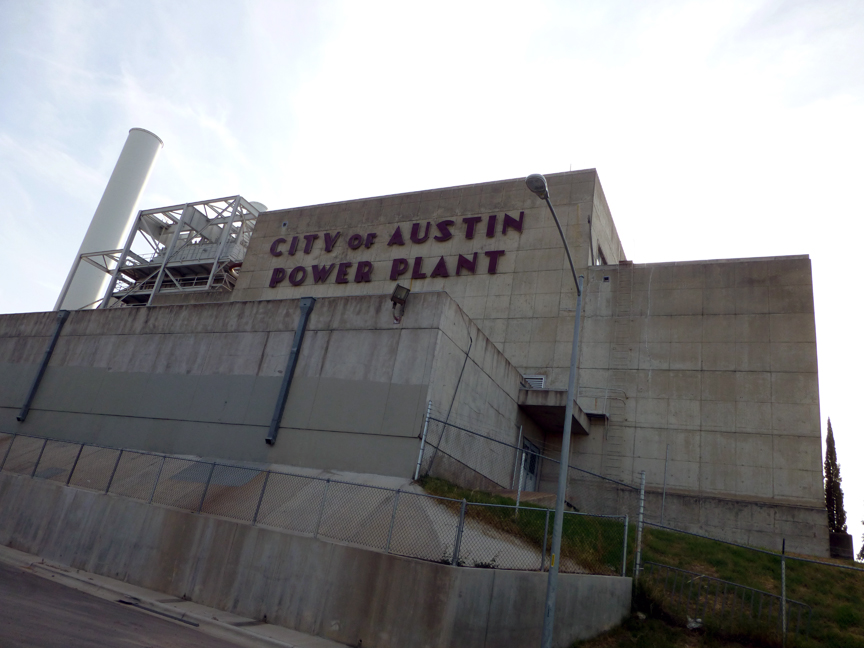
City of Austin Power Plant – A Great Use for Old Power Plants.

This electric power plant in downtown Austin is being de-commissioned.  But, rather than tearing the plant down, the plant is being renovated for historical, cultural and recreational uses.  It is located near the Lady Bird Johnson Hiking and Biking paths near downtown Austin.

New Thoughts on Global Warming


Observations

Observations


Opinion, arguments & analyses from the editors of Scientific American

Observations HomeAboutContact

Has the Time Come to Try Geoengineering?

By David Biello | August 15, 2012 |  Comments16
ShareShare  ShareEmail  PrintPrint


Earth’s average temperature has warmed by 0.8 degree Celsius over the last 100 years or so. The reason is increasing concentrations of greenhouse gases, particularly carbon dioxide, in the atmosphere. The concentration of CO2 has now reached 394 parts-per-million in the air we breathe—and would be even higher, roughly 450 ppm, if the oceans weren’t absorbing a good deal of the CO2 we create by burning fossil fuels, clearing forests and the like.

The basic physics have been understood for 150 years. Global warming has been observed for at least 30 years. International negotiations to restrain greenhouse gas emissions have been ongoing since 1992. And yet, other than during economic recessions, emissions have steadily marched up. If global warming is a problem—one likely already producing weird weather, rising seas and extinctions, among other effects that could be considered dangerous—we are not addressing it.

So is it time to consider something a little more radical? Specifically, the family of ideas for restraining climate change captured under the rubric of geoengineering? Or, as the U.K.’s Royal Society puts it: the deliberate, large-scale manipulation of the planetary environment. As the guest editors of a special issue of Philosophical Transactions of the Royal Society A note: “Geoengineering is no longer the realm of science fiction.”

The science fiction-y schemes vary from proposals to block out the sun viamimicking volcanic eruptions to massive machines the size of power-plant cooling towers to strip CO2 from the air at an accelerated rate. Or maybe you prefer creatingCO2-storing peatlands by raising water tables, or engineering Sphagnum moss to better fend off microbial decomposition when dead. While we’re at it, the crops that cover 11 percent of Earth’s continental surface could be engineered to reflect more sunlight, or the ocean near Antarctica could be fertilized with iron to promotediatom blooms that ultimately bury carbon at sea.

In the end, there is a set amount of greenhouse gases that can be dumped into the atmosphere if we want to avoid catastrophic climate change. Scientists’ best guess is that we can emit 1,000 petagrams, or 1 trillion metric tons, of carbon if we want to stay below 2 degrees Celsius of warming (less than the amount of warming that characterized the shift from the ice-ridden Pleistocene to the milder epoch that birthed human civilization known as the Holocene). We have already emitted more than half of that and will emit the rest of that limit within a few decades if we continue to burn fossil fuels, clear forests and such at anything like present rates.

As climate modeler Ken Caldeira of Stanford University discusses in the September issue of Scientific American in his article “The Great Climate Experiment,” we are now effectively setting the temperature of the planet for the next several millennia.

If the world collectively fails to restrain pollution, then we might need to deploy geoengineering techniques in a hurry to prevent catastrophic climate change. So doesn’t it make sense to investigate the promise of various techniques promise and perils? This is not a new idea—geoengineering hit President Lyndon Johnson’s deskin the 1960s along with a report on climate change that suggested he might deal with the problem by spreading reflective particles on the oceans—just a relatively unexplored one.

All this points to a more fundamental philosophical question about geoengineering, which, as the name implies, is global in scope: Who controls the thermostat? If greenhouse gas emissions are unlikely to turn Earth into Venus, technical remedies are quite sufficient to induce another Ice Age. In fact, weather control was first explored as a weapon during the Cold War. The barriers to entry are relatively low: an island nation, say, with a battery of big guns could start shooting sulphates into the air to block sunlight and cool the climate until somebody stopped them. Or sulphates could be used regionally to stave off, say, a heat wave. Scientists have already begun the task of assessing which method (existing aircraft or, maybe,tethered balloons) and particles might serve best (it’s not sulphate, it’s diamonds or, even better, the minerals you find in your sunblock!) Bonus: these other particles might let the sky stay blue rather than the hazy white expected from stratospheric sulphates, though the impacts of such particles falling out of the sky and covering the planet are unknown.

Such schemes have an apocalyptic feel and bring up images of Dr. Strangelove or other mad scientists. As one respondent to a survey of public attitudes toward geoengineering in England, Scotland and Wales in 2010 put it: “I don’t think you should mess about with the climate… I think that’s very dodgy to be honest.” Of course, we already are messing about with the climate. And that means the question that can’t be dodged is: What are we going to do about it?

About the Author: David Biello is the associate editor for environment and energy at Scientific American. Follow on Twitter @dbiello.More »

Sidewalk Po’ Boy Stand – Austin, Texas

One of the newer food venues in downtown Austin.  This one serves Cajun style P0′ Boys.  P0′ boys usually include meat or fried seafood and are served on baguettes.

Android’s Share of Global Market Gains at Expense of I Phone

Android share grows as China takes over while iPhone buyers pause

New figures from Gartner show Android reinforcing its grip on the market, notably in China – but US shows more balanced breakdown while featurephone sales dip

Android Jelly Bean

The Android OS has tightened its grip on the world’s smartphone market

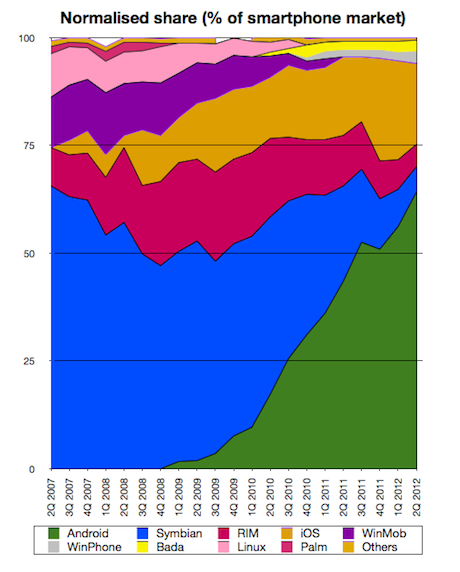
Android‘s grip on the world smartphone market is confirmed by figures from the research group Gartner, which says that in the second quarter of 2012 it powered 64.1% of the 153.7m smartphones shipped, up from 43.4% a year ago as that segment of the market grew by 42.6%. (Mobile users can see the graph here.)

Smartphone market share 1Q 2007 - 2Q 2012Smartphone market share 1Q 2007 – 2Q 2012; normalised to 100%. Source: GartnerIn sheer numbers, Android handset shipments more than doubled from 46.8m to 98.5m–- far faster than any other platform. Of other smartphone platforms, only Apple‘s iPhone had more than a double-digit share, registering an 18.8% share – essentially flat, up 0.6%, year-on-year – as it shipped 28.9m units. That confirms the situation drawn out by other analysts, which see the smartphone platform race as belonging to Android and Apple – and the handset race to Apple and Samsung, which have about 50% of the market together.

Gartner’s figure for Apple’s shipments is higher than the number given by the company in its financial results, explained smartphones analyst Carolina Milanesi, because “we track sales to consumers, and Apple burnt inventory”. The latter point, in which Apple is reducing the number of phones with carriers, could point to the launch of a new iPhone comparatively soon.

The analysts reckon that new iPhone purchases were postponed by some who expect the company to announce the next version of its handset imminently: its market share dipped by 3.7% sequentlally “as users postponed their upgrade decisions in most markets ahead of the upcoming launch of the iPhone 5”.

A growing number of apparent leaks from Apple’s supply chain, as well as information from carriers who have begun stocking up on the nano-SIM agreed by Apple and other handset makers as a new standard, points to a release soon. Online speculation revolves around 12 September, though Apple has given no indication so far of any event on that date.

But Gartner’s figures also point to a growing world divide, with China trending towards low-cost Android smartphones made by “white box” manufacturers while western markets, and particularly the US, look to high-end names.

China is the world’s largest smartphone market, with 39m shipments, or a quarter of the world total, of which 80%, or 31.2m, were Android and 12%, or 4.7m, were iPhones.

By contrast in the US, the largest single western market, total shipments were 23m, of which 58% – 13.3m – were Android, and 36%, or 8.3m, were iPhones.

Separate mobile data from Baidu, the Chinese search engine, analysed by Benedict Evans of the research company Enders Analysis, indicates that page views there from Android phones passed those from NokiaS60 Symbian phones during the second quarter, and at 21.4% are running at about three times the iPhone’s 7.9%.

Symbian is still second, at 16.6%. (Other featurephone platforms make up the remaining proportion of accesses.) That suggests that many of the Android smartphones being sold in China are not yet being used to connect to mobile data networks.

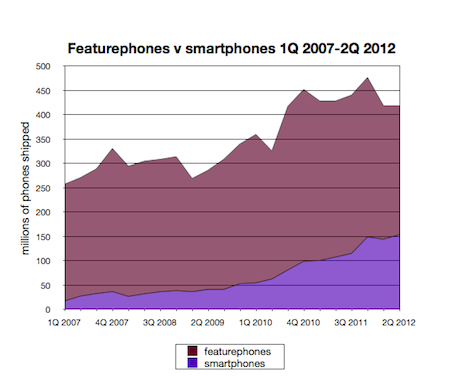
The overall mobile phone market dipped by 2.3% to 419m units, as the number of featurephones sold fell even further, having peaked in the fourth quarter of 2010 and now begun a steady decline as smartphone sales grow. The latter now comprise 36.7% of the world mobile phone market – indicating a long-term decline for featurephone sales. (Mobile users: graph here.)

Featurephones v smartphonesFeaturephones v smartphones, world market, 1Q 2007 – 2Q 2012. Source: GartnerThat in turn poses a risk particularly to Finland’s Nokia, which shipped a total of 83.4m phones in the quarter, of which about 70m were featurephones. So far, Nokia’s adoption of the Windows Phone platform from Microsoft has been of little benefit; sales were around 4m for the quarter, still smaller than the fast-declining Symbian platform, which has been earmarked for phasing out yet still shipped on 9m handsets.

“Declining smartphone sales are worsening Nokia’s overall position, as it had already lost the No.1 phone-maker position to Samsung in the previous quarter and is facing reduced profitability due to continuous declining sales of premium smartphones,” said Anshul Gupta, principal research analyst at Gartner.

Windows Phone eked out a 2.7% share, with 4.1m handsets – equal to Samsung’s home-grown Bada operating system. But that was still more than double the position a year ago, before Nokia began shipping Windows Phone devices.

However for BlackBerry maker RIM, once a pre-eminent player on the smartphone stage, there is no let-up in the bad news: its share dwindled to 5.2% from 11.7% a year ago as total shipments shrank from 12.6m to just under 8m.

Among smartphone handset makers, the dominance of Apple and Samsung – the latter shipping an estimated 45.6m units by Gartner’s measurement, which excludes the Galaxy Note device – has left little room for rivals.

Taiwan’s HTC saw a drop in total shipments year-on-year, from 11m to 9.3m. Motorola, recently acquired by Google, also saw a fall in total shipments from 10.2m to 9.1m; Google this week announced that it would cull 4,000 jobs, reduce the number of handsets and close a number of its foreign offices as it tries to return the company to profitability.

But for Chinese manufacturers ZTE and Huawei, the quarter saw them driving up the world mobile phone rankings, to take fourth and sixth positions respectively, behind Samsung, Nokia and Apple.
Ice Cream Shop Featuring Mexican Ice Creams – Bishop Arts District in Oak Cliff Section of Dallas, Texas

This store, located in the Bishop Arts District Section of Dallas Texas sell some wonderful ice cream.  With the heat of the Texas summer, it would be a great place to visit anytime.  Try the Vanilla.  It is great stuff.

New Ethanol Production Process to Increase Recoverable Energy by 2000% – from Oil Price.com

New Ethanol Production Process Claims to Increase Recoverable Energy by 2000%

By Joao Peixe | Mon, 13 August 2012 21:45 | 1

With all the focus on electric vehicles it can be easy to forget the billions that the government pours into biofuels, and especially corn based ethanol production. Most people prefer the idea of EV’s than using ethanol blended gasoline to fuel their cars, but a new method for ethanol production could increase its popularity.

Researchers at the Michigan State University claim that they can increase the amount of energy recovered during ethanol production by 2000 percent.

Using a fermentation process optimised to recover as much energy as possible from the corn stover. Traditional methods generally get 3.5% to 4.5% of the potential energy from the corn product, but this new bioelectrochemical process uses special microbial electrolysis cells in steps that have been “custom-designed” to be as efficient as possible. The result is that 35% to 40% of the energy is recovered.

The waste products from the procedure are then used to generate hydrogen which helps to further increase the energy produced, up to 73%; a bit of an improvement from the current 4.5%, and one that could revolutionise the whole industry.

The US is currently suffering its worst drought in 100 years, yet if this technique works as well as it claims, the volume of ethanol produced could be higher than ever. Corn farmers could become the largest source of fuel in America.

By. Joao Peixe of Oiprice.com

Meet Myer Elizabeth

My daughter Elizabeth gave birth to her first child on August 13th at about the same time that I was having my deviated septum repaired.  Mae was about 3 weeks early, but is in excellent health as is Elizabeth.  Mae is tiny at 5 lbs, 11 oz, but that is due to her being slightly premature.

Confidential Memo from Mitt Romney to Paul Ryan – from the New Yorker

The Borowitz Report

AUGUST 13, 2012

LEAKED MEMO FROM ROMNEY TO RYAN

Posted by 
NEW YORK (The Borowitz Report)—After watching its Vice-Presidential pick on the campaign trail over the weekend, the Romney campaign today issued the following confidential memo to Representative Paul Ryan (R., Wisc.):

From: Romney for President Campaign
To: Paul Ryan
Subject: Tweaks

We want to stress just how excited we are to have you as a member of America’s Comeback Team. The following suggestions are intended to make a super performance even superer:

1. On your first stop on Saturday, you said, “I’m opposed to Obamacare and Medicare, and also the word ‘care.’ ” Even though that was a big applause line, we’re concerned that the MSM may take it out of context.

2. Some of your proposals, while bold and terrific, may need to be focus-grouped before you go public with them. We’re thinking in particular of your town hall meeting on Sunday, when you proposed replacing Medicaid with Groupons. Also, we may want to dial back comments about putting the elderly on ice floes and letting them drift out to sea. Whenever an audience member at a campaign event needs a defibrillator that makes for bad optics.

3. Good people to quote in speeches: Ronald Reagan, Grover Norquist, Milton Friedman. Names to avoid: Ayn Rand, Marie Antoinette.

4. Just a suggestion/thought, but maybe come up with alternative ending for stump speech, other than “We’re America’s Comeback Team, and we’re going to make America come back to the year 1860.”

Other than those tweaks, just keep doing what you’re doing. Don’t know if you’ve noticed, but nobody’s talking about Mitt’s tax returns anymore! LOL


Get the Borowitz Report delivered to your inbox for free by clicking here

Read more http://www.newyorker.com/online/blogs/borowitzreport/2012/08/leaked-memo-from-romney-to-ryan.html#ixzz23WSwp9Q8

Surgery Tomorrow – may not be blogging for a few days

I am having surgery tomorrow to correct a deviated septum.  While the surgery is minor, it is painful – worse than that – I am not allowed to run for two weeks or cycle for a week.  The upside for me is that my deviated septum has gotten so bad that it restricts my ability to breathe in while I am doing distance running or cycling on hills or sprints.

I scheduled my surgery for two days after I ran the Georgetown, Colorado to Idaho Springs, CO half marathon. I finished in 1 hour 46 minutes and 26 seconds, not bad for someone who turned 68 this past April.  I am looking forward to an even better time once I can run again.  I am thinking of doing the Denver Half in October, before returning to Austin.

I will most likely not be blogging but I look forward to receiving your posts.  Endeavor to persevere!

10 Things Apple Won’t Tell You – from the Wall Street Journal


Why customers may want to think different about the consumer-tech giant.

By QUENTIN FOTTRELL

1.”Our customers are worn out.”

All that initial excitement over the first iPhone or iPad has quickly given way to what analysts are dubbing “upgrade fatigue” — with even Apple’s most loyal customers upset about the steady stream of newer models. In fact, when people buy Apple’s latest product, the company is usually already preparing its replacement, says technology consultant Patchen Barrs, who has owned 25 Apple products over the last 20 years. “Everything we buy from them is already out of date,” he says. Take a count: Since 2001, there have been six iPods, two iPod minis, six iPod Nanos, four iPod Shuffles and four editions of the iPod Touch. Apple has released five iPhone models since 2007 and has had three iPads since 2010.t

Of course, newer models have their upsides: They’re usually slimmer, faster and have additional features like better cameras and improved screen quality. And Apple (AAPL: 621.70, 0.97, 0.16%), which declined to comment for this story, has said that such improvements more than justify the fast pace of their new additions. (In March, for example, Apple spokeswoman Trudy Muller said the latest iPad delivered a “stunning” screen display.) But that argument isn’t enough to appease some cash-strapped consumers. Almost 50% of consumers say they’re increasingly unwilling to buy new products for fear that they will be rendered outdated by even newer versions, according to a recent survey of 2,000 people by Marketing Magazine in the U.K.

What Apple Won’t Tell You

5:03Customers may want to think different about Apple, as SmartMoney’s Quentin Fottrell discusses on digits.

It doesn’t stop with devices, say experts: Software upgrades also gently nudge people to buy new hardware. Last month, Apple launched a new version of its Airplay software, which virtually connects Apple gadgets and can beam video from computers to Apple TV. But the new Airplay is not compatible with iMacs and MacBook Air computers bought before mid-2011. Some Mac owners expressed their unhappiness online. One irate Mac customer wrote: “I don’t care how much you plan for obsolescence, there is no way that new software should not be backward compatible for at least a couple of years.”

NEXT

2. “Be careful of that app.”