Iran in a Strategic Bind – From Oil Price Daily

Iran at Its Strategic Juncture

By Gregory R. Copley | Wed, 18 July 2012 23:35 | 1


Iran, no less than the European Union or the United States of America, faces a series of problems which place it at a critical strategic junction. It now faces urgent challenges, the response to which will determine its viability — even its survival — over the coming decades.

The US thinker Hans Morgenthau said, in Politics Among Nations: “Never put yourself in a position from which you cannot retreat without losing face, and from which you cannot advance without grave risks.” Iran has allowed itself to be put in this position, and — with regard to a potential conflict with Iran — Israel and the United States have also allowed themselves to be put in such a position, albeit not so gravely as Iran.

Iran has traditionally been surrounded by hostile, or competitive, forces. In the past century, Iran was contained and constrained by the Russian Empire and then the USSR to the North; by the Ottoman Empire and then Iraq to the West; by the British, and then the Taliban, to the East; and by the Sunni Arabs and British to the South. This mold broke apart with the collapse of the USSR, the defeat of the Taliban, the destruction of Saddam Hussein’s Iraq, and by the ongoing strategic weakness of the Arabian states. This latter situation in the Persian Gulf was accelerated by the withdrawal of the, and then — in 2011-2012 — by the de facto withdrawal of the US (or of US influence) which had replaced Britain as the Gulf external power.

This confluence of events provided a unique alliance of the stars for Iran. But Iran lacked the leadership, efficiency, and vision to take advantage of that respite from the chains which bound it.

In part, this situation — this inability to seize the situation — has been based on Iran’s failure to evolve from the overthrow of the Shah in 1979. The clerical leadership of the State has sustained an approach to governance and statehood since that time which has not evolved to create a national grand strategy which could help it assert Iran’s, or Persia’s, traditional geopolitical vision.

That is not to say that Iran’s clerics have failed to instinctively take paths which have been traditionally Persian in a geopolitical sense, but that they have not done this with any real understanding of history. Moreover, the clerics have attempted to use religion — Shi’ism — as the “carrier wave” and justification of all of its activities, both domestic and foreign. This has hampered the ability of Iran to take full advantage of its situation, and left it by 2012 as almost a vassal of the Russian Federation and the People’s Republic of China (PRC).

Iran has, in many respects, been unable to develop viable strategic and foreign policies because it has not yet resolved its domestic governance in a way which guarantees efficiency, or popular support for the State. The clerical Government has, essentially, failed (or refused) to draw upon and galvanize traditional Persian culture, values, and loyalties, but instead has attempted to make Shi’ism the sole process of legitimacy and governance. Again, that is not to say that the clerical Government has failed to take foreign, military, or strategic steps; it has, but many of these have been reactive or have been undertaken outside of a valid strategic context, and lacked the force and efficiency required to make them effective.

Domestically, there is little unity and little cause for optimism. The economy is in tatters, and not merely (or even mainly) as a result of the US-led trade embargo against Iran. Inflation is at destructive levels: officially it was 21.5 percent in urban areas for the year-ending March 19, 2012; in reality it is clearly much higher than that (The Economist in July 2012 claimed it at around 30 percent). Unemployment is high, reaching 35 percent in some urban areas as of mid-2012.

Iran’s oil exports — its major source of foreign exchange earnings — declined by some 50 percent between February and June 2012, but stabilized at that point. They were expected to average 1.084-million barrels per day (bpd) in July 2012, only a fraction down from June, as a result of an increase in PRC oil imports from Iran. [Only four major clients existed for Iranian oil in July 2012: the PRC, India, Japan, and the Republic of China (ROC: Taiwan).] An EU embargo on oil purchases and shipping insurance on traffic to and from Iran came into force at the start of July 2012, and even Turkey — which is, of course, outside the EU embargo framework — cut back sharply on Iranian oil purchases.

Thus, with or without sanctions, the economic malaise in Iran has worsened to the point where social and political consequences internally seem inevitable. The situation has been hampered by relative mis-management of the economy, or at least a lack of direction within it. Again, this is not to deny the reality that the Government has attempted to undertake industrial and commercial projects, but these have been hampered by the lack of a domestic economic and political strategy, and by rampant (although possibly declining) corruption within the Government.

All of this, however, has been symptomatic of the real weakness in the Iranian structure: the lack of coherent, singular leadership. This, too, has been symptomatic of the failure of the clerical Government since 1979 to build a broad base of popular support. Rather, it has been successful only at the suppression of opposition, and even when popular unrest has spilled into the streets — as it did with the 1999 student uprising, and the 2009 open unrest in almost all cities — even the opposition has lacked leadership.

The success of the clerical Government in suppressing unrest has been achieved with significant support and assistance from the Russian and PRC governments. As well, the clerics can be said to have successfully diverted the popular unrest by having clerical adherents, such as Mir-Hossein Mousavi Khameneh and Hojjat-ol-Islam Mehdi Karroubi, emerging as “opposition” leaders to channel the unrest into a powerless stream. These so-called opposition figures were not even the other side of the same coin as the clerical leadership; they were the same side of the same coin.

In all of this, Iran has become increasingly dependent — as it is for trade and protection — on the PRC and Russia, despite the significant resentment of Moscow by the Iranian leadership, and the growing resentment against PRC dominance of the domestic economy by many Iranians.

An extensive body of opposition to the ruling clerics exists within the four- to five-million Iranians in the diaspora, but even though the expatriate Iranians have the freedom to remain engaged in debate about the future of their country, they lack cohesion, leadership, and a vision of their demands. Thus they remain ineffective in acting as a voice for Iran, or against the clerics. The result is that most major power policies toward Iran are made without reference to the vast expatriate body of knowledge on the country. This is in distinct contrast to, for example, the effectiveness of the anti-Turkish activities of the diaspora Armenian communities of North America, Europe, and Australasia.

The key bridge in this, and in any discussion about Iranian strategic outcomes and activities, is the Revolutionary Guard (Iranian Revolutionary Guard Corps: Pásdárán). The Pásdárán is the dynamic element in the Iranian political equation, even though this force of some 250,000 armed personnel is not a unified or single-faceted body. The clerics are, essentially, now subject to the power of the Pásdárán, the creature of their own making. If leadership emerges from that armed body, it could drive changes in Iran.

Indeed, the Quds Force of the Pásdárán is already the key element of Iranian strategic projection, both with regard to its intelligence capabilities, its control of formal and informal non-Iranian forces outside the country, and with its own covert paramilitary functions. Pásdárán also controls Iranian strategic weapons: the ballistic missiles and the existing nuclear warheads. The question, then, is whether the Revolutionary Guard will continue to support the clerical leadership, particularly as that leadership weakens and becomes increasingly engaged in fratricidal internal conflict.

As we bridge the analysis from the domestic situation to Iranian foreign and strategic policy, it is worth noting that “Supreme Leader” Ayatollah Ali Hoseini-Khamene‘i and Pres. Mahmud Ahmadi-Nejad are becoming progressively weaker. Ahmadi-Nejad is now, politically, almost powerless, and even at the height of his “power” — as perceived by external analysts — he was never in a position to overrule the Revolutionary Guard, even as he attempted to put his own supporters in positions of authority within it. The “Supreme Leader” is in declining health, and also, arguably has (and based on observations of his activities in 2012), lost his political legitimacy and sense of leadership.

Given the stalemate in the domestic political situation, with regard to the economic and social situation, as well as the feeling of isolation which is now becoming pervasive within the community, it would not be surprising if elements of the Revolutionary Guard sought to exert their power. The clerics’ only hope is that the Guard itself is not cohesive, and has mutually competitive elements. There is definitely a growing body of thought within Iran that the isolation cannot continue indefinitely, and that the longer it continues the greater Iran’s subservience to Russia and the PRC — and dependency on North Korean weapons — must become.

Significantly, there is surprisingly little hostility among Iranians toward the West, and even the US and Israel, despite the decades of propaganda by the clerics. It is generally acknowledged that most Iranians would prefer normalization of relations with the West, including Israel, rather than dependency on the Shanghai Cooperation Organization (SCO) member states, dominated by Russia and the PRC.

These are critical considerations as the Western media, and some politicians, consider the “inevitability” of a US-led or Israeli-led war against Iran over the issue of Iran’s acquisition of a domestic nuclear weapons manufacturing capability. The reality, when the long-term structural architecture of Iran and its population is concerned, is that Iran does not pose an “existential” threat to Israel, for example. Iran has not, for the past 250 years, initiated war against any state, and even the late 20th Century Iran-Iraq war came directly as a result of conflict initiated by Iraq’s Saddam Hussein. Moreover, the past 2,500 years have been dominated by a bond between Iran and Israel, which has been as much a geopolitical strength for both as it has been a cultural bond.

Both modern states, in fact, see a common cause for concern in the hostility of the Sunni Arab states, including Saudi Arabia, Turkey, and (lately) Qatar.

Bearing on this is the reality that the Israeli Government led by Binyamin Netanyahu (Likud Party) was, on July 17, 2012, facing a considerable weakening, as the Kadima party quit the Coalition Government in a dispute over drafting ultra-Orthodox Jews into the military. The Government was not expected to collapse because Likud still had a majority in the Knesset, but the issue took away a little of the Government’s ability to stake the country’s future on proposed military action against Iran. Indeed, increasingly, Israeli officials have been speaking out against military action against Iran. [Nonetheless, Kadima was likely to return to the Coalition; it has nowhere else to go.]

In terms of foreign policy — as a subset of strategic policy — Iran has been running more-or-less on fumes. Its basic approach of mobilizing the Shi’a populations of the region has been relatively successful, and this has extended to its relationship with Syria, at present dominated by an ‘Alawite (essentially Shi’a) minority Government. This policy approach of building a stepping stone path of Shi’a communities linking Iran with the Mediterranean has, however, dramatically reinforced Sunni-Shi’a antagonisms, and, arguably, has served to help reinforce the radicalization of the already-fundamentalist Wahhabi sect of Sunnism and its jihadist approach toward competing with Iran in Syria and other areas.

Again, this has been caused by the transformation of traditional Iranian geopolitical visions, subordinating them to being conducted through the vehicle of Shi’a religious projection. Iran has always had a sense of belonging to, and participating in, the Mediterranean. Its links with the Levant, including ancient Israel, as well as its forays toward Greece, are native to Persian geopolitical thinking. The Islamization of this process, however, has reduced the pragmatic nature of Iranian foreign policy, and this Islamization was used to help fight against the US-led war in neighboring Iraq. But this caused a schism in the historical link which Iran had with Israel. The clerics in Tehran did not seem to notice this; they were oblivious to Persian historical geopolitical thinking.

Clearly, at the bottom line, if Iran loses Syria, it will be reduced dramatically in its strategic posture, and this would be directly attributable to the failure of the Iranian Government to project a tiered and textured approach toward the Mediterranean, including Israel. Even now, despite the polemics of Israeli Prime Minister Netanyahu, Israel is silent on the West’s (and the Sunni region’s) call for the overthrow of the Bashar al-Assad Government in Syria. With regard to Syria — which has been a base for the major missile threat which the Iranian clerics have posed to Israel — Israel and Iran both wish to avert a Sunni revolution in Syria.

Also at the bottom line is the reality that the US and Israel face the impasse which also faces Iran. All the powers have limited ability to move; they have placed themselves in a position — as has Turkey in the regional unrest — where they cannot retreat without embarrassment, and cannot advance without risk.

By. Dr Assad Homayoun and Gregory R. Copley, Editor, GIS/Defense & Foreign Affairs.

When In Venice – from Intelligent Life Magazine

VeniceLion.jpg 

Do as the Venetians do. Jane da Mosto, scientific adviser to the Venice in Peril Fund, gives her tips

From INTELLIGENT LIFE magazine, July/August 2012

DO try to stay for as long as possible, even months or years. Apart from the obvious draws, Venice is a great base from which to set off on trips around the lagoon, to the beach (Lido, but also Punta Sabbioni and Jesolo) and to picturesque local towns like Bassano del Grappa and Vicenza.

DO visit the museums and churches, often a sanctuary from the crowded alleys. The secret tour of the Doge’s Palace is essential, and some guides can organise a visit to St Mark’s Basilica at night, when it’s empty and dramatically lit. Special arrangements can also be made to look around the Arsenale (once the heart of Venice’s naval power) and the Fondazione Cini (on the island of San Giorgio) which, through their architecture, views and particular contexts speak more than words about Venice.

DON’T walk around with your nose buried in a map or worry about getting lost. It won’t be long before you find a familiar landmark, or a sign to Piazza San Marco, Rialto or Accademia. The areas of northern Cannaregio, lower Castello and Giudecca are particularly fine wandering spots.

DON’T eat anywhere with a plasticated menu showing photos of the food on offer. Or give business to the absurd drinks and snack vending machines that have recently landed around Venice. The only good one is the milk machine parked in the Garage Comunale, Piazzale Roma—it dispenses fresh, unpasteurized milk straight from the nearest dairy.

DO
 try some Venetian specialities when eating in or out: castraure (earliest artichokes, fried or stewed), mauve mantis shrimp, and moeche—little soft-shell crabs from the lagoon—are all delicious, as is the wild duck with artichokes at the Antica Trattoria alla Maddalena, just by the vaporetto stop on the outlying island of Mazzorbo.

DON’T come on a cruise ship: they are ugly, spoil the view, damage air quality and building fabric, and destroy the fragile lagoon ecosystem.

DO rent a bicycle and explore the Lido or the little-visited area of Forte Marghera. Take a picnic bought from the Rialto market or the vegetable barge on the San Barnaba canal.

DO take a gondola ride, but don’t let your gondoliere talk on his mobile. Nor should your taxi driver go too fast across the lagoon, or too near small boats or other islands: the wake waves are damaging and dangerous.

DON’T bother with shops selling mass-produced tat (mainly Chinese). This applies to clothes and handbags as much as rip-off “Venetian souvenirs” in the form of tacky masks and glass geegaws—there is so much high-quality stuff on offer if you keep your eyes open.

DO support local artisans. San Samuele, the area between Campo San Stefano and Palazzo Grassi, is crammed with superb jewellers, antique dealers, galleries and boutiques. Buying glass direct from the outlets in Murano can be tricky, so try Giordana Naccari’s Angolo del Passato, or the glass artist Massimo Micheluzzi for chandeliers and vases. Stationery is still hand-printed in the workshop of Gianni Basso (his son, a marine biologist, has just joined the firm).

DO keep to the right when moving slowly, allowing Venetians to overtake you—they’re not on holiday and know where they’re going.

DON’T walk side by side (in doppia fila): most streets are too narrow for two-lane traffic.

Jane da Mosto has lived in Venice since 1995. She is scientific adviser to the Venice in Peril Fund and author of “The Science of Saving Venice”

Illustration Neil Gower

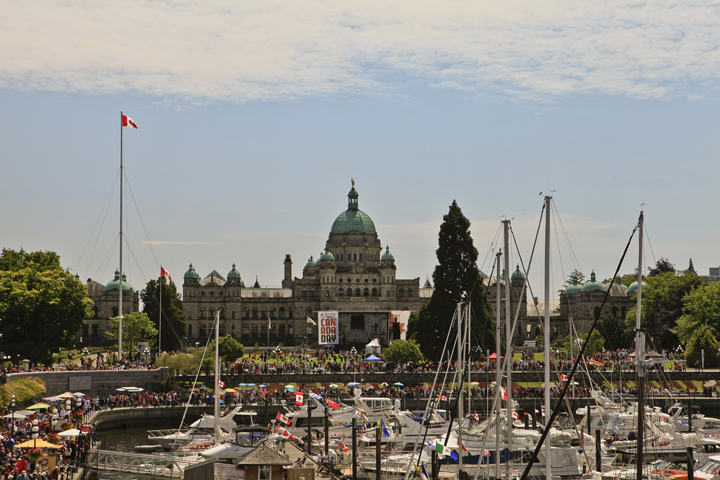
Parliament in Victoria, BC on Canada Day 2011

What a glorious day we had for our trip to Victoria, BC on Canada Day 2011.

Massive Ice Island Breaks Off Greenland Glacier – From CNN

06:44 AM ET

Massive ice island breaks off Greenland glacier

The Petermann Glacier before the ice island broke off this week.

An island of ice twice the size of Manhattan broke off this week from a Greenland glacier, a University of Delaware researcher reports.

The 59-square-mile (150 square kilometers) iceberg is the second massive loss for the Petermann Glacier in two years, researcher Andreas Muenchow reports. In 2010, an ice island four times the size of Manhattan was lost from the glacier.

“While the size is not as spectacular as it was in 2010, the fact that it follows so closely to the 2010 event brings the glacier’s terminus to a location where it has not been for at least 150 years,” Muenchow says in a university press release.

The researcher says it’s too early to blame global warming for the loss of Greenland ice, however.

“Northwest Greenland and northeast Canada are warming more than five times faster than the rest of the world,” Muenchow says in the press release, “but the observed warming is not proof that the diminishing ice shelf is caused by this, because air temperatures have little effect on this glacier; ocean temperatures do, and our ocean temperature time series are only five to eight years long — too short to establish a robust warming signal.”

Muenchow says the massive chunk of ice is expected to eventually enter the Nares Strait between Greenland and Canada, where it will break up into smaller icebergs.

That could take a while. Pieces of the 2010 calving can still be found along the Canadian coast as far south as Labrador, Muenchow said.


Bald Eagle with Paint Daubs Filter from Photoshop CS5

Took this picture against a gray sky so there was not much background to deal with so I tried the paint daubs artistic filter in Photoshop CS5.  It is an ok picture, but does not do justice to this magnificent bird.  Any suggestions?

Electric Vehicles in China

China Targets 5 Million Electric Vehicle’s by 2020

By Joao Peixe | Tue, 17 July 2012 22:08 | 0

Benefit From the Latest Energy Trends and Investment Opportunities before the mainstream media and investing public are aware they even exist. The Free Oilprice.com Energy Intelligence Report gives you this and much more. Click here to find out more.

China’s State Council has released plans to introduce subsidies to customers and manufacturers of electric vehicles (EV’s) in an attempt to encourage the numbers produced and sold. Even though only 8,159 EV’s have been sold in China, the government is adamant that it will encourage production and sales to increase, in order to achieve its massive target of 5 million EV’s by 2020. The aim is to reduce the country’s dependence on oil imports, and reduce its carbon emissions.

The government announced a $4.19 billion subsidy program in May which will cover electric cars, plug-in hybrids, normal hybrid cars, and vehicles with energy-saving engines.

The Chinese government intends to reduce the average fuel consumption of all vehicles to 6.9 litres per 100km by 2015, and 5 litres per 100km in 2020. The energy-efficient, hybrid, and electric vehicles will have an average fuel consumption of 5.9 litres per 100km in 2015, and then 4.5 litres per 100km in 2020.

China is the world’s largest car market, however according to the China Association of Automobile Manufacturers, sales have recently fallen due to increasing oil prices.

By. Joao Peixe of Oilprice.com

Crime Without Punishment – Want to Commit Fraud, Be a Banker

Annals of Banking

The same bankers that brought the melt-down of the jobs, housing and financial markets in 2008 are at it again and why not.  No one was really punished for the wreckage they caused then so why not try to find other ways to gouge bank customers again. Huffington Post has the following on the Libor Scandal: “The Libor scandal gets more expensive for the banking sector almost by the day.

Banks may end up paying $35 billion in civil (for some reason no one is currently bringing criminal charges) damages for manipulating Libor, according to a new report by analysts at Keefe, Bruyette & Woods, an investment bank specializing in financial services.

Relative to the size of the 16 banks at risk of lawsuits in the Libor scandal, $35 billion is chump change. But it will be another blow to the banks’ ability to hold enough capital to satisfy higher regulatory requirements in the wake of the financial crisis. And the damage the Libor scandal does to the sector’s ability to push back against regulations is priceless.

Among the group at risk are three U.S. banks reportedly under investigation for their role in setting Libor: Bank of America, Citigroup and JPMorgan Chase. KBW analyst Frederick Cannon estimated that JPMorgan may end up paying $4.8 billion, Bank of America $4.2 billion and Citigroup $3.1 billion to settle civil lawsuits over Libor.

KBW analysts warn that they are not legal experts and that such estimates are speculative. Legal settlements are also “likely years away.”

Then we have what has the appearance of a cover up by the New York Times:

How the New York Times Hides the Truth About Wall Street’s Catastrophic Misdeeds

July 5, 2012   ·   0 Comments

Source: Wall Street on Parade / AlterNet

Fact Check

By Pam Martens:

The paper of record is in serious need of a fact checker when it comes to whether the Glass-Steagall Act could have prevented the financial crisis.  Promoting ignorance could help sink the financial system  – again.

Back on April 8, 1998, the New York Times ran a slobbering editorial pushing for the repeal of the Glass-Steagall Act.  It sounded like it came straight from Sandy Weill’s public relations flacks.  Weill, head of Wall Street brokerage and investment firms Smith Barney and Salomon Brothers, as well as insurance company, Travelers Group, wanted to merge with a large commercial bank, Citicorp, owner of Citibank, and get his speculative hands on that pile of insured deposits.

The merger was illegal at the time under the depression era Glass-Steagall Act.  The legislation was enacted after the 1929 stock market crash to keep speculative gambling on margin and risky underwriting of stocks away from conservative savers’ bank deposits.  Jamie Dimon, today’s  Chairman and CEO of JPMorgan Chase, who just this year oversaw the blow up of $2 billion of insured depositors’ funds through risky derivatives trading, was Weill’s first lieutenant at the time of the merger and helped to mastermind the deal.  The merged firm was called Citigroup.

The Glass-Steagall Act (formally known as the Banking Act of 1933) created the Federal Deposit Insurance Corporation (FDIC) and barred banks holding insured deposits from merging with securities firms or investment banks.  The Travelers/Citicorp merger was also illegal under the Bank Holding Company Act of 1956 which barred bank and insurance company mergers.

The New York Times editorial gushed:

“Congress dithers, so John Reed of Citicorp and Sanford Weill of Travelers Group grandly propose to modernize financial markets on their own. They have announced a $70 billion merger — the biggest in history — that would create the largest financial services company in the world, worth more than $140 billion… In one stroke, Mr. Reed and Mr. Weill will have temporarily demolished the increasingly unnecessary walls built during the Depression to separate commercial banks from investment banks and insurance companies.”

What the New York Times calls “unnecessary walls” were the bulwarks  that stood between the small investor and a rigged looting machine; between another Great Depression and a stable economy; between fair distribution of wealth and a nation with 46 million people living below the poverty level, including one in every five children; between a Nation where people were proud to save to buy a few shares of stock and a Nation that now reviles everything about Wall Street, from its lousy repentance to its obscene pay to its sappy regulators.  According to a CNN poll conducted between October 14 to 16, 2011, 80 percent of Americans say Wall Street bankers are greedy; 77 percent say they’re overpaid; 66 percent say they are dishonest. And that’s likely just what’s fit to print.

Having greased the skids for the financial debacle, the New York Times, instead  of doing an intense examination of how it got it so wrong, is now permitting the revisionist history of the crisis  through the pen of their financial writer, Andrew Ross Sorkin, who doubles as a co-anchor at the serially conflicted CNBC.

On May 21, 2012, the Times published a piece by Sorkin, titled: “Reinstating an Old Rule Is Not a Cure for Crisis.”  The premise was that the Glass-Steagall Act would not have prevented the financial collapse, the very claptrap coming out of the mouths of Wall Street lobbyists into the attentive ears of the Senate Banking Committee. The article put forth the following “facts.”

“Let’s look at the facts of the financial crisis in the context of Glass-Steagall.

“The first domino to nearly topple over in the financial crisis was Bear Stearns, an investment bank that had nothing to do with commercial banking.  Glass-Steagall would have been irrelevant. Then came Lehman Brothers; it too was an investment bank with no commercial banking business and therefore wouldn’t have been covered by Glass-Steagall either. After them, Merrill Lynch was next — and yep, it too was an investment bank that had nothing to do with Glass-Steagall.

“Next in line was the American International Group, an insurance company that was also unrelated to Glass-Steagall.”

There are four companies mentioned in those five sentences and in every case, the information is spectacularly false.  Lehman Brothers owned two FDIC insured banks, Lehman Brothers Bank, FSB and Lehman Brothers Commercial Bank.  Together, they held $17.2 billion in assets as of June 30, 2008, 75 days before Lehman went belly up.  Lehman Brothers Banks FSB is where Lehman handled its mortgage loan originations.  When the FDIC approved the Lehman Brothers Commercial Bank application in 2005, it specifically noted that the FDIC insured bank “anticipates acting as a derivatives intermediary, engaged in matched trading of interest rate products, primarily interest rate swaps, as well as forward purchase agreements and options contracts.”

Merrill Lynch also owned three FDIC insured banks.  At an FDIC symposium held at the National Press Club in 2003, Merrill Senior VP, John Qua, explained the banking side of Merrill as follows:

“Merrill Lynch conducts banking in the United States through two depository institutions – Merrill Lynch Bank USA, a Utah industrial loan corporation; and Merrill Lynch Bank and Trust, a New Jersey state non-member bank. We also own a federal savings bank that offers personal trust services to our clients. And we conduct significant banking activities outside the United States through banks in London, Dublin, Switzerland, and elsewhere. The combined balance sheet of our global banks is approximately $100 billion.”

Bear Stearns owned Bear Stearns Bank Ireland, which is now part of JPMorgan and called JPMorgan Bank (Dublin) PLC.  According to JPMorgan, “It is the only EU passported bank in the non-bank chain of JPMorgan and provides the firm with direct access to the European Central Bank repo window. It has also been added to the JPMorgan Jumbo issuance programs to issue structured securities for distribution outside the United States.”

As for the statement that AIG was “an insurance company that was also unrelated to Glass-Steagall,” one has the initial reaction to cancel one’s subscription to the New York Times.  AIG owned, in 2008 at the time of the crisis, the FDIC insured AIG Federal Savings Bank.  On June 30, 2008, it held $1 billion in assets.  AIG also owned 71 U.S.-based insurance entities and 176 other financial services companies throughout the world, including AIG Financial Products which blew up the whole company selling credit default derivatives.  What this has to do with Glass-Steagall is that the same deregulation legislation, the Gramm-Leach-Bliley Act that gutted Glass-Steagall in 1999, also gutted the 1956 Bank Holding Company Act and allowed insurance companies and securities firms to be housed under the same umbrella in financial holding companies.

AIG’s annuities are owned by moms and pops all over this country and around the world.  In many cases, they represent a significant source of income to retirees.  Had AIG been allowed to fail, state guaranty funds for insurance products could have been wiped out and the taint of buying insurance products would have damaged legitimate businesses for a lifetime.

For ongoing evidence as to why insured deposit banks cannot be under the same roof with speculating Wall Street firms, one need only look at what the largest banks in the U.S. are holding today.  According to the Office of the Comptroller of the Currency which oversees national banks, as of December 31, 2011, inside the insured banks – not their broker-dealer   components – were the following derivative holdings:  $70.1 trillion at JPMorgan Chase; $52.1 trillion at Citibank; $50.1 trillion at Bank of America; $44.2 trillion at Goldman Sachs Bank USA.

These insured deposit banks have a tiny fraction of their derivative holdings in assets.  For example, JPMorgan Chase has $2.3 trillion in assets in the insured bank.  So why does it need to hedge to the tune of $70.1 trillion in derivatives?  That’s the crux of the issue.  It is not just hedging for the insured bank, it is hedging for its hedge fund clients and corporate clients and institutional clients in the investment bank as well as making proprietary bets to generate profits.

Why should the U.S. taxpayer, through the implied backstop of insured deposits, help JPMorgan make its rich clients richer or eat the losses when the bets go wrong?

Insured deposit banks were meant to function as lenders to individuals and businesses and provide the foundation for stable economic growth in the country.  Today, as the recent blowup in the Chief Investment Office of JPMorgan Chase demonstrates, surplus insured deposits which are backstopped by the U.S. taxpayer are being deployed in exotic, illiquid derivatives.  And these high risk gambles are likely to blow up the system for the second time in a decade while the New York Times and Sorkin pedal egregiously bad data to the public.

Sorkin goes on in the article to make another factually indefensible statement: “Citigroup’s problems are probably the closest call when it comes to whether Glass-Steagall would have avoided its problems. It gorged both on underwriting bad loans and buying up collateralized debt obligations…But Citi’s troubles didn’t come until after Bear Stearns, Lehman Brothers, A.I.G., Fannie Mae and Freddie Mac were fallen or teetering — when all hell was breaking loose.”

By taking Citigroup out of the lead role in the crisis, Sorkin also marginalizes the Glass-Steagall Act.  But he’s dead wrong, again.

Bear Stearns got its emergency infusion from the Fed on March 14, 2008 and was bought out by JPMorgan Chase on March 16, 2008. Lehman failed on September 15, 2008;  AIG, Fannie and Freddie were all rescued by the government in September 2008.  Citigroup’s dire problems began as early as the summer of 2007 according to the Office of the Comptroller of the Currency, regulator of its national bank, and the press was writing about its drastic need for a bailout fund, proposed to be called the SuperSIV, in the fall of 2007.  I wrote extensively about its desperate situation in November 2007.

Sorkin wrote the 2009 bestseller “Too Big to Fail,” a 600-page epic on the 2008 crash.  How he researched the book without discovering these pivotal players owned insured deposit banks is mystifying.

According to Gabriel Sherman in a 2009 piece in New York Magazine, the book party for Sorkin, age 32 at the time, was attended by the titans of Wall Street: Jamie Dimon; John Mack, former head of Morgan Stanley; Steve Rattner, a former New York Times reporter who went on to become a Wall Street investment banker and private equity honcho; Ken Griffin, head of the behemoth Citadel hedge fund;  and other luminaries.

Sherman reveals in the piece that one of Sorkin’s former editors at the Times called his work “thinly reported or loosely written.”  That may not be a big deal if you’re writing gossipy stuff about Wall Street.  But when the public has finally gotten the attention of Congress on the topic of restoring the Glass-Steagall Act to save the country from a potentially more apocalyptic meltdown, putting out a spectacularly inaccurate assessment of the role of Glass-Steagall undermines the safety and soundness of the United States.

The New York Times has financial writers who have been delivering consistently reliable information about Wall Street to the public for more than a decade. Gretchen Morgenson stands out in particular.  It’s time to let those accurate writers weigh in on the Glass-Steagall Act.

These settlements would address only the lawsuits that will almost certainly be brought by hordes of plaintiffs, including cities and states that lost money in interest-rate swaps because of bank manipulation of Libor, a key interest rate often used as an index that affects borrowing costs throughout the economy.

This estimate does not include any penalties the banks might face at the hands of regulators, which could come much more quickly. Barclays, for example, has already agreed to pay $450 million to regulators to settle charges of Libor manipulation. It may still be on the hook for another $4.9 billion in civil damages, according to KBW’s analysis.”

Internal email’s between traders show a complete lack of ethical underpinning:

“The emails sound casual: Dude reaching out to dude, begging for favours and offering rewards ranging from coffee to fine champagne.But what the bankers were allegedly doing was as serious as it gets: fixing an interest rate that affects the cost of half a quadrillion dollars — that’s $554 trillion — in financial contracts around the world, from mortgages to loans.

U.S. and British investigators say the employees of Barclays Bank — and possibly those of other major international banks — clearly knew it was wrong to manipulate the London interbank office rate, known as the LIBOR, which determines the rate at which banks lend to each other and, by extension, the rate at which they lend to consumers and businesses.

The rate is calculated daily by the British Bankers’ Association, based on lending rate figures submitted by global banks. Some of Barclays’ staff, however, allegedly succumbed to the temptation to adjust the figures in a bid to boost profits or disguise financial weaknesses.

One trader messaged a colleague about helping to influence the three-month LIBOR.

“As always, any help wd be greatly appreciated,” the trader wrote.

“I am going 90 altho 91 is what I should be posting,” came the reply.

The trader responded: “When I retire and write a book about this business your name will be written in golden letters.”

“I would prefer this not be in any book!” came the answer.

And yet it did appear — not in a book, but in court papers that led to fines totalling $453 million against the bank. U.S. and British officials are considering criminal charges against individuals and British investigators are probing other major banks including Citigroup in the United States, Switzerland’s UBS, Britain’s HSBC and Royal Bank of Scotland.

The scandal has added fuel to public anger at the banking industry, whose executives face mounting accusations of being overpaid and unethical. Shares in Barclays plummeted 15.5 per cent on Thursday as investors worried about the impact of fines any tighter regulation. The British Bankers Association confessed to being “shocked” at the accusations.

“One of the reasons London is a major international financial centre is because of the perceived emphasis on trust and integrity in the London market,” said Simon Culhane, chief executive of the Chartered Institute for Securities & Investment. “This scandal can only serve to damage London’s reputation.”

Treasury chief George Osborne said the messages cited by the Financial Services Authority read like “an epitaph to an age of irresponsibility.”

“These contracts may sound exotic, but they are the bread and butter of our financial system and are used by businesses and public authorities every day, and they affect the mortgage payments and loan rates of millions of families and hundreds of thousands of firms, large and small,” Osborne said.

To the traders, those rates affect whether they win or lose.

“Duuuude. whats up with ur guys 34.5 3m fix . tell him to get it up!” another trader implored a contact at another bank.

“If it comes in unchanged I’m a dead man,” another trader messaged to a colleague, who promised to “have a chat.” Barclays’ rate duly came in lower, and the trader sent a thank-you note: “Dude. I owe you big time! Come over one day after work and I’m opening a bottle of Bollinger.” (Source – ARY New.tv).”

And, so the beat goes on, more accurately the beat-down of the public at large goes on.  At least the British Regulators are seeking criminal charges.  These greedy illegitimi are thieving and stealing with impunity and immunity that would impress mafiosi dons.  Occupy Wall Street had it right and look what New York’s finest did to them., at the behest of the bankers and their contacts with state and local police – all while they were stealing from state and municipal pension funds.  Write your public officials.  Many of them, of course, are in the pockets of our bankers but try anyway, express moral outrage – at least doing that will make you feel better.  Press your newspapers to do the investigative reporting they are supposed to be doing.  Keep up the good fight for our children and our children’s’ children.

One should ask why alleged co-conspirators such as Jamie Dimon still have jobs with these banks.  They are failing to exercise management oversight.  Better still, what are the supposedly independent directors doing?  Right now all that is happening is that the banks are being fined.  This does not hurt Dimon or other bankers, but hurts shareholders who were not in on the scams.  Let’s fine Dimon and his cohorts.  If you are a shareholder file lawsuits against the banks’ executives and boards of directors.  Be relentless!


Trouble in the Arctic for Shell Oil CO

Shell Drill Ship Slips Anchor and Runs Aground in the Arctic, No Damage Reported

By Joao Peixe | Mon, 16 July 2012 21:58 | 0

The Shell drilling ship, the Noble Discoverer, one of two on their way to start exploring for oil in the Arctic waters of Alaska’s Chukchi and Beaufort Seas, recently dragged its anchor and drifted towards the shore of an Alaskan island.

Both Shell and the Coast Guard claim that the ship is not damaged in any way and shows no sign of having grounded. They say that the ship only came within 100 yards of the shore before it was recovered and towed back out to see to be re-anchored on Saturday. However, Kristjan Laxfoss, a Dutch harbour captain said that he was of the opinion that the ship came far closer to the shore, and actually grounded on the sea bed below.

“There’s no question it hit the beach,” he said. “That ship was not coming any closer. It was on the beach.”

The soft, sandy sea bed in the area along with the 35 mph winds, allowed the ship to drag its anchor and move towards the shore.

Conservation groups protesting Arctic oil exploration have used this incident to highlight their worries. Greenpeace released a statement saying, that “Shell can’t keep its drill rig under control in a protected harbor, so what will happen when it faces 20 foot swells and sea ice while drilling in the Arctic?”

The ship will now be moved to the Dutch Harbour city pier where divers will inspect the exterior, whilst the Coast Guard inspect the interior. So far no sign of damage has been reported, and no oil has been spilled.

By. Joao Peixe of Oilprice.com

Peter Sagan Set to Be Driving a Porsche

Sagan set to win Porsche in Paris

By: 
Cycling News
Published: 
July 17, 14:11, 

Points leader in line to collect on bet made with Liquigas team boss

Having bagged three stages and all but wrapped up victory in the points competition, Peter Sagan has admitted that he already has his eye on theTour de France‘s final stage finish on the Champs Elysées. But even if the Slovak misses out in Paris, he’s still set for a nice bonus as he prepares to collect on a pre-race bet made with Team Liquigas president Paolo Zani.

In the days before the race started in Liège, Sagan asked Zani whether he would give him a car if he could win the green jersey in Paris. OK, Zani said, but to claim it you also have to win two stages. With three in the bag, all Sagan now has to do is cross the finishing line in Paris in green to collect the Porsche that Zani put up as an incentive to the Slovak sensation.

“I’m not certain of reaching Paris in the green jersey, but I’ve got a good advantage over André Greipel,” Sagan told Spanish news agency EFE. “There are still five stages left and anything could happen on any of those days.”

Sagan leads Greipel by 102 points ahead of Wednesday’s big Pyrenean stage. Beyond that, there are only two stages where the sprinters are likely to feature. In order to deny Sagan the green jersey, Greipel would have to win both of them and hope that the Liquigas rider does not pick up any points at all, which is very unlikely given Sagan’s staggering performances throughout the race.

Sagan admits that he has been helped in his quest for green by Sky’s focus on the GC, which has left world champion Mark Cavendish isolated in the sprints. He also believes that his rapidly advancing reputation helped him on Monday’s stage into Pau. “I was surprised that the other sprinters’ teams didn’t work to bring back the breakaway, but I was happy to see that. Now I know that the rest of the riders don’t want to fight with me [for the green jersey] any longer,” he said.

But Sagan isn’t allowing any thoughts of complacency to take hold. He has, he insists, still got plenty to learn. “This is the Tour of my dreams, but I know that I’ve still got to improve a lot of things. I’ve got to get used to the fact that everyone will rider against me if I get into a break, as happened the other day when Luis León [Sánchez] won. I made an important mistake because when the Spaniard attacked, he took advantage of the fact I was eating.”

Sagan says that the only barrier between him and victory in the points competition is the Pyrenees. “If I can get through the mountains OK, I can reach Paris in the green jersey. In the time trial I will hold back some energy for the sprint on the final day,” he added.

Win or not in Paris, Sagan looks likely to be driving home in style.

Follow Cyclingnews on Twitter for the very latest coverage of events taking place in the cycling world –twitter.com/cyclingnewsfeed

A Truly Novel Approach! – From Recharge

In Depth: Berlin car-sharing paves way to an electric futureThe pilot project seeks to integrate electric vehicles into the daily lives of BerlinersPhotograph: Hartmut Reiche/Innoz

In Depth: Berlin car-sharing paves way to an electric future

There would be something poetic about Germany, the birthplace of the modern automobile, also pioneering the manufacture of mass-demand electric vehicles (EVs).

“ The point here is to go further — to completely rethink the way people move themselves around urban spaces”Florian Lennert

Yet while Germany is known for its green-leaning tendencies and its propensity for making beautiful and highly engineered cars, its contribution to the burgeoning EV industry has been negligible compared with manufacturers in Asia, the US and even other European countries.

The German government has set a target of having one million EVs on the road by 2020, but experts believe it will probably miss that target widely.

But if Germany has fallen behind on the supply of EVs, it is looking to pull ahead on their integration into its broader energy system.

This is not only critical for meeting its long-term climate targets; but more immediately, an expanding fleet of interconnected EVs can help soak up the excess electricity produced by the country’s constellation of wind and solar installations, making the national energy transition far more economical.

At the centre of these efforts is a clutch of once-derelict buildings under the shadow of a towering gasometer in southern Berlin.

Over the next few years, the small campus will become a focal point for Germany’s renewables, smart-grid and EV communities. The influential Potsdam Institute for Climate Impact Research is set to open a bureau, and future tenants such as Schneider Electric are building aggressively modern headquarters on the premises.

For now, however, the Innovation Center for Mobility and Societal Change, Innoz, pretty much has the run of the place.

On paper, Innoz — whose industry shareholders include Deutsche Bahn and T-Systems, a subsidiary of Deutsche Telekom — appears similar to the Masdar City initiative in the United Arab Emirates, with the aim of bringing together industry, government and academia to begin untangling issues that markets alone may take decades to digest.

But whereas many of the breakthroughs at Masdar City will be limited in their relevance to greenfield developments, Innoz has the “living laboratory” of Berlin to use as its guinea pig.

One of the principal missions at Innoz is finding new but commercially viable ways to integrate more EVs into urban transport networks — no easy task in car-crazy Germany.

“Rather than simply looking at a model where everything stays the same but we swap traditional car engines with something electric, the point here is to go further — to completely rethink the way people move themselves around urban spaces,” explains Florian Lennert, a director at Innoz.

He notes that 90% of cars in Germany are parked 90% of the time — and most of them travel only about 20km per day.

“There’s a huge underutilisation of the capital and materials tied up in those cars, not to mention that they just take up a lot of space in crowded cities,” he tells Recharge.

Innoz’s pilot project is an “intermodal” transportation network — linking up an EV car-share scheme, Berlin’s broader public transport network and the city’s decade-old bike-share scheme, which is run by Deutsche Bahn.

By calling up an app on their smart phones, registered users are able to find “the nearest available car, which might lead to a train station, and then maybe to a bike for the last bit”.

The cars can be unlocked with smart phones, and joining the programme costs no more than buying an all-inclusive public transport pass, at least initially.

Lennert is convinced that as more EV stations are installed, and people grow accustomed to the idea, that it will be a cheaper, healthier and more convenient option for many in Berlin. There are currently about 20 stations and 100 cars.

Such share schemes also chime with demographic trends that see vastly more European households — particularly those headed by younger people — forgoing car ownership altogether.

However, the challenges facing the EV roll-out across Germany are great.

One of the biggest headaches is simply getting enough charging stations in place, a problem that is particularly acute in big cities. Several years ago, major power utilities seemed likely to spearhead such a push, given the opportunity for them to steal market share from petrol retailers.

But as it takes only 1-2kWh of electricity — worth maybe €2 ($2.52) — to charge a car, the utilities quickly soured on the idea. And then there is the centrality of the traditional automobile industry to Germany’s GDP, meaning that nearly everyone — government included — remains cautious about upsetting the apple cart.

“In a sense, German car companies are quite right to say, ‘Nobody’s going to make much money selling EVs for the next ten or 15 years, and in the meantime we’re making a lot of money selling [Mercedes-Benz] S-classes to China’,” Lennert says.

But rapidly evolving technology and consumer mindsets are already altering the commercial and political landscape. Thanks in part to some gentle arm-twisting from the government, German car makers are on track to launch a dozen or so EV models by 2014.

Lennert says share schemes like the one Innoz is pioneering will be even more relevant in emerging economies. “If you think about Mumbai or Jakarta or Bangkok, and imagine replicating the level of motorisation we have in the West, it’s just not feasible,” he says. “Quite aside from the environmental cost, there’s simply not enough space.”

That presents huge opportunities for German industry.

“How the world manages its transport fleets in the mega-cities of tomorrow, how it connects all these various parts of the energy system, is also very interesting for the Siemenses and Bosches of this world,” says Lennert.

Karl-Erik Stromsta, Berlin

Published: Monday, July 16 2012