More Problems in Africa

Ebola Strikes Again

(CNN) — A young boy wanders through the high grass, looking lost after attending church services in Kakata, Liberia.
The child, Moses Kallie, wears a black T-shirt that’s too big for him. It reads “Trouble is my middle name.”
Trouble has certainly come into his life. He’s lost 13 of his relatives recently — his parents among them. They were all killed by Ebola. His village is a hotspot for the virus.
Desperation grows in heart of Ebola zone
So far 1,578 people are believed to have died from Ebola in Liberia alone, according to the latest numbers from the World Health Organization. The country has seen a 52% of increases in cases in just the past three weeks.
That’s in large part because there is little or no outside medical help for residents who get sick there.
Searching for the answers: Can the world stop Ebola?
In Monrovia, the country’s crowded capital, doors to hospitals and clinics are shut tight, locked with thick padlocks. Many health care workers in West Africa have lost their lives due to the way the virus spreads — through contact with bodily fluids from those who are infected. On Monday, the World Health Organization urged the affected countries to give health care workers both the adequate security and safety equipment they need, as well as appropriate education and training on infection control.
A new Ebola clinic opened in Monrovia this week, but bodies lay on the ground outside its walls. Ambulances filled with Ebola patients, some that have traveled seven hours to get there, are not unloaded. Without help to get them inside, the patients fall in the dirt, mere feet away from treatment.
Without help, family members must care for these Ebola patients. And without the proper safety equipment, they too fall sick and Ebola continues to spread. The virus forces the local dead body management teams to work 12 hours a day, six days a week. All for a paycheck of $300 to $500 a month.
Why I became a human guinea pig for Ebola
Dressed from head to toe in white protective suits and thick goggles, the burial teams try to stay safe, but nothing can shield them from the unspeakable horrors they’ve seen when they make their regular rounds. On Friday, Kiyee described what he saw when he entered a home:
“I took the key and opened the door and went in and saw a 6-month-old child licking on the mother’s skin,” said Kiyee. The mother was lying on her stomach. She had died from Ebola. The baby was searching for the mother’s milk. “Right away I started shedding tears.”
WHO said on Monday the overall death toll in the Ebola outbreak has risen to 2,803 in the five countries at the heart of the epidemic: Sierra Leone, Liberia, Guinea, Nigeria and Senegal.
When people go out in public, they are encouraged to take whatever precautions they can. In Monrovia, people get their temperatures taken wherever they go — at the grocery store, the office and at church. A fever is one of the early symptoms of the disease.
At the little boy’s church in Kakata, the pastor is both practical and philosophical about Ebola. He has spent his career thinking deeply about death and what happens afterward.
When his congregation asked the Rev. Victor King if he’s afraid of death he said “No,” but “I don’t want to die from Ebola.”
Ebola outbreak: How to help
At his church, he’s called off the part of the service where congregation members shake hands. He tells them not to hug when they see each other, and no one takes communion wine from the same chalice any more. Many in his congregation were at first displeased when he ended that practice, he said. Communion is the high point of the church service and it is central to their tradition of worship.
But he believes the congregation, like many in Liberia, are starting to better understand the disease and how it spreads.
After services, the congregation files out the door and stops at a container the pastor has placed right outside.
The container looks like it should hold a sports drink. Instead, it contains bleach for them to wash their hands. To a person the congregation stops and takes their time to wash up thoroughly.
Anthony Kallah, a teacher, is one of them.
“We are all afraid,” Kallah said. “This is a threatening disease.”

Fracking in China

N A HAZY MORNING LAST SEPTEMBER, 144 American and Chinese government officials and high-ranking oil executives filed into a vaulted meeting room in a cloistered campus in south Xi’an, a city famous for its terra-cotta warriors and lethal smog. The Communist Party built this compound, called the Shaanxi Guesthouse, in 1958. It was part of the lead-up to Chairman Mao’s Great Leap Forward, in which, to surpass the industrial achievements of the West, the government built steelworks, coal mines, power stations, and cement factories—displacing hundreds of thousands and clearcutting a tenth of China’s forests in the process. Despite its quaint name, the guesthouse is a cluster of immense concrete structures jutting out of expansive, manicured lawns and man-made lakes dotted with stone bridges and pagodas. It also features a karaoke lounge, spa, tennis stadium, shopping center, and beauty salon.

The guests at the compound that week were gearing up for another great leap: a push to export the United States’ fracking boom to China’s vast shale fields—and beyond. Attendees slid into black leather chairs behind glossy rosewood tables, facing a stage flanked by large projector screens. Chinese businessmen wore high-waist slacks with belts clasped over their bellies. I watched as one thumbed through business cards bearing the logos of Chevron, ConocoPhillips, Exxon Mobil, and Halliburton. Behind closed doors, a select group of Chinese and American officials and executives held a “senior VIP meeting.” Outside, a troop of People’s Liberation Army guards marched in tight formation.

The US-China Oil and Gas Industry Forum, sponsored by the US departments of Commerce and Energy, as well as China’s National Energy Administration, has convened for the last 13 years. But the focus turned to shale gas in 2009, when President Obama and then-President Hu Jintao announced an agreement to develop China’s immense resources. The partnership set the stage for companies in both countries to forge deals worth tens of billions of dollars.

Here at the 2013 conference, the first American to take the podium was Gary Locke, the US ambassador to China at the time. He wore a dark suit and a striped red-and-purple tie; his slick black hair glistened in the fluorescent light. “From Sichuan to Eagle Ford, Texas, from Bohai Bay to the Marcellus Shale in Pennsylvania and Ohio, US and Chinese companies are investing and working together to increase energy production in both countries,” he proclaimed. US and Chinese companies were so tightly knit, Air China had recently started offering nonstop flights between Beijing and Houston, “making business trips much quicker for many of you gathered here.”

The soft, static voice of a Chinese interpreter seeped from the headphones as young women in red vests quietly passed through each row, pausing to pour hot tea, their strides almost synchronized. Tiny plumes of steam arose from the teacups lining each table, like miniature smokestacks. It seemed fitting, because underlying all the talk of new energy was an urgency to wean China from its decades-long addiction to coal. Locke promised that shale gas would do just that: “We can make further strides to improve energy efficiency, produce cleaner energy, increase renewables, and increase supply,” he asserted. “Unconventional gas, especially shale gas, is just the start.”

THERE ARE TWO MAIN REASONS behind China’s newfound zeal for gas. As Michael Liebreich, the founder of New Energy Finance, an energy market analytics firm now owned by Bloomberg LP, put it, “One is to feed the growth. There has to be energy and it has to be affordable in order to continue the growth machine. But the other one is that they’ve got to get off this coal.”
Constituting a whopping 70 percent of China’s energy supply, coal has allowed the country to become the world’s second-largest economy in just a few decades. But burning coal has also caused irreparable damage to the environment and the health of China’s citizens. City officials have been forced to shut down roads because drivers are blinded by soot and smog. China’s Civil Aviation Administration ordered pilots to learn to land planes in low-visibility conditions to avoid flight delays and cancellations. Scientists wrote in the medical journal The Lancet that ambient particulate matter, generated mostly by cars and the country’s 3,000 coal-fired power plants, killed 1.2 million Chinese people in 2010. In late 2013, an eight-year-old girl in Jiangsu Province was diagnosed with lung cancer; her doctor attributed it to air pollution. And earlier this year, scientists found that up to 24 percent of sulfate air pollutants—which contribute to smog and acid rain—in the western United States originated from Chinese factories manufacturing for export.
“The air quality in China has reached a kind of tipping point in the public consciousness.”

“The air quality in China has reached a kind of tipping point in the public consciousness,” says Evan Osnos, The New Yorker’s former China correspondent and author of Age of Ambition: Chasing Fortune, Truth, and Faith in the New China. “The entire Chinese political enterprise is founded on a bargain: We will make your lives better, if you’ll allow us to stay in power.” As more Chinese citizens demand clean air and water, China’s leaders and foreign businessmen have taken drastic measures to get rid of pollution. Some local officials have tried to wash away soot by cloud seeding, a process in which chemicals are rocket-launched into clouds to make it rain. One company is developing a column of copper coils that will use electric charges to suck soot out of the air like a Hoover. Environmental officials in the northern city of Lanzhou attempted to level its surrounding mountains to let the wind blow the soot away—not to be confused with the city’s actual plan to demolish 700 mountains in order to expand its footprint by roughly the area of Los Angeles.
More: The Atlantic’s James Fallows on the politics of China’s environmental crisis
But China’s push to wean itself from coal has also triggered a rush to develop alternative power sources. The natural gas that lies deep within its shale formations is now a top contender. By current estimates from the US Energy Information Administration, China’s shale gas resources are the largest in the world, 1.7 times those in the United States. So far, fewer than 200 wells have been drilled, but another 800 are expected by next year. By then, China aims to pump 230 billion cubic feet of natural gas annually from underground shale—enough to power every home in Chicago for two years. By 2020, the country expects to produce as much as 4.6 times that amount. It’s moving at “Chinese speed,” as one energy investment adviser put it—the United States took roughly twice as long to reach that volume.
Yet just as fracking technology has crossed over from the fields of Pennsylvania and Texas to the mountains of Sichuan, so have the questions about its risks and consequences. If fracking regulations in the United States are too weak, then in China the rules are practically nonexistent. Tian Qinghua, an environmental researcher at the Sichuan Academy of Environmental Sciences, fears that fracking operations in China will repeat a pattern he’s seen before. “There’s a phenomenon of ‘pollute first, clean up later,'” he says. “History is repeating itself.”

When my colleague James West and I traveled to China last September, it didn’t take long to see the toll of the country’s coal addiction: James had a burning cough by our second day. On a bullet train from Beijing to Xi’an (roughly the distance between San Francisco and Phoenix), we whizzed along at 150 miles per hour through some of China’s most polluted pockets, including the northeastern city of Shijiazhuang, where the smog registers at emergency levels for a third of the year—twice as often as in Beijing. A thick miasma hung heavy, clinging so low to fields of corn that it was hard to see where the earth met the dark, gray sky. Every few minutes we passed another giant coal-fired power plant, its chimneys spewing a continual billow of thick, white smoke.

By the time of our trip, villagers living near fracking wells had already complained about the deafening noise of drilling machinery, the smell of gas fumes, and strange substances in their water. One night last April, in a small southwestern town called Jiaoshi, an explosion at a shale gas drilling rig rattled residents awake, triggering a huge fire and reportedly killing eight workers. In the wake of the accident, an official from the Ministry of Environmental Protection said, “The areas where shale gas is abundant in China are already ecologically fragile, crowded, and have sensitive groundwater. The impact cannot yet be estimated.”

“WE CALL THIS SHALE COUNTY,” the driver shouted to us in the backseat as he steered the four-wheel-drive SUV up a steep mountain in Sichuan Province. The clouds faded as we climbed, revealing a quilt of farmland dotted with pingfang, or flattop houses. We drove down a road lined with new hotels, small restaurants, and hardware stores—the markings of a boomtown. Roughly the size of Minnesota, the Sichuan Basin—where many of China’s experimental fracking wells are located—is home to some 100 million people, many of them farmers. It’s not the only part of China with shale gas, but fracking requires a lot of water, and with a subtropical climate and proximity to the mighty Yangtze River, Sichuan has that, too, making it the nation’s first fracking frontier.
With each turn, the road became narrower and muddier, until we stopped at a gate behind which a tall red-and-white drilling rig shot up as high as the lush mountains surrounding it. We were at a shale gas well owned by China National Petroleum Corporation (CNPC), one of the nation’s largest energy companies and its leading oil producer. Most of China was on holiday that week to commemorate 64 years since Mao declared the founding of the People’s Republic, but out here there was no sign of rest. Workers in red jumpsuits drove by in bulky trucks. A drill spiraled 3,280 feet underground in search of shale gas, screeching as it churned around the clock.

An engineer whom we’ll call Li Wei greeted us, peering out from under a hard hat. In his mid-20s, with a brand new degree, Li worked for a Chinese energy firm partly owned by Schlumberger, the Houston-based oil service company. Last July, Schlumberger opened a 32,000-square-foot laboratory in the region devoted to extracting hydrocarbons from shale gas resources. Like many other engineers at China’s new wells, Li had never worked on a fracking operation before. We watched as he shooed away neighborhood kids playing by a brick structure straddling a pool marked “hazard” as though it were their tree house.

At first, Li said, drilling here didn’t go so smoothly: “We had leaks, things falling into the well.” They had to slow down operations as a result. Still, the team planned to drill and frack about eight other new wells in the area in the coming months.

China’s early fracking operations face many risks, but the incentives to keep drilling are too good to pass up. Based on early sampling, Bloomberg New Energy Finance’s Liebreich estimates that China is currently extracting shale gas at roughly twice the cost of the United States. Analysts expect those costs to fall as China gains experience, but even at current levels, shale gas production has been up to 40 percent cheaper—and geopolitically more desirable—than importing gas. As China’s demand for natural gas continues to grow—between 2012 and 2013 it grew at 15 times the rate of the rest of the world’s—domestic reserves will become increasingly important, says Liebreich: If China can continue to extract shale gas at the current cost, that “would be a game-changer.” The “golden age” of natural gas that took root in North America, the International Energy Agency declared in June, is now spreading to China.
All that growth comes with a steep learning curve. Fracking requires highly trained engineers who use specialized equipment to mix vast quantities of water with chemicals and sand and shoot it into the ground at high pressures, cracking the dense shale bed and releasing a mix of gas, water, and other sediments to the surface. That’s why service companies like Schlumberger and Halliburton have much to gain: China needs technology and know-how—and is willing to pay handsomely. “Selling the picks and shovels for the gold rush would be the analogy,” Liebreich says.

No wonder, then, that multinational oil and gas giants have pounced. In 2012, Royal Dutch Shell inked a contract with CNPC. A company executive pledged to invest around $1 billion a year for the next several years in shale gas. BP, Chevron, Exxon Mobil, and Hess also have signed joint ventures to explore shale prospects with Chinese energy companies. In return, Chinese companies have invested in US fracking operations. Since 2010 the Chinese energy company Sinopec, the China National Offshore Oil Corporation (CNOOC), and the state-owned Sinochem spent at least $8.7 billion to buy stakes in shale gas operations in Alabama, Colorado, Michigan, Mississippi, Ohio, Oklahoma, Texas, and Wyoming. Chesapeake Energy alone got $4.52 billion out of its deals with CNOOC.

“The reason Chinese oil companies have gone after Chesapeake in the past year was because they wanted to apply the technology to tap the world’s No. 1 shale gas reserves in China,” Laban Yu, a Hong Kong investment analyst, told Bloomberg News. Whether or not China will be able to replicate the American shale gas revolution, it is clearly determined to try.
Breakthrough in Auto Technology – from the MIT Technology Review

Smart Headlight Illuminates the Road without Blinding Other Drivers
Computerized headlights could eliminate glare from oncoming cars while improving visibility.

By Iddo Genuth on September 19, 2014

WHY IT MATTERS

Although only 25 percent of all driving occurs in the dark, that’s when almost half of fatal car accidents occur.

headlightsx299
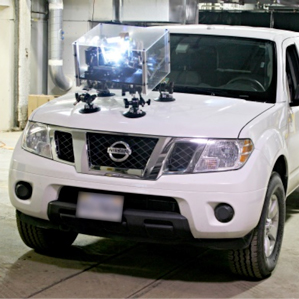
The CMU-Intel prototype programmable headlight secured to the hood of a vehicle. An acrylic enclosure protects components from dust, dirt, and moisture.

If you hate it when the driver in the opposite lane blinds you with his high beams, or when the glare from the truck behind keeps you from looking in the rearview mirror, a solution might be just around the corner. An experimental programmable headlight automatically adjusts thousands of tiny, individually controlled light sources to prevent other drivers from being blinded while still highlighting signs or obstacles ahead.

Researchers from Carnegie Mellon and Intel developed the prototype headlight, which scans the road ahead using an infrared camera and can locate other drivers and selectively disable the light directed at them, and it can do this at up to 140 miles per hour. Although it reduces glare for oncoming drivers, it doesn’t make the road noticeably darker for the person behind the wheel.

The headlight could perform other useful tasks. It could highlight hard-to-see objects in the dark; show the driving lane when it is not marked or well-lit; project navigational information on the road in front of the driver; or even reduce the glare during a snowfall by distributing light between snowflakes. Improving the ability to drive in the dark and in other low-visibility scenarios could help save at least some of the 32,000 people who die in car accidents each year in the U.S.

Although adaptive headlights already have been introduced in recent years by car manufacturers such as BMW, Audi, Mercedes, and Volvo, they are typically much slower and less finely controlled. They point the way around a corner or dim the lights if a pedestrian is crossing, but they lack the ability to improve lane illumination.
The glare typically seen from high beams is shown on the top; the anti-glare feature of the new headlight is seen below.

The Carnegie Mellon-Intel prototype includes a camera, a computer, and a digital projector. Information from the infrared camera is processed by a computer that tries to identify relevant objects on the road, such as cars, pedestrians, or road signs. The projector uses a light source that’s 4,700 lumens (much brighter than a halogen headlight) with an array of almost 800,000 micromirrors that can be controlled individually by the computer.

The ability to control the light with so many micromirrors provides a high-resolution, highly tunable system that can also turn on and off every “pixel” in just under one millisecond (the flap of a fly wing takes almost three times as long).

John Leonard, a professor of mechanical engineering at MIT who was not involved in the research, says the Carnegie Mellon programmable headlight could improve automotive machine vision. “This is a great example of taking ideas from computer vision and applying them to a challenging real-world problem,” he says. “This is a known stumbling block for self-driving vehicles, and one can envision how the extension of these concepts might lead to better sensors for advanced active safety and driverless car systems.”

The Carnegie Mellon team, which recently presented its findings at the European Conference on Computer Vision in Zurich, Switzerland, is still modifying the prototype, which should be finished within the next six months. Over the next two years the team plans to miniaturize the components and make the system faster. Robert Tamburo, lead engineer for the project, says: “We are currently exploring all options to bring our headlight design to market.”

3

Gutless Republicans Strike Again

Congress dodges ISIS bill on its way out of town
From Dana Bash, CNN Chief Congressional Correspondent
updated 12:21 PM EDT, Fri September 19, 2014

Is Congress avoiding ISIS debate?
STORY HIGHLIGHTS
Congress leaves D.C. to campaign full-time, with no vote yet on ISIS
Republicans Democrats for not vote, Democrats blame Republicans
Some members of Congress are openly appalled that their colleagues left town
Washington (CNN) — The smell of exhaust from idling cars fills up the Capitol parking lot. Congressional aides have their engines revved — ready to whisk their bosses to train stations and airports as soon as they cast their last vote.
It’s a familiar scene when Congress is getting ready to leave town, especially for an extended period. But this time the race for a six-week respite feels different.
There is bipartisan consensus that the United States is now at war with ISIS and that Congress should be a part of the decision-making process on how to deal with that, by passing a new authorization for military force.
Bill Clinton: U.S. has proven it can’t win an Iraq land war without Iraqis
Paul’s false charge against McCain Corker: Obama’s ISIS strategy not serious Can ISIS be beat without combat troops?
But Congress took off to go campaign full time to try to keep their jobs rather than staying to do their jobs.
“There is broad agreement in the country that this ISIS group is a threat,” Rep. Chaka Fattah, D-Pennsylvania, told CNN.
“So why not stay and debate it and not go home if your constituents believe it’s a threat?” we asked.
“I don’t disagree,” Fattah replied. “I’m prepared to vote yes. So I’m not ducking any vote.”
“It’s ridiculous,” Rep. Jared Polis, D-Colorado, said a few minutes later.
“As if there is not enough to do and it’s not just the war issues, it’s immigration reform, ENDA (Employment Nondiscrimination Act) — it’s a number of different bills that have been filed that have bipartisan support,” Polis said.
It is true that rank-and-file House members, especially those like Fattah and Polis who are in the minority party, don’t have much choice but to follow the schedule leaders lay out.
Still, as we weaved through the slew of waiting cars to talk to lawmakers before they left, it was striking — but not surprising — the way blame was tossed around.
Republicans blamed the Democrat-controlled Senate.
W.H. defends plan to arm Syrian rebels A wary Congress votes to combat ISIS General doesn’t rule out ground forces
“The problem is that we have a do-nothing Senate,” Sen. Ted Cruz, R-Texas, said.
Republicans also blamed the president.
Rep. Richard Hudson, R-North Carolina, said he’d be glad to vote for a new use-of-force authorization against ISIS.
“I wish the President would ask for one,” Hudson said.
Obama: ISIS threat against U.S., allies ‘doesn’t frighten us’
Democrats noted that leaving now has become a tradition to help the House, where Republicans are a majority.
“The House of Representatives runs every two years, and for many, many years the House has adjourned for the month of October.” Democratic Sen. Claire McCaskill of Missouri said.
Some senators were openly appalled that colleagues were heading home.
Freshman Sen. Deb Fischer, R-Nebraska, had publicly urged her colleagues to stay, to no avail.
Brazile: Congress should debate on ISIS Congress to consider Syria strategy Obama: No ground troops to combat ISIS
“We need to be here we need to debate this issue,” Fischer told us.
Sen. Susan Collins, R-Maine, is on the ballot in November, but hers is a safe seat. Going home to campaign is not her first priority.
“My job is to be in the Capitol working for the people of Maine and the American people and that’s where I think we all belong now,” said Collins, standing in the Capitol parking lot, pointing to the dome.
Sen. Lindsey Graham, R-South Carolina, who won his big primary fight earlier this year and should face an easy reelection in November, had a trademark pithy synopsis.
“We seem to be more worried about who runs the place than how the place runs,” he said.
Ultimately, all the lawmakers who complained and called it important to stay got in their cars and left, too.
There’s no reason to stay — there are no more votes until after the election.

WeHave a Voice

We Have A Voice. We Have A Vote.
AUGUST 25, 2014 | MARVIN LETT, SENIOR RESEARCH & POLICY ANALYST
Image for We Have A Voice. We Have A Vote.

txcongmaps-800x513
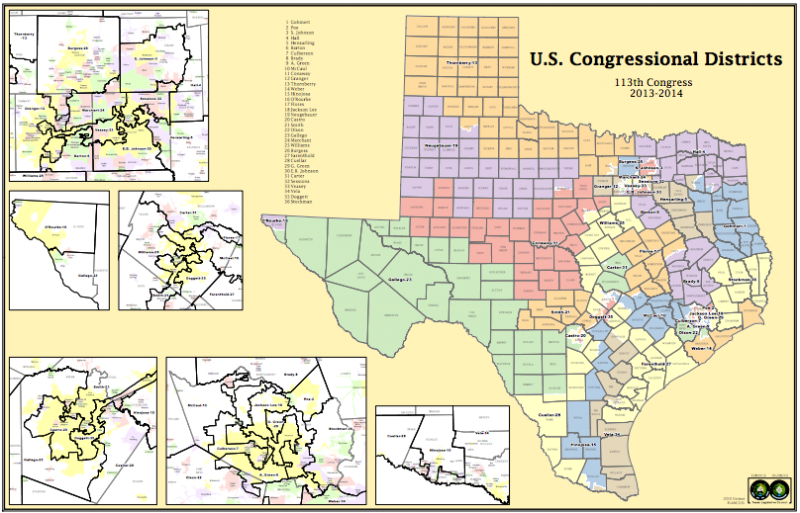
Texas’ population has mushroomed in the last decade—and Hispanic and African-American communities account for roughly 80% of this growth.

But their political voice hasn’t gotten louder. In fact, it was deliberately muted. Texas got four new congressional seats, but the Republican-controlled legislature redrew district lines that upped their own party’s representation in Congress by five districts. Not only did minorities not gain seats at the table—they lost one.

This week, a federal court in San Antonio will hear closing arguments in a trial investigating whether the Texas Legislature intentionally discriminated on the basis of race when it redrew these district lines in 2011. During the trial, witnesses testified that the Office of the Attorney General advised on and recommended adopting the map.

There’s precedent for this. A federal court in Washington, D.C., found “sufficient evidence to conclude that the Congressional Plan was motivated, at least in part, by discriminatory intent.” The court pointed out, “In the last four decades, Texas has found itself in court every redistricting cycle, and each time it has lost.” And in San Antonio, the Department of Justice has sided with the plaintiffs, fighting for hardworking Hispanic and African-American voters.

The final court ruling’s yet to come. But the fight should not stop there, and it should not stop with just the people in the courtroom. All Texans, regardless of race, gender, economic stature, or even political party, should be troubled by the testimony and evidence coming from the trial. And we don’t have to wait to prevent something like this from happening again.

Elections matter. We have a voice. We have a vote.

Let’s make sure we use it.

Cheapest Place to Buy Gasoline in the United States

You think the gas near you is getting cheaper? Try filling up in the South Carolina city of Rock Hill.
That’s the market with the nation’s lowest gas price heading into Labor Day weekend — an average of $3.09 a gallon, according to industry observer GasBuddy.com.

The good news for drivers is that prices like that could come soon to a station near you — as long as you don’t live on the West Coast or some other pockets of high-priced gas.
The nationwide average price stands at $3.44 a gallon, down about eight cents from a month ago and nearly 12 cents from this time last year.
The summer driving season will end with the cheapest Labor Day gas prices since 2010. And prices will drop even further when stations stop selling the more expensive summer blends of gasoline in late September.
Related: What’s the gas price in your state?
“We think the national average will bottom out in the $3.15 to $3.25 range later this year, but that is actually inflated by the high prices on the West Coast,” said Tom Kloza, GasBuddy’s chief oil analyst. “From the Rocky Mountains, east, most people will be able to find gas at or below $3.”
rock hill gas prices
Gas prices are already approaching $3 a gallon in parts of South Carolina, and prices at or below that level could be common later this fall.
South Carolina is the state with the lowest statewide average with an price of $3.17 a gallon.
“South Carolina has one of the lowest state gas taxes. And states supplied by Gulf Coast refiners, they tend to have the cheapest wholesale prices,” said Kloza.
Kloza said the Gulf Coast refineries are producing gasoline at record levels right now, helped by the fact they have avoided disruptions from hurricanes or major accidents this summer.
Drivers are also benefiting from increased production of U.S. crude, which has kept oil prices below global averages despite unrest in the Middle East.
The increased fuel economy of U.S. cars, which has limited demand for gas, also helps.
Related: Your Labor Day BBQ will cost more
Finally, low natural gas prices are helping to keep gasoline prices low, since refineries use natural gas to heat the crude oil in order to refine it into gasoline, jet fuel and other products.
There can be short-term disruptions, such as hurricanes or refinery accidents, that could cause gas price spikes. But Kloza said he expects the downward pressure on U.S. gas prices will continue for at least the next few years.
First Published: August 29, 2014: 12:38 PM ET

If the Boot Fits


Applied Fashion Special: sick of searching for the boot to end all boots, Rebecca Willis went to the top: shoe designer Tracey Neuls. Together they created the perfect answer—well, almost

boot1


From INTELLIGENT LIFE magazine, September/October 2014

As the door to the street opens and closes, the shoes move slightly in the breeze. They hang from the ceiling on bright orange ribbons; the walls around them are white. One pair, steel-blue and frilled with a row of tiny leather oak leaves, has a curved heel, tapering like an animal’s claw. Another has the slightly worn shagginess of a much-loved teddy bear. I could be in an art gallery, but in fact I’m in a shop in central London. It’s one of two belonging to Tracey Neuls, a footwear designer garlanded by the fashion industry. I have come to meet her in the hope that she will be able to make—for once and for all, so that I never have to shop for them again—the perfect pair of boots.

The word “perfect” is, I know, a trope used by marketing people, journalists and retailers to make you take notice, so I admit to using it tongue-in-cheek. No piece of clothing can be perfect for every­one. So let me define exactly what, on this occasion, I mean by it. When we asked some of our readers, for our Fashion Manifesto last year, whether you have to suffer to look good, the groundswell of opinion was, “No…except for high heels.” Wearing heels is a bit like childbirth—for some women it’s a breeze, but for most of us it hurts. Still, is it really so impossible to make a pair that are truly comfortable? Heels that you can walk around in all day without wanting to take them off and put your feet up? We decided to find out.

We make no apology for choosing boots rather than shoes: boots are warmer, more supportive and harder-wearing. In the cooler latitudes they are a contemporary uniform. Yet the quest for the Holy Grail looks like a walk in the park compared with finding a pair that ticks all the required boxes. Boots that work with jeans don’t work with a skirt. Boots that look right in the day look wrong in the evening. If they’re stable they’re clumpy, and if they’re low they’re frumpy. And if you do eventually find the pair of your dreams, you’ll wear them to death and won’t be able to replace them. It’s not famine in Africa, I know, but it would be nice to find a solution.

So we asked Tracey Neuls to work with us to create a comfortable boot with a heel—the Intelligent Life boot—which would go on sale to the public. It would have to be stable, stylish, interesting and relatively fashion-proof. Also, the boots would need to pass what I call the Gallery Test: can you wander in a pair round an exhibition without thinking about your feet? All of which is, if you’ll forgive the expression, a tall order.

Neuls, 46, is a gentle-voiced Canadian with an infectious laugh, pale skin and long red hair, which she often wears in schoolgirl plaits or on top of her head, Heidi-style. We approached her not just because it is her stated mission to make footwear that is “individual, timeless and comfortable”—a promising trio of adjectives—but because she cares about feet themselves as much as what we put on them. “I design from the inside out,” she tells me. “I always start with the foot.” One reason that she suspends her wares from the ceiling is so that you can see them from all angles. “Sometimes the best view is from the back,” she 
explains. But also she wants them to move, to remind us what footwear is for: boots are made for walking. Or should be. She wants women to be “empowered, not impeded” by their footwear. And impeded is the right word, since its roots are in the Latin impedio, to shackle—literally, to un-foot.

We begin with me showing her photographs of my collection of boots past and present—I could start a small museum. She dates them all with uncanny accuracy (“that’s from the mid-1990s”, she says and she is right; I’d told myself they were timeless). And although she doesn’t actually say the word “boring”, I’m pretty sure it’s what she’s thinking. Neuls worked in big-brand fashion for ten years (Nike and Falke are on her CV), but since she set up her own label in 2000 she has shown no signs of swimming in the fast-moving mainstream, and she eschews its methods, too. Most shoes on sale in the high street are mass-produced. They are, in effect, assembled from a kit of parts offered by manufacturers each season in response to the trends decreed by fashion forecasters: gladiator sandals, biker boots, whatever. That’s why the stock in shoe shops appears to move as one body, like a shoal of fish. Neuls, by contrast, starts the design process from scratch, modelling organic shapes from a piece of plasticine, Zaha Hadid-style. All her shoes are hand-made. The more I hear about her methods, the more I feel like someone who has just discovered fresh food after years of living on ready meals.

On the subject of heels, Neuls gives me fair warning. “Something happens between 5cm and 7cm. We’ve found that once you go beyond a certain height—about 5.5cm, I’d say—the foot is always going to be less comfortable. But let’s see what we can do.” She talks me through some of her past creations. There are court shoes in knitted woolly overcoats and others covered with a filigree of orangey-pink fishing net. There are boots made of hand-knitted leather strips that look like chain mail, and others with a transparent PVC panel at the toe—change your socks and you change your look. Some knee-length boots are unlined to allow the leather to stretch to the calf, others are buckled, with expandable panels for the same reason.

Then Neuls shows me a piece of charcoal she found which gave her an idea for boots with burnt heels, burnished and black. The Italian factory she used didn’t want the fire risk (and who can blame them?), so Neuls burnt the heels herself with a blow-torch, in her back garden. That’s about as far from mass production as it gets. Whether or not wearing our boot feels like walking on air, it is unlikely to be dull.

Above right Walk this way: The Intelligent Life boots—things of beauty even from below

20 Signs of a broken film culture

Across the Ungreat Divide
20 signs of a broken film culture

By Armond White

pic_giant_082814_SM_Batman-Joker_0
Heath Ledger in The Dark Knight (Warner Bros. Pictures)

Since 2004, the year that film culture split along moral and artistic lines, political and class biases have been exhibited in films that became more and more partisan. This rift was furthered by a compromised media, where critics praised movies that exhibited cynicism along with political bias.

Not just entertainment, the 20 films listed here effectively destroyed art, social unity, and spiritual confidence. They constitute a corrupt, carelessly politicized canon.

1) Good Night and Good Luck (2005) — George Clooney, president of the corrupt canon, directed and acted in a dishonest fantasy biopic of TV-news icon Edward R. Murrow to revive blacklist lore as part of a liberal agenda.

2) The Dark Knight (2008) used the Batman myth to undermine heroism, overturn social mores, and embrace anarchy.

3) Ocean’s Twelve (2004) — Steven Soderbergh salutes land of the greedy and home of the depraved in a reboot franchise sequel, scoffing at the post-War conviction of Sinatra’s Rat Pack original.

4) 12 Years a Slave (2013) distorted the history of slavery while encouraging and continuing Hollywood’s malign neglect of slavery’s contemporary impact.

5) Wall-E (2008) — Nihilism made cute for children of all ages who know nothing about cultural history or how to sustain it.

6) Manderlay (2005) — Lars Von Trier’s Dogville sequel sold American self-hatred back to us, and critics fawned.

7) United 93 (2006) reduced the pain and tragedy of 9/11 to the inanity of a disaster movie.

8) Frost/Nixon (2008) — Political vengeance disguised as a dual biopic that prized showbiz egotism over conflicted public service.

9) Knocked Up (2007) — Judd Apatow’s comedy of bad manners attacked maturity and propriety.

10) The Social Network (2010) — David Fincher’s new Horatio Alger tale glorified technocrat Mark Zuckerberg with chic, digital-era arrogance.

11) Precious (2009) coincided with Obama’s first year in office to revive racial condescension with the audacity of nope.

12) The Hangover (2009) infantilized privileged adulthood, a celebration of chaos and irresponsibility.

13) Slumdog Millionaire (2008) — an Oscar-winning tale of game-show greed as an answer to systemic poverty.

14) A History of Violence (2005) — David Cronenberg’s new take on Ugly Americans blamed patriotic sadism.

15) Inglourious Basterds (2009) — Quentin Tarantino’s answer to Abu Ghraib, a cruel, jokey, ahistorical revision of WWII.

16) The Bourne Ultimatum (2007) — Ass-kicking espionage disparaged American foreign policy while making money off it.

17) Mr. and Mrs. Smith (2005) — Sarcastic violence is the new marriage equality, says Brangelina, Hollywood’s POTUS and FLOTUS.

18) Che (2008) — Steven Soderbergh gives Hipster Hollywood its own four-hour rebuttal to Oliver Stone’s JFK.

19) There Will Be Blood (2007) — Paul Thomas Anderson’s pseudo-epic of the American soul cooked up an anti-Christian, weirdly misogynist history lesson.

20) Lincoln (2012) — Spielberg succumbs to Tony Kushner’s limousine-liberal cynicism to valorize Obama-era political chicanery.

— Armond White, a film critic, writes about movies for National Review Online. He is the author of The Resistance: Ten Years of Pop Culture That Shook the World and the forthcoming What We Don’t Talk about When We Talk about the Movies.

35 Young Entrepreneurs Who Might Change the World

INVENTORS

Introduction
All 35 of these people are doing exciting work that could shape their fields for decades. But they’re solving problems in remarkably different ways. We consider some of them to be primarily Inventors; they’re immersed in building new technologies. Others we call Visionaries, because they’re showing how technologies could be put to new or better uses. Humanitarians are using technology to expand opportunities or inform public policy. Pioneers are doing fundamental work that will spawn future innovations; such ­breakthroughs will be taken up by tomorrow’s Entrepreneurs, ­people who are building new tech businesses.

Everyone on the list was nominated either by the public or by MIT Technology Review’s editors. Some got our attention when they were picked by our international publishing partners as Innovators Under 35 for their regions. After our editors pared the roughly 500 nominees to 80 finalists, outside judges rated the originality and impact, or potential impact, of their work; those scores guided the editors as they crafted the list.

GET STARTED

The Judges
David Berry, Partner, Flagship Ventures; Edward Boyden, Associate Professor, MIT Media Lab and McGovern Institute; Yet-Ming Chiang, Professor of Materials Science and Engineering, MIT; James Collins, Professor of Biomedical Engineering, Boston University; John Dabiri, Professor of Aeronautics and Bioengineering, Caltech; Jennifer Elisseeff, Professor of Biomedical; Engineering, Johns Hopkins; Javier García-Martínez, Director of Molecular Nanotechnology Laboratory, University of Alicante, Spain; Julia Greer, Professor of Materials Science and Mechanics, Caltech; Eric Horvitz, Managing Director, Microsoft Research; Hao Li, Assistant Professor of Computer Science, University of Southern California; Cherry Murray, Dean, School of Engineering and Applied Sciences, Harvard University; Kristala Jones Prather, Associate Professor of Chemical Engineering, MIT; Carmichael Roberts, Entrepreneur and General Partner, North Bridge Venture Partners; John Rogers, Professor of Chemistry and Materials Science Engineering, University of Illinois; Umar Saif, Vice Chancellor, Information Technology University, Punjab; Laura Schewel, Cofounder and CEO, StreetLight Data; Rachel Sheinbein, Managing Director, Balfour Asset Management; Sophie Vandebroek, CTO, Xerox; Ben Zhao, Professor of Computer Science, UC Santa Barbara

The List
Fadel Adib, 25
Here’s how you can use Wi-Fi to track people moving around in other rooms.
Emily Balskus, 34
More precise knowledge of the bacteria in our guts could lead to better-targeted treatments for chronic conditions.
George Ban-Weiss, 33
A USC professor who studies climate and pollution influences policy in California.
Miles Barr, 30
The CEO of a solar startup hopes you never see his product.
Ayah Bdeir, 31
Electronic blocks that link with one another also connect art and engineering. (+video)
Kuang Chen, 34
A novel way to get data off paper records and into the digital age.
Rumi Chunara, 32
Crucial information about disease outbreaks can be gleaned earlier.
Emily Cole, 31
Can we cheaply convert carbon dioxide into something useful?
Tanuja Ganu, 31
Simple devices allow consumers to cheaply and easily monitor India’s rickety power grid.
Shyam Gollakota, 28
An expert on wireless technology figures out how to power devices without batteries.
Severin Hacker, 30
A novel approach to learning languages is making the Web more accessible.
David He, 28
This watch could finally get your blood ­pressure under control.
Kurtis Heimerl, 30
Inexpensive boxes could help bring mobile coverage to the billion people who lack it.
Rand Hindi, 29
Guiding your life using the power of big data.
Sarah Kearney, 29
A financial innovator is crafting a way for foundations to invest in clean energy.
Duygu Kuzum, 31
Brain-inspired chips could mean better computer processing and neural implants.
Quoc Le, 32
Frustration with waiting for computers to learn things inspired a better approach.
Jinha Lee, 27
Finding more powerful ways to manipulate and interact with digital data.
Aaron Levie, 29
The founder of Box wants to reconfigure the way we work.
Alex Ljung, 32
SoundCloud is changing how music gets made.
Palmer Luckey, 21
If you can make virtual reality affordable for consumers, things fall into place.
Megan McCain, 31
Heart on a chip paves the way for personalized cardiac medicines.
Maria Nunes Pereira, 28
Patching holes in the hearts of sick infants.
Manu Prakash, 34
Imaginative inventions liberate science from the ivory tower.
Michael Schmidt, 32
There aren’t enough data scientists to go around—unless you automate them.
Julie Shah, 32
This MIT engineering professor is turning robots into ideal colleagues for humans.
Maryam Shanechi, 33
Using control theory to build better interfaces to the brain.
Bret Taylor, 34
The former CTO of Facebook is reimagining the word processor.
Kay Tye, 33
Identifying how the connections between regions of the brain contribute to anxiety.
Santiago Villegas, 29
An online reporting system encourages crime victims and witnesses to speak up.
Jonathan Viventi, 32
A high-resolution interface reveals the brain storms of people suffering seizures.
Kathryn Whitehead, 34
A systematic search discovered nanoparticles that could improve drug delivery.
Tak-Sing Wong, 33
Carnivorous plant inspires solution to “sticky” problems.
Hui Wu, 31
Cheaper and more powerful batteries could help reduce China’s deadly air pollution.
Guihua Yu, 33
Electronic gels could lead to sensors and batteries that are more like biological tissue.
SUGGEST CANDIDATES FOR 2015

Abbey Road Still Going Strong at 45

ABBEY ROAD STILL FAMOUS AT 45

~ Posted by Rebecca Willis, August 8th 2014

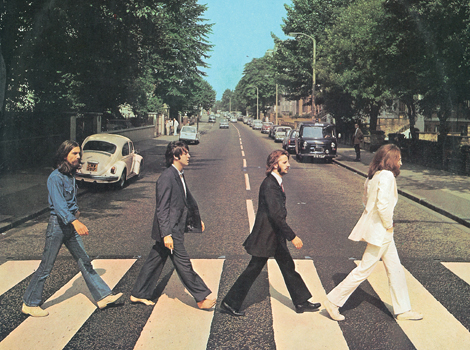
BEATLES ABBEY ROAD album cover from October 1969 Courtesy EMI Apple

Forty-five years ago today, four young men walked across a zebra crossing in north-west London, the shutter of a camera clicked, and history was made. The cover of the Beatles’ 11th studio album immortalised the Abbey Road crossing—and everything else in the picture, too. (Apparently the number plate of the white VW Beetle parked half on the pavement in the background was repeatedly stolen.)

Paul McCartney, who still lives around the corner, had the idea for the image and sketched it out. The creative director decided not to put the name of the band or the album on the cover—even though EMI wanted it—because “they were the most famous band in the world”. And so, thanks to the contagion of celebrity, it’s now the most famous zebra crossing in the world.

Those of us who live nearby are accustomed to being asked for directions to Abbey Road by strangers outside the tube station. Legions of fans crowd the crossing—especially at this time of year, and no doubt even more today—eager for their chance to get “The Shot”. There is even a “crossing cam”, so you can watch it live online.

If you drive regularly over it, as I do, you soon learn that the rules of the Highway Code are virtually impossible to implement here. You can still “look out for pedestrians waiting to cross” and “be ready to slow down or stop to let them cross”, but however much you may want to “give way when a pedestrian has moved onto a crossing”, they just don’t want you to. They wave you impatiently on, scanning the road beyond for a break in the traffic. The last thing they want is your car in their photo—even my little electric car, which is white and could do a passable imitation of the Beetle behind George Harrison’s head.

What the fans possibly don’t know is that, at 11.35am on August 8th 1969 (also a Friday), a policeman stopped the traffic for the shoot, and the photographer, Iain Macmillan, stood on a stepladder in the middle of the road to get his vantage point. Today, at the same time exactly 45 years on, cast members of “Let It Be” (a Beatles musical) will lead a group of fans across the crossing. There will be a sing-a-long to mark the occasion too.

I knew a French woman who parodied the album cover for her change-of-address card when she moved back to Paris. She hired a photographer and turned her husband and two young children out of bed at 4.30am to get the shot with no vehicles on the road. It worked brilliantly. But on a normal day, once the 21st-century daytime traffic has built up, forget it. Fans will still try, but unless they start very early (jetlag could be a positive here) they will have cars, lorries and double-decker buses in their photos. And local drivers will still find that Abbey Road is the only place in Britain where pedestrians give way to vehicles on a zebra crossing.

Rebecca Willis is associate editor of Intelligent Life

Image Alamy

LONDON
MUSIC
REBECCA WILLIS