I saw this group of Rhinos. From a great distance they appeared to be a rock formation. Then, as I got nearer the rocks were moving! Oh, Rhinos, not rocks.

I saw this group of Rhinos. From a great distance they appeared to be a rock formation. Then, as I got nearer the rocks were moving! Oh, Rhinos, not rocks.
June 24, 2012 | 3
 Image: JAMIE CARROLL iStockphoto
–David Graybill, Wilton, Conn.
Jeannine Stamatakis, instructor at several colleges in the San Francisco Bay Area, responds:
There is no denying the high you feel after a run in the park or a swim at the beach. Exercise not only boosts your physical health–as one can easily see by watching a marathon or a boxing match–but it also improves mental health.
According to a recent study, every little bit helps. People who engaged in even a small amount of exercise reported better mental health than others who did none. Another study, from the American College of Sports Medicine, indicated that six weeks of bicycle riding or weight training eased stress and irritability in women who had received an anxiety disorder diagnosis.
To see how much exercise is required to relieve stress, researchers at the National Institute of Mental Health observed how prior exercise changed the interactions between aggressive and reserved mice. When placed in the same cage, stronger mice tend to bully the meeker ones. In this study, the small mice that did not have access to running wheels and other exercise equipment before cohabitating with the aggressive mice were extremely stressed and nervous, cowering in dark corners or freezing when placed in an unfamiliar territory. Yet meek rodents that had a chance to exercise before encountering their bullies exhibited resistance to stress. They were submissive while living with the aggressive mice but bounced back when they were alone. The researchers concluded that even a small amount of exercise gave the meeker mice emotional resilience.
The scientists looked at the brain cells of these so-called stress-resistant mice and found that the rodents exhibited more activity in their medial prefrontal cortex and their amygdala, both of which are involved in processing emotions. The mice that did not exercise before moving in with the aggressive mice showed less activity in these parts of the brain.
Although this study was done in mice, the results likely have implications for humans as well. Exercising regularly, even taking a walk for 20 minutes several times a week, may help you cope with stress. So dig out those running shoes from the back of your closet and get moving.

Snapshot: Samantha Weinberg explains what happens at the Aldabra atoll in the Seychelles when the lagoon tides chip away at the coral…
From INTELLIGENT LIFE magazine, May/June 2012
From above, the Aldabra atoll looks like a giant green fortress, adrift in the Indian Ocean. Approached at sea level it is more remarkable still, a protected paradise where nature has been left to form and crumble, grow, wither and regrow, undisturbed by human meddling.
Aldabra, a World Heritage site, consists of four coral islands encircling a large central lagoon. Although closest to Madagascar, it belongs to the Seychelles, 1,200km to the north-east. But, unlike the Seychelles, Aldabra does not welcome tourists; it is far off the shipping lanes and there is nowhere to stay. Even scientists, who are lured here by the world’s largest population of giant tortoises and the opportunity to study what happens to species when evolution is allowed to unfold unchecked, are only granted limited study licences.
The central lagoon is tidal: twice a day oceanic water whooshes in, bringing with it sharks, green turtles and vital nutrients. But when it drains, it leaves bizarre limestone structures—or champignons as they are known—teetering above the shallows like outspread parasols. Over time, the water erodes the coral, chipping away at the stem of the champignons until, eventually, the whole structure topples over.
Cheryl-Samantha Owen, a conservation scientist and photographer, was on an expedition to document the shark species when she took this picture of a five-metre-high champignon at low tide. “Everything you do on Aldabra is controlled by the tides,” she says. “You anchor off the reef and swim in through the channels, which can be pretty hairy.” Water flowing through the largest of the channels, Grande Passe, can run at seven knots on a spring tide. “The lagoon is an incredible green colour, which is reflected in the clouds above. It is an extraordinary place, full of mystique, a glimpse of what the world might be like if we hadn’t interfered.”
Samantha Weinberg is our assistant editor, and a former commissioning editor on Eureka at the Times
Photograph Cheryl-Samantha Owen
 This is located on the grounds of the Birch Aquarium in San Diego, CA. This aquarium is well worth a visit if you are in the San Diego area.
Darcy Burner developing smartphone app to allow shoppers to avoid brands owned by the Kochs and other right wingers

Mopping up that spilled organic, fair trade coffee with a Brawny kitchen roll? Off to yoga in your Lycra shorts? Serving your kids kale chips on a Dixie paper plate? Did you know you were lining the pockets of the Charles and David Koch, billionaire bankrollers of the extreme right? Well, soon there’ll be an app for that.
A former tech head turned politician is developing an app that will allow shoppers to avoid products made by the Kochs or other billionaires currently spending fortunes backing rightwing candidates and policies.
Darcy Burner, a Democrat politician running for Congress in Washington state, said she came up with the idea when she started looking at exactly what the Kochs own.
The brothers’ interests include Georgia Pacific, a packaging and paper products firm whose brands include Brawny and Sparkle paper towels, Angel Soft and Soft n’ Gentle bath tissue and the Dixie range of paper cups and plates.
Koch Industries also owns Invista, the world’s largest fibre and textiles company and owner of Lycra, Cordura and the Stainmaster carpet brand.
“The Kochs have a record of spending enormous amounts of money to move very reactionary, right-wing policies. Most Americans disagree with those policies but they may be buying products that are bankrolling them,” she said.
Burner said the app would allow “folks to make informed buying decisions.”
“We talk about boycotts but with someone like the Kochs, they own so much that it’s difficult to track,” she said.
Burner, a Harvard computer science grad and former Microsoft programmer, said the app was still in the early stages. “We are talking to people but hopefully someone will take it on soon,” she said.
The first version is likely to check a product against its owners using a barcode but eventually she hopes it could be developed to warn people when they enter a store with bad labor or environmental practices.
“It could suggest somewhere nearby where you might feel better shopping,” she said. “But that’s not for the first version.”
Burner said she would love to see the app launched ahead of this election, not least because of the huge amounts of money a handful of billionaires are now pouring into the 2012 presidential run-off.
“I’m a believer in government by and for the people. Just seeing that less than 100 people wield so much say in this election is very disturbing.”

German flags outnumbered a blue-and-white Greek flag on Friday in Berlin at a public viewing of the quarterfinals of the European soccer championships held in Poland. Germany won, 4-2.
GDANSK, Poland — The giant blue-and-white flag blotted out the overcast Baltic sky on Friday as the Greek fans pounded their drums and cheered at the foot of the centuries-old City Hall here. The Germans took up a chant in honor of their chancellor, Angela Merkel.
Chancellor Angela Merkel on Friday as Germany beat Greece in a Euro 2012 quarterfinal game that reflected unease between the countries.
“Without Angie, you wouldn’t be here,” bellowed the German fans, referring to the multibillion-dollar bailouts Greece has received from European partners, first and foremostGermany.
“We’ll never pay you back,” countered the Greeks. “We’ll never pay you back.”
The leaders of Germany and Greece may be scrambling to hold Europe together, but on the popular level the strain of a three-year-old financial crisis is beginning to tear it apart. And while the European soccer championships have often served as a safe outlet for channeling nationalist passions into Europe’s favorite pastime, for thousands of Greeks and Germans — brought together by chance in the quarterfinals here — this encounter turned into something more than a game.
“They’ve provoked us with all of this terrible talk about Greece,” said Dimitrios Gorovelis, 33, part of a group from Aachen, in the far west of Germany, that had rented two silver vans and driven overnight to Poland. Some were originally from Greece and others were born in Germany, but they all were there to support the motherland.
For Greeks, Germany now represents austerity and foreign diktats. For Germans, the Greeks represent tax-dodging wastrels looking for handouts. “Goodbye Greeks,” declared the front page of the daily newspaper Bild on Friday; the paper has previously published calls for Greek islands and even the Acropolis to be sold. “Today we can’t rescue you,” the paper said.
“A lot of people, including myself, would have never thought even just a few short years ago that the relationship could deteriorate the way that it has,” said Janis A. Emmanouilidis, a senior analyst at the European Policy Center who is half-Greek and half-German. He cited the ties of migration and tourism and the regard Germany held for Greece as the cradle of democracy and Greece for Germany as a model of efficiency. “You have these reflexes, like defending oneself,” Mr. Emmanouilidis said.
Everyone from soccer experts to political analysts to fans cautioned that, in the end, the only thing on the line was the right to move on to the semifinals against the winner of the game between England and Italy. And for the most part, the mood before the game on Gdansk’s historic Dluga Street was peaceful and joyous.
Still, one middle-age Greek implored Germans in their own language, his voice quavering with anger, to stop teasing about pensions and poverty “before things escalate into violence.” A man in a German jersey rushed from the crowd and gave him a hug.
Outside the stadium after the game, which Greece lost handily to heavily favored Germany, a group of Greek men dressed as Olympians of myth clapped and sang, while one danced in the aisle. “We Greeks don’t have money, but we have a big heart,” said Christos Mistridis, 33. The dancer shushed him and said, as if sharing a secret, “Angela Merkel thinks we’re at work.”
The penalty kick that gave Greece its consolation goal near the end of the game was “a little present on top of the money we gave them,” said Hendrik Grote, who wore a German soccer jersey and lederhosen. “That’s enough now though.”
The tournament is held every four years, but this time around has been scrutinized from the very beginning through the kaleidoscope of the Continent’s crisis, with Twitter users, headline writers and barroom wits comparing the records of bailout countries to triple-A-rated ones with more than a hint of schadenfreude.
Portugal, which was forced to seek financial assistance, was the first country to qualify for the semifinals. The Netherlands, a soccer powerhouse with a sterling credit rating, lost all of its matches. But nothing quite compared to this match, between the major antagonists of the crisis, who have been trading barbs for more than two years.
Gdansk, with its intertwined Polish-German history and recent Communist past, is a fitting location to realize how far Europe has moved from the old cleavages of the cold war and East-West thinking. The new reality is a paradigm of a hard-money north led by Germany that is starkly at odds with a soft-money south, which would not be such a problem if they did not also share a currency and a central bank.
Reporting was contributed by Niki Kitsantonis and Liz Alderman in Athens, and Melissa Eddy in Berlin.
Do animals other than humans have a sense of humor? Maybe so
By Jesse Bering | June 22, 2012 | 10

 Image: Jonathan Bartlett
Once, while in a drowsy, altitude-induced delirium 35,000 feet somewhere over Iceland, I groped mindlessly for the cozy blue blanket poking out beneath my seat, only to realize—to my unutterable horror—that I was in fact tugging soundly on a wriggling, sock-covered big toe. Now, with a temperament such as mine, life tends to be one awkward conversation after the next, so when I turned around, smiling, to apologize to the owner of this toe, my gaze was met by a very large man whose grunt suggested that he was having some difficulty in finding the humor in this incident.
Unpleasant, sure, but I now call this event serendipitous. As I rested my head back against that sanitation-paper-covered airline pillow, my mid-flight mind lit away to a much happier memory, one involving another big toe, yet this one belonging to a noticeably more good-humored animal than the one sitting behind me. This other toe—which felt every bit as much as its overstuffed human equivalent did, I should add—was attached to a 450-pound western lowland gorilla, with calcified gums, named King. When I was 20 and he was 27, I spent much of the summer of 1996 with my toothless friend King, listening to Frank Sinatra and the Three Tenors, playing chase from one side of his exhibit to the other, and tickling his toes. He’d lean back in his night house, stick out one huge ashen-gray foot through the bars of his cage and leave it dangling there in anticipation, erupting in shoulder-heaving guttural laughter as I’d grab hold of one of his toes and gently give it a palpable squeeze. He almost couldn’t control himself when, one day, I leaned down to act as though I were going to bite on that plump digit. If you’ve never seen a gorilla in a fit of laughter, I’d recommend searching out such a sight before you pass from this world. It’s something that would stir up cognitive dissonance in even the heartiest of creationists.
Do animals other than humans have a sense of humor? Perhaps in some ways, yes. But in other ways there are likely uniquely human properties to such emotions. Aside from anecdotes, we know very little about nonhuman primate laughter and humor, but some of the most significant findings to emerge in comparative science over the past decade have involved the unexpected discovery that rats—particularly juvenile rats—laugh. That’s right: rats laugh. At least, that’s the unflinching argument being made by researcher Jaak Panksepp, who published a remarkable, and rather heated, position paper on the subject in Behavioural Brain Research.
In particular, Panksepp’s work has focused on “the possibility that our most commonly used animal subjects, laboratory rodents, may have social-joy type experiences during their playful activities and that an important communicative-affective component of that process, which invigorates social engagement, is a primordial form of laughter.” Now, before you go imagining some chortling along the lines of one rakish Stuart Little (or was he a mouse?), real rat laughter doesn’t tend to sound very much like the human variety, which normally involves pulsating sound bursts starting with a vocalized inhalation and consisting of a series of short distinct saccades separated by almost equal time intervals. The stereotypical sound of human laughter is an aspirated h, followed by a vowel, usually a, and largely because of our larynx is rich in harmonics. In contrast, rat laughter comes in the form of high-frequency 50-kilohertz ultrasonic calls, or “chirps,” that are distinct from other vocal emissions in rats. Here’s how Panksepp describes his discovery of the phenomenon:

Those attributes point to potential adaptability for sorghum. Scientists from Purdue, the University of Nebraska-Lincoln, University of Illinois and Cornell University believe sorghum, a grain crop similar to corn, could benefit from the rail system, grain elevators and corn ethanol processing facilities already in place.
Their article explaining the perspective has been published early online in the journal Biofuels, Bioproducts & Biorefining.
Click here for Oilprice.com’s Special FREE Investment Report on Sorghum
Nick Carpita, a Purdue professor of botany and plant pathology said, “The Midwest is uniquely poised to get the biorefining industry going on cellulose. As we move to different fuels beyond ethanol, the ethanol plants of today are equipped to take advantage of new bioenergy crops.”
The scientists argue that no single plant is a silver-bullet answer to biofuels, but sorghum should be a larger part of the conversation than it is today. Cliff Weil, a Purdue professor of agronomy, said some types of sorghum would require fewer inputs and could be grown on marginal lands.
Weil points out, “In the near future, we need a feedstock that is not corn. Sweet and biomass sorghum meet all the criteria. They use less nitrogen, grow well and grow where other things don’t grow.”
The ability to minimize inputs such as nitrogen could be a key to sorghum’s benefits as a bioenergy crop. Carpita said corn, which has been bred to produce a maximum amount of seed, requires a lot of nitrogen. But sorghum could be genetically developed in a way that maximizes cellulose, minimizes seeds and, therefore, minimizes inputs.
Another plus is farmers may also be more willing to grow sorghum – a crop they’re familiar with – because it is an annual, compared with perennials such as switchgrass or Miscanthus, that would take up a field for a decade or longer. Sorghum would fit in a normal crop rotation with food crops rather than tying up valuable cropland.
One crucial point not noticed in the media, press or blogs is as Nathan Mosier, a Purdue associate professor of agricultural and biological engineering points out, “If we’re talking about planting switchgrass, that’s a 15-year commitment. You can’t switch annually based on the economy or other factors. You are committed to that crop.”
For income the farm operator and capital investment owner would have to believe that producing companies and government policy would stand behind the commitment. This is not something easily believed.
Even today just using the corn ethanol available isn’t possible – from a lack of flex-fuel vehicles, regulatory impediments, and competitive industry pressure. E-15 has been dawdled on for years now.
Maureen McCann, a Purdue professor of biology and director of the Energy Center and the Center for Direct Catalytic Conversion of Biomass to Biofuels notes conversion processes for turning biomass into fuel need to be scalable and take advantage of existing infrastructure for grain production. Sorghum could be harvested and transported using existing rail lines to collection points such as grain elevators, where the crop could be processed to a higher-value, more energy-dense product before being transported for further processing in a refinery. That would seem an odd concept to folks in the corn belt where almost all rail lines have been abandoned with only major routes for international export or North American long distance transport still operating.
Yet McCann has worthwhile points that should fit for trucking, the primary form of heavy transport in the corn belt, “Biomass has roughly half the energy content of gasoline – even if it’s very compressed and tightly packed. The issue is really how to increase the intrinsic energy density by preprocessing conversion steps that could be done on farm or at the silo so that you’re transporting higher-energy (density) products to the refineries.”
Purdue’s Farzad Taheripour, a research assistant professor of agricultural economics, said bringing sorghum back as a biofuel crop could have an economic impact on poorer rural areas of the country. “Given that sorghum can be produced on low-quality, marginal lands in dry areas, producing sorghum for biofuel will significantly improve the economy of rural areas that rely on low-productivity agriculture. This could improve welfare in less-developed rural areas and increase job opportunities in these areas.”
The good folks the universities have missed the point – sorghum is a crop long used on farms and found wanting. Sorghum offers quality attributes to production of biofuels, but the market is still at war over ethanol in particular and other biofuels can expect the same multiyear problems. Sorghum has no political base as a special interest like corn farmers, processors and blenders, knowledgeable environmentalists and well-informed consumers. But the big problem is capital, the financing to install a transport, storage and processing handling systems costing of hundreds of billions of dollars.
There is over a hundred years of investments in handling grains worldwide – nothing remotely similar exists for handling cellulosic materials. The logistical framework doesn’t exist.
Sorghum is great material for biofuel, a very interesting cellulosic resource that isn’t compelling for risk or investment. Not yet by any means. But the study does show that the transition to a cellulose resource from a corn resource is possible and that sorghum might be the ideal first step.
By. Brian Westenhaus
Jun 23rd 2012 | ATHENS | from the print edition

GREECE has given birth to its first proper coalition government in modern times. The three-party deal, routine by north European standards, emerged smoothly after just 48 hours of negotiations. Antonis Samaras, the centre-right New Democracy leader, was sworn in as prime minister pledging to “give stability and hope” to Greeks enduring the deepest recession in the country’s modern history. It is a pledge he cannot fulfil without lots of help from the rest of Europe.
That Greece has a government at all is due to New Democracy’s better-than-expected performance in the June 17th election. It won 29.7% of the vote to 26.9% for Syriza, the radical left coalition led by 37-year-old Alexis Tsipras, a brash new political star whose claim that Greece could renegotiate its latest €130 billion ($164 billion) bail-out yet stay in the euro appealed to many voters. The PanHellenic Socialist Movement (Pasok) finished a distant third with 12.3%.
Related topics

With 129 seats, New Democracy is much the biggest party in the 300-member parliament (thanks to an electoral law that gives the front-runner an extra 50 seats). By teaming up with Pasok’s 33 members and another 17 from Democratic Left, it will have a comfortable majority of 179 seats. Syriza has 71 seats in an otherwise fragmented house. Independent Greeks, the neo-Nazi Golden Dawn and the Greek communist party each have a handful of deputies.
Many held their noses as they voted for New Democracy. Mr Samaras is a political veteran with a reputation for nationalism and poor judgment. He is widely blamed for insisting on a first, inconclusive election in May, rather than allowing Lucas Papademos, a technocratic prime minister, to govern for longer. But fear that Greece might be flung out of the euro caused voters to rally to New Democracy, including many who normally support other parties.
To his credit, Mr Samaras was set to make two bold decisions ahead of a euro group meeting of finance ministers on June 21st. Vassilios Rapanos, a banker and public-finance specialist, will be finance minister. And Yannis Stournaras, the caretaker development minister, will stay on. Both men are technocrats with socialist connections; they were part of an efficient team that took Greece into the euro in 2002, an optimistic time marked by economic liberalisation and growth rates of more than 4% a year. Their appointment also signals a willingness to weaken Greece’s clientilist political system.
The make-up of the rest of the cabinet is unclear. So tough were the discussions between Mr Samaras’s team and that of Evangelos Venizelos, the Pasok leader, that the first cabinet meeting was postponed. Fotis Kouvelis, boss of the Democratic Left, the junior coalition partner, said he would support New Democracy; his central committee has decided against seeking any cabinet posts.
Once his government is in place, Mr Samaras must parley with Greece’s paymasters in Brussels and Berlin. He will seek approval for a few tweaks such as a two-year delay until 2016 of €11.7 billion of spending cuts and the sacking of 150,000 public-sector workers demanded by international lenders. Mr Samaras also wants to increase social spending to ease the pain of a deeper-than-expected recession. GDP is set to shrink this year by up to 7%, against earlier forecasts of 4.5%.
But his room for manoeuvre is limited. Without its next slice of bail-out money, the new government would be unable to pay pensions and public-sector salaries at the end of July. And the Greek economy is desperate for a bit of stability. More than €10 billion has been taken out of Greek banks since the May election; even profitable companies are denied loans because of a credit squeeze; and three international export-insurance agencies are refusing to provide cover for products sold to Greece.
The coalition wants to govern for exactly 24 months, until the European Parliament elections in mid-2014. It might manage that. Mr Venizelos, a former finance minister who clashed with Greece’s creditors, is reinventing himself as a pro-European statesman. He needs time to rebuild his party after two disastrous performances at the polls. Mr Kouvelis, the first leftist to play a big role in government, has little reason to shake things up. Another election might bring Mr Tsipras to power; Syriza might even gain the 35% of the vote needed for a parliamentary majority. That prospect should be enough to ensure the loyalty of Mr Samaras’s partners.
Mr Samaras’s belief that two years will give him enough time to turn the economy around is more questionable. Funds to promote growth are already available: as much as €14 billion from European Union structural funds for infrastructure and other big modernisation projects, and perhaps €2 billion-3 billion from the European Investment Bank. The previous Pasok government could get only a trickle of funding from Brussels thanks to the inefficiency of its bureaucrats. Mr Rapanos and Mr Stournaras should do better, say their conservative backers.
But the question hanging over Greece is not whether the government can unlock more official funding, but whether it can entice private capital. The big fear for foreign investors is a euro break-up, not just in Greece but elsewhere. Mr Samaras can hasten that outcome, but he cannot prevent it. Until a lasting solution is found to the euro crisis, Greece will be in limbo.
from the print edition | Europe
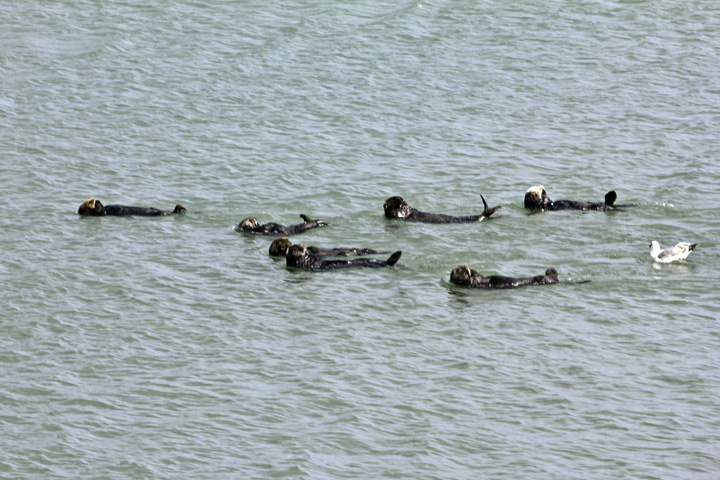
Life seems pretty good for these sea otters. They spend most of the day on their backs eating. As they are in a protected lagoon they are protected from most predators.

 See Inside
 Passing Through . . . .