abcdefghli
War and Oil
Daily Comment
DAILY COMMENT
AUGUST 10, 2014
Oil and Erbil
BY STEVE COLL
CREDIT PHOTOGRAPH BY SEBASTIAN MEYER/CORBIS.
To the defense of Erbil: this was the main cause that drew President Obama back to combat in Iraq last week, two and a half years after he fulfilled a campaign pledge and pulled the last troops out.
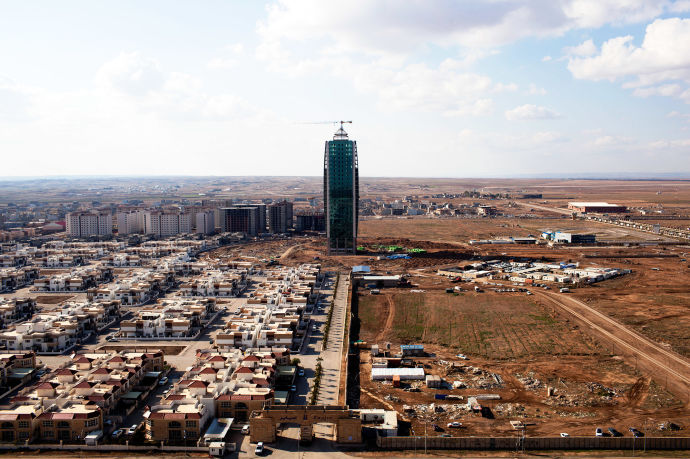
After Mazar-i-Sharif, Nasiriyah, Kandahar, Mosul, Benghazi, and a score of other sites of American military intervention—cities whose names would have stumped most American “Jeopardy!” contestants before 2001—we come now to Erbil. One can forgive the isolationist: Where?
Erbil has an ancient history, but, in political-economic terms, the city is best understood these days as a Kurdish sort of Deadwood, as depicted in David Milch’s HBO series about a gold-rush town whose antihero, Al Swearengen, conjures up a local government to create a veneer of legitimacy for statehood, all to advance his rackets. Erbil is an oil-rush town where the local powers that be similarly manipulate their ambiguous sovereignty for financial gain—their own, and that of any pioneer wild and wily enough to invest money without having it stolen.
Erbil is the capital of the oil-endowed Kurdish Regional Government, in northern Iraq. There the United States built political alliances and equipped Kurdish peshmerga militias long before the Bush Administration’s invasion of Iraq, in 2003. Since 2003, it has been the most stable place in an unstable country. But last week, well-armed guerrillas loyal to the Islamic State in Iraq and al-Sham, or ISIS, threatened Erbil’s outskirts, forcing Obama’s momentous choice. (The President also ordered air operations to deliver humanitarian aid to tens of thousands of Yazidis and other non-Muslim minorities stranded on remote Mount Sinjar. A secure Kurdistan could provide sanctuary for those survivors.)
“The Kurdish region is functional in the way we would like to see,” Obama explained during a fascinating interview with Thomas Friedman published on Friday. “It is tolerant of other sects and other religions in a way that we would like to see elsewhere. So we do think it is important to make sure that that space is protected.”
All true and convincing, as far as it goes. Kurdistan is indeed one of a handful of reliable allies of the United States in the Middle East these days. Its economy has boomed in recent years, attracting investors from all over and yielding a shiny new international airport and other glistening facilities. Of course, in comparison to, say, Jordan or the United Arab Emirates, Kurdistan has one notable deficit as a staunch American ally: it is not a state. Nor is it a contented partner in the construction of Iraqi national unity, which remains the principal project of the Obama Administration in Iraq. In that light, Obama’s explanation of his casus belli seemed a little incomplete.
Obama’s advisers explained to reporters that Erbil holds an American consulate, and that “thousands” of Americans live there. The city has to be defended, they continued, lest ISIS overrun it and threaten American lives. Fair enough, but why are thousands of Americans in Erbil these days? It is not to take in clean mountain air.
ExxonMobil and Chevron are among the many oil and gas firms large and small drilling in Kurdistan under contracts that compensate the companies for their political risk-taking with unusually favorable terms. (Chevron said last week that it is pulling some expatriates out of Kurdistan; ExxonMobil declined to comment.) With those oil giants have come the usual contractors, the oilfield service companies, the accountants, the construction firms, the trucking firms, and, at the bottom of the economic chain, diverse entrepreneurs digging for a score.
Scroll the online roster of Erbil’s Chamber of Commerce for the askew poetry of a boom town’s small businesses: Dream Kitchen, Live Dream, Pure Gold, Events Gala, Emotion, and where I, personally, might consider a last meal if trapped in an ISIS onslaught, “Famous Cheeses Teak.”
It’s not about oil. After you’ve written that on the blackboard five hundred times, watch Rachel Maddow’s documentary “Why We Did It” for a highly sophisticated yet pointed journalistic take on how the world oil economy has figured from the start as a silent partner in the Iraq fiasco.
Of course, it is President Obama’s duty to defend American lives and interests, in Erbil and elsewhere, oil or no. Rather than an evacuation of citizens, however, he has ordered a months-long aerial campaign to defend Kurdistan’s status quo, on the grounds, presumably, that it is essential to a unified Iraq capable of isolating ISIS. Yet the status quo in Kurdistan also includes oil production by international firms, as it might be candid to mention. In any event, the defense of Kurdistan that Obama has ordered should work, if the Kurdish peshmerga can be rallied and strengthened on the ground after an alarming retreat last week.
Yet there is a fault line in Obama’s logic about Erbil. The President made clear last week that he still believes that a durable government of national unity—comprising responsible leaders of Iraq’s Shiite majority, Kurds, and Sunnis who are opposed to ISIS—can be formed in Baghdad, even if it takes many more weeks beyond the three months of squabbling that have already passed since the country’s most recent parliamentary vote.
The project of a unified Baghdad government strong enough to defeat ISIS with a nationalist Army and then peel off Sunni loyalists looks increasingly like a pipe dream; it was hard to tell from the Friedman interview what odds Obama truly gives the undertaking.
Why has political unity in Baghdad proven so elusive for so long? There are many important reasons—the disastrous American decision to disband the Iraqi Army, in 2003, and to endorse harsh de-Baathification, which created alienation among Sunnis that has never been rectified; growing sectarian hatred between Shiites and Sunnis; the infection of disaffected Sunnis with Al Qaeda’s philosophy and with cash and soft power from the Persian Gulf; interference by Iran; the awkwardness of Iraq’s post-colonial borders, and poor leadership in Baghdad, particularly under Prime Minister Nouri al-Maliki. But another reason of the first rank is Kurdish oil greed.
During the Bush Administration, adventurers like Dallas-headquartered Hunt Oil paved the way for ExxonMobil, which cut a deal in Erbil in 2011. Bush and his advisers could not bring themselves to force American oil companies such as Hunt to divest from Kurdistan or to sanction non-American investors. They allowed the wildcatters to do as they pleased while insisting that Erbil’s politicians negotiate oil-revenue sharing and political unity with Baghdad. Erbil’s rulers never quite saw the point of a final compromise with Baghdad’s Shiite politicians—as each year passed, the Kurds got richer on their own terms, they attracted more credible and deep-pocketed oil companies as partners, and they looked more and more like they led a de-facto state. The Obama Administration has done nothing to reverse that trend.
And so, in Erbil, in the weeks to come, American pilots will defend from the air a capital whose growing independence and wealth has loosened Iraq’s seams, even while, in Baghdad, American diplomats will persist quixotically in an effort to stitch that same country together to confront ISIS.
Obama’s defense of Erbil is effectively the defense of an undeclared Kurdish oil state whose sources of geopolitical appeal—as a long-term, non-Russian supplier of oil and gas to Europe, for example—are best not spoken of in polite or naïve company, as Al Swearengen would well understand. Life, Swearengen once pointed out, is often made up of “one vile task after another.” So is American policy in Iraq.
Why Would This Surprise Anyone?
Hedge Funds Run by Women Outperform Those Run by Men
Is it because women are more averse to risk?
JOE PINSKERAUG 4 2014, 2:39 PM ET
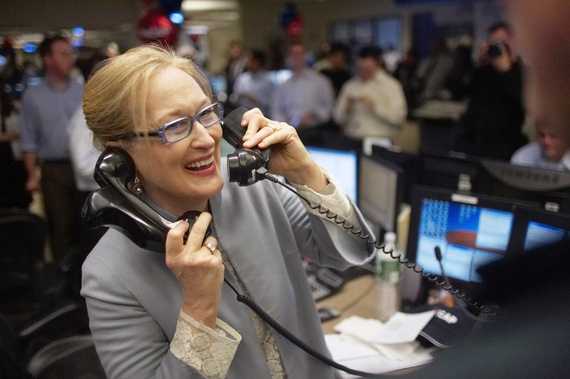
Meryl Streep books a trade in 2008. It no doubt generated great returns. (Jacob Silberberg/Reuters)
This morning, the Wall Street Journal reported on funds that choose to tie their fates to the performance of companies led by women. Barclays’ Women in Leadership Total Return Index, which consists of American companies with a female CEO or whose proportion of female board members is at least 25 percent, is one of number of new funds that aims to capitalize on the finding that companies with female leaders tend to outperform those where women are relatively absent. (Amusingly and depressingly, even if Barclays were based in the U.S., it wouldn’t qualify for its own fund, due to its lack of female leaders.)
The female-favoring trend the Journal identified stems from research suggesting that companies run by women simply do better. For example, a 2011 report from Catalyst, a nonprofit promoting women in business, found that over the course of five years, companies with women on their boards had average returns on equity of 15.3 percent, while those of companies without any female board members were 10.5 percent. (Return on equity is a figure that gives a sense of a company’s ability to generate profit from shareholders’ investments.)
But the benefits of investing in female-led financial endeavors go even further than the Journal has it: Hedge funds run by women tend to outperform other hedge funds. A report put out in early 2013 by the accounting firm Rothstein Kass indicated that between January 2012 and September 2012, an index of 67 hedge funds owned or managed by women had a return of 8.95 percent—significantly more than the 2.69 percent return generated by an index “designed to be representative of the overall composition of the hedge fund universe.” (The 67 funds were chosen because they reported their monthly performance to HedgeFund.net or the Hedge Fund Research Database.) The impacts of these outsized gains, however, largely remain to be felt, as there are only about 125 female-run hedge funds in the world, according to Reuters.
Those who ascribe one’s financial worldview to gender-based differences might be oversimplifying.
Many, including Meredith Jones, the author of the Rothstein Kass report, chalk up these disparities to women’s inherent risk-aversion. Jones called the findings “not surprising,” noting that women’s preferences for financial conservatism have been borne out by countless studies. It’s true: A ton of research backs her up.
As unsurprising and clear as these results may be to some, their causes are less easy to identify. While the Catalyst report promotes the idea that women create higher returns, it could be the case that prosperous companies and hedge funds are more likely to hire women.
Moreover, those who ascribe one’s financial worldview to gender-based differences might be oversimplifying. A 2012 paper took issue with the prevailing line of thinking, arguing that previous research into women’s risk-aversion overstated the differences revealed by the data. In what is probably a healthier way of viewing the world—hedge fund owners and all—the paper suggests that the correlations between gender and risk aversion are “considerably more mixed … than might be expected.”
That said, the fact remains that female-led companies and hedge funds are, almost across the board, besting their competitors.
Finding Vivian Maier
WHY WOULDN’T YOU SHARE THEM?
~ Posted by Simon Willis, July 21st 2014
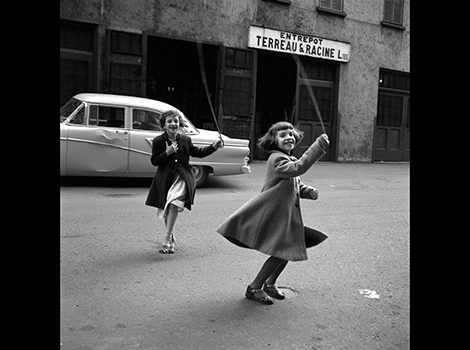
In the winter of 2007, a young estate agent called John Maloof was rootling around in some boxes at an auction house in Chicago. He was looking for old photographs of the city for a book he was writing on the side, and came across a box of negatives. He didn’t know what they were, but he snapped them up and took them home. As he began to look more closely, he liked what he saw. There were shots of a black man riding a powerful horse under a flyover in New York, of an elegant white-haired woman in a lace veil glancing querulously at the camera, of a blond boy in a fur-collared coat crying his eyes out. They were intimate and spontaneous, and when he posted them on a blog the response was an ecstasy of exclamation marks. The pictures, which nobody had seen before, added nothing to Maloof’s book. But they did add a new name to the photographic canon: Vivian Maier.
Now Maloof has made a documentary, “Finding Vivian Maier”, which tells the enthralling story of his discovery and the sad mysterious life of the woman behind the work, much of it spent as an itinerant nanny in Illinois. He bought all the negatives he could find until he had 100,000 of them. He bought thousands of rolls of undeveloped film. He tracked down people she’d worked for, and raided storage units. “She was a pack rat,” he says. She kept old receipts and bus passes, uncashed income-tax cheques, old coats and dresses, pile upon pile of newspapers. There were old home-videos and voice recordings she’d made. Gradually he pieced together her life—from her birth in New York in 1926 to her solitary death in a park on the shores of Lake Michigan in 2009. The central question of the film and of her life was—as one of the people she nannied puts it—“Why would you hoard all this great art? Why wouldn’t you share it?”
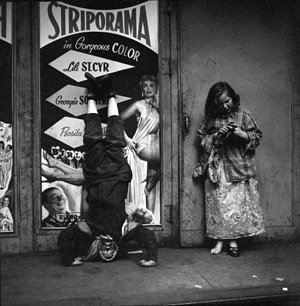
Her art has drawn comparisons with Diane Arbus and Robert Frank. Among the photographers interviewed in the film is Mary Ellen Mark: “She had a great eye. A great sense of framing. She had a sense of humour and a sense of tragedy. She had it all.” She had a spiky determination too. Maier would go to supermarkets with a tape recorder and conduct mini vox-pops on the political stories of the day. “What do you think of the impeachment?” she asks one woman. “I don’t know,” the woman replies. “Well you should have an opinion. Women are supposed to be opinionated, I hope.” As a nanny, she would take her kids to parades, and give them armfuls of candy from the Marshall Fields department store. But once, when one of her charges was knocked off his bike by a car, she got out her camera and photographed him lying in the street. Sometimes she would hit the children, and one woman recalls Maier force-feeding her. “She would hold me down and shove the food in my throat,” she says, “and she would choke me until I swallowed it. And she would do that over and over again.” And she was always elusive, locking the doors of the rooms she lived in, and lying about her name, either giving entirely false names or using variations of her real one: Meier, Meyer, Meyers, B. Maier, D. Maier. “I’m a sort of spy,” she once said.
In unveiling her character, the film zooms in on the secret of her art, which may also have been the secret of reticence. She was drawn to drifters and marginal people because in many ways she was one herself. At one point we see a series of shots—a dead horse in the gutter, the rotting corpse of a cat, a homeless man holding himself desperately against a wall. “She sees the bizarreness of life, the incongruity of life, and the unappealingness of human beings,” a woman who once employed Maier says. She turned it into great photography, but perhaps, paradoxically, it also kept her locked away in her own world.
“Finding Vivian Maier” is in cinemas in Britain and America now
Simon Willis is apps editor of Intelligent Life
Apple’s i Cloud
Inside the Huge Solar Farm That Powers Apple’s iCloud
Lisa Jackson on Apple’s wide-ranging plan to green its act.
—By Suzanne Goldenberg and James West | Mon Jul. 28, 2014 6:00 AM EDT
This story was originally published by the Guardian and is reproduced here as part of the Climate Desk collaboration. The article was reported by the Guardian’s Suzanne Goldenberg, and the video was produced by Climate Desk’s James West.
The skies are threatening to pour on the Apple solar farm but as the woman in charge of the company’s environmental initiatives points out: The panels are still putting out some power. Apple is still greening its act.
The company, which once drew fire from campaigners for working conditions in China and heavy reliance on fossil fuels, is now leading other technology companies in controlling its own power supply and expanding its use of renewable energy.
After converting all of its data centers to clean energy, the Guardian understands Apple is poised to use solar power to manufacture sapphire screens for the iPhone 6, at a factory in Arizona.
And in a departure for its reputation for secretiveness, Apple is going out of its way to get credit for its green efforts.
“We know that our customers expect us to do the right thing about these issues,” Lisa Jackson, the vice-president of environmental initiatives told the Guardian.
This week the company invited journalists on a rare tour of its data center in North Carolina to showcase its efforts.
Until a year ago, the telegenic Jackson was the front woman for Barack Obama’s environmental ambitions as the administrator of the Environmental Protection Agency.
Now she is leading the effort to shrink Apple’s carbon footprint—and make sure customers realize the company is doing its bit to decarbonize its products and the internet.
Data centers require huge loads of electricity to maintain climatic conditions and run the servers carrying out billions of electronic transactions every day.
With Apple’s solar farm, customers could now be confident that downloading an app or video-chatting a friend would not increase carbon pollution, Jackson said.
“If you are using your iPhone, iPad, Siri or downloading a song, you don’t have to worry if you are contributing to the climate change problem in the world because Apple has already thought about that for you. We’ve taken care of that. We’re using clean energy,” she said.
The company is also moving to install solar and geothermal power at a plant in Mesa, Arizona, that has been manufacturing sapphire glass. Apple would not directly comment on the Arizona factory but the state’s governor, Jan Brewer, has publicly praised the company’s decision to relocate there and to use solar and geothermal in manufacturing.
“We are aware that almost 70 percent of our carbon footprint is in our supply chain,” Jackson said. “We are actively working on the facilities that we have here in the United States.”
The initiatives mark a turnaround for Apple, which was criticized in the past for working conditions and the use of toxic chemicals at its factories in China and for its heavy reliance on carbon intensive sources such as coal to power the cloud.
Greenpeace now says the company is out ahead of competitors like Google and Facebook, which also operate data centers in North Carolina.
“They are the gold standard in the state right now,” said David Pomerantz, a senior Greenpeace campaigner. “There are a lot of data centers in North Carolina and definitely none has moved as aggressively as Apple has to power with renewable energy,” he said.
The 55,000 solar panels tracking the course of the sun from a 400,000 square meter field across the road from Apple’s data center in Maiden were not in the picture seven years ago when Duke Energy and local government officials sought to entice Apple to open up a data center in North Carolina.
Apple’s solar farm is said to be the largest privately owned array in the US. James West/Climate Desk
Duke Energy, which has a near monopoly over power supply in the Carolinas, set out to lure big companies like Apple, Facebook and Google to the state with offers of cheap and reliable power for the data centers that are the hub of internet.
Data centers, with their densely packed rows of servers and requirements for climatically controlled conditions, are notorious energy hogs. Some use as much power as a small city. In Apple’s case, the North Carolina data center requires as much power as about 14,000 homes—about three times as much as the nearby town of Maiden.
Charging up a smart phone or tablet takes relatively little electricity, but watching an hour of streamed or internet video every week for a year uses up about as much power as running two refrigerators for a year because of the energy powering data centers elsewhere.
That made data centers a perfect fit for Duke, said Tom Williams, the company’s director of external relations. With the decline in textile and furniture factories that had been a mainstay in the state, the company had a glut of electricity.
“What the data centers wanted from Duke was low cost and reliable power. Those two things—cost and reliability—are fundamental to their operations,” he told the Guardian. “What we like about these data centers is that it’s an additional load on our system.”
In the early days, Apple bought renewable energy credits to cover the center’s electricity use. In 2012, the company built its first solar farm across the road from the data center.
Apple built a second solar farm, and announced plans this month for a third, all roughly about the same size, to keep up with the growing use of data. It also operates fuel cells, running on biogas pumped in from a landfill. All of the power generated on-site is fed into the electricity grid.
“On any given day 100 percent of the data center’s needs are being generated by the solar power and the fuel cells,” Jackson said.
The company has been less successful in its efforts to get other companies to switch to solar power. Duke, in cooperation with Apple, launched an initiative last year to encourage other big electricity users to go solar but so far there have been no takers.
Renewable energy accounts for barely 2 percent of the power generated in North Carolina, and Duke does not see the share growing significantly by 2020.
Lisa Jackson with President Obama during her time as EPA administrator. Mike Theiler/DPA/ZUMA
Meanwhile, consumer groups accuse Duke of offering Apple cheap energy at the expense of ordinary residential customers and of blocking rooftop solar.
“We think Duke is actually trying to tamp down the solar industry in this state. They are accommodating big customers like Apple who want to do solar farms, but as far as rooftop solar or other solar developments they are doing things that hurt solar,” said Beth Henry, who sits on the board of NC Warn, a local environmental group.
It’s also questionable whether Apple can ever operate entirely off the grid. On bright sunny days, the solar farms generate excess power. But Apple still needs a backup.
“They are still hooked up to our grid,” Williams said. “They are still a very important part of our system. We provide back-up power. I expect it in times of a storm.”
One morning during last winter’s deep freeze—the so-called polar vortex—was a case in point, Williams said. “With the polar vortex we reached an all-time peak in the winter time,” he said. “There was no solar on our system at all.”
What is clear is that Apple and the other big tech companies are in a race to control and clean up the cloud.
Google uses renewable energy to power about a third of its data centers. Facebook says its new Iowa data center will run entirely off wind power when it comes on-line in 2015.
Microsoft earlier this month announced a second wind farm in Illinois to power its data centers.
That expansion of renewable energy on the cloud is likely to continue, Jackson said.
“There is an opportunity in getting ahead of the trend to move towards being self-sufficient on energy and in using clean energy,” she said.
“It’s something our customers value. They ask about corporate values around things like climate change and we are really proud to be able to say that we acknowledge climate change is a problem and that more than just being a problem we are actually doing something about it.”
Stepping into the Frame in the South of France
Stepping Into the Frame in the South of France
By RACHEL DONADIO JULY 25, 2014
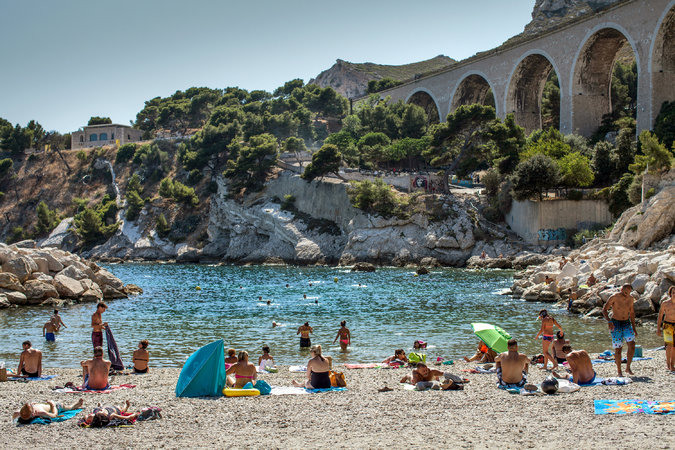
A beach in L’Estaque earlier this month. Credit France Keyser for The New York Times
It was Paul Cézanne who went to L’Estaque first, in 1864. He escaped the gray dreariness of Paris and later avoided army conscription in the Franco-Prussian War of 1870 in this sunny shorefront village outside Marseille. From the windows of a rented house next to the little church on the hill, he could look out on the tile rooftops leading down to the harbor, with its fishing boats, and across the wide bay to Marseille, the low, rocky mountains at its back.
He painted intensely. With every brush stroke and every year, the landscape changed, the picture plane began to dissolve — the rooftops, the sea, the barren rocks, the forest-green scrub, all becoming new versions of themselves, transformed by his vision. “It’s like a playing card. Red roofs against a blue sea,” Cézanne wrote of L’Estaque to his friend the painter Camille Pissarro in an 1876 letter. “There are olive trees and pines that always keep their leaves. The sun is so frightful that it seems as if all the objects are reduced to silhouette, not only in black and white, but in blue, in red, in brown, in violet.”
In 1906, Georges Braque went to L’Estaque after seeing Cézanne’s work on view in Paris. He stayed five months. “It was in the South that I felt my rapture rise in me,” wrote Braque, who grew up in Le Havre, on the English Channel. That same fall, Cézanne died. One century was giving way to the next. Braque had reshuffled the playing cards, making the familiar landscape even more unfamiliar. With his brush, the boxy roofs became puzzle pieces, the arches of the local viaduct a study in the contrast between positive and negative space. By 1908, he had flattened the windswept trees to the boundary between the second and third dimensions. Impressionism changed to Fauvism in Braque’s hallucinatory forests, where solitary walkers lose themselves in oneiric expanses of yellow and purple — and then to Cubism.
I wanted to see it for myself, this landscape of L’Estaque that I had known from so many paintings over the years, and that I had rediscovered in the Musée d’Orsay and the Pompidou Center since moving to Paris last year. And so, one weekend this spring, I took a train to Marseille to look around. The sun was bright, but I was in a ruminative mood. My own picture plane was starting to shift. I wanted new vistas. I wanted, I think, to step into a painting.
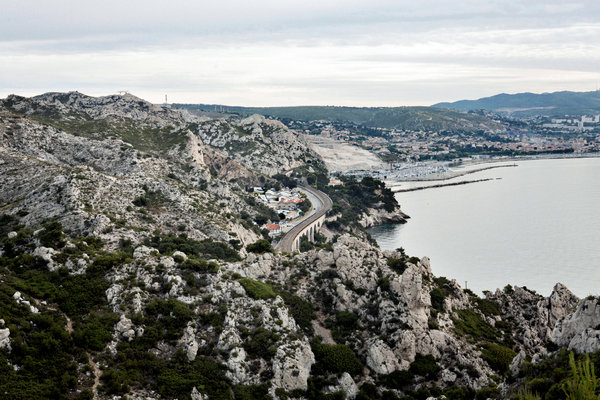
L’Estaque’s harbor. The former sleepy fishing village is now part of Marseille. Credit Gianni Cipriano for The New York Times
But scenes change over time. While van Gogh’s Arles maintains much of its postcard perfection, and Monet’s gardens at Giverny theirs, L’Estaque, in spite of its significance in art history, is perhaps the least touristic and least romanticized of the locales that so inspired the great French painters. Today, L’Estaque is not the sleepy fishing village that Cézanne and Braque found more than a century ago. It is part of the 16th Arrondissement of vivacious Marseille, a working-class area absorbed into the busy larger city, with a pretty harbor, one main street lined with shops and cafes, and a dearth of parking. I was glad to be there anyway. After all, what is travel — or life, for that matter — but a continuing negotiation between expectation and reality?
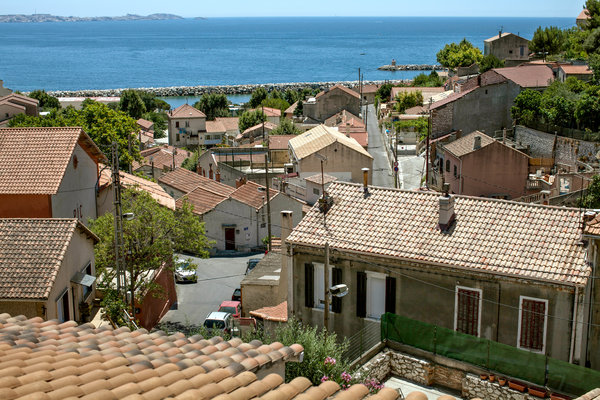
A friend and I arrived at midday on a lazy Saturday. In the cafes by the harbor, people drank coffee or stirred glasses of cloudy yellow Pernod. There were market stalls with cheap socks, housewares and towels, and a flea market where women in abayas browsed for bargains. We settled into a waterfront restaurant and ate fish and got drowsy on dry rosé, watching boats bobbing in their moorings. Off a nearby dock, young boys, tanned and fearless, somersaulted off the rocks into the water, like so many of their kin around the Mediterranean, over so many centuries.
Rooftops and water in L’Estaque. Credit France Keyser for The New York Times
Up the hillside on the edge of town, the landscape opens up to a wide view of the harbor. You can see a small island, and the hills east of Marseille, bluish in the distance, just as they appear in so many of Cézanne’s landscapes, “Gulf of Marseille Seen From L’Estaque,” which are now scattered in museums around the world. On a lookout point near the Fondation Monticelli, which celebrates Adolphe Monticelli, a lesser-known Marseille painter who died in 1886, a group of young men were drinking beer and having a makeshift barbecue. Their car radios played Arabic-inflected hip-hop. On the beach below, people were sunning themselves on the rocks.
When Cézanne was here, there were no doubt 19th-century locals also picnicking nearby. But the artist willfully left out the quotidian, the bustling harbor, instead shaping the landscape to his own imaginative needs. “I have a lot of good points of view, but that doesn’t exactly add up to a theme,” Cézanne wrote of L’Estaque to his friend Émile Zola in a letter. It was Cézanne’s mother who had first taken a house in L’Estaque in the summer of 1864, when the painter was 25. Later, in 1870, he hid out here to avoid army conscription, and also to hide the existence of his partner, Marie-Hortense Fiquet, from his father, who disapproved. One wonders how the course of art history might have turned out had Cézanne’s mother chosen a house in a different town.
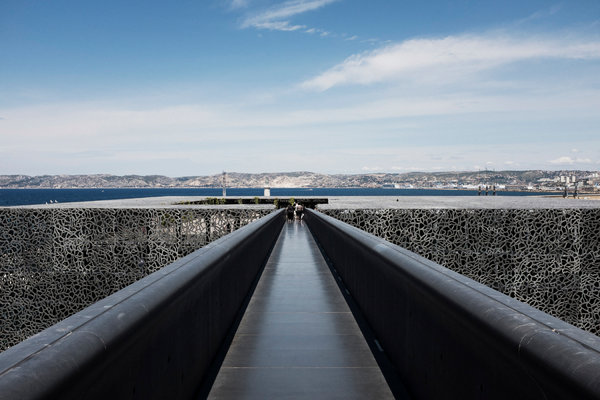
A bridge connects Fort St. Jean and the Museum of European and Mediterranean Civilizations, or MuCEM, in Marseille. Credit Gianni Cipriano for The New York Times
For artists who found their way here, the village was a place of refuge, but also a place of nostalgia. In 1877, Zola spent time here, escaping the polemics directed against his novel “L’Assommoir,” about a working-class alcoholic. “The country is superb,” he wrote in a letter that year. “You might find it arid and desolate, but I was brought up on these exposed rocks and these bare moors, so I am moved to tears when I see them again. The smell of the pines alone brings back my youth.” While there, Zola wrote a short story, “Naïs Micoulin,” about a hunchback who works in a local factory, which Marcel Pagnol adapted into his 1945 film, “Naïs.”
In 1882, Pierre-Auguste Renoir came to visit Cézanne, and the two painted together. Renoir’s “Rocky Crags at L’Estaque” of that year shows the hillside and vegetation in his characteristically fuzzy style. Cézanne always stayed more angular, more intense. He painted like a man working out a mathematical problem. Each brush stroke, each painting, reveals how he reached his conclusions. Every painter had a different perspective. In 1908, Raoul Dufy arrived to paint with his friend Braque, after seeing Braque’s L’Estaque works displayed in Paris. The Fauvist André Derain painted colorful, happy harbor scenes that make Cézanne’s look melancholy in comparison.
The best way to visit L’Estaque is as an afternoon or twilight jaunt, by boat, from Marseille, that great Mediterranean port city — Naples meets Barcelona — famous for its blinding light, its bouillabaisse, its couscous, its close ties to the Maghreb, and, alas, its often violent organized crime. Ferries to L’Estaque leave every hour from Marseille’s Old Port, a deep harbor that has been in continuous use since the days of the ancient Greeks. The boat pulls out of the harbor and rounds the bend by the MuCEM — the Museum of European and Mediterranean Civilizations — a spectacular new space designed by Rudy Ricciotti, an architect based in nearby Bandol.
Today, some of the best views of L’Estaque are from the roof of the MuCEM. With its dark cement latticework facade meant to evoke a casbah, the MuCEM is also a study in positive and negative space. (Mr. Ricciotti has said that in Marseille, the light is one of the strongest architectural elements.) From the top of an adjacent fortress, the MuCEM’s roof stretches just below the line where the ocean meets the shore. In the foreground, a sparkling new tower by the architect Zaha Hadid swoops up into the air, reflecting the light and straddling the highway running west toward L’Estaque. Along that road, a billboard for Panzani Zakia halal lasagna fills the entire side of a tall building. Huge ferries bound for Tunisia and Algeria sit in the harbor.
Kiosks on L’Estaque’s main street sell local specialties: chichi frégi, fried dough with a hint of crushed black pepper inside and coated in coarse sugar, and panisses, chickpea flour fritters. We bought a snack and a cold bottle of La Cagole, a Marseille beer, and strolled up the quiet back streets. They were empty of people, except for a few other tourists hoping to walk in the footsteps of the great artists, and looking a bit disappointed. There were posters for the coming European parliamentary elections, for the Greens and the right-wing National Front, which would later triumph. We sat in the square by the church, by Cézanne’s house, now marked by a small, unassuming plaque, and watched the sun set, turning the mountains behind Marseille a reddish pink. Some new buildings blocked the view of the harbor. Cranes rose high in the industrial port and the hulks of vast cruise ships lingered in the blue waters.
For years, Cézanne had ignored the parts of L’Estaque that he didn’t want to paint. By 1885, he stopped coming. The landscape was changing too much for his taste, becoming too industrialized, with factories and chimneys cropping up along the shore. Economic development and artistic development subtly intertwined. Braque saw the factories, with their smokestacks spewing sodium and sulfuric acid, as source of inspiration. In 1910, he painted “Rio Tinto Factories at L’Estaque,” a Cubist study in grays and browns that is now in the collection of the Pompidou Center.
Cézanne moved elsewhere, to find new vistas. I remember that one spring, in my early 20s, I took the TGV from Avignon to Nice. Out the window, fields of lavender blurred by. And then, in the distance, there it was: Mont Ste.-Victoire. I already knew it by heart, the mountain Cézanne had painted so many times — a study in form, an exercise of style, a realm of the imagination. Not just a mountain, but the idea of a mountain. It was even more familiar out the windows of the fast train, the perspective ever changing. “Magnificent in the distance, meaningless closer up, mountains are but a surface standing on end,” Joseph Brodsky wrote in “An Admonition,” one of my favorite poems. Like Petrarch in the 14th century, who opened the door to the Renaissance and to new ways of thinking when he climbed Mont Ventoux simply to take in the view, Cézanne, by power of his vision, also changed forever the way we think and see.
At a monumental retrospective of paintings by Georges Braque at the Grand Palais in Paris that I saw last year, I found myself unexpectedly moved by some of the artist’s late paintings, tiny landscapes from the mid-1950s, when he was in his 70s. His career had traced almost every new development in art for half a century, and then, nearing the end of his life, he returned to the beginning, to landscapes with rough brush strokes, more like van Gogh than Picasso. They seemed not just landscapes, but memories of landscapes.
In the end, the L’Estaque of the artists may outshine the L’Estaque of life. But the place still lingers in my mind. I revisit the paintings in the museums. I think back to the weekend — to the sun, to the crusted sugar on the fried dough, to the ferries headed for the Maghreb, to the rocky coastline. The boat glides across the harbor toward the village. Marseille is at our back, the limestone hills approaching in the distance. There is a cool breeze. The ocean opens up before us. It is filled with possibility — and with the memory of possibility.
Rachel Donadio is a culture correspondent for The New York Times, based in Paris.

 Passing Through . . . .