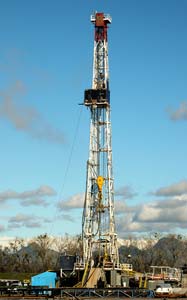
Gas well drilling in Sutter/Colusa County, California CalWest/Flickr
There isn’t supposed to be much fracking in California. In the past, the state’s Division of Oil, Gas, and Geothermal Resources (DOGGR) has said that it “does not believe that fracking is widely used” in the state. More recently, the division allowed that the practice is “used for a brief period to stimulate production of oil and gas wells,” but added (PDF) that “the division doesn’t believe the practice is nearly as widespread as it is in the Eastern U.S. for shale gas production.”
Californians, then, should be able to breathe a sigh of relief, since the controversial practice of fracking, short for hydraulic fracturing, has been linked to a host of environmental problems, including air pollution, groundwater contamination, and possibly even earthquakes.
But according to a report (PDF) just released by the Environmental Working Group, fracking is much more common in California than the regulators would like you to believe. A team of EWG investigators has unearthed dozens of industry documents and academic papers indicating that the practice has been going on in at least six California counties for 60 years or more. And evidence suggests that it’s still going strong: “We asked Halliburton, ‘What percentage of wells are you fracking in Kern County, for example?,'” says Bill Allayud, EWG’s California Director of Governmental Affairs. “And they said 50 to 60 percent of oil wells.” A 2008 paper by the Halliburton subsidiary Pinnacle Technologies detailed the widespread current use of fracking in California.
The DOGGR didn’t respond to the multiple emails I sent asking for comment, and EWG says that in a meeting earlier this month, division officials claimed again that it did not have any information about fracking in California. But the really strange thing is that the practice is clearly on the agency’s mind: In 2010, the DOGGR requested funding to broaden its regulatory program to include new oil extraction technologies like fracking. It received more than $3.2 million for that very purpose in its 2010-11 budget, but according to the EWG report, so far it has not used the funds to regulate fracking. “They told us that regulating fracking is not on their plate,” Allayud says. “Until they see manifest harm, they won’t act.”

 Passing Through . . . .
Hydraulic fracturing has been used for 60 years, everywhere there are old oil wells that are in decline or tight rock formations. According to http://energyanswered.org/questions/how-does-hydraulic-fracturing-work?gclid=CLWbi8bJ-q4CFSyhtgodCmctyg it has been used in over a million wells in the US. Most of these wells would have been vertical wells, and the fracking would therefore affect only a small area of rock around the well bore.
The reason that fracking has become newsworthy and controversial is that it is now routinely used in the completion of horizontal wells in shale formations, which has become a booming industry. These are often the source rocks for oil (i.e. the rocks that contained organic matter that gradually turned to oil and/or gas due to millions of years of heat and pressure). Up until the last few years it has been impossible to get the oil out of source rocks – we had to rely on Mother Nature to do that, and she was often very inefficient. The horizontal parts (“legs”) of well bores can be a few miles long, and thus when they are fracked, the area affected is a great deal larger than that affected by fracking in vertical wells. Also, some fracking of horizontal well-bores is being done at relatively shallow depths in some areas.
More importantly, the technique is being used in areas such as the Appalachian Basin, where there are thousands of undocumented or poorly-docunented wells going back to 1859. Very many of the early wells were abandoned with no attempt to isolate them from shallow groundwater units, and even more were shut down using practices that have not been tolerated since government regulation began, over 80 years ago. Thus there has been much leakage from old well bores into shallower formations, and there is also the potential for fracking to drive fluids up old abandoned wells whose existence is unknown to the operator. This is causing a public storm, much of which is pure NIMBYism, and some of which is probably an attempt to cure problems of long standing that have nothing to do with fracking. A major study by a UT group has recently shown that the risks of contamination from fracking by itself are very (vanishingly) small.
On the other hand, fracking provides at least the hope of several years of energy independence for the USA, and thus at least the hope of extricating ourselves from foreign entanglements that are destroying our economy, colsting thousands of young American lives and hundreds of thousands of lives of the people in the affected countries.
Thanks for your comment. Too much of what has been in the media has been to create donations for advocacy groups. I really appreciate commentary based on the science.